Advertisements
Advertisements
प्रश्न
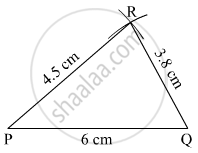
In ∆ PQR, l(PQ) = 6 cm, l(QR) = 3.8 cm, l(PR) = 4.5 cm
Advertisements
उत्तर
Steps of construction:
- Draw a line PQ = 6 cm.
- With P as centre and 4.5 cm as the radius, draw an arc above the line PQ.
- With Q as the center and 3.8 cm as the radius, draw an arc cutting the previous drawn arc at point R.
- Join RP and RQ.
APPEARS IN
संबंधित प्रश्न
Draw an isosceles triangle with base 5 cm and the other sides 3.5 cm each.
Draw an equilateral triangle with side 6.5 cm.
Construct a triangle of the measures given below.
In ∆ABC, l(AC) = 7.5 cm, m ∠ABC = 90°, l(BC) = 5.5 cm.
Students should take examples of their own and practise the construction of triangles.
Construct ∆XYZ such that l(XY) = 3.7 cm, l(YZ) = 7.7 cm, l(XZ) = 6.3 cm.
Construct a triangle using the given data: AB = 6.5cm, BC = 8.4cm and AC = 7.2cm
Construct a triangle using the given data: XY = 5.2cm, XZ = 6.5cm and ∠X = 75°
Construct a triangle using the given data: BC = 6.0cm, ∠B = 60° and ∠C = 45°
Construct a triangle using the following data: XY + YZ = 5.6 cm, XZ = 4.5 cm and ∠X = 45°
Construct a triangle using the following data: PQ + PR = 10.6 cm, QR = 4.8 cm and ∠R = 45°
