Advertisements
Advertisements
प्रश्न
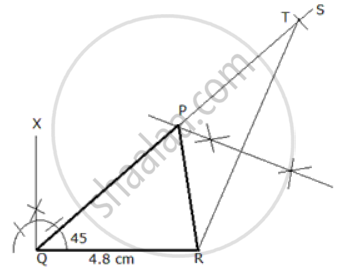
Construct a triangle using the following data: PQ + PR = 10.6 cm, QR = 4.8 cm and ∠R = 45°
Advertisements
उत्तर
PQ + PR = 10.6 cm, QR = 4.8 cm and ∠R = 45°
Steps of construction:
1. Draw a line segment QR = 4.8 cm
2. With Q as centre, construct ∠SQR = 45°
3. Cut QT = 10.6 cm on QS.
4. Join TR.
5. Draw perpendicular bisector of TR which cuts QT at P.
6. Join PR.
Thus PQR is the required triangle.
APPEARS IN
संबंधित प्रश्न
In ∆ STU, l(ST) = 7 cm, l(TU) = 4 cm, l(SU) = 5 cm
Draw triangle with the measures given below.
In ∆FUN, l(FU) = 5 cm, l(UN) = 4.6 cm, m∠U = 110°
Construct a triangle of the measures given below.
In ∆SAT, l(AT) = 6.4 cm, m ∠A = 45°, m ∠T = 105°
Construct a triangle of the measures given below.
In ∆EFG, l(EG) = 6 cm, m∠F = 65°, m∠G = 45°
Construct a triangle of the measures given below.
Construct ∆ABC such that m∠A = 55°, m∠B = 60°, and l(AB) = 5.9 cm.
Construct a triangle using the given data: DE = 6.5cm, EF = 5.8cm and DF = 4.2cm
Construct a triangle using the given data: Perimeter of triangle is 9 cm, and the base angles are 60° and 45°
Construct a ΔABC, right-angled at B with a perimeter of 10 cm and one acute angle of 60°.
For Construction of △ABC where AB = 4 cm, ∠A = 60°, and ∠B = 30°, what is the critical step used to locate vertex C?
