Advertisements
Advertisements
प्रश्न
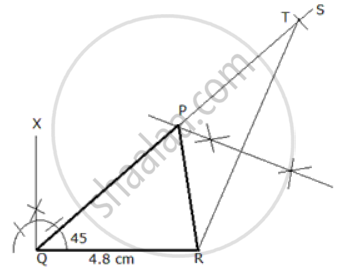
Construct a triangle using the following data: PQ + PR = 10.6 cm, QR = 4.8 cm and ∠R = 45°
Advertisements
उत्तर
PQ + PR = 10.6 cm, QR = 4.8 cm and ∠R = 45°
Steps of construction:
1. Draw a line segment QR = 4.8 cm
2. With Q as centre, construct ∠SQR = 45°
3. Cut QT = 10.6 cm on QS.
4. Join TR.
5. Draw perpendicular bisector of TR which cuts QT at P.
6. Join PR.
Thus PQR is the required triangle.
APPEARS IN
संबंधित प्रश्न
Draw triangle with the measures given below.
In ∆ NTS, m ∠T = 40°, l(NT) = l(TS) = 5 cm
Construct a triangle of the measures given below.
In ∆EFG, l(EG) = 6 cm, m∠F = 65°, m∠G = 45°
Construct a triangle of the measures given below.
In ∆ABC, l(AC) = 7.5 cm, m ∠ABC = 90°, l(BC) = 5.5 cm.
Construct a triangle of the measures given below.
Construct a triangle using the given data: BC = 6cm, AC = 5.0cm and ∠C = 60°
Construct a triangle using the given data: XY - XZ = 1.5 cm, YZ = 3.4 cm and ∠X = 45°
Construct a triangle using the given data: Perimeter of triangle is 10.6 cm, and the base angles are 60° and 45°
For constructing △XYZ where XY = 6 cm, YZ = 5 cm, and XZ = 4 cm, which construction method should be used?
In Construction of △ABC where AB = 3 cm, BC = 5 cm, and ∠ABC = 60°, which side must be drawn first as the base?
