Advertisements
Advertisements
प्रश्न
A Read the first activity, read the extract and then do all the activities :
A1. Complete :
Complete the following sentences :
(1) The two organizations that conducted the research to develop a smartphone-based optical bio-sensor are _______ and __________ .
(2) The _________ and _________ methods were used in the research instead of the differential method.
|
Urea is a major product of nitrogen metabolism in humans. It is eliminated from the body mainly by the kidneys through urine. Urea levels in body fluids, such as blood and saliva, rise drastically under certain kidney dysfunctions. Heart failure, hypovolemic shock, gastrointestinal bleeding, and severe infections can also lead to a rise. Thus urea in blood and saliva provides key information on renal function and helps diagnose various disorders. Most methods for estimating urea in body fluids are based on colorimetry. These methods are time-consuming and involve painful blood extraction. Collecting saliva is non-evasive and research has correlated salivary and blood urea levels. Recently scientists from the IIT-D and the AIIMS, New Delhi successfully developed a smartphone-based optical biosensor to detect urea in saliva. To fabricate the sensor, they directly immobilised the urease enzyme with a pH indicator on a filter paper-based strip. As a response to the urea on saliva, the paper strip changes colour. The red, green and blue levels help measure urea concentration. The scientists used the slope method, sensor response change per unit time, instead of the differential method, the difference in sensor response between two-time intervals, to increase sensitivity and eliminate interference by variations in ambient light. The team clinically validated spiked saliva samples and samples from healthy volunteers. The smartphone application with paper strip can even be operated by non-professional with limited training. This saves time and cost spent on bulky spectroscopic procedures. The report can revolutionise the medical screening of large populations. And such mass screening of diseases would boost national health. |
A2. Complete the following sentence using the correct alternatives from those given below :
Two objectives to conduct the research are ___________ .
(i) The colorimetry method used to estimate urea in body fluids consumes more time.
(ii) Information obtained from the presence of urea in blood and saliva is not helpful to diagnose various diseases.
(iii) Collecting samples of saliva is a non-invasive procedure.
(iv) Blood extraction is the easiest and less painful exercise.
A3. Write two benefits of the smartphone-based optical biosensor.
A4. Find out similar-meaning words from the extract for the following words :
(1) specimen (2) extremely (3) focus (4) remove
A5. Personal Response :
'Research revolutionises the lifestyle of people in all spheres of life'-
Do you agree? Explain with an example in about 25 words.
A6. Grammar :
Rewrite the following sentences in the ways instructed :
(1) These methods are time consuming and painful.
(Rewrite the sentence using 'as well as'.)
(2) The smartphone application with paper-strip can be operated.
(Begin the sentence with 'They ___ .)
(B) Summerise the above extract with the help of the points given and suggest a suitable title::
Research by the organisations - methods adopted - reasons for the research - advantages.
Advertisements
उत्तर
A1.
(1) The two organisation that conducted the research to develop a smartphone-based optical biosensor are IIT-D and AIIMS New Delhi.
(2) The slope method and sensor response change per unit time methods were used in the research instead of the differential method.
A2. Two objectives to conduct the research are.
(i) The colorimetry method used to estimate urea in body fluids consumes more time.
(ii) Collecting samples of saliva is a non-invasive procedure.
A3. Benefits of the smartphone-based optical biosensor are.
(1) Non - professionals with limited training can also use it.
(2) It saves time and cost spent on bulky spectroscopic procedures.
A4.
| (1) specimen | sample |
| (2) extremely | drastically |
| (3) focus | concentrate |
| (4) remove | extract/eliminate |
A5. Yes, I agree. The inventions resulting from research. like the mobile phone and the Internet, have added to the comfort. They have helped people at all levels and changed their lives for the better. Research has also helped in curing diseases like TB and cancer and improving the quality of life.
A6.
(1) These methods are time-consuming as well as painful.
(2) They can operate the smartphone application with a paper-strip.
B
BREAKTHROUGH IN THE ESTIMATION OF UREA IN BODY FLUIDS
| Urea levels in blood and saliva provide important information on renal function and help diagnose various disorders. The methods used earlier were time-consuming and painful. Hence, scientists from IIT-D and the AIIMS, New Delhi, successfully developed a smartphone-based optical biosensor to detect urea in saliva. They used the slope method, sensor response change per unit time, etc. for this, instead of the differential method. This smartphone application, with a pH indicator on a filter paper-based strip, saves time, avoids painful blood extraction and can even be operated by non-professionals. |
APPEARS IN
संबंधित प्रश्न
Nicholas chorier is not your usual photographer. He is a kite aerial photographer. He uses a kite to hoist his camera into the skies and clicks photographs while the camera dangles precariously mid – air.
As a teenager, Nicholas had two passions – photography and kite flying. During’ a trip to India to make a photo report on kite making, he learnt about this unique style of photography. Fascinated, he literally tied his two hobbies together for a living.
Nicholas learnt to make a strong modelled on the Japanese kites, Rokkaku that could endure harsh winds. A novice in his chosen field, he then set out to train himself. Today he is one of the most well – known aerial photographers in the world.
The technique is to tie a cradle containing the photography equipment to the string of the kite and then fly it, thus launching the camera into air. From the ground, Nicholas manipulates the angles of the camera with a remote. An air – to – ground video link enables him to see the view from the kite’s vantage point. Once satisfied with the frame, he clicks a picture.
However, the job does have its pitfalls too. Once, his kite disappeared in the Yamuna river, with his expensive camera in tow.
He is especially fond of India, having made a couple of trips and taken many spectacular photos. “India is too vast and beautiful a country to be captured through the lenses in one life” he says.
He recently released a book, Kite’s Eye View: India between Earth and sky. Though it includes photographs of oft takes sites like the Taj Mahal, it shows them from a totally different perspective.
(1) What were Nicholas’s two passions?
(2) How does Nicholas take aerial photographs?
(3) What is ‘Rokkaku’?
(4)
(a) Pick out words from the passage which mean :
(i) To tolerate
(ii) Costly
(b) Nicholas has two passions. [Start the sentence with ‘Nicholas was …….using the adjective form of passion]
(a) India is too vast a country to be captured through the lenses. [Remove too ………. And rewrite] (b) Nicholas learnt to make strong kites. [Rewrite using past perfect tense]
(6) What risks do aerial photographers face?
It is rare to find someone with good technical and communication skills. You can get far ahead of your colleagues if you combine the two early in your career. People will judge, evaluate, promote or block you based on your communication skills. Since habits form by repeating both good and bad forms of communication, learn to observe great communicators and adopt their styles and traits — in written and verbal forms. The art of listening and learning from each and every interaction is another secret recipe. Develop the subconscious habit of listening to yourself as you speak and know when to pause.
Learning what not to say is probably more important than learning what to say. As your career develops, you will realize that the wise speak less. Speak when you have value to add, else refrain. Poorly constructed emails with grammatical errors are acceptable between friends, but they should be seriously avoided while communicating formally with your seniors. Avoid any communication in an emotional state when might say things you will regret later. One unnecessary word uttered at the wrong time or place can ruin a relationship, career or even your life. Such is the power of words. If such a thing happens, you should immediately apologise, else it may haunt you for life.
Another problem to overcome is speaking too fast. Since our minds are working faster than our speech, we are inclined to speak fast. This does not necessarily mean that the person hearing it will get it any faster. On the contrary, it is always the reverse. So slow down and think before you speak. “When I get ready to speak to people,” Abraham Lincoln said, “I spend two-thirds of the time thinking what they want to hear and one-thirds of the time thinking what they want to hear and one-third thinking what I want to say.” Adding humour and wit is also essential. But realize that not all jokes are funny and observe certain boundaries. Never say anything that could offend. Remember you are not a comedian who must offend as many people as you can to be witty.
2.1 Answer the following questions briefly:
(a) Why is it necessary to have good communication skills?
(b) How can communication skills be developed?
(c) What, according to the writer, should be avoided while communicating?
(d) Why should you be careful when you tend to be humorous?
2.2 Choose the most appropriate meanings of the given words from the options provided:
(a) evaluate (para 1)
(i) estimate
(ii) assume
(iii) punish
(iv) evolve
(b) trait (para 1)
(i) treaty
(ii) trail
(iii) quality
(iv) liberty
(c) utter (para 2)
(i) flatter
(ii) speak
(iii) rot
(iv) unique
(d) haunt (para 2)
(i) hunt
(ii) chant
(iii) trouble
(iv) avoid
The Perfect Dog
In the summer of 1967, when I was ten years old, my father caved into my persistent pleas and took me to get my own dog. Together we drove in the family station wagon far into the Michigan countryside to a farm run by a rough-hewn woman and her ancient mother. The farm produced just one commodity—dogs. Dogs of every imaginable size and shape and age and temperament. They had only two things in common: each was a mongrel of unknown and distinct ancestry, and each was free to a good home.
I quickly decided the older dogs were somebody else’s charity case. I immediately raced to the puppy cage. “You want to pick one that’s not timid,” my father coached. “Try rattling the cage and see which ones aren’t afraid.”
I grabbed the chain-link gate and yanked on it with a loud clang. The dozen or so puppies reeled backward, collapsing on top of one another in a squiggling heap of fur. Just one remained. He was gold with a white blaze on his chest, and he charged at the gate, yapping fearlessly. He jumped up and excitedly licked my fingers through the fencing. It was love at first sight.
I brought him home in a cardboard box and named him Shaun. He was one of those dogs that give dogs a good name. He effortlessly mastered every command I taught him and was naturally well-behaved. I could drop a crust on the floor and he would not touch it until I gave the okay.
Relatives would visit for the weekend and returned home determined to buy a dog of their own, so impressed were they with Shaun – or “Saint Shaun”, as I came to call him. Born with the curse of an uncertain lineage, he was one of the tens of thousands of unwanted dogs in America. Yet by some stroke of almost providential good fortune, he became wanted. He came into my life and I into his – and in the process, he gave me the childhood every kid deserves.
The love affair lasted fourteen years, and by the time he died I was no longer the little boy who had brought him home on that summer day. I was a man, out of college and working across the state in my first real job. Saint Shaun had stayed behind when I moved on. It was where he belonged. My parents, by then retired, called to break the news to me. My mother would later tell me, “In fifty years of marriage, I’ve only seen your father cry twice. The first time was when we lost Mary Ann” – my sister, who was still-born. “The second time was the day Shaun died.”
Saint Shaun of my childhood. He was a perfect dog. At least that’s how I will always remember him. It was Shaun who set the standard by which I would judge all other dogs to come.
(Marley and Me by John Grogan)
1.1 Based on your reading of the passage, complete the following statements.
(a) The dog farm was run by ________________________________.
(b) The author did not want an old dog because ______________________________.
(c) He fell in love with the dog the moment the latter _______________________.
(d) Shaun became so obedient that he ______________________ until the author allowed him.
(e) After visiting them, their relatives wanted ________________________.
(f) When Shaun died even _______________________.
1.2 Find words from the passage which mean the same as the following.
(a) urgent requests (para 1)
(b) falling (para 3)
Read the extract given below and answer the questions that follow:
I even considered fleeing to my hometown, where I could have been a real lawyer right away, without going through this unpleasant training period
(a) Who is 'I'?
(b) How did 'I' suffer during the training period?
(c) What does the word, 'fleeing' mean?
Read the passage given below :
Kausani is situated at a height of 6,075 feet in the Central Himalayas. It is an unusally attractive little town. It covers just about 5.2 sq. kms. It lies to the north of Almora in Uttarakhand's picturesque kumaon region.
Kausani provides the 300-km wide breathtaking view of the Himalayas. It is the most striking aspect of the place. Snow-capped peaks are spread in a stately row. They stare at you in silvery white majesty. The most famous peak on view is Nanda Devi, the second highest mountain in India. It is situated at a height of 25.645 feet and 36 miles away as the crow files. The other famous peaks on view are choukhamba (23,420 feet) and Trishul (23,360 feet). Then there are also Nilkanth, Nandaghunti, Nandaghat and Nandakot. On a clear day, the blue of the sky makes a splendid background to these peaks. At sunrise and at sunset, when the colour changes to a golden orange, the scene gets etched in your memory.
When Gandhiji visited this place in 1929, its scenic beauty held him spellbound. He named it the 'Switzerland of Indian'. He prolonged his two-day stay to fourteen days, making time to write a book, 'Anashakti Yoga'. The place where he was staying was originally a guest-house of the tea estate. It was renamed 'Anashakti Ashram' after the book.
Kausani is the birthplace of Sumitranandan Pant, India's poet laureate. Its natural surroundings inspired many of his poems. Its tea gardens mingle with dense pine forests and fruit orchards. The area is also host to many fairs and religious caremonies. If Uttaranchal is the abode of gods, Kausani is God's own backyard. There is no traffic, no one is in a hurry. If serenity could be put on a canvas, the picture would resemble Kausani.
On the basis of your reading of the above passage, answer the following questions :
(a) Where is Kausani situated ?
(b) What is the most striking aspect of Kausani ?
(c) Which is the most famous peak on view from Kausani ?
(d) How did Kausani influence Sumitranandan Pant ?
(e) When does the view of peaks become so memorable ?
(f) How can we say that Gandhiji was greatly charmed by the natural beauty of Kausani ?
(g) What makes Kausani a calm and quiet place ?
(h) Why, do you think, is Kausani known as 'God' s own backyard' ?
Read the passage given below:
1. I rested for a moment at the door of Anand Bhawan, on Market Road, where coffee-drinkers and tiffin-eaters sat still at their tables, uttering low moans on seeing me. I wanted to assure them, "Don't mind me, you hugging the cash box − you are a coward, afraid even to breathe. Go on, count the cash, if that is your pleasure. I just want to watch, that's all. If my tail trails down to the street, if I am blocking your threshold, it is because, I'm told, I'm eleven feet tip to tail. I can't help it. I'm not out to kill − I'm too full. I found a green pasture full of food on my way. I won't attack until I feel hungry again. Tigers attack only when they feel hungry, unlike human beings who slaughter one another without purpose or hunger."
2. To the great delight of children, schools were being hurriedly closed. Children of all ages and sizes were running helter-skelter, screaming joyously. "No school, no school. Tiger, tiger!" They were shouting and laughing and even enjoying being scared. They seemed to welcome me. I felt like joining them. So I bounded away from the restaurant door. I walked along with them, at which they cried, 'The tiger is coming to eat us; let us get back to school!"
3. I followed them through their school gate while they ran up and shut themselves in the school hall securely. I climbed up the steps of the school, saw an open door at the far end of a veranda, and walked in. It happened to be the headmaster's room. I noticed a very dignified man jumping on the table and heaving himself up into an attic. I walked in and flung myself on the cool floor, having a special liking for cool stone floors.
4. As I drowsed, I was aware of cautious steps and hushed voices all around. I was in no mood to bother about anything. All I wanted was a little moment of sleep; the daylight was very bright.
On the basis of your reading of the above passage, answer the following questions:
(a) How did the diners at Anand Bhawan react on seeing the tiger?
(b) When do tigers attack? In this context, how are human beings different from tigers?
(c) Why were children happy and even enjoying being scared?
(d) What did the headmaster do on seeing the tiger? What did the tiger like to do in the headmaster's office?
(e) Identify the word which means the same as 'hugging'. (Para 1)
(i) counting
(ii) hiding
(iii) rubbing
(iv) holding tightly in the arms
(f) Identify the word which means the same as 'delight'. (Para 2)
(i) pleasure
(ii) fear
(iii) sorrow
(iv) nervousness
(g) Identify the word which means the same as 'dignified'. (Para 3)
(i) tall
(ii) honourable
(iii) terrified
(iv) tired
(ii) jumped forward
(iii) walked with heavy steps
(iv) ran lazily
Read the passage given below and answer the questions that follow:
The most alarming of man’s assaults upon the environment is the contamination of air, earth, rivers, and sea with lethal materials. This pollution is for the most part irrevocable; the chain of evil it initiates is for the most part irreversible. In this contamination of the environment, chemicals are the sinister partners of radiation in changing the very nature of the world; radiation released through nuclear explosions into the air, comes to the earth in rain, lodges into the soil, enters the grass or corn, or wheat grown there and reaches the bones of a human being, there to remain until his death. Similarly, chemicals sprayed on crops lie long in soil, entering living organisms, passing from one to another in a chain of poisoning and death. Or they pass by underground streams until they emerge and combine into new forms that kill vegetation, sicken cattle, and harm those who drink from once pure wells.
It took hundreds of millions of years to produce the life that now inhabits the earth and reached a stage of adjustment and balance with its surroundings. The environment contained elements that were hostile as well as supporting. Even within the light of the sun, there were short wave radiations with power to injure. Given time, life has adjusted and a balance reached. For time is the essential ingredient, but in the modern world is no time.
The rapidity of change and the speed with which new situations are created follow the heedless pace of man rather than the deliberate pace of nature. Radiation is no longer the bombardment of cosmic rays; it is now the unnatural creation of man’s tampering with the atom. The chemicals to which life is asked to make adjustments are no longer merely calcium and silica and copper and all the rest of the minerals washed out of the rocks and carried in the rivers to the sea; they are the synthetic creations of man’s inventive mind, brewed in his laboratories, and having no counterparts in nature.
(a) On the basis of your understanding of the above passage make notes on it using headings and sub-headings. Use recognizable abbreviations (wherever necessary-minimum four) and a format you consider suitable. Also supply a title to it.
(b) Write a summary of the passage in about 80 words.
Read the passage given below :
1. To ensure its perpetuity, the ground is well held by the panther both in space and in time. It enjoys a much wider distribution over the globe than its bigger cousins and procreates sufficiently profusely to ensure its continuity for all time to come.
(ii) in the branches of the trees
(iii) behind the tree trunks
(iv) at its heels
(ii) trains its cubs
(iii) watches the progress of the mother
(iv) is impulsive and impatient
Answer the following questions briefly :
(ii) came down / fell (para 7)
Read the following extract and answer the questions given below:
But even in a poverty-free world where every man and woman would earn enough to take care of themselves and their family, there would still be situations of temporary poverty due to a sudden catastrophe or misfortune, a bankruptcy or business downturn leading to failure, or some personal disease or disaster.
A poverty-free world might see a whole group of families, locations, or even regions devastated by some shared disasters, such as floods, tire, cyclones, riots, earthquakes or
other disasters. But such temporary problems could be taken care of by the market mechanism through insurance and other self-paying programmes, assisted of course by social-consciousness-driven enterprises.
There would always remain differences in lifestyle between people at the bottom of society and those at the top income levels. Yet that difference would be the difference between the middle-class and luxury class, just as on trains in Europe today you have only first-class and second-class carriages, whereas in the nineteenth century there were third- class and even fourth-class carriages - sometimes with no windows and just hay strewn on the floor.
Can we really create a poverty-free world? A world without third-class or fourth-class citizens, a world without a hungry, illiterate, barefoot under-class?
(1) What is the extract about?
(2) How will the poverty-free world take care of natural disasters?
(3) According to the writer, what would, 'the world without poverty' be like?
(4) What can we do to help the poor in our society?
(5) Rewrite the following sentences in the ways instructed:
(i) Temporary problems could be taken care of by market mechanisms.
(Rewrite the sentence beginning with 'Market mechanism ........ ')
(ii) In the nineteenth century, there were third-class carriages.
(Form a Wh-question to get the underlined part as an answer.)
(iii) There would still be situations of temporary poverty.
(Rewrite it using 'can'.)
( 6) What do the following words in the extract mean -
(i) devastated
(ii) hay
Read the following extract and answer the questions given below:
One day, King Amrit and Chandan were taking a walk on the terrace of the palace. The terrace offered a beautiful view of the surroundings, and they could see far into the distance. They spotted the weekly market from up there, with people in colourful clothes buying and selling all kinds of things. There was plenty to buy and people had money to buy too. There were no poor people to be seen anywhere. The King watched with a smile on his face. He was delighted to see the prosperity of his kingdom. Like any good ruler, he was happy ·when his people were happy.
He turned to Chandan and said, ''See how contented my people are. But I want to check this first-hand by talking to them. Tomorrow, summon people from all walks of life to the court, and I will ask them myself how they are doing.'' Chandan was used to the king's strange requests and went off to carry out this order.
The next day, the King arrived in the court humming a happy tune to himself. Seeing all the people gathered there waiting for him, he was even more pleased. He cleared his throat and said in a loud voice, ''I have called you here to ask you a very important question. As your king, I need to know if all of you are contented. Do you have enough for your needs? Do you know anyone who is not happy about anything?''.
(1) What do you understand about the King from this extract?
(2) Why did the King want to talk to his people?
(3) How did the King come to know about the prosperity of his kingdom?
(4) According to you, what should the Government do for the bettennent of the poor people?
(5) Rewrite the following sentences in the ways instructed :
(i) He was delighted to see the prosperity of his kingdom.
(Make it a rhetorical question.)
(ii) Summon people from all walls of life to the court
(Rewrite it beginning with 'Let ..... ')
(iii) As soon as the King arrived in the court humming a
happy tune to himself, he cleared his throat.
(Rewrite it using 'No sooner .... than'.)
(6) Find out the words from the extract which mean:
(i) development
(ii) examine
Read the following extract and answer the questions given below:
There are some glimmers of hope. I met up young Navdeep. Ahuja who along with another colleague began the innocuously named Graduates Welfare Association, Fazilka. They are bringing about change with the mandate of citizens' participation in governance and are facilitating the creation of physical and social infrastructure across 22 cities in Punjab. They have put in place a network of cycle rickshaws called Eco-cabs which can be booked through a mobile phone. They are also developing car tree zones, food and culture streets in these cities. All this is being done very efficiently and at a low cost. We need many such organizations. However, my idea of a city in 2020 is not a utopian dream. It is achievable. It has streets where people walk on wide footpaths shaded by leafy trees. Streets are usually one-third of a city's area and its most democratic segment. Public space dedicated to pedestrians reduces inequality and should be accorded priority when developing cities. Adjoining the streets should be cycle lanes where bicycles and, rickshaws can sail past smoothly. It'll have a great public transport system with buses, metro and taxis. Parking will be difficult and expensive so people will use public transport rather than cars. There will be parks and gardens and the air will be clean, as pollution levels will have dropped dramatically. And then cities will become areas of graceful living and a charmed way of life.
(1) What is the extract about?
(2) What will happen when parking becomes difficult and expensive?
(3) How has Graduates Welfare Association brought about changes in some cities?
(4) What efforts will you take to make your city a livable place?
(5) Rewrite the following sentences in the ways instructed :
(i) We need many such organizations.
(Frame a ' Wh-question' to get the underlined part as an answer.)
(ii) It reduces inequality.
(Rewrite it using the Present Perfect Tense.)
(iii) The air will be clean, as pollution levels will. have dropped dramatically.
(Rewrite it using 'unless')
(6) Find out the words from the extract which mean:
(i) co-worker
(ii) small signs
Read the following extract and answer the questions given below:
Questions :
(2) What sort of patients did the doctor have?
(3) What were the reasons for the doctor's indigestion?
(4) “A doctor should have a pleasing personality and good manners.” Do you agree? Explain.
(ii) unsewn
Read the following extract and answer the questions given below:
Researchers recently announced the earth could actually withstand up to 200,000 times the current population. They arrived at this figure by calculating the amount of heat a human body emits, and only at 1·3 million billion would the earth be too hot to be habitable. And though it would feel like being ina can of sardines if that figure were ever reached, the earth is capable of comfortably sustaining a population several times the current 6·5 billion.
In fact, fertility is actually on the decline worldwide. Though the population has grown, the rate of growth has fallen sharply. Twenty years ago, the UN projected that the population would reach 11·I6 billion in 2050, today they say it will reach only 9·3 billion. Moreover, the human population will stabilize at about 11·5 billion. While this figure is almost twice the current one, it is hardly claustrophobic.
True, the demands on resources are heavy even now, but this is more due to the manner in which these resources are being used. In fact, figures show that a bigger population does not amount to greater consumption. Over 20% of the world's people in the highest-income countries account for 86% of total private consumption expenditure - the poorest 20% a tiny 1·3%. With just 5% of the world's population, the US consumes about 40% of the world's resources. Would you say the US is overpopulated?
Concerns on the scarcity of food are equally baseless. In fact, global food production has actually kept up with population growth. If people starve in many countries it is not because food is becoming scarce; it is because those people cannot afford it.
Questions:
(1) What conclusions did the researchers arrive at?
(2) How does the writer explain that fertility is on the decline?
(3) What does the extract predict about the fear of scarcity of food?
(4) How will the population become a gift in the global market scene?
(5) Rewrite the following sentences in the ways instructed:
(i) The earth could withstand up to 200,000 times the current population.
(Rewrite the sentence using the modal auxiliary showing 'certainty'.)
(ii) The earth would be too hot to be habitable.
(Remove 'too' and rewrite the sentence.)
(iii) These resources are being used.
(Rewrite the sentence beginning with, 'We ........... .')
(6) Write the antonyms of:
(i) habitable
(ii) stabilize
Read the following extract and answer the questions given below.
| A | B |
| (i) valedictorian | (a) feeling of annoyance |
| (ii) frustration | (b) dunce |
| (c) school topper | |
|
(d) validity
|
Read the following extract and answer the questions given below:
|
We often hear this statement that “many of our young people spend more time before their T.V. sets, than they do in their classrooms or with their textbooks. “A bit exaggerated though it may sound, it is nearly true and our teenagers are being considerably influenced by the electronic media, particularly the T.V. The television has become the single most powerful influence in the lives of many of our youngsters today. Too often this happens to us much before we realise it ourselves. I am in no way trying to deny the many advantages of T.V. or minimise its manifold contributions to our world. On the other hand, I consider T.V. as one of the greatest scientific achievements of our times, bringing people closer than ever before. Television’s use of the modern satellite technology brings today even the remotest regions of the world to us in seconds, making the world a small (global) village. As we know, television also provides us with a fuller and more impressive coverage of current events than any other media. The T.V. does serve. In addition, as medium of education as well as entertainment. Besides, helping us to learn subjects taught in schools, college in greater depth, it enables us (National Geographic, Discovery channel etc.) to see and appreciate from close quarters (without having to go there, which is very expensive or even impossible for most of us) the wonders of God’s creation in any part of the world. |
- Our young people spend more time before their T.V. set than in their classrooms. (1)
(Rewrite it using positive degree) - The T.V. does serve as medium of education as well as an entertainment. (1)
(Rewrite it using ‘not only ..... but also’) - I consider T.V. as one of the greatest scientific achievements of our times. (1)
(Rewrite it using the noun form of the underlined word.)
Read the following passage and do the activities.
Galaxies are vast clusters of thousands of millions of stars, planets, gases and dust, which are held together by gravity. There are over one thousand million galaxies, and each is a very long way from its nearest neighbour.
Galaxies were formed during the Big Bang explosion about 15,000 million years ago. When this phenomenon occurred, everything that was in the universe flew out in different directions. Scientists believe that the galaxies were formed from lumps of matter that resulted. However, the process is nowhere near complete. The universe is still expanding, galaxies are still moving away from each other, new stars are still being created.
Galaxies are classified according to their shapes. There are three main types. The most common type of galaxy is The Spiral. This has several spiral arms radiating out from the center. Spiral galaxies have a large cluster of stars in their nucleus. The second type is the Barred spiral. In this type of galaxy, the spiral arms curve away from the opposite ends of a sort of bar going through the middle of the nucleus. These contain large amounts of gas and dust as well stars. The third type of galaxy is electrical. These consist almost entirely of stars and contain very little gas or dust. Some galaxies have irregular, uneven shapes and cannot be classified.
(A1) State whether the following statements are true or false. 02
(1) The most common type of galaxy is the barred spiral.
(2) Galaxies are clusters, held by gravity.
(3) Scientists do not believe in the Big Bang explosion.
(4) Galaxies are moving from each other.
(A2) Complete the web chart. 02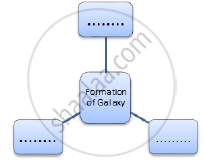
(A3)
(a) Find out similar words from the passage. 01
(i) mass (ii) happenings
(b) Give the verb form of the given words. 01
(i) classified (ii) directions
(A4) Identify and name the clause. 02
Scientists believe that the galaxies were formed from the lumps of matter.
(A5) Can there be life in another galaxy? Give reasons for your answer. 02
(B) Read the passage given in Q. 4 (A) and write the summary of it. Suggest a suitable title to your summary. (05)
Read the extract and do the activities that follow :
‘Your father was my enemy,’ said Frederick. ‘I would have been better pleased by your brave deed if you had told me of another father?’
‘I am proud to be Sir Rowland's son,’ answered Orlando angrily,’ and I would not change my place to be the heir of this dukedom.’
The Duke and his lords went away, leaving Orlando alone with Rosalind and Celia. Celia was angry with her father for speaking so unkindly to Orlando. ‘Would I have done this in my father’s place?’ she said to Rosalind.
‘My father loved Sir Rowland as much as his own soul,’ Rosalind said to Celia, ‘and all the world agreed with him. If I had known that his young man was Sir Rowland’s son I should have begged him with tears not to take so great a risk.’
‘Let us go and speak to Orlando,’ said gentle Celia. ‘I am ashamed of my father’s rude and angry words.’
The two girls went up to Orilando and praised him for his bravery. Rosalind took a gold chain from her neck and gave it to him. ‘I would like to give you more’, she said, ‘but I am not rich.’ Then she and Celia went away.
Orlando, however, could not forget them. He had already fallen in love with the fair Rosalind, but he could not stay at the Duke’s palace. His friends warned him that Frederick was angry and jealous of him. They told Orlando to leave the dukedom, because the Duke meant to do him harm.
A1. Match -
Match the characters and their attributes:
| A | B | ||
| i. | Celia | a. | fair |
| ii. | Orlando | b. | rude and unkind |
| iii. | Frederick | c. | gentle |
| iv. | Rosalind | d. | brave |
A2. Write an imaginary paragraph:
Write an imaginary paragraph in about 50 words in continuation with the given extract.
Read the extract and do the activities that follow:
My mother was still managing Green's, even though its days were numbered. The day after my return I joined her in the small office, where she sat behind her over-large desk, telephone on her right and the latest paperback western before her, ready to be taken up when noting much was happening – which was fairly often. My mother enjoyed reading westerns-particularly Luke Short, Max Brand, and Clarence E Mulfordmuch in the same way that I enjoyed detective fiction. Both genres were freely available in cheap collins ‘White Circle’, edition published during and just after the War.
We discussed the affair of the skeleton in the cupboard, but as there was no longer any mystery about it, there was nothing for me to investigate. However, armed with the key to the store room, I went down to the basement on my own and made a thorough search of all the old furniture, on the offchance that another skeleton moght tumble out of a cupboard or be found jammed into a drawer or trunk. I did find some old tennis rackets, back numbers of Punch, a cracked china chamber-pot, some old postcards of Darjeeling and Simla, and a framed photograph of King Edward the Seventh. I took the copies of ‘Punch’ to my room and read the reviews of all the plays that had been running in London between 1926 and 1930, thus becoming an authority on the theatre in England of that period.
A1. True/False
State whether the following statements are true or false:
(i) The narrator found one skeleton jammed into a drawer
(ii) The narrator did not like to read detective fiction
(iii) The narrator's mother was managing the Green's hotel
(iv) The narrator wanted to be an authority on the English theatre of that period
A2. Write a gist :
Write a gist of the above given extract in about 50 words.
Read the extract and do the activities that follow:
“And that skeleton,” I asked. “ What about the skeleton in the cupboard? Did you know about it?”
“Yes, I knew about it. But I have no idea whose skeleton it was. You see, back in the twenties, when Green took over this hotel, he had one of his sudden enthusiasms and was convinced this town needed a medical school or college, and he set about preparing the ground for one. He was ready to finance the project, or part of it. And of course medical students need a skeleton. So he acquired one from the Lady Hardinge Medical College in New Delhi. It was a medical school skeleton you found. And if you’d looked closely you'd have noticed that it was varnished.”
“Why was it varnished?” I asked.
“To help preseve it, of course. It was also articulated”
“Articulated?”
“That means the joints were connected up, so that the whole thing wouldn't fall apart. Want to be a doctor, young man?”
“No,” I said. “A detective.”
“Well, you didn't solve this case”.
“I wasn't here. And now we'll never be able to identify the skeleton.”
“Some poor woman of the streets, no doubt. Unclaimed, unwanted. But in the end you gave her a decent burial-even if she wan't a Cristian. Padre Duett is a bit embarrassed, but I've told him I don’t mind my name on the tombstone. I’ll be returning to Africa shortly, and when I die I shall have another tombstone there. Not everyone is lucky enough to have two tombstones! “
B1. True/False - (2)
State whether the following statements are true or false:
(i) The narrator wanted to be a doctor.
(ii) Mrs. Green counted herself lucky to have two tombstones.
(iii) The skeleton was varnished to preserve it for a longer time.
(iv) Mrs. Green was embarrased to see her name on the tombstone.
B2. Provide a different ending: (2)
Provide a different ending to the above given extract in about 50 words.
Read the following passage and do the given activities :
A1. Fill up the blanks with virtues of dogs : (2)
(1) __________
(2) __________
(3) __________
(4) __________
| Human and dogs are inseparable for thousands of years and they are dependent on each other for protection and survival. Relationship between humans and dogs is often characterized by strong emotional bonds which run both way. Dogs are very popular as pets and companions. Dog is the ‘Man’s Best Friend’ and a family member. The dog is one of the most loyal, faithful and devotee animal. In earlier days dogs were kept mainly for hunting and guarding; now they are kept for companionship, protection and showmanship. There are millions of people all over the world who are dog lovers Puppies need more attention at the, early age. As much as possible try many methods of socialization, such as playing with them, taking them for walk, expose them to crowds, make them to obey the orders etc. |
A2. Methods of socialization of puppies are : (2)
(1) …......................
(2) …......................
(3) …......................
(4) …......................
A3. Cross out the odd man : (2)
(i) Inseparable, dependent, protection, popular.
(ii) Hunting. guarding, playing, petting.
(iii) Earlier, human, relationship, family
(iv) Often, mainly, now, emotional
A4.
(1) There are millions of people all over the world. (1)
(Pick out the determiners and write them)
(2) Puppies need more attention. (1)
(Rewrite the sentence without changing its meaning beginning with : Puppies don’t ….....)
A5. Should we ban keeping pets ? Justify. (2)
Read the following extract and answer the questions given below:
But being named an 'AdarshGaon' is far from easy. Villages had to give a proposal after which a committee headed by Mr. Pawar inspected the villages. "The Villages had to show dedication in the struggle to fight mediocrity. They had to follow all the conditions of becoming an 'AdarshGaon'. We chose villages with a revolutionary spark, "Mr. Pawar says.
Villages need to follow strict rules. The process begins with effective water management through the watershed technique and water auditing. taking responsibility for the village's natural resources-planting trees and stopping grazing. contributing labour for the village work, and then expanding to bring about behavioral changes in the people for harboring social change. Hiware Bazaar is free of any kind of addiction and there are no liquor or tobacco shops in the village. Vasectomy has been made compulsory, as is the pre-marital HIV test.
The 'AdarshGaon' model prides itself on being based on the joint decisions made by the Gram Sabha, where all the villagers are present. Even while selecting the new villages under the scheme, Mr. Pawar made sure that the decision to become an ideal village was taken by the entire village together.
The greatest victory for Hiware Bazaar so far has been the reverse migration that the village has witnessed since 1989. As many as 93 families have come back to the village," from the slums in Mumbai and Pune," Mr. Pawar says.
Questions:
(1) What features of 'Adarsh Gaon' are given in this extract?
(2) What is the procedure for selecting 'Adarsh Gaon'?
(3) What is the greatest victory for Hiware Bazaar?
(4) Do you think all villages in Maharashtra should follow the ideals of Hiware Bazaar? why?
(5) Rewrite the following sentences in the ways instructed :
i. Mr. Pawar inspected the villages.
(Rewrite it using the noun form of the word underlined.)
ii. Vasectomy has been made compulsory by the villagers.
(Rewrite it beginning with-"The villagers........".)
iii. There are no liquor or tobacco shops in the village.
(Rewrite it using 'neither......nor'.)
(6) Find out the words from the extract which mean:
(i) causing a great change
(ii) the quality of being average
Read the following extract and answer the questions given below :
Reuben arrived at the factory. The sack buyer was about to lock up.
"Mister! Please don't close up yet." The man turned and saw Reuben, dirty and sweat-stained.
"Come back tomorrow, boy."
"Please, Mister. I have to sell the sacks now-please." The man heard a tremor in Reuben's voice and could tell he was close to tears.
"Why do you need this money so badly?"
"It's a secret."
The man took the sacks, reached into his pocket and put four nickels into Reuben's hand. Reuben murmured a quiet thank-you and ran home.
Then, clutching the tin can, he headed for the store.
"I have the money" he solemnly told the owner, pouring his coins onto the counter.
The man went to the window and retrieved Reuben's treasure. He wiped the dust off and gently wrapped it in brown paper. Then he placed the parcel in Reuben's hands.
Racing home, Reuben burst through the front door. His mother was scrubbing the kitchen range. "Here Mum!Here!" Reuben exclaimed as he ran to her side. He placed a small box in her work-roughened hand.
She unwrapped it carefully, to save the paper. A blue-velvet jewel box appeared. Dora lifted the did, tears beginning to blur her vision.
In gold tettering on a small, almond-shaped brooch was the word 'Mother'
It was Mother's Day, 1946
Dora had never received such a gift; she had no finery except her wedding ring. Speechless, she smiled radiantly and gathered her son into her arms.
(1) Why did Reuben insist on the sack buyer to buy his sacks that day only?
(2) How did the mother react when Reuben gave her the gift?
(3) In what way was Reuben's gift special to his mother?
(4) What do you plan to do on Mother's Day?
(5) Rewrite the following sentences in the ways instructed :
(i) I have to sell the sacks.
(Rewrite it replacing the underlined part with the modal auxiliary showing 'compulsion'.)
(ii) She smiled radiantly and gathered her son into her arms. (Use 'As soon as'.)
(iii) She unwrapped it carefully.
(Rewrite the sentences using the noun form of the underlined word.)
(6) Find out the words/phrases from the extract which mean:
(i) showing joy (ii) got back
Read the following extract and answer the questions given below:
Researchers recently announced the earth could actually withstand up to 200,000 times the current population. They arrived at this figure by calculating the amount of heat a human body emits, and only at 1.3 million billion would the earth be too hot to be habitable. And though it would feel like being in a can of sardines if that figure were ever reached, the earth is capable of comfortably sustaining a population several times the current 6.5 billion.
In fact, fertility is actually on the decline worldwide. Though the population has grown, the rate of growth has fallen sharply. Twenty years ago, the UN projected that the population would reach 11.16 billion in 2050, today they say it will reach only 9.3 billion. Moreover, the human population will stabilize at about 11.5 billion. While this figure is almost twice the current one, it is hardly claustrophobic.
True, the demands on resources are heavy even now, but this is more due to the manner in which these resources are being used. In fact, figures show that a bigger population does not amount to greater consumption. Over 20% of the world's people in the highest-income countries account for 86% of total private consumption expenditure - the poorest 20% a tiny 1.3%. With just 5% of the world's population, the US consumes about 40% of the world's resources. Would you say the US is overpopulated?
Concerns on the scarcity of food are equally baseless. In fact, global food production has actually kept up with population growth.
(1) What is the main idea of the first paragraph?
(2) What is the relationship between the population and the available resources?
(3) Why do the researchers claim that the earth is capable of sustaining a bigger population?
(4) What, according to you, are the problems caused by the increasing population?
(5) Rewrite the following sentences in the ways instructed :
(i) The earth would be too hot to be habitable. (Remove 'too'.)
(ii) Though the population has grown, the rate of growth has fallen sharply. (Rewrite it using 'but')
(iii) Moreover, the human population will stabilize at about 11.5 billion. (Make it 'less definite'.)
(6) Find out the words from the extract which mean :
(i) natural capacity to produce (ii) shortage
Read the following extract and complete the table given below:
Children are perpetually asking questions. As adults, we are awkward with questions. We link the act of asking questions to ignorance. It indicates that we do not know; hence, we may look stupid while asking questions.
Children have no shame, whereas adults suffer from layers and layers of shame. Because children have no shame, they are more capable of failing at something and moving on from it. Our sense of shame makes us inhibited. So we do not try new things at work.
Children quickly make friends with strangers. Put two small kids alongside a few toys and they will start playing before they care to know about each other’s antecedents. As adults, we seek the false comfort of known relationships before we agree to play with each other.
Children freely express their emotions; adults learn to suppress their emotional side. We come to the workplace and are frequently counselled, “Do not get emotional.”
Children play. They find play in everything. Adults shun play and consider it the opposite of “serious work”. To a child, every act is an act of play.
Traits Delinking Childhood and Adulthood:
| Traits | Children | Adults | |
| 1 |
Asking Questions |
Perpetually ask questions freely |
(1) Feet awkward with questions (2) ___________ |
| 2 |
Feeling Shame |
(1) Feel no shame (2) ____________ |
(1) Suffer from shame (2) Inhibited to try new things at work |
| 3 |
Making friends |
(1) Quick in making friendship without knowing each other |
(1) ____________ |
| 4 |
Expressing emotions |
(1) ____________ |
(1) Suppress emotions. |
Read the first activity, read the extract and then do all the activities:
A1. Complete the following sentence choosing the correct alternatives:
He goes for a morning walk at 1 p.m., because -
(1) ______________________________________________
(2) ______________________________________________
(a) He arrives from work past midnight.
(b) He has to stay in bed for a longer time till late morning.
(c) He has a special plan for early morning.
(d) He does not like to join the early birds' club.
|
Some people can just never wake up early. They munch their breakfast on the way to work. They have excuses ready when they reach the office late. They miss trains on a regular basis. They have never seen a sunrise or met the milkman. Until a loved one turned over a new leaf recently, she was one such late riser. Try as she might, she couldn't help pressing the snooze button a hundred times before she finally got up. She felt terrible about this tendency but there was nothing she could do about it. Come morning, She would just not be able to shrug off the desire to sleep a while more. Only when divine intervention answered her prayers recently was she able to join the early bird's club. Another relative has no plans of joining this league through. She is rather unabashed about waking up past noon on a daily basis. To be fair, her husband is a media personality who typically arrives home from work past midnight. That does indeed give them sufficient justification to stay longer in slumberland each morning. This practice does lead to certain oddities through. He goes for his 'morning' walk at 1 pm, heatwaves, and appalled onlookers notwithstanding. They once returned from a night out only to meet the neighbour's son who was off on an early morning jog! Early risers clearly have the edge in life. By the time most of us wake up, they've been through their morning rituals, enjoyed their walk, had their tea and read the daily news. They're also likely to have made long-distance calls before dawn to those similarly inclined. Thus, by the time the sun warms up they're likely to have discussed all varieties of 'men, matters, and affairs' with a dozen people. |
A2. Web :
Complete the following web :
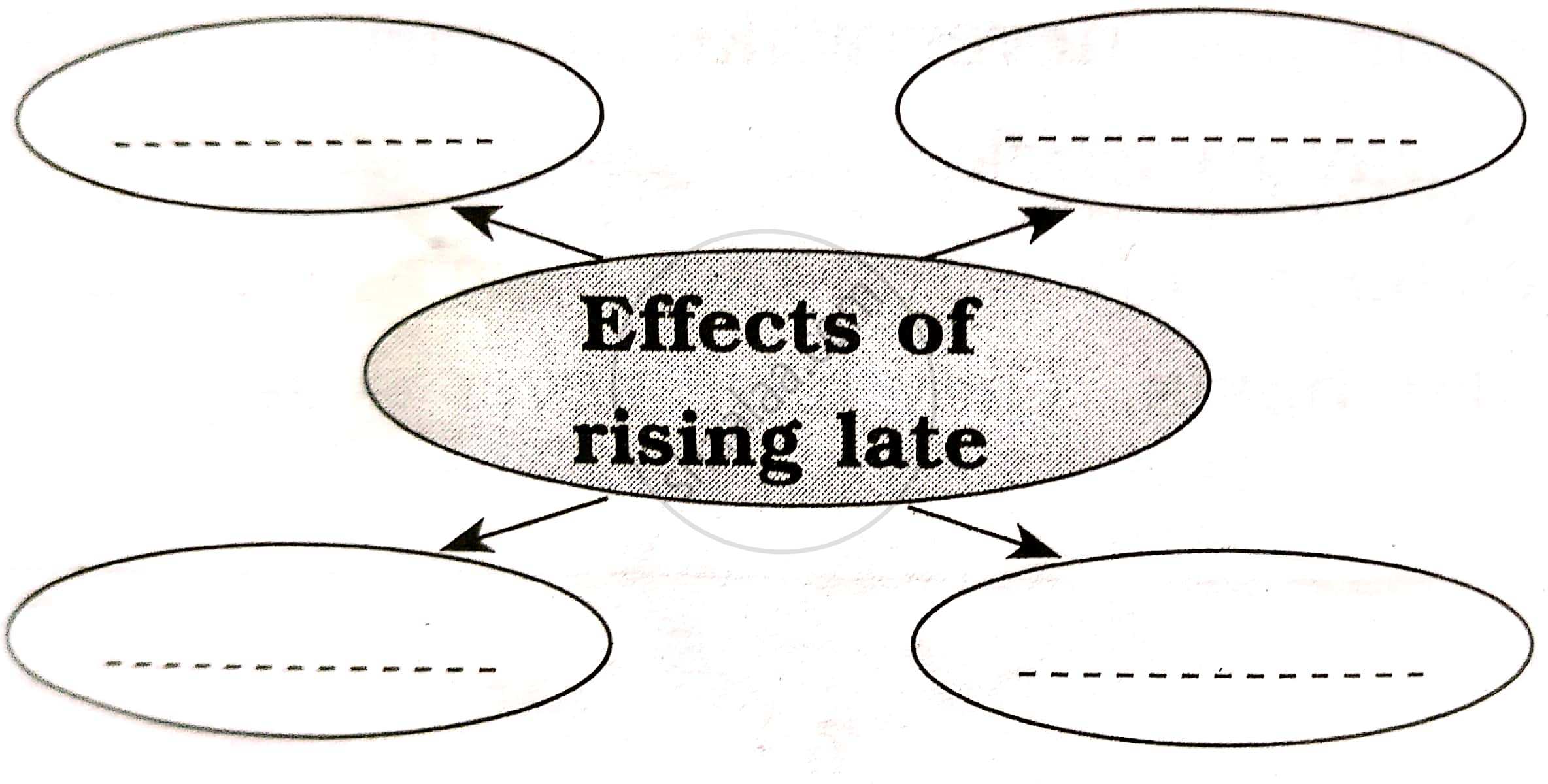
A3. Complete the following statement :
Early risers clearly have the edge in life, because -
(1)
(2)
A4. Vocabulary :
Match the words in column 'A' with their meanings in Column 'B'.
| Column 'A' | Column 'B' |
| (1) justification | (a) dismiss |
| (2) oddities | (b) sleep |
| (3) slumber | (c) strange things |
| (4) shrug off | (d) clarification |
A5. Personal Response:
State two things that you can do to join the early birds' club.
A6. Grammar:
Rewrite the following sentences in the ways instructed :
(1) She felt terrible about this tendency but there was nothing she could do about it. (Rewrite the sentence using 'although'.)
(2) They have never seen a sunrise or met the milkman. (Rewrite using 'neither ... nor'.)
Read the first activity, read the extract and then do all the activities:
A1. Correct the following statements with the help of the facts from the extract :
(1) Everybody in every part of the globe would have access to administration and social care services because he or she would not be able to afford them.
(2) We would avoid boom and bust cycles and be able to surmount natural disaster with great ease.
|
To me, a world without poverty means that every person would have the ability to take care of his or her own basic life needs. In such a world, nobody would die of hunger or suffer from malnutrition. This is a goal world leaders have been calling for decades, but have never set out any way of achieving it. Today 40,000 children die each day around the world from hunger-related diseases. In a poverty-free world, no children would die of such causes. Everybody in every part of the globe would have access to education and health-care services because he or she would be able to afford them. Unlike today, the state would not be required to provide free or subsidized health-care or schooling. All state organizations created to provide free or subsidized services for the poor would no longer be required and welfare agencies, or the national welfare department. No free schools, no free hospital care, no begging in the streets. State-run safety-net programmers would have no rationale for existence because no one would live on charity anymore. State-run social security programmers, income-support programmes would be unnecessary. Social structures in a poverty-free world would, of course, be quite different from those that exist in a poverty-ridden world. But nobody would be at the mercy of anyone else, and that is what would make all the difference between a world without poverty and one riddled with it. Finally, a poverty-free world would be economically much Stronger and far more stable than the world today. one-fifth of the world's inhabitants who today live a life of extreme poverty would become income earners and income spenders. They would generate extra demand in the market to make the world economy grow. They would bring their creativity and innovations into the market-place to increase the world's productive capacity. Since nobody would ever become poor, except on a temporary and limited basis, the economy would probably not go through extreme swings. We would avoid boom-and-bust cycles and be able to surmount man-made disasters with greater ease. |
A2.
Complete the following statement :
The situation in the world without poverty would be different, because -
(1) the state need not ___________
(2) nobody __________
A3. Find out :
Find and write in the blank boxes :
One-fifth of the world's inhabitants today live a life of extreme poverty. How would they economically Stand in a poverty-free world?
| They would be income earners and income spenders |
A4. Vocabulary :
Find out the words from the extract that mean the following :
(1) calamity (2) overcome
(3) bringing new ideas (4) financially
A5. Personal Response :
Suggest at least four solutions to overcome the problems of increasing poverty.
A6. Grammar :
Rewrite the following sentences in the ways instructed :
(1) Nobody would die of hunger or suffer from malnutrition.
(Remove the negative and rewrite.)
(2) Everybody in every part of the globe would have accessed education and health-care services.
(Rewrite the above sentences beginning with 'Education'.)
Read the extract and do the activities that follow :
Two weeks later, I wrote: "Dear Mum, thanks for the socks. But I wish you had sent me a food parcel instead. How about some guava cheese? And some mango pickle. They don't give us pickle in school. Headmaster's wife says it heats the blood."
"About that skeleton. If a dead body was hidden in that cupboard after 1930- must have been, if the newspapers of that year were under the skeleton - it must have been someone who disappeared around that time or a little later. Must have been before Tirloki joined the hotel, or he'd remember. What about the registers- would they give us a clue?"
Received a parcel containing guava cheese, strawberry jam, and mango pickle. HEadmaster confiscated the pickle. Maybe he needed it to heat his blood.
A note enclosed with parcel read: "Old hotel registers missing. Must have been thrown out. Or perhaps Mr. Green took them away when he left. Tirloki says a German spy stayed in the hotel just before the War broke out. The spy used to visit the Gurkha Lines and the armaments factory. He was passing information on to a dentist who visited Germany every year. When war broke out, the dentist was kept in a prisoner-of-war camp. The spy disappeared-some say to Tibet. Could the spy have been silenced and put away in the cupboard? But I keep forgetting it was a woman's skeleton. Tirloki says the spy was a man. But a clever spy may have been a woman dressed as a man. But a clever spy may have been a woman dressed as a man. what do you think? "
It was the football season, and I wasn't doing much thinking. Chasing a football in the monsoon mist and slush called for single-minded endurance, especially when we were being beaten 5-0 by Simla Youngs, a team of junior clerks from the government offices. Not the ideal training for a boy-detective. The winter holidays were still four months distant, and the case of the unidentified skeleton appeared to be resolving itself with a little help from my mother and her friends.
B1. Complete :
Complete the following sentences :
(1) The narrator's football team was beaten 5-0 by ___________ .
(2) Headmaster's wife says that ___________ .
(3) Things that the narrator received in the parcel are __________ .
(4) The German spy was passing information ___________ .
B2. Write a gist :
Write a gist of the extract in about 50 words.
Read the following extract and answer the questions given below :
I was 33 at the time, a doctor in the West End of London. I had been lucky)' in advancing through severed arduous Welsh mining assistantships to my own practice- acquired on the installment plan from a dear old family physician who, at our first interview, gazed at my cracked boots and frayed cuffs and trusted me.
I think I wasn't a bad doctor. My patients seemed to like me not only 1he nice old ladies with nothing wrong with them, who lived near the Park and paid handsomely for my cheerful bedside manner but the cabbies, porters, and deadbeats in the mews and back streets of Bayswater, who paid nothing and often had a great deal wrong with them. Yet there was something- though I treated everything that came my way, read all Ille medical journals, attended scientific meetings, and even found time to take complex postgraduate diplomas - I wasn't quite sure of myself. I didn't stick at anything for long. I had successive ideas of specializing in dermatology, in aural surgery, in pediatrics, but discarded them all. While I worked all day and half of most nights, I really lacked perseverance, stability. One day I developed indigestion. After resisting my wife's entreaties for several weeks, I went casually to consult a friendly colleague. I expected a bottle of bismuth and an invitation to a bridge. I received instead of the shock of my life: a sentence to six months' complete rest in the country on a milk diet. I had a gastric ulcer.
(I) What does the doctor tell us about his profession?
(2) What sort of patients did the doctor handle?
(3) What shock of life did the doctor receive when he visited his doctor colleague?
(4) What qualities of the doctor appeal you the most?
(5) Rewrite the following sentences in the ways instructed:
(i) I read all the medical journals.
(Rewrite it using the past perfect continuous tense.)
(ii) I treated everything that came n1y way.
(Rewrite the sentence beginning with "Everything ... ")
(iii) I received the shock of my life.
(Make it a Rhetorical question.)
(6) Find out the words from the extract which mean :
(i) involving a lot of effort and energy.
(ii) serious requests
Read the passage given below :
Success
Everybody wants to succeed in life. For some, success means achieving whatever they desire or dream. For many, it is the name, fame, and social position. Whatever be the meaning of success, it is a success that makes a man popular.
All great men have been successful. They are remembered for their great achievements. But it is certain that success comes to those who are sincere, hardworking, loyal, and committed to their goals.
Success has been man's greatest motivation. It is very important for all. Success has a great effect on life. It brings pleasure and pride. It gives a sense of fulfillment. It means all-around development. Everybody hopes to be successful in life. But success smiles on those who have a proper approach, planning, vision, and stamina. A proper and timely application of all these things is bound to bear fruit. One cannot be successful without cultivating these certain basic things in life. It is very difficult to set out on a journey without knowing one's goals and purposes. The clarity of the objective is a must to succeed in life. A focused approach with proper planning is certain to bring success. Indecision and insincerity are big obstacles on the path to success.
One should have the capability, capacity, and resources to turn one's dreams into reality. Mere desire cannot bring you success. The desire should be weighed against factors like capability and resources. This is the basic requirement of success. The next important thing is the eagerness, seriousness, and the urge to be successful. It is the driving force that decides success. It is the first step on the ladder of success.
One needs to pursue one's goals with all one's sincerity and passion. One should always be in high spirits. Lack of such spirit leads to an inferiority complex which is a big obstruction on the path to success. Time is also a deciding factor. Only the punctual and committed have succeeded in life. The lives of great men are examples of this. They had all these qualities in plenty which helped them rise to the peak of success.
Hard labor is one of the basic requirements of success. There is no substitute for hard labor. It alone can take one to the peak of success. Every success has a ratio of five percent inspiration and ninety-five percent perspiration. It is patience, persistence, and perseverance which play a decisive role in achieving success. Failures are the pillars of success as they are our stepping-stones and we must get up and start again and be motivated.
2.1 On the basis of your reading of the passage, answer any four of the following questions in 30-40 words each:
(a) To whom does success come certainly?
(b) What are the basic things in life we need to achieve success?
(c) What did great men have in plenty to rise to the peak of success? Give any two examples
(d) What is the one basic requirement of success?
(e) Explain: "Failures are pillars of success."
2.2 On the basis of your reading of the passage, fill in any two of the following blanks with appropriate words/phrase :
(a) ________________ plays a decisive role in achieving success.
(b) Goals have to be pursued with ________________ and ________________
(c) Ratio of success is ________________ inspiration.
2.3 Find out the words from the passage that mean the same as the following :
(a) endurance (para 2)
(b) obstruction (para 4)
(c) motivation (para 5)
Read the following passage carefully:
|
On the basis of your reading of the above passage, answer the following question:
- The Dancing Girl belongs to:
- Mohenjo-Daro
- Greek culture
- Homo sapiens
- Tibet
- In the museum she’s kept among:
- dancing figures
- bronze statues
- terracotta animals
- books
- Which information is not given in the passage?
- The girl is caged behind glass.
- She is a rare artefact.
- School books communicate the wealth of our heritage.
- She cannot be rediscovered as she’s bronze.
- ‘Great Art’ has power because:
- It appeals to us despite the passage of time.
- It is small and can be understood.
- It’s seen in pictures and sketches.
- It’s magnified a million times.
- The jewellery she wears:
- consists of only bangles of shell or ivory or thin metal.
- is a necklace with two pendants.
- both (i) and (ii) are correct.
- neither (i) nor (ii) is correct.
- She reminds us:
- of the never-say-die attitude of humans.
- why museums in our country are exciting.
- why she will make us come into money.
- of dancing figures.
- The synonym of the word “among” in para 1 is ______.
- The size of the dancing girl is equal to the length of the human palm. (True/False)
Read the passage carefully:
|
2.1 On the basis of your understanding of the above passage, answer the following questions in 30-40 words each:
- Write one advantage and one disadvantage of allowing every family member to be part of the decision-making process.
- In today’s world, what are parents asking their kids?
- Which two pieces of advice does the writer give to the parents?
- The passage supports the parents. How far do you agree with the author’s views? Support your view with a reason.
2.2 On the basis of your reading of the above passage, answer the following:
- The synonym of ‘hurt’ as given in paragraph 2 is ______.
- The word, which means the same as a style or method of cooking in paragraph 4, is:
- cuisine
- gourmet
- gastric
- science
- The antonym of ‘agreeable’ as given in paragraph 5 is ______.
- The antonym of ‘simple’ as given in paragraph 6 is:
- difficult
- complicated
- easy
- tricky
A. Read the following passage and do the given activities:
A1. List the benefits of Yoga (02)
- ______
- ______
- ______
- ______
We give undue importance to our health and the treatment of diseases. A large number of medicines treat only the symptoms of the disease, and not the root cause. In fact, the cause of many chronic ailments is still being researched. It is here that Yoga therapy comes to our assistance. Yoga emphasizes the treatment of the root cause of an ailment. It works in a slow, subtle and miraculous manner. Modern medicine can claim to save a life at a critical stage, but, for complete recovery and regaining of normal health, one must believe in the efficiency of Yoga therapy.
The Yogic way of life includes a code of ethics, regulations, discipline, combined with prayer and meditation. Even a discussion of these subjects helps one relieve mental tensions and change attitudes. Simple Asana has helped to stretch and relax the whole body and release tensions. The sincere practice of Yoga postures is beneficial, for the mind and body.
The continued practice of Yoga has a profound effect on the inner dimensions of life. Yoga aims at developing mental, physical, spiritual, and emotional facilities. Other forms of physical exercises, like aerobics, assure only physical well-being. They have little to do with the development of the soul and mind.
A2. Complete the following statement according to the passage: (02)
- One must believe in the ________
- Aerobics assure only __________
A3. Fill up the word-formation chart: (02)
| Noun | Verb | Adjective |
| development | ______ | ______ |
| ______ | believe | ______ |
A4.
- Yoga emphasizes the treatment of the root cause of an ailment.
(Frame ‘Wh-‘ Question to get the underlined part as an answer) (02) - We give undue importance to our health.
(Begin with Undue importance......) (02)
A5. Do you believe Yoga Asanas are better than physical exercises? Justify your answer.
B. Summary Writing (5)
Write a short summary of the passage given in above and suggest a suitable title.
A. Read the following passage and do the given activities:-
A1. Answer in one word or two:- (02)
- The Queen of the spices.
- The areas of cultivation of the first type of cardamom.
- Anyone area of cultivation of the second type of cardamom
- The small variety of cardamom is known for-
Cardamom, the Queen of all spices, has a history as old as the human race. It is the dried fruit of a herbaceous perennial plant. Warm humid climate, loamy soil rich in organic matter, distributed rainfall and special cultivation and processing methods all combine to make Indian cardamom truly unique in aroma, flavour, size and it has a parrot green colour.
Two types of cardamom are produced in India. The first type is the large one, which has not much significance as it is not traded in the international market. It is cultivated in the North-eastern area of the country. The second type is produced in the Southern states and these are traded in the international market. These are mainly cultivated in Kerala, Tamil Nadu, and Karnataka. As per the international market rules, only 7 mm quality was previously traded in exchanges. But later, it relaxed its norms, and now 6 mm quality is also traded in the exchanges. Special to Indian taste buds, cardamom is not only unique to our land but also to our senses. The addition of this fragrant spice can add layers of taste to your tea, food, and overall dining experience.
The small variety is known for its exotic quality throughout the world. Traditional auction markets also exist for trading in small cardamom in the country.
A2. Provide information: Indian cardamom is said to be unique in aroma, flavor, size, and colour due to -- (02)
- ______
- ______
- ______
- ______
A3. Write the synonyms for the following from the passage :- (02)
- unusual
- pleasant smell
- importance
- holding moisture
A4. Do as directed:- (02)
- The first type is the large one, which has not much significance.
(Identify the subordinate clause) - Cardamom is not only unique to our land but also to our senses.
(Rewrite the sentence using ‘as well as’)
A5. Indian food is incomplete without spices. State your view. (02)
B. Write a short summary of the passage given in above and suggest a suitable title. (05)
Read the passage given below.
|
5 |
Technology is making advancements at a rapid rate but at the cost of a valued tradition - the crafts industry. The traditional crafts industry is losing a lot of its trained and skilled craftsmen. With that, the art of embellishing brass and copper utensils with fine engravings is also disappearing. The government has identified around 35 crafts as a languishing craft. |
|
10 |
The speciality of handcrafted items is their design, an association with long traditions belonging to a specific region. The word ‘handcrafted’ does not imply the involvement of dexterous human fingers or an agile mind with a moving spirit anymore. Lessening drudgery, increasing production and promoting efficiency have taken precedence. The labour-saving devices are taking the place of handcrafted tools and this has jeopardized the skills of these artisans. |
|
15 |
Mechanisation has made its way into everything - cutting, polishing, edging, designing etc. Ideally, the use of machinery should be negligible and the handicrafts should be made purely by hand with a distinguishable artistic appeal. However, with the exception of small-scale industries, the export units are mostly operated by machines. The heavily computerised designs contribute to faster production at lower costs. |
|
20 |
Although mechanization of crafts poses a challenge to safeguarding traditional crafts, the artisans are lured with incentives in order to impart handicrafts training. Some makers do see machines as a time-saving blessing since they are now able to accomplish difficult and demanding tasks with relative ease. These machines might give a better 25finesse to these products but they don’t stand out as handcrafted. The quantity has overtaken quality in this industry. |
|
30 |
A need to highlight the importance of the handmade aspect is required by both the government and private sectors, in order to amplify awareness and also support the culture of making handicrafts. A few artisans are still trying their best to rejuvenate and revive their culture and heritage but it’s an uphill task competing with the machine-made goods. A multitude of artisans have changed their professions and are encouraging their progeny to follow suit. There are others who have stayed their ground but are clearly inclined towards buying machines. |
|
35 |
Nearly two decades ago, there were around 65 lakh artisans in the country. Three years ago, when the government started the process of granting a unique number to the artisans based on the Aadhaar card, 25 lakhs were identified. Loss of traditional crafts is clearly a worrying issue, but it stands to reason that forcing any artisan to follow old ways when concerns of livelihood overrule other considerations, is unfair. |
Based on your understanding of the passage, answer the questions given below.
- What does the writer mean by calling handicrafts a ‘valued tradition’?
- Rewrite the following sentence by replacing the underlined phrase with a word that means the same from lines 5-15.
If it continues, the workcation (work + vacation) trend will be a powerful boost to domestic tourism operators failing to make progress in the economic slump caused due to the pandemic. - State any two reasons why artisans are choosing to work via machines rather than handcrafted tools.
- Why do the artisans need to be ‘lured with incentives’ to impart handicrafts training?
- List one likely impact of the support of government and private sectors towards the culture of making handicrafts.
- How does the writer justify an artist’s act of abandoning her/his traditional craft for a more lucrative option?
Read the passage given below.
|
5 |
I saw ‘Jaws’, the popular shark movie, the summer it came out, in 1975 and became paranoid about sharks. Though I kept swimming after Jaws, it was always with the vague fear that a shark’s teeth could tug on my leg at any moment. Never mind that there’d been only two shark bites since 1900 on the Connecticut coast, where I lived. |
| 10 | So, when I got this assignment for the National Geographic magazine, I decided to accept and do what I’d never wanted to do: swim with the sharks. I had to go to a place in the Bahamas known as Tiger Beach and dive with tiger sharks, the species responsible for more recorded attacks on humans than any shark except the great white. It was to be my first dive after getting certified-which meant it would be my first dive anywhere other than a swimming pool or a quarry-and without a diver’s cage. Most people who got wind of this plan thought I was either very brave or very stupid. |
|
15
|
But I just wanted to puncture an illusion. The people who know sharks intimately tend to be the least afraid of them, and no one gets closer to sharks than divers. The divers who run operations at Tiger Beach speak lovingly of the tiger sharks and the way people talk about their children or their pets. In their eyes, these sharks aren’t man-eaters any more than dogs are. |
|
20
25 |
The business of puncturing illusions is never just black and white. My fellow divers had hundreds of dives under their belt and on the two-hour boat ride to the site on the morning of our first dive, they kept saying things like, “Seriously, I really can’t believe this is your first dive.” All this was okay with me until I reached the bottom and immediately had to fend off the first tiger shark, I had ever laid eyes on. However, when I watched the other divers feeding them fish and steering them gently, it became easy to see the sharks in a very benign light. |
| 30 | I think it would be unfair not to mention that tiger sharks are apex predators. They act as a crucial balancing force in ocean ecosystems, constraining the numbers of animals like sea turtles and limiting their behaviour by preventing them from overgrazing the seagrass beds. Furthermore, tiger sharks love warm water, they eat almost anything, have a huge litter and are the hardiest shark species. If the planet and its oceans continue to warm, some species will be winners and others will be losers, and tiger sharks are likely to be winners. |
Based on your understanding of the passage, answer the questions given below.
- Cite a point in evidence, from the text, to suggest that the writer's post-Jaws fear was not justified.
- State any one trait of the writer that is evident from lines 5-10 and provide a reason for your choice.
- People thought the writer was ‘either brave or very stupid’. Why did some people think that he was ‘very stupid’?
- Why does the writer say that people who know sharks intimately tend to be least afraid of them?
- Rewrite the given sentence by replacing the underlined phrase with another one, from lines 10-20.
Some academicians think that reward, as a form of discipline, is a simple right or wrong issue. - What does the use of the phrase ‘benign light’ suggest in the context of the writer’s viewpoint about tiger sharks?
- Select a suitable phrase from lines 15-25 to complete the following sentence appropriately.
I agree the team will find this experience tough, but competing will be easier next time after they get this tournament ______ - Apex predators serve to keep prey numbers in check. How can we say that tiger sharks are apex predators?
- Analyse why having a large litter is one of the features that empower tiger sharks to emerge, winners, if global warming persists.
Read the following passage and do the activities.
|
November 4, 1851. Dear Brother John Honston, When I came to Charleston day before yesterday, I learned that you were anxious to sell the land where you live, and move to Missouri. I have been thinking of this ever since, and cannot but say such an idea is quite foolish. What can you do in Missouri better than here? Is the land any richer? Can you, there, any more than here, raise com and wheat without work? Will anybody there, any more than here, do your work for you? If you intend to go to work, there is no better place than right where you are; if you do not intend to work, you cannot get along anywhere. Crawling about from place to place can do you no good. You have raised no crop this year. What you really want is to sell the land, get the money and spend it. Part with the land you have and my life upon it-never after will you own a spot big enough to bury you. Half of what you will get for the land, you will spend in moving to Missouri, and the other hall you will eat, drink, wear out and no foot of land will be brought. Now I feel it my duty to have no hand in such a piece of foolery. Now do not misunderstand this letter. I do not write it in any unkindness. I write it in order, if possible, to get you to face the truth which truth is, you are poor and needy because you have idled away your time. Your thousand excuses for not getting along better are all nonsense. They deceive nobody but yourself. To go to work is the only cure for your case. Affectionately, |
A1. Answer the following whether True or False:
- Writer came to Charleston
- Writer is Abraham Lincoln
- Letter is for sister Honston
- No crop was raised
A2. How, according to Lincoln, would his brother spend the money coming from selling the land?
A3.
- Find out two words with prefix from the passage.
- Write two different words on your own by using the same prefix.
A4. Do as directed:
- Rewrite the sentence using 'Not only .......... but also'.
She forgot to wish me on my birthday and did not even apologize. - Change the voice:
The workers built the dome.
A5. Lincoln wishes to have no hand in selling the land Justify.
Read the passage and write a summary of it in a paragraph. Suggest a suitable title.
|
Vegetarianism promotes a natural way of life. But despite its implicit message of universal love and nonviolence, it has not spread as it should have. This may be because it usually is an inward looking habit and is best cultivated in the mind. Leading a vegetarian way of life helps the animal kingdom to coexist with man. The animals supply milk, manure and energy. This has been central to Indian culture for thousands of years. A vegetarian lifestyle is natural, multifaceted and helps preservation in a healthy way. Food and health are closely related. Vegetarians are of various types. There are lacto-vegetarians who consume dairy products; Lacto-ovo-vegetarians include eggs in addition to dairy products. Vegans are pure vegetarians who do not consume any food derived from animals. The Western science of food considers food as something to sustain only the human body, whereas Indian science considers food as something which sustains not only the body but also maintains the purity of heart, mind and the soul. Thus, an item of food that is injurious to the mind is not considered to be fit for consumption, even if it is otherwise beneficial to the body or satisfies the taste. Indian food science does not give so much importance to protein or even to a balanced diet but it gives importance to food that increases the strength of the body and its vitality. Vegetarian foods provide an infinite variety of flavours whereas non-vegetarian foods have hardly any taste of their own. In fact, non-vegetarian foods have to be seasoned with ingredients from the vegetable kingdom to make them palatable. |
Read the passage given below and answer the questions that follow:
|
1. The Higgs boson has been called, or miscalled, the God particle, enabling it to pass into the realm of popular scientific lore, like the discovery of the smallpox vaccine, the structure of DNA, or the theory of relativity. It would be difficult for most people to understand its significance, just as it would be to comprehend the notion of relativity, but such problems are overcome by locating science in personalities as well as cultural and national traditions. The first thing that you and I know about the Higgs boson is that it’s named after Peter Higgs, a physicist at Edinburgh University who made the discovery - although the original insight, in one of those recurrent back stories of science, was Philip Anderson’s. 2. Still, we have Higgs, and Edinburgh, and western civilisation to fall back on. The rest - “the Higgs boson is a hypothetical elementary particle predicted by the Standard Model of particle physics. It belongs to a class of particles known as bosons ...” - we needn’t worry too much about. But maybe we should worry just enough to ask, “What is a boson?” since the word tends to come up as soon as Higgs does. Is it, an ignoramus such myself would ask, akin to an atom or a molecule? It is, in fact, along with the fermion (named after Enrico Fermi), one of the two fundamental classes of subatomic particles. 3. From Bose The word must surely have some European genealogy. In fact, “boson” is derived from Satyendra Nath Bose, an Indian physicist from Kolkata who, in 1924, realised that the statistical method used to analyse most 19th-century work on the thermal behaviour of gases was inadequate. He first sent off a paper on quantum statistics to a British journal, which turned it down. He then sent it to Albert Einstein, who immediately grasped its immense importance, and published it in a German journal. Bose’s innovation came to be known as the Bose-Einstein statistics and became a basis of quantum mechanics. Einstein saw that it had profound implications for physics; that it had opened the way for this subatomic particle, which he named, after his Indian collaborator, “boson.” Still, science and the West are largely synonymous and coeval: they are words that have the same far-reaching meaning. Just as Van Gogh and Toulouse-Lautrec’s paintings digest the Japanese prints they were responding to so we don’t need to be aware of Japanese prints when viewing the post-impressionists, western science is pristine, and bears no mark of what’s outside itself. 4. Other Indian contributions The last Indian scientific discovery that is universally acknowledged is zero. Indians are very strong at maths, and the only modern Indian who’s remotely part of the western mythology of science is Srinivasa Ramanujan, equally well known for his Hindu idiosyncrasies and his agonised stay in Cambridge as he is for his mathematical genius. 5. Indians can be excellent geeks, as demonstrated by the tongue-tied astrophysicist Raj Koothrappalli in the U.S. sitcom Big Bang Theory; but the Nobel prize can only be aspired to by Sheldon Cooper, the super-geek and genius in the series, for whom Raj’s country of origin is a diverting enigma, and miles away from the popular myth of science on which Big Bang Theory is dependent. Bose didn’t get the Nobel Prize; nor did his contemporary and namesake, J.C. Bose, whose contribution to the fashioning of wireless predates Marconi’s. The only Indian scientist to get a Nobel Prize is the physicist C.V. Raman, for his work on a light at Kolkata University. Other Indians have had to become Americans to get the award. 6. Conditions have always been inimical to science in India, from colonial times to the present day; and despite that, its contributions have occasionally been huge. Yet non-western science (an ugly label engendered by the exclusive nature of western popular imagination) is yet to find its Rosalind Franklin, its symbol of paradoxical success. Unlike Franklin, however, scientists were never in a race that they lost; they simply came from another planet. |
Based on your reading of the passage, answer twelve out of fifteen questions that follow:
(a) What is the first thing which the narrator knows about Higgs Boson?
(b) What is Bose-Einstein statistics?
(c) How does Sheldon view Raj’s country of origin?
(d) What do Van Gogh’s paintings do to Japanese prints?
(e) Has India always got credit for its merit?
(f) What do Higgs Boson have in common with Smallpox vaccine?
- Both are used in medical radiography.
- Both are part of scientific myth and legends now.
- Both were met with scepticism on their discovery.
- Both fetched their teams a Nobel prize.
(g) Which statement is not true about Boson?
- They were not discovered by Enrico Fermi.
- They constitute one class of subatomic particle.
- It is named after an Indian Physicist.
- It was discovered by Satyendra Nath Bose.
(h) Choose the word which is an apt synonym of the word Ignoramus. (used in para 2)
- Idiot
- Intelligent
- Idealist
- Ingenious
(i) How are esoteric scientific concepts made understandable for people?
- By printing short introductory courses.
- By comparing it with other scientific discoveries.
- By locating science in personalities, social and cultural traditions. iv. By revising the country’s educational structure.
(j) Based on the reading of the passage, which statements are correct about Higgs Boson.
- They are called God’s particle.
- Philip Anderson’s study provided the original insight.
- This concept is easily understood by common people.
- A physicist from Edinburgh University made the discovery.
- It was discovered by Albert Einstein.
- 1, 2 & 3
- 2, 3 & 5
- 1, 4 & 5
- 1, 2 & 4
(k) Which field of Physics was SN Bose working on?
- Quantum Mechanics
- Electromagnetism
- Geophysics
- Acoustic
(l) Which scientist/mathematician out of the following won the Nobel prize?
- J C Bose
- C V Raman
- Srinivasa Ramanujan
- S N Bose
(m) What is Srinivasa Ramanujan known for in popular culture?
- Mathematical genius.
- For formulation of game theory.
- Hindu Idiosyncrasies.
- Troubled stay in Cambridge.
- For devising another explanation for chaos theory.
- 1, 2 & 3
- 1, 3 & 5
- 1, 3 & 4
- 1, 4 & 5
(n) The conclusion of third paragraph highlights that ______.
- Western art grants recognition to all its inspirations.
- Van Gogh painted Japanese prints.
- Western art subsumes all the influences under it.
- Van Gogh and Toulouse-Lautrec are post-impressionist painters.
(o) Why did JC Bose deserve a Nobel?
- He was an Indian physicist.
- He was the only one researching on wireless.
- His research & findings on wireless started before Marconi.
- He acquired American citizenship.
Read the passage given below.
| 1 | Ghost nets aren’t supernatural, but they are legitimately scary. A ghost net is a fishing net that’s been lost or abandoned in the ocean. They are one particularly appalling part of the global ghost fishing problem, which includes fishing gear abandoned in the water. Any net or line left in the ocean can pose a threat to marine life. Just because a net is no longer used by fishers doesn’t mean it stops working. These nets continue to trap everything in their path, presenting a major problem for the health of our oceans and marine life. |
| 2 | Ghost nets entangle sea turtles, dolphins and porpoises, birds, sharks, seals and more, apart from catching fish. The nets keep animals from moving freely, cause injuries and keep mammals and birds from rising to the surface for air. Since hundreds of animals can be caught in a single net, this threat is monumental. The ghost nets harm coral reefs too — breaking corals, exposing them to disease and even blocking the reefs from needed sunlight. |
| 3 | Ghost nets are also a major contributor to the ocean plastics crisis. Most modern nets are made of nylon or other plastic compounds that can last for centuries. According to a 2018 study in Scientific Reports, ghost nets make up at least 46 percent of the Great Pacific Garbage Patch. Those abandoned fishing lines and nets that do breakdown never go away; they just become smaller pieces of plastic. Marine animals mistake this microplastic for food and eat it, which can harm internal organs, keep them from eating and expose them to toxic chemicals. |
| 4 | Exorcising ghost nets from our oceans will require commitment, cooperation and innovation. Many groups are working to remove ghost nets from the sea and are collaborating with local fishers and governments around the world to identify target areas and remove as many nets as possible. In 2015, a single World Wildlife Fund for Nature (WWF)-led mission in the Baltic Sea hauled up 268 tons of nets, ropes and other material. |
| 5 | To stop these nets from becoming ghosts in the first place, conservation organisations advocate for fishing gear that can be traced to its owner so anyone dumping nets can be fined and refundable deposits on nets to encourage returning or recycling rather than littering. Tools like sonar reflectors that can make ghost nets easier to find and working with small-scale fisheries to develop more sustainable fishing gear and practices are other suggestions. It is only by attacking this problem from all sides, together with conservation partners, fishers and supporters, can we banish ghost nets and protect our oceans. |
Based on your understanding of the passage, answer the questions given below.
(i) Complete the sentence by choosing an appropriate option. (1)
Ghost nets have been named so because they ______
- cause much harm to the marine life.
- are functional though not in use by fishers.
- are not owned by anyone.
- act as a snare for all animals in oceans.
(ii) Comment on the writer’s reference to the ghost nets in paragraph one, as a health problem for the oceans. (1)
(iii) List the two ways being entangled in a ghost net is likely to impact a walrus. (1)
(Clue: Think about the type of animal a walrus is)
(iv) Select the option that conveys the opposite of ‘negligible’, from words used in paragraph two. (1)
- unimpressive
- monumental
- exposing
- threat
(v) The writer would agree with the given statements based on paragraph three, EXCEPT: (1)
- Most ghost nets take a few years to completely disintegrate.
- Ghost nets contribute to the Great Pacific Garbage Patch.
- Most ghost nets provide nutrition to marine animals, upon disintegration.
- Ghost nets can curtail freedom of marine animals.
(vi) Some records share that fishing nets used to be made of common rope using natural fibres, prior to the 1960s. Based on your understanding of paragraph three, list one major advantage that these had over the fishing nets being used in present times. (1)
(vii) Why is it fair to say that commitment and innovation have to go hand-in-hand to rid the oceans of ghost nets? (1)
(viii) Complete the given sentence with an appropriate inference, with respect to the following: (1)
The writer quotes the example of the WWF-led mission in the Baltic Sea (Paragraph 4), in order to ______.
(ix) How can the solutions, suggested in paragraph five, best be described? (1)
- practical
- presentable
- popular
- prejudiced
(x) Select the most suitable title for the above passage. (1)
- The Scary Side of Ghost Nets
- Ghost Nets – A Result of Human Dominance
- Ghost Nets – A Menace to Marine Life
- Ways to Tackle the Problem of Ghost Nets
Read the passage given below.
| 1 | It is generally accepted that leadership development should be a part of the education system's responsibility for preparing individuals to participate in a democratic and progressive society. Many schools, colleges and universities, across nations, provide their students with leadership courses, curricular programs and co-curricular programs that are designed to develop students’ formal knowledge about leadership as well as opportunities and experiences to develop students as leaders and actually practise leadership. Yet, only a handful of studies have sought to understand leader development from the students’ point of view, with students describing their own experiences and what they learned from them in their own words. | ||||||||||||||||||||||||||||||||||||||||||||||||||||||||
| 2 |
A 2014 descriptive study sought to understand student leadership with research through key events via the following research questions:
|
||||||||||||||||||||||||||||||||||||||||||||||||||||||||
| 3 | This study described the rich array of leadership lessons that students are learning through their experiences. It revealed that student leaders are learning foundational leadership skills and competencies that have positively impacted how to accomplish work, how to work with others and how to be both supported by and support others. |
Based on your understanding of the passage, answer the questions given below.
(i) Does the following statement agree with the information given in paragraph 1? (1)
The researcher believes that educational institutions have ideal resources to study impact of leadership skills on young adults.
Select from the following:
- True - if the statement agrees with the information
- False - if the statement contradicts the information
- Not Given - if there is no information on this
(ii) Do you think the researchers of the study aimed to change the students’ outlook towards the development of leadership skills, directly or indirectly? Support your answer with reference to the text. (1)
(iii) Select the option that displays the most likely reason for including Research Question 3 in the 2014 study. (1)
In order to find out if...
- learning opportunities shape students’ overall personality.
- leadership lessons are the result of the designed learning opportunities.
- all learning opportunities cater to a specific lesson.
- certain lessons are common in more than one learning opportunity.
(iv) Complete the sentence based on the following statement. (1)
More than 50% of the identified student respondents were keen to participate in the 2014 study.
We can say this because ______.
(v) Select the option that displays the key event designed with “Balancing Roles” (Table 1) as the objective. (1)
- Students will be able to debate the issue at hand, with different teams.
- Students will be able to manage the responsibilities of a mentor, planner researcher and presenter.
- Students will be able to surmount minor problems and focus on the final goal.
- Students will be able to explain concepts and clarify them for peers.
(vi) Complete the given sentence by selecting the most appropriate option. (1)
The 2014 study attempts to understand student leadership by focussing on ______
- experiences that shaped students’ overall personality.
- lessons gained by students as they grew up.
- relationship of key events with particular lessons.
- students in leadership roles.
(vii) The lessons for ‘Individual competencies’ had a range of responses. (1)
Give one reason why having the least number of responses for ‘Decision Making’, is a matter that needs attention.
(viii) Complete the given sentence by selecting the most appropriate option. (1)
The concluding sentence of the text makes a clear case for ______ by listing it as a core competency for student leadership.
- collaboration
- flexibility
- hard work
- observation
(ix) Complete the sentence appropriately with one/two words. (1)
In the context of “Working with Others” in Table 1, the lesson of ‘Conflict’ refers to ______.
(x) Based on the reading of the text, state a point to challenge the given statement. (1)
When theoretical knowledge about leadership suffices, it is a waste of funds by educational organisations, to organise leadership camps and programmes.
Read the passage given below-
| (1) | Milkha Singh, also known as The Flying Sikh, was an Indian track and field sprinter who was introduced to the sport while serving in the Indian Army. He is the only athlete to win gold in 400 metres at the Asian Games as well as the Commonwealth Games. He also won gold medals in the 1958 and 1962 Asian Games. He represented India in the 1956 Summer Olympics in Melbourne, the 1960 Summer Olympics in Rome and the 1964 Summer Olympics in Tokyo. He was awarded the Padma Shri, India's fourth-highest civilian honour, in recognition of his sporting achievements. |
| (2) | The race for which Singh is best remembered is his fourth-place finish in the 400 metres final at the 1960 Olympic Games. He led the race till the 200 m mark before easing off, allowing others to pass him. Singh's fourth-place time of 45.73 seconds was the Indian national record for almost 40 years. |
| (3) | From beginning that saw him orphaned and displaced during the partition of India, Singh became a sporting icon in the country. In 2008, journalist Rohit Brijnath described Singh as "the finest athlete India has ever produced". |
| (4) | He was disappointed with his debut performance at the 1956 Melbourne Olympics. "I returned to India, chastened by my poor performance in Melbourne. I had been so excited by the prospects of being part of the Indian Olympics team, but, hadn't realized how strong and professional the competition would be. My success in India had filled me with a false sense of pride and it was only when I was on the track that I saw how inconsequential my talents were when pitted against superbly fit and seasoned athletes. It was then that I understood what competition actually meant, and that if I wanted to succeed on the international arena, I must be prepared to test my mettle against the best athletes in the world." |
| (5) | Then he decided to make sprinting the sole focus of his life. "Running had thus become my God, my religion and my beloved". "My life during those two years was governed by strict rules and regulations and a self-imposed penance. Every morning I would rise at the crack of dawn, get into my sports kit and dash off to the track, where I would run two or three miles cross-country in the company of my coach." |
| (6) | On how he pushed himself through the tough days of vigorous training. "I practiced so strenuously that often I was drained of all energy, and there were times when I would increase my speed to such an extent that after my rounds, I would vomit blood or drop down unconscious through sheer exercise. My doctors and coaches warned me, asked me to slow down to maintain my health and equilibrium but my determination was too strong to give up. My only focus was to become the best athlete in the world. But then images of a packed stadium filled with cheering spectators, wildly applauding me as I crossed the finishing line, would flash across my mind and I would start again, encouraged by visions of victory." |
Based on your reading answer any five questions from the six given below: (5)
- What is Milkha Singh known as? What realization did Milkha Singh have when he was on the track during the Melbourne Olympics?
- List any two of Milkha Singh's achievements.
- What strict rules and regulations did Milkha Singh follow?
- State two consequences of his hard and strenuous practice.
- What motivated Milkha Singh to become the best athlete in the world?
- Explain the phrase 'I would start again' in the last sentence.
Read the following passage and answer the questions that follow:
|
Based on your understanding of the passage, answer the questions given below:
- When was King Tutankhamen burled? (1)
- 1717
- 1886
- 3300 years ago
- 1848
- Why did Egyptians hold gold in great esteem? (1)
- because it is a good conductor of electricity.
- because of its religious significance.
- for lovely gold ornaments.
- because it is indestructible.
- According to the passage, which of the following statements is NOT true? (1)
- Gold is the best conductor of electricity.
- Apart from gold, copper and silver are good conductors of electricity.
- Gold can be easily beaten, hence it is easy to work with.
- Gold plays an important role in the modern electronics industry.
- Select the option that displays what the writer projects, with reference of the following: (1)
The wandering Israelites worshipped a golden calf ______.- importance of religion
- importance of the metal
- good conductor
- can replace money
- How were the black labourers exploited? (1)
- Complete the following with the phrase from paragraph 1: (1)
Opinion Reason King Tutankhamen was buried in
a solid gold coffin 3300 years ago. - Based on your reading of the text list 2 reasons why the writer says that,
Not only is gold beautiful but it is virtually indestructible. (1) - Who launched South Africa into the gold age? (1)
- Issac Newton
- George Harrison
- George Bernard Shaw
- A farmer
- Select the option that corresponds to the following: (1)
The ancient Egyptians and the modern electronic industry both hold gold in high esteem.- The hardworking student came first because of his diligent practice.
- Honesty is underrated whereas strategy is appreciated.
- The vibrant colours made the interiors look luminous.
- The steaming food was both appetizing and tasty.
- Supply one point to justify the following: (1)
The desire to hoard gold at home has been primarily an occupation of the working and peasant classes.
Read the extract given below:
| (1) | Necessity is indeed the mother of invention. When areas in and around Leh began to experience water shortages, life didn't grind to a halt. Why? Because a retired civil engineer in the Jammu and Kashmir Government came up with the idea of artificial glaciers. |
| (2) | Ladakh, a cold desert at an altitude of 3,000 - 3,500 meters above sea level, has a low average annual rainfall rate of 50 mm. Glaciers have always been the only source of water. Agriculture is completely dependent on glacier melt, unlike the rest of river/monsoon-fed India. But over the years, with increasing effects of climate change, rainfall and snowfall patterns have been changing, resulting in severe shortage and drought situations. Given the extreme winter conditions, the window for farming is usually limited to one harvest season. |
| (3) | It is located between the natural glacier above and the village below. The one closer to the village and lowest in altitude melts first, providing water during April-May, the crucial sowing season. Further, layers of ice above melt with the increasing temperature, thus ensuring continuous supply to the fields.
Therefore, farmers have been able to manage two crops instead of one. It costs about 1,50,000 and above to create a glacier. |
| (4) |
Fondly called the glacier man, he has designed over 15 artificial glaciers in and around Leh since 1987. In recognition of his pioneering effort, he was conferred the Padma Shri by The President of India. |
| (5) |
There are a few basic steps followed while creating an artificial glacier. River or stream water at high altitude is diverted to a shaded area of the hill, facing north, where the winter sun is blocked by a ridge or a mountain range. At the start of winter ie., in November, the diverted water is made to flow on sloping hills facing distribution channels. Stone embankments are built at regular intervals which impede the flow of water, making shallow pools which freeze, forming a cascade of ice along the slope. Ice formation continues for 3-4 months resulting in a large accumulation of ice which is referred to as an ‘artificial glacier’. |

Based on your understanding of the extract, answer the questions below:
- Infer one reason for, the following, based on information in paragraph 1. (1)
Areas in and around Leh began to experience water shortage but life didn't grind to a halt. - Select from the passage the appropriate option to fill in the blanks: (1)
Agriculture is completely dependent on ______ unlike the rest of river/monsoon-fed India.- rainfall pattern
- climate change
- glaciers melt
- extreme winter conditions
- Complete the following analogy correctly with a word/phrase from paragraph 3: (1)
Icing : cake :: layers : ______. - Select the correct option to complete the following sentence: (1)
At the start of winter the diverted water is made to flow ______.- on sloping hills facing distribution channels.
- on high altitude.
- on ice-cold water level.
- on mountain range.
- From the chart select the months of water surplus. (1)
- January, February.
- November, December.
- July, August, September.
- March, April
- Fill in the blank by selecting from the passage the correct option: (1)
The ______ have been the only source of water in areas in and around Ladakh.
- glaciers
- rivers
- streams
- water springs
- The word 'located' in paragraph 3 means: (1)
- found
- locally found
- situated
- adapted
- Write any two steps followed while creating the glaciers. (1)
- List one reason why artificial glaciers seem the best option. (1)
- Select the most suitable title from the following for the passage: (1)
- Water Shortage.
- New Ways Pool Water.
- Artificial Glacier.
- River Beds.
Read the passage given below:
|
- Infer one reason for the following based on information in paragraph 1. (1)
The 'blackout' phase is significant ______. - Choose the appropriate option to fill in the blank. (1)
From paragraph 1 & 2, we can infer that there will be ______.
1. no communication with the people.
2. blackout phase.
3. satellite will get no communication.
4. the moon will block the earth.
5. the communication break will be for 15 days.- 1, 2 & 3
- 1, 3 & 4
- 2, 3 & 5
- 3, 4 & 5
- The communication with the satellite will break for approximately ______ days. (1)
- 10
- 15
- 20
- 25
- Complete the following analogy correctly with a word/phrase from paragraph 2: (1)
aroma : cooking : : ______ : space research
(Clue - just like aroma is integral to cooking, similarly __ is/are integral to space research.) - According to ISRO official till 8th July, when Sun will block Mars, ______ signal/signals per day will be sent to the spacecraft. (1)
- no
- considerable
- indefinite
- only for few
- Select the correct option to complete the following sentence: (1)
The ISRO officials are ______ about their control over the spacecraft after the blackout phase.
- doubtful
- apprehensive
- confident
- jittery
- The spacecraft's life was extended by six months because of ______. (1)
- extra fuel
- incomplete work
- lack of communication amongst ISRO officials
- technical problems in its landing
- Read the following sentences: (1)
(A) The blackout was a sudden development.
(B) Because of this, the officials are very nervous about the success of the spacecraft.
- Both (A) & (B) are true.
- Both (A) & (B) are false.
- (A) is true and (B) is false.
- (A) is false and (B) is true.
- Substitute the word 'nonpareil' with one word similar in meaning in the following sentence from paragraph 5. (1)
India managed to get into the nonpareil club of Mars spacecraft in orbit. - The word scarcity in the passage means the opposite of: (1)
- excess
- plenty
- inadequacy
- surplus
Read the passage given below:
| (1) | When we think of the game of cricket, we come to the conclusion that it is primarily a game that depends on outstanding physical activities, good hand-eye coordination, speed, skill and strength. It provides entertainment and generates strong feelings of excitement. A good match of cricket or of any other game neither adds to the existing stock of human knowledge nor reveals any secret of existence. It does not carry any deep meaning but most people, particularly the lover of sports attach deep emotions and numerous meanings to it. Games are thought of as a metaphor for life. They are supposed to teach many lessons. In fact, more is said and written about a cricket match than about scientific findings or great philosophy. |
| (2) | This is because games, like a morality play, in which settings and rules are made by us, can easily make people test their fair and foul conduct, principles of reward and punishment, and emotions of joy and disappointment. They can make us experience the thrill of war without exposing us to its dangers. A man watching a cricket match on T.V. and munching popcorn is like a surrogate warrior. In fact, games provide us with a safe outlet for our aggressiveness. If games become aggressive, they lose the very purpose of providing entertainment and purging us of our aggressiveness. They can calm our impatience without creating any conflict. |
| (3) | Commentators, journalists, politicians and analysts can do a great favour to the competing teams by keeping the excitement within limits. The teams should play without being dominated by feelings of national honour and shame. Excellent performance of the players of both teams should be enjoyed and appreciated. Winning or losing in a game should not be taken seriously. A game is fun if it is played with true spirit of sportsmanship. |
Based on your understanding of the passage, answer the questions given below:
- Complete the sentence by choosing an appropriate option: (1)
Most people conclude that cricket is primarily a game because ______.- it is played as a match
- it requires two teams
- it includes physical activity
- it depends only on skill and strength.
- Comment on the writer's reference to 'that cricket does not reveal any secret of existence. (1)
- List two responses to which watching a game of cricket gives rise to. (1)
- Select the option that conveys the opposite of 'destroy' from words used in the passage. (1)
- reveals
- experience
- generate
- purging
- The writer would not agree with the given statements based on paragraph 2, EXCEPT (1)
- Rules of any game are made by people.
- Watching a cricket match makes the viewer believe that he is fighting a battle.
- It is necessary for a game to be aggressive in order to build excitement.
- A game can test people's sense of fair judgement.
- With reference to the passage, a spectator is compared to a 'surrogate warrior'. (1)
Choose the option that best describes this phrase:- a spectator who is paid to watch.
- a spectator who is in pain while watching the match.
- a spectator who enjoys the match as an armchair soldier.
- a spectator who makes judgments about reward and punishment.
- Why does the writer compare games to a morality play? (1)
- Complete the given sentence with an appropriate inference with respect to the following: (1)
The writer says that games can calm our impatience without creating any conflict by ______. - The writer advises the players that games should not become aggressive because ______. (1)
- Select the most suitable title for the above passage. (1)
- Excellent Performance by Cricketers
- The Benefits of Playing Cricket
- Cricket - The King of Games
- The True Spirit of Playing Games
Read the passage given below:
| (1) | Seagulls, as you know, never falter, never stall. To stall in the air is for them a disgrace and a dishonour. But Jonathan Livingston Seagull, unashamed, stretching his wings again in that trembling hard curve – slowing, slowing, and stalling once more –was no ordinary bird. Most gulls don't bother to learn more than the simplest facts of flight – how to get from shore to food and back again. For most gulls, it is not flying that matters, but eating. For this gull, though, it was not eating that mattered, but flight. More than anything else, Jonathan Livingston Seagull loved to fly. |
| (2) | This kind of thinking, he found, is not the way to make oneself popular with other birds. Even his parents were dismayed as Jonathan spent the whole day alone, making hundreds of low-level gliders, experimenting. "Why, Jon, why?" his mother asked. "Why is it so hard to be like the rest of the flock, Jon? Why can't you leave low flying to the pelicans, the albatross? Why don't you eat? Son, you're bone and feathers!" "I don't mind being bone and feathers, Mom. I just want to know what I can do in the air and what I can't, that's all. I just want to know." "See here Jonathan," said his father, not unkindly. "Winter isn't far away. Boats will be few, and the surface fish will be swimming deep. If you must study, then study food, and how to get it. This flying business is all very well, but you can't eat a glide, you know. Don't you forget that the reason you fly is to eat?" |
| (3) | Jonathan nodded obediently. For the next few days, he tried to behave like the other gulls; he really tried, screeching and fighting with the flock around the piers and fishing boats, diving on scraps of fish and bread. But he couldn't make it work. It wasn't long before Jonathan Gull was off by himself again, far out at sea, hungry, happy, learning. The subject was speed and in a week's practice he learned more about speed than the fastest gull alive. Time after time it happened. Careful as he was, working at the very peak of his ability, he lost control at a high speed. The key, he thought at last, dripping wet, must be to hold the wings still at high speeds – to flap up to fifty and then hold the wings still. |
| (4) | From two thousand feet he tried again, rolling into his dive, beak straight down, wings full out and stable from the moment he passed fifty miles per hour. It took tremendous strength, but it worked. In ten seconds he had blurred ninety miles per hour. Jonathan had set a world speed record for seagulls! But victory was short-lived. The instant he began his pullout, the instant he changed the angle of his wings, he snapped into the same uncontrollable disaster, and at ninety miles per hour, it hit him like dynamite. Jonathan Seagull exploded in midair and smashed down into a brick-hard sea. As he sank low in the water, a strange hollow voice sounded within him. There's no way around it. I am a seagull. I am limited by my nature. If I were meant to learn so much about flying, I'd have charts for brains. If I were meant to fly at speed, I'd have a falcon's short wings. Short wings. A falcon's short wings! That's the answer! What a fool I've been! All I need is a tiny little wing, all I need is to fold most of my wings and just fly on the tips along. Short wings! |
Based on your understanding of the passage, answer the questions given below:
- Complete the sentence by choosing an appropriate option: (1)
Majority of seagulls fly only short distances as ______.- they are more interested in food than flight
- they don't have energy
- they are not meant to fly low
- food is not available at high speed
- Why were Jonathan Livingston's parents' dismayed? (1)
- Give two reasons for Jonathan's unconventional behaviour. (1)
(Clue: think about Jonathan's point of view.) - Select the option that conveys the opposite of 'glory' from the words used in paragraph 1. (1)
- disgrace
- dishonour
- learning
- unashamed
- The writer would not agree with the given statements based on paragraph 2, EXCEPT (1)
- Jonathan could not fly but only glide.
- Jonathan wanted to be popular with other birds.
- Jonathan realised that even the albatross flew at high altitudes.
- The reason seagulls flew was to find food.
- Jonathan was different, from other seagulls. Based on your understanding of paragraph 2, list what Jonathan wanted to know. (1)
- What was the mother's concern about Jonathan? (1)
- Complete the given sentence with an appropriate inference with respect to the following: (1)
Father reminds Jonathan that he 'can't eat a glide' in order to ______. - It, wasn't long before Jonathan Gull was off by himself again, far out at sea. Which trait of Jonathan does this statement reveal? (1)
- practical bird
- persistent learner
- lonely and sad
- carefree and irresponsible
- Was it fair to fly like a falcon when he was just a seagull? Why does he say so? (1)
Read the passage given below:
| (1) | Fast-Moving Consumer Goods (FMCG) are products that sell quickly at relatively low cost. FMCG is the fourth-largest sector in the Indian economy. There are three main segments in the sector – food and beverages, which accounts for 19% of the sector; healthcare, which accounts for 31% of the share; and household and personal care, which accounts for the remaining 50% share. The urban segment contributes to about 55% of the revenue share, while the rural segment accounts for 45%. Rise in rural consumption will drive the FMCG market. The Indian processed food market is projected to expand to US\[\$\] 470 billion by 2025, up from US\[\$\] 263 billion in 2019-20. |
| (2) | The Indian FMCG industry grew by 16% in 2021, a 9-year high, despite nationwide lockdowns, supported by consumption-led growth and value expansion from higher product prices, particularly for staples. Real household spending is projected to increase 9.1% after 2021, after a decrease of 9.3% in 2020 due to the economic impact of the pandemic. Price increases across product categories will offset the impact of rising raw material prices, along with volume growth and a resurgence of demand for discretionary items. |
| (3) | The FMCG sector has received good investments and support from the Government in the recent past. The sector witnessed healthy FDI inflows from April 2000-March 2022. Furthermore, as per the Union Budget 2022-23, a substantial amount has been allocated to the Department of Consumer Affairs, and an increased amount has been allocated to the Department of Food and Public Distribution. In 2021-22, the Government approved the Production-Linked Incentive Scheme for the Food Processing Industry (PLISFPI) with an outlay of a larger amount to help Indian brands of food products in the international markets. |
| (4) | The Government's Production-Linked Incentive (PLI) Scheme gives companies a major opportunity to boost exports. The future outlook of the FMCG rural sector looks on track now. Rural consumption has increased, led by a combination of increasing income and higher aspiration levels. There is an increased demand for branded products in rural India. The growth of the organised sector in FMCG is expected to rise with an increased level of brand consciousness, augmented by the growth in modem retail. |
 |
|
| Table. FMCG Products | |
| 1. Processed foods: | Cheese products, cereals |
| 2. Prepared meals: | Ready-to-eat meals |
| 3. Beverages: | Bottled water, aerated drinks, and juices |
| 4. Baked goods: | Biscuits, bread |
| 5. Fresh foods, frozen foods, and dry goods: | Fruits, vegetables, milk, butter, frozen food, and nuts |
| 6. Medicines: | Aspirin, pain relievers, and over-the-counter medication that can be purchased without a prescription |
| 7. Cleaning products: | Baking soda, washing powder |
| 8. Cosmetics and toiletries: | Beauty products, soaps, toothpaste |
| 9. Office supplies: | Pens, pencils |
Based on your understanding of the passage, answer the questions given below:
- Does the following statement agree with the information given in para 1? (1)
Food and beverages segment dominates the Global FMCG market and is expected to retain its dominance.
Select from the following:- True - If the statement agrees with the information.
- False - If the statement contradicts the information.
- Not Given - If there is no information on this.
- What do you think gives opportunities to boost exports? (1)
- Select the option that displays the most likely reason for FMCG rural sector being on track. (1)
- FMCG sector has been unable to get investments from the government.
- PLI schemes don't reach the rural sector.
- Gross Merchandise Value (GMV) of the online grocery segment in India is expected to double in the next five years.
- There is a desire to buy branded products in the villages too.
- Complete the sentence based on the following statement: (1)
The Indian FMCG industry grew by 16% in 2021, a 9-year high, despite nationwide lockdowns because ______. - From the given pie chart, which segment of FMCG accounts for the maximum percentage of the sector? (1)
- Complete the given sentence by selecting the most appropriate option: (1)
The combination of increasing income and higher aspiration levels in the rural areas has led to ______.- the Government taking a direct interest
- the demand for branded products
- price increases across product categories
- the fall of supply in urban areas
- How is the Government trying to help Indian brands of food products in the international markets? (1)
- Complete the given sentence by selecting the most appropriate option: (1)
The concluding paragraph of the passage makes a clear case ______.- that the rural people also want branded products
- that the FMCG industry will not focus on brand consciousness
- for the role of data analytics in the FMCG industry
- for the Government's role by providing incentives
- What will be the impact of the increased level of brand consciousness? (1)
- Based on the reading of the passage, correct the following statement: (1)
The urban segment contributes to about 45% of the revenue share, while the rural segment accounts for 55%.
Read the following extract and Complete the activities given below:
|
Love is a great force in Private life; it is indeed the greatest of all things, but love in public affairs does not work. It has been tried again and again; by the people of the Middle Ages, and also by the French Revolution, a secular movement which reasserted the Brotherhood of Man, And it has always failed. The idea that nations should love one another, or that business concerns or marketing boards should love one another or that a man in Portugal should love a man in Peru of whom he has never heard — it is absurd, unreal, dangerous. ‘Love is what is needed,” we chant, and then sit back and the world goes on as before. The fact is we can only love what we know personally. And we cannot know much. In public affairs, in the rebuilding of civilization, something much less dramatic and emotional is needed, namely tolerance. Tolerance is a very dull virtue. It is boring. It is negative. It merely means putting up with people, being able to stand things. No one has ever written an ode to tolerance or raised a statute to her. Yet this is the quality which will be most needed after the war. This is the sound state of mind which we are looking for. This is the only force which will enable different races and classes and interests to settle down together to the work of reconstruction. The world is very full of people— appallingly full; it has never been so full before and they are all tumbling over each other. Most of these people one doesn’t know, and some of them doesn't like. Well, what is one to do? If you don't like people, put up with them as well as you can. Don't try to love them; you can't. But try to tolerate them. On the basis of that tolerance, a civilized future may be built. Certainly, I can see no other foundation for the post-war world. |
A1. Choose two correct alternatives which define the theme of the extract: (2)
- Love is a greater force in private as well as in public affairs.
- To rebuild civilization we need tolerance more than love.
- Patience is the solution in any sort of confrontation.
- When you do not like people, nations or civilizations, you need to love them to change them.
A2. Complete the following table with the help of the extract: (2)
Give one merit and one demerit of ‘Love’ and ‘Patience.’
| Love | (i) ______ |
| (ii) ______ | |
| Patience | (i) ______ |
| (ii) ______ |
A3. Write how we can build up a civilized society; with the help of the extract: (2)
A4. ‘Love and tolerance are the true indicators of a civilized person.’ Justify. (2)
A5. Do as directed: (2)
- It has been tried again and again.
(Identify the Active Voice of the above sentence from the given options and rewrite.)
- They had tried it again and again.
- They has tried it again and again.
- They tried it again and again.
- They have tried it again and again.
- It is the sound state of mind which we are looking for.
(Identify the correct simple sentence from the given options and rewrite.)- It is the sound state of mind and we are looking for it.
- We are looking for the sound state of mind.
- We are looking for it but it is the sound state of mind.
- The sound state of mind is looked for.
A6. Match the words in column ‘A’ with their meanings in column ‘B’. (2)
| Column ‘A’ | Column ‘B’ |
| (i) Secular | (a) feeling of great friendship and understanding between people. |
| (ii) Absurd | (b) a society which has its own highly developed culture and ways of life. |
| (iii) Civilization | (c) not connected with any religion. |
| (iv) Brotherhood | (d) not at all logical or sensible. |
Read the following passage carefully:
|
(1) Rotation of crops is a universal phenomenon which is practised by most of the farmers of the tropical and temperate countries. The main objective of rotation of crops is to obtain higher agricultural returns on the one hand, and to maintain the soil fertility on the other. (2) In other words, the rotation of crops helps in making agriculture more sustainable. The importance of crop rotation is more in the areas where farmers grow two, or more than two crops in the same field in a year. Irrigation facilities have also been appreciably developed in the country during the last three decades. The availability of water to the arable land has helped in the intensification of agriculture. (3) In the areas such as Punjab and Haryana, where the Green Revolution is a big success, one soil exhaustive crop (rice) is followed by another soil exhaustive crop (wheat). Subsequently, the field vacated by wheat is devoted to either rice or maize or cotton. Thus, in one year, the farmers are harvesting three soil exhaustive crops from the same field. Such a rotation of crops may fetch more income to the farmers, but depletes the soil fertility at a faster pace. (4) A number of field studies were conducted to assess the traditional crop rotation pattern. One such field study about the changes in the rotation of crops was conducted in the village Banhera (Tanda), Haridwar district. The main rotation of crops of the village is shown in the table below. |
| Traditional Rotation of Crops (1960-65) in Banhera (Tanda) | ||||
| Year | Kharif (mid-June to mid-October) | Rabi (mid-October mid-April) | Zaid (April to June) | No. of days land left fallow |
| 1960 | Millet/fodder/rice | Gram | Fallow | 90 |
| 1961 | Fallow | Wheat | Fallow | 210 |
| 1962 | Millet/fodder/rice | Gram | Fallow | 90 |
| 1963 | Fallow | Wheat | Fallow | 210 |
| 1964 | Millet mixed with urad/fodder/rice | Gram | Fallow | 90 |
| 1965 | Fallow | Wheat | Fallow | 210 |
Answer the following questions, based on the above passage:
- Fill in the blanks with the appropriate option from those given in brackets, based on your understanding of para 2.
One of the reasons that there has been an intensification of agriculture in the country is the development of irrigation facilities is a/an ______ (fact/opinion) because it is a/an ______ (subjective judgement/objective detail). - Based on your understanding of paras 1 and 2, state whether the following statement is true or false.
If proper irrigation facility is provided, higher agricultural returns can be obtained by making crop rotation more sustainable. - Justify the following in about 40 words.
Crop rotation may fetch more income to the farmers, but depletes the soil fertility at a faster pace. - Based on the table, mention the years when the land was left fallow for maximum number of days.
- The study conducted in village Banhera (Tanda) reflects that during the years 1960 to 1965, from April to June, the land was left fallow or uncultivated throughout. State any one inference that can be drawn from this.
- Select the option that correctly states the significance of crop rotation as given below:
- Crop rotation is done to obtain higher agricultural returns.
- Higher agricultural returns can be obtained by harvesting soil-exhaustive crops.
- Crop rotation demands that land should be left fallow for a few months to increase the fertility of soil.
- Better irrigation facility to the arable land has helped in the intensification of agriculture.
- If crops to be harvested are chosen wisely, crop rotation can help in maintaining fertility of soil.
- (1), (2) and (4)
- (1) only
- (3) and (5)
- (1) and (5)
- Crop rotation is helping in making agriculture more sustainable. Mention one benefit and one drawback of crop rotation. (Answer in about 40 words)
- Which of the following is the main takeaway from the study mentioned in the passage?
- The study needs to include more valid data to support the practice of crop rotation
- Crop rotation is a sustainable practice that can transform the agricultural sector.
- The impact of crop rotation on farmer’s upliftment has been thoroughly explained.
- Crop rotation is independent of the type of crops harvested and availability of water for irrigation.
