Advertisements
Advertisements
प्रश्न
Read the following report and answer the questions by choosing the correct/most appropriate option:
![]() |
|
| (1) |
How bird hits happen, why they are a concern? New Delhi June 20 At least two bird strike incidents happened on Sunday. Both aircrafts returned to their airports of origin and were grounded for maintenance. An ABC aircraft, which took off from Guwahati towards Delhi, suffered damage to its left engine following a bird hit at 1600 feet. The pilots returned to Guwahati. The other strike happened on another flight from Patna to Delhi. The pilots of the aircraft suspected a bird strike during the take-off roll but continued to climb. Following the take-off rotation, they were informed by the cabin crew of sparks emanating from the left engine. Subsequently, the pilots were also informed by air traffic control of smoke coming out of one of the engines. The pilots declared an emergency and returned to Patna. |
| (2) |
Why are bird strikes a concern? Bird strikes are among the most common threats to aircraft safety, and they typically occur during take-off or landing. Dozens of bird-strikes happen each day but some can be more dangerous than others. Typically, when birds collide with an aircraft's airframe, it is unlikely to cause significant problems for the pilots flying. But there are instances when the aircraft engine ingests the birds. This can lead to a loss of thrust for the engine and cause manoeuvrability problems for the crew. In these cases, where a jet engine ingests a bird, procedures would generally call for pilots to land the plane at the closest airport. While most airframe bird strikes are not considered critical to air safety, if a collision cracks a window or a wind screen, pilots will look to land as early as possible. |
| (3) |
How critical are bird strikes to air safety? Smaller planes would generally be more susceptible to the dangers of bird strikes than larger ones. However, given that bird strikes mostly happen during take-off and landing, these incidents could distract the pilots during what are highly critical phases of flights that demand the complete attention of the crew. |
| (4) |
What causes bird-strikes? The presence of birds around an aircraft increases the chances of a bird strike. In the monsoon, as water puddles emerge on open grounds attracting insects to breed, the presence of birds increases. In some cases, bird hits also happen at higher altitudes when a plane is cruising. These are more dangerous than the low-altitude hits, given that they can cause rapid depressurization of cabins. Other reasons for bird activity around the airfield could be presence of landfills or waste disposal sites that can attract a large number of birds. |
- Does the following statement agree with the information given in paragraph 1? (1)
When an airplane is hit by a bird or is suspected to have been hit, the passengers must be asked to get down at once.
Select from the following:
True: If the statement agrees with the information.
False: If the statement contradicts the information.
Not Given: If there is no information on this. - Select the option that displays the most likely reason for bird hits. (1)
- when the aircraft is overloaded
- at the time of landing or taking off
- when the crew become negligent
- when the passengers become panicky
- Complete the sentence appropriately with one word. (1)
Smaller planes are generally more ______ than larger ones. - Complete the sentence by selecting the most appropriate option: (1)
When the window or the windscreen of the airplane is cracked due to a bird hit ______.- the crew must rush to the cockpit
- the pilot must land at the earliest airport
- the pilot must inform the maintenance engineer
- the pilot must get instructions from the aviation wing on what should do in emergency
- Based on the reading of the text, state a point to further the statement. (1)
Dozens of bird hits take place every day ______.
- but only a few are dangerous
- all of them are fatal
- but after every bird hit it is imperative to land the aircraft
- the pilot should ignore them
- Complete the sentence based on the following statement: (1)
Complete attention of the crew is demanded during take-off and landing.
We can say this because ______. - Complete the sentence appropriately with one/two words. (1)
In cases where the aircraft engine infests the bird, it leads to the loss of thrust and causes problems in ______. - Which are the areas more prone to bird hits? (1)
- Based on the reading of the text, state a point to challenge the given statement: (1)
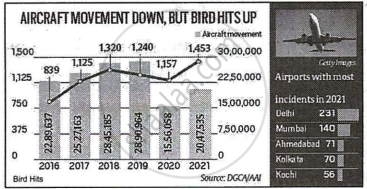
The area around air fields should be clear of any waste disposal sites. - Look at the graph. It shows that between 2016 and 2021, whereas air flights have come down, the bird-hits have gone up. This implies that the incidence of bird hits has: (1)
- decreased
- increased
- remained constant
- been alarming
Advertisements
उत्तर
- False: If the statement contradicts the information.
- at the time of landing or taking off
- Smaller planes are generally more susceptible than larger ones.
- When the window or the windscreen of the airplane is cracked due to a bird hit the pilot must land at the earliest airport.
- Dozens of bird hits take place every day but only a few are dangerous.
- We can say this because bird strikes typically occur during take-off and landing.
- In cases where the aircraft engine infests the bird, it leads to the loss of thrust and causes problems in the manoeuvrability of the crew.
- Open fields with puddles, as well as the existence of landfills and trash disposal sites, are more prone to bird strikes.
- A high number of birds are drawn to the presence of landfills or trash disposal sites.
- increased
APPEARS IN
संबंधित प्रश्न
During the devastating July 2005 floods that hit Mumbai, Rajen Dutia received an urgent call from a relative, Lopa Vyas late in the evening. “A friend’s mother is stranded near your home, Rajen. Can you please take her home? Her name is Rashmi,” Vyas told him.
Mumbai had come to a halt and people were trapped everywhere. Despite power failure and raging rain, Dutia stepped out and made his way to the spot, where he found Rashmi as well as a dozen other people. They were stranded in the dark, shivering in the rain. They all lived far away and had no place to go for the night.
Rajen took all of them to his one-bedroom flat, where he served them dinner and invited them to spend the night.
"By doing so," says Rajen, "I was simply fulfilling my karma, paying the universe back for the good it had done for me."
"God is kind. My daughter had just started her new job that day, and had gone for her training. She was stranded too. While she was trying to get to our relatives, she almost drowned, but a young stranger saved her. He and his friends even dropped her to my relative's place and phoned me to say she was safe. One good turn deserves another."
A2. Order
Look at the following sentences from the passage and put them in the correct sequence: (2)
(a) He took them to his one-bedroom flat.
(b) Rajen found Rashmi as well as a dozen other people shivering in the rain.
(c) Mumbai had come to a halt and people were trapped everywhere.
(d) Rajen Dutia received an urgent call.
A3

During the devastating July 2005 floods that hit Mumbai, Rajen Dutia received an urgent call from a relative, Lopa Vyas late in the evening. “A friend’s mother is stranded near your home, Rajen. Can you please take her home? Her name is Rashmi,” Vyas told him.
Mumbai had come to a halt and people were trapped everywhere. Despite power failure and raging rain, Dutia stepped out and made his way to the spot, where he found Rashmi as well as a dozen other people. They were stranded in the dark, shivering in the rain. They all lived far away and had no place to go for the night.
Rajen took all of them to his one-bedroom flat, where he served them dinner and invited them to spend the night.
"By doing so," says Rajen, "I was simply fulfilling my karma, paying the universe back for the good it had done for me."
"God is kind. My daughter had just started her new job that day, and had gone for her training. She was stranded too. While she was trying to get to our relatives, she almost drowned, but a young stranger saved her. He and his friends even dropped her to my relative's place and phoned me to say she was safe. One good turn deserves another."
A2. Order
Look at the following sentences from the passage and put them in the correct sequence: (2)
(a) He took them to his one-bedroom flat.
(b) Rajen found Rashmi as well as a dozen other people shivering in the rain.
(c) Mumbai had come to a halt and people were trapped everywhere.
(d) Rajen Dutia received an urgent call.
A3(i). Fill in the blanks :
Select the words given in the passage (1)
(i) Thousands Of pilgrims were …………….. due to the cloud burst in Uttarakhand.
(ii) The tiger was ……………… by the hunter.
(ii). Antonyms:
Select the correct antonyms for the given words from the alternatives :
(1) Please :
(a) unplease (b) displease (c) misplease
(2) Safe: '
(a) insafe (b) safeless (c) unsafe
A4(i) Tags :
Select the correct tag for the alternatives given below :
One good turn deserves another.
(a) Doesn’t it? (b) don’t it (c) does it?
(ii). Guess:
Choose the correct answer : (1)
Rajen can you please take her home? ‘Can’ indicates :
(a) Obligation (b) ability (c) permission
A5. Personal Response :
‘ one good turn
Deserves another.’
Explain with an
example of your own.
Look at the balloons. Which are the qualities inculcated in the author by her teacher? Write them. (2)

Sister Monica, however, wasn't quite as lenient as that, and spent most of the time telling me about the importance of regularity and hard work. She made me realise that success is, like genius, 99 per cent perspiration and 1 per cent inspiration. It's a lesson that has stood me in good stead.
The teachers I'm most grateful to, though, are not those who have taught me the most, but those who have simply been friends to me, believed me and believed in me. Prominent among them is Sudha Ramasubramanium-Rambo, as we used to call her. I didn't know her too well. She taught me in college, and apart from being incredible in class unless one missed class, she also believed that I actualIy had a Problem when I developed an injury (which several doctors found difficult to diagnose). Despite my missing an exam-the HSC, of all exams- she was the only person who told me to concentrate on my health and assured me that I could take the exam off the top of my head any time I wanted to.
I'm not even certain she remembers it, but at the time, it felt like one of the only rays of hope in an extremely dark tunnel. Perhaps few teachers realize how far their influence extends or how much of a difference their actions and words can make. A number of my teachers have unfortunately taught me kindness and tolerance and patience by being precisely the opposite, and quite obviously, they aren't the people I like to think about. But many of my teachers have been extraordinary people, who have not only taught me in class but also helped mould me and my character in every other way. I only hope that I live up to what their endeavors were undoubtedly mean to create.
B2.Answer
(1) What kind of teachers are disliked by the author? (1)
(2) What was Sudha Ramasubramanium's advice to the author when she was going to miss her HSC exam. ? (1)
B3. Match :
Match the words with their appropriate meanings : (2)
| ‘A’ | ‘B’ |
| (i) Prominent | (a) Treatment |
| (ii) Incredible | (b) Natural |
| (iii) Diagnose | (c) Unbelievable |
| (iv) Endeavours | (d) Noticeable |
| (e) Efforts | |
| (f) Identify a disease |
B.4(i) ‘Wh question’
She made me realize that success is, like genius. (1)
(Frame a ‘Wh’ question to get the underlined part as an answer)
(ii) She taught me in college. (1)
(Begin the sentence with ‘I’ and rewrite).
B5. Personal Response
Do you agree that a teacher should also be your good friend? Justify your answer. (2)
AI. Who said to whom
(i) "Is he going to live, sir?"
(ii) "______ the struggle is too hard at the end ______.”
The doctor said to himself, "If my word can save his life, he shall not die.
The will be damned." He called, "Gopal, listen." This was the first time he was going to do a piece of acting before a patient, simulate a feeling and conceal his Judgement. He stooped over the patient and said, with deliberate emphasis, "Don't worry about the will now. You are going to live. Your heart is absolutely sound."
A new glow suffused the patient's face as he heard it. Be asked in a tone of relief,
"Do you say so? If it comes from your lips it must be true............ . "
The doctor said, "Quite right. You are improving ever second. Sleep in peace. You must not exert yourself on any account. You must sleep very soundly.
I will see you in the morning." The patient looked at him gratefully for a moment and then closed his eyes. The doctor picked up his bag and went out, shutting the door softly behind him.
On his way home he stopped for a moment at his hospital, called out his assistant and said, "That Lawley Extension case. You might expect the collapse any second now. Go there with a tube of .....................................'in hand, and give it in case the struggle is too hard at the end. Hurry up.”
Next morning he was back at Lawley Extension at ten. From his car he made a dash for the sick bed. The patient was awake and looked very well. The assistant reported satisfactory pulse. The doctor put his tube to his heart, listened for a while and told the sick man's wife, "Don't look so unhappy, lady. Your husband will live to be a ninety.’’ When they were going back to the hospital, the assistant sitting beside him in the car asked, "Is he going to live, sir?"
"I will bet on it. He will live to be ninety. He has turned at corner. How he has survived this attack will be a puzzle to me all my life," replied the doctor.
A2. Web
Complete the web:

A3. Personal Response
What is your opinion about the doctor and his behaviour?
The natural life span of a domesticated horse is about 25 – 30 years, 10 years down from what it was in the wild. You can tell a horse’s age from the number of teeth he has. They get all their teeth by the age of 5, after which those teeth just get longer. Horses have close to 360 degree all round vision. The only place they cannot see is directly behind or right in front of themselves, which is why it’s dangerous to stand behind a horse. If they later I it also means that they cannot see a jump once they are about four feet from it, and have to rely on memory as to its height and shape! Each of the horse’s two eyes work independently wherever a horse’s ear points is where the horse is looking. A horse is able to sleep standing up as he is able to lock his leg muscles so that he dosen’t fall asleep. Nor do all horses in the same field ever lie down at once – one animal always stands “on look out” duty.
1) What is the life span of a wild horse?
(2) Why do the horse owners cover their horse’s eyes with blinkers?
(3) What prevents a horse from falling while asleep?
(4)
(a) Falls /shorter/ the mane/ on the/ side/ legged.[Rearrange the words to make a meaningful sentence]
(b) Form antonyms by adding a prefix :
(i) able
(ii) direct
(5)
(a) They get all their teeth by the age of five. [Pick out the prepositions]
(b) If they feel something behind them they may kick. [Rewrite using ‘unless’]
(6) How have horses helped man through the ages?
The hopping kangaroo is a familiar sight in every snapshot relating to Australia. Members of the kangaroo family can be as small as a rat or as big as a man. Kangaroos are found mainly in Australia, Tasmania and New Guinea. Kangaroos, which are big-footed marsupials that evolved in Australia, use their short front legs like arms. The man-sized kangaroos of Australia are capable of speeding up to 88 km/hr for short distances, their means of locomotion being their powerful hind legs, which carry them over the ground in jumps of 9 m or more at a time.
Weighing around 70 kg, they have an average lifespan of around six to eight years and a maximum lifetime of 20 years. When bothered by predators, kangaroos often head for the water, standing submerged to the chest and attempting to drown the attacker by holding him under water. Another defensive technique is to get their back to a tree and kick at their adversary with their clawed hind feet, sometimes with sufficient force to kill a man. Normally shy animals, they alert other kangaroos to danger by beating on the ground with their hind feet. This loud alarm signal carries over a long distance.
The tail is important for kangaroos. It holds them in balance and supports them when they sit or fight against other kangaroos. The kangaroo uses its short legs as arms. With them it scratches itself, cleans its fur and holds branches when it eats leaves. Kangaroos are marsupials and the females carry newborns in a pouch in front of their abdomens. The babies are born small and climb up into safety of the pouch. There, for the next 225 days or so, they eat, sleep and grow. Once they reach full development, they leave the pouch. A young kangaroo that leaves the pouch is called a ‘joey’. To keep from getting too hot, the kangaroos take naps in the afternoon and do most of their grazing at night. But the best stay-cool secret of these creatures is the spit bath! Kangaroos drool and lick saliva all over their faces and bodies to cool down.
On the basis of your reading of the above passage, complete the following sentences with appropriate words/phrases:
(a) When followed by predators, kangaroos submerge ____________ and _________________.
(b) The powerful hind legs help kangaroos to __________________.
(c) Kangaroos are mainly found in Australia and are ____________________.
(d) They use their front legs to ___________________.
(e) Kangaroos warn others of danger by _______________________.
(f) The secret of kangaroos to stay cool is ______________________.
(g) They use their tails to _________________________.
(h) Before becoming ‘joeys’, the young ones stay in the ______________ and ________________.
One of the greatest advances in modern technology has been the invention of computers. They are widely used in industries and in universities. Now there is hardly any sphere of human life where computers have not been pressed into service of man. We are heading fast towards the day when a computer will be as much part of man's daily life as a telephone or a calculator.
Computers are capable of doing extremely complicated work in all branches of learning. They can solve the most complex mathematical problems or put thousands of unrelated facts in order. These machines can be put to varied uses. For instance, they can provide information on the best way to prevent traffic jams. This whole process by which machines can be used to work for us has been called 'automation'. In the future 'automation' may enable human beings to enjoy more leisure than they do today. The coming of automation is bound to have important social consequences.
Some years ago an expert on automation, Sir Leon Bagrit, pointed out that it was a mistake to believe that these machines could 'think'. There is no possibility that human beings will be "controlled by machines". Though computers are capable of learning from their mistakes and improving on their performance, they need detailed instructions from human beings to operate. They can never, as it were, lead independent lives or "rule the world" by making decisions of their own.
Sir Leon said that in future, computers would be developed which would be small enough to carry in the pocket. Ordinary people would then be able to use them to obtain valuable information. Computers could be plugged into a national network and be used like radios. For instance, people going on holiday could be informed about weather conditions. Car drivers can be given alternative routes when there are traffic jams. It will also be possible to make tiny translating machines. This will enable people who do not share a common language to talk to each other without any difficulty or to read foreign publications.
a) What is the greatest advancement in modern technology?
b) What complicated works are computers capable of doing?
c) Write one use of computers.
d) Explain automation.
e) Why can't computers lead independent lives or rule the world?
f) How would computers as translating machines help people?
g) What was the prediction of Sir Leon about computers in the future?
h) How can computers help people going on holiday?
Read the extract given below and answer the questions that follow:
I even considered fleeing to my hometown, where I could have been a real lawyer right away, without going through this unpleasant training period
(a) Who is 'I'?
(b) How did 'I' suffer during the training period?
(c) What does the word, 'fleeing' mean?
Read the passage given below :
Kausani is situated at a height of 6,075 feet in the Central Himalayas. It is an unusally attractive little town. It covers just about 5.2 sq. kms. It lies to the north of Almora in Uttarakhand's picturesque kumaon region.
Kausani provides the 300-km wide breathtaking view of the Himalayas. It is the most striking aspect of the place. Snow-capped peaks are spread in a stately row. They stare at you in silvery white majesty. The most famous peak on view is Nanda Devi, the second highest mountain in India. It is situated at a height of 25.645 feet and 36 miles away as the crow files. The other famous peaks on view are choukhamba (23,420 feet) and Trishul (23,360 feet). Then there are also Nilkanth, Nandaghunti, Nandaghat and Nandakot. On a clear day, the blue of the sky makes a splendid background to these peaks. At sunrise and at sunset, when the colour changes to a golden orange, the scene gets etched in your memory.
When Gandhiji visited this place in 1929, its scenic beauty held him spellbound. He named it the 'Switzerland of Indian'. He prolonged his two-day stay to fourteen days, making time to write a book, 'Anashakti Yoga'. The place where he was staying was originally a guest-house of the tea estate. It was renamed 'Anashakti Ashram' after the book.
Kausani is the birthplace of Sumitranandan Pant, India's poet laureate. Its natural surroundings inspired many of his poems. Its tea gardens mingle with dense pine forests and fruit orchards. The area is also host to many fairs and religious caremonies. If Uttaranchal is the abode of gods, Kausani is God's own backyard. There is no traffic, no one is in a hurry. If serenity could be put on a canvas, the picture would resemble Kausani.
On the basis of your reading of the above passage, answer the following questions :
(a) Where is Kausani situated ?
(b) What is the most striking aspect of Kausani ?
(c) Which is the most famous peak on view from Kausani ?
(d) How did Kausani influence Sumitranandan Pant ?
(e) When does the view of peaks become so memorable ?
(f) How can we say that Gandhiji was greatly charmed by the natural beauty of Kausani ?
(g) What makes Kausani a calm and quiet place ?
(h) Why, do you think, is Kausani known as 'God' s own backyard' ?
Read the passage given below:
1. I rested for a moment at the door of Anand Bhawan, on Market Road, where coffee-drinkers and tiffin-eaters sat still at their tables, uttering low moans on seeing me. I wanted to assure them, "Don't mind me, you hugging the cash box − you are a coward, afraid even to breathe. Go on, count the cash, if that is your pleasure. I just want to watch, that's all. If my tail trails down to the street, if I am blocking your threshold, it is because, I'm told, I'm eleven feet tip to tail. I can't help it. I'm not out to kill − I'm too full. I found a green pasture full of food on my way. I won't attack until I feel hungry again. Tigers attack only when they feel hungry, unlike human beings who slaughter one another without purpose or hunger."
2. To the great delight of children, schools were being hurriedly closed. Children of all ages and sizes were running helter-skelter, screaming joyously. "No school, no school. Tiger, tiger!" They were shouting and laughing and even enjoying being scared. They seemed to welcome me. I felt like joining them. So I bounded away from the restaurant door. I walked along with them, at which they cried, 'The tiger is coming to eat us; let us get back to school!"
3. I followed them through their school gate while they ran up and shut themselves in the school hall securely. I climbed up the steps of the school, saw an open door at the far end of a veranda, and walked in. It happened to be the headmaster's room. I noticed a very dignified man jumping on the table and heaving himself up into an attic. I walked in and flung myself on the cool floor, having a special liking for cool stone floors.
4. As I drowsed, I was aware of cautious steps and hushed voices all around. I was in no mood to bother about anything. All I wanted was a little moment of sleep; the daylight was very bright.
On the basis of your reading of the above passage, answer the following questions:
(a) How did the diners at Anand Bhawan react on seeing the tiger?
(b) When do tigers attack? In this context, how are human beings different from tigers?
(c) Why were children happy and even enjoying being scared?
(d) What did the headmaster do on seeing the tiger? What did the tiger like to do in the headmaster's office?
(e) Identify the word which means the same as 'hugging'. (Para 1)
(i) counting
(ii) hiding
(iii) rubbing
(iv) holding tightly in the arms
(f) Identify the word which means the same as 'delight'. (Para 2)
(i) pleasure
(ii) fear
(iii) sorrow
(iv) nervousness
(g) Identify the word which means the same as 'dignified'. (Para 3)
(i) tall
(ii) honourable
(iii) terrified
(iv) tired
(ii) jumped forward
(iii) walked with heavy steps
(iv) ran lazily
Read the extract given below and answer the questions that follow :
When I got to New Mullion, my eager expectations of a sweet and simple country village were severely disappointed. Its streets were rivers of mud, with rows of wooden shops, either painted a sour brown, or bare of any paint at all.
(a) Who is 'I'?
(b) Why was 'I' disappointed?
(c) What does the word 'expectations' mean ?
Read the passage given below and answer the questions that follow:
1. Thackeray reached Kittur along with a small British army force and a few of his officers. He thought that the very presence of the British on the outskirts of Kittur would terrorise the rulers and people of Kittur and that they would lay down their arms. He was quite confident that he would be able to crush the revolt in no time. He ordered that tents be erected on the eastern side for the fighting forces and a little away on the western slopes tents be put up for the family members of the officers who had accompanied them. During the afternoon and evening of 20thOctober, the British soldiers were busy making arrangements for these camps.
On the basis of your understanding of the above passage complete the statements given below with the help of options that follow:
(ii) army officer
(iii) adviser to Rani of Kittur
(iv) treasury officer
(ii) enjoy life in tents
(iii) stay in the palace
(iv) give company to officers
(c) Why did Thackeray come to Kittur?
(d) Why did the Kittur officials refuse to give the desired assurance to Thackeray?
(e) What happened to the Horse Artillery?
(f) How do we know that the Rani was a noble queen?
(g) How in your opinion would the British women have felt after meeting the Rani?
(h) Why did the Rani refuse to meet Thackeray?
(i) Find words from the passage which mean the same as the following :
ii. aggressive/refusing to obey (para 2)
Read the passage given below and answer the questions that follow:
The most alarming of man’s assaults upon the environment is the contamination of air, earth, rivers, and sea with lethal materials. This pollution is for the most part irrevocable; the chain of evil it initiates is for the most part irreversible. In this contamination of the environment, chemicals are the sinister partners of radiation in changing the very nature of the world; radiation released through nuclear explosions into the air, comes to the earth in rain, lodges into the soil, enters the grass or corn, or wheat grown there and reaches the bones of a human being, there to remain until his death. Similarly, chemicals sprayed on crops lie long in soil, entering living organisms, passing from one to another in a chain of poisoning and death. Or they pass by underground streams until they emerge and combine into new forms that kill vegetation, sicken cattle, and harm those who drink from once pure wells.
It took hundreds of millions of years to produce the life that now inhabits the earth and reached a stage of adjustment and balance with its surroundings. The environment contained elements that were hostile as well as supporting. Even within the light of the sun, there were short wave radiations with power to injure. Given time, life has adjusted and a balance reached. For time is the essential ingredient, but in the modern world is no time.
The rapidity of change and the speed with which new situations are created follow the heedless pace of man rather than the deliberate pace of nature. Radiation is no longer the bombardment of cosmic rays; it is now the unnatural creation of man’s tampering with the atom. The chemicals to which life is asked to make adjustments are no longer merely calcium and silica and copper and all the rest of the minerals washed out of the rocks and carried in the rivers to the sea; they are the synthetic creations of man’s inventive mind, brewed in his laboratories, and having no counterparts in nature.
(a) On the basis of your understanding of the above passage make notes on it using headings and sub-headings. Use recognizable abbreviations (wherever necessary-minimum four) and a format you consider suitable. Also supply a title to it.
(b) Write a summary of the passage in about 80 words.
Read the passage given below :
It is surprising that sometimes we don't listen to what people say to us. We hear them, but we don't listen to them. I was curious to know how hearing is different from listening. I had thought both were synonyms, but gradually, I realised there is a big difference between the two words.
Hearing is a physical phenomenon. Whenever somebody speaks, the sound waves generated reach you, and you definitely hear whatever is said to you. However, even if you hear something, it doesn't always mean that you actually understand whatever is being said. Paying attention to whatever you hear means you are really listening. Consciously using your mind to understand whatever is being said is listening.
Diving deeper, I found that listening is not only hearing with attention, but is much more than that. Listening is hearing with full attention, and applying our mind. Most of the time, we listen to someone, but our minds are full of needles chatter and there doesn't seem to be enough space to accommodate what is being spoken.
We come with a lot of prejudices and preconceived notions about the speaker or the the subject on which he is talking. We pretend to listen to the speaker, but deep inside, we sit in judgement and are dying to pronounce right or wrong, true or false, yes or no. Sometimes, we even come prepared with a negative mindset of proving the speaker wrong. Even if the speaker says nothing harmful, we are ready pounce on him with our own version of things.
What we should ideally do is listen first with full awareness. Once, we have done that, we can decide whether we want to make a judgement or not. Once we do that, communication will be perfect and our interpersonal relationship will become so much better. Listening well doesn't mean one has to say the right thing at the right moment. In fact, sometimes if words are left unspoken, there is a feeling of tension and negativity. Therefore, it is better to speak out your mind, but do so with awareness after listening to the speaker with full concentration.
Let's look at this in another way. When you really listen, you imbibe not only what is being spoken, but you also understand what is not spoken as well. Most of the time we don't really listen even to people who really matter to us. That's how misunderstandings grow among families, husbands and wives, brothers and sisters.
(A) On the basis of your reading of the above passage make notes on it, using heading and sub-headings. Use recognizable abbreviations (wherever necessary − minimum four) and a format you consider suitable. Also supply an appropriate title to it.
(B) Write a summary of the passage in about 80 words.
(A) Read the fo llowing extract and answer the questions given below :
Kalpana Chawla was extremely proud other birth-place and made every effort to bring it into the lime-light. During space flights she vit, (mid prondk point it out to her Fellow-astronauts. Once, during the second Hight she remembered her closest friend, Dais Chawla, who died in a road accident. In fact, despite her celebrity status, she took pains to track down her former teachers, classmates and friends in India and showed a keen desire to stay in touch with them.
Her affectionate and humble nature won the hearts of all who came in contact with her. Although Kalpana had a strong desire to go to Mars, fly over its canyons she was equally concerned about the well-being of the earth. She always urged young people to listen to the sounds of nature and take care of our fragile planet. During, her space trips, she took many breatlitakilig photographs of the earth for various terrestrial studies later on the ground. When she was in space, she always felt a sense of connection with everyone on the earth.
It was Kalpana's cherished desire to visit India again. But that was not to be. A few months after her tragic death, Harrison visited India. He went to her school and college, met her family, teachers and friends and scattered her ashes over the Himalayas.
(1) What is the extract about? (1)
(2) How was Kalpana connected with India and Indians? (2)
(3) How was Kalpana concerned about the well-being of the earth? (2)
(4) What would you like to do For India? (2)
(5) Rewrite the following sentences in the ways instructed:
(i) She took many breathtaking photographs of the earth.
(Rewrite it using the Present Perfect Continuous tense.) (1)
(ii) He scattered her ashes over the Himalayas.
(Rewrite it beginning with 'Her ashes ...... ')(1)
(iii) Kalpana was extremely proud of her birth-place and made every effort to bring it into limelight.
(Rewrite it using 'not only ...... but also'.)(1)
( 6) Give the antonyms from the extract for -
(i) collected (1/2)
(ii) forgot (1/2)
(B) Summary :
Write a summary of the above extract with the help of the following
points and suggest a suitable title :
Points : Kalpana's affection towards India and Indians her humble - nature her love for the earth Harrison's visit to India. (4)
Read the following extract and answer the questions given below:
Now, as I stood on the shore of that desolate Highland loch
I raised my voice in a surge of self-justification : ''By Heavens!
This is my opportunity. Gastric ulcer or no gastric ulcer, I will
write a novel.'' Before I could change 1ny mind I walked straight to the village and bot1ght myself two dozen penny exercise books.
Upstairs in my cold, clean bedroom was a scrubbed deal table and a very hard chair. Next morning, I found myself in this chair, facing a new exercise book open upon the table, slowly' becoming aware that, short of dog-Lati11 prescriptions, I had never composed a significant phrase in all my life. It was a discot1raging thought as I picked 11p my pen and gazed out of the window. Never mind, I would begin. Three hours later Mrs. Angus, the farmer's wife, called me to dinner. The page was still blank.
As I went dow-n to m:y milk and junket-they call this "curds'' in Tarbert - I felt a dreadful fool. I felt like the wretched poet in Daudet's Jack whose im1nortal masterpiece never progressed beyond its stillborn opening phrase : ''In a remote valley of Pyrenees ..... ". I recollected, rather gri111ly, the sharp advice with which my old schoolmaster had goaded me to action. ''Get it down!'' he had said. ''If it ~tops in your head it will always be nothing.
Get it down.'' And so, after lunch, I went upstairs and began to get it down.
(1) What is the main idea of the extract? (1)
(2) Why did the narrator buy two dozen penny exercise books? (2)
(3) How was the narrator unprepared for writing his novel? (2)
(4) Write in brief about what you will do in your forthcoming vacation. (2)
(5) Rewrite the following sentences in the ways instructed:
(i) I stood on the shore of that desolate Highland loch.
(Rewrite it using 'used to'.) (1)
(ii) I went down to my milk and junket.
(Rewrite it in the Past Perfect Tense.) (1)
(iii) I walked straight to the village and bought myself
two dozen penny exercise books. (Make it simple). (1)
(6) Find out the words from the extract which mean:
(i) chance (1/2)
(ii) lake (1/2)
Read the following extract and answer the questions given below:
There are some glimmers of hope. I met up young Navdeep. Ahuja who along with another colleague began the innocuously named Graduates Welfare Association, Fazilka. They are bringing about change with the mandate of citizens' participation in governance and are facilitating the creation of physical and social infrastructure across 22 cities in Punjab. They have put in place a network of cycle rickshaws called Eco-cabs which can be booked through a mobile phone. They are also developing car tree zones, food and culture streets in these cities. All this is being done very efficiently and at a low cost. We need many such organizations. However, my idea of a city in 2020 is not a utopian dream. It is achievable. It has streets where people walk on wide footpaths shaded by leafy trees. Streets are usually one-third of a city's area and its most democratic segment. Public space dedicated to pedestrians reduces inequality and should be accorded priority when developing cities. Adjoining the streets should be cycle lanes where bicycles and, rickshaws can sail past smoothly. It'll have a great public transport system with buses, metro and taxis. Parking will be difficult and expensive so people will use public transport rather than cars. There will be parks and gardens and the air will be clean, as pollution levels will have dropped dramatically. And then cities will become areas of graceful living and a charmed way of life.
(1) What is the extract about?
(2) What will happen when parking becomes difficult and expensive?
(3) How has Graduates Welfare Association brought about changes in some cities?
(4) What efforts will you take to make your city a livable place?
(5) Rewrite the following sentences in the ways instructed :
(i) We need many such organizations.
(Frame a ' Wh-question' to get the underlined part as an answer.)
(ii) It reduces inequality.
(Rewrite it using the Present Perfect Tense.)
(iii) The air will be clean, as pollution levels will. have dropped dramatically.
(Rewrite it using 'unless')
(6) Find out the words from the extract which mean:
(i) co-worker
(ii) small signs
Read the following extract and answer the questions given below:
Questions :
(2) What sort of patients did the doctor have?
(3) What were the reasons for the doctor's indigestion?
(4) “A doctor should have a pleasing personality and good manners.” Do you agree? Explain.
(ii) unsewn
Read the following extract and answer the questions given below:
Researchers recently announced the earth could actually withstand up to 200,000 times the current population. They arrived at this figure by calculating the amount of heat a human body emits, and only at 1·3 million billion would the earth be too hot to be habitable. And though it would feel like being ina can of sardines if that figure were ever reached, the earth is capable of comfortably sustaining a population several times the current 6·5 billion.
In fact, fertility is actually on the decline worldwide. Though the population has grown, the rate of growth has fallen sharply. Twenty years ago, the UN projected that the population would reach 11·I6 billion in 2050, today they say it will reach only 9·3 billion. Moreover, the human population will stabilize at about 11·5 billion. While this figure is almost twice the current one, it is hardly claustrophobic.
True, the demands on resources are heavy even now, but this is more due to the manner in which these resources are being used. In fact, figures show that a bigger population does not amount to greater consumption. Over 20% of the world's people in the highest-income countries account for 86% of total private consumption expenditure - the poorest 20% a tiny 1·3%. With just 5% of the world's population, the US consumes about 40% of the world's resources. Would you say the US is overpopulated?
Concerns on the scarcity of food are equally baseless. In fact, global food production has actually kept up with population growth. If people starve in many countries it is not because food is becoming scarce; it is because those people cannot afford it.
Questions:
(1) What conclusions did the researchers arrive at?
(2) How does the writer explain that fertility is on the decline?
(3) What does the extract predict about the fear of scarcity of food?
(4) How will the population become a gift in the global market scene?
(5) Rewrite the following sentences in the ways instructed:
(i) The earth could withstand up to 200,000 times the current population.
(Rewrite the sentence using the modal auxiliary showing 'certainty'.)
(ii) The earth would be too hot to be habitable.
(Remove 'too' and rewrite the sentence.)
(iii) These resources are being used.
(Rewrite the sentence beginning with, 'We ........... .')
(6) Write the antonyms of:
(i) habitable
(ii) stabilize
Read the following extract and answer the questions given below:
So what is a city? It's a dense amalgamation of buildings and people. A city must provide equity and also be sustainable. As an architect who has been closely connected with Delhi and its planning, my wish list is more about the direction we need to take so that future generations don 't end up living in chaotic dysfunctional cities.
The first requirement for a city is a pragmatic plan. Many of our cities such.as Delhi and Bhubaneswar and even Port Blair in the Andamans have reasonably good master plans. Many also have City Development Plans which have been made an essential requirement to draw funds. from the government's Urban Renewal Programme (JNNURM). But they should be updated frequently based on the changing needs of its people.
And let's not forget its citizens - they need to be more pro-actively involved when evolving master plans. But often, there's lack of planning and inadequate implementation systems. This applies to all essential components of a city-streets, public transport system, traffic management, affordable housing, cars and parking, drainage. water supply, sewerage, and garbage. Any deficiency in these will lead to poor quality cities that won't be able to handle the pressure of increased population and changing needs.
The second require1nent of a good city is good social infrastructure such as parks and places for leisure such as rivers and seafronts. It needs to preserve and protect its heritage. We are a nation with a rich diversity in culture, arts, and crafts.
Questions:
(1) What issue is raised in the above extract?
(2) What are the requirements for a good city?
(3) Why is it necessary to update our city development plan?
(4) Do you think unplanned cities make the life of its people
miserable? How?
(5) Rewrite the following sentences in the ways instructed :
(i) A city must provide equity and also be sustainable.
(Rewrite the sentence using 'not only ...... but also'.)
(ii) Many of our cities have good master plans.
(Frame a Wh-question to get the underlined part as its answer.)
(iii) It needs to preserve and protect its heritage.
(Identify the tense used in the sentence.)
(6) Find out from the extract the words which mean:
(i) practical
(ii) blend
Read the following extract and answer the questions given
below:
Today, at 29, \.1.ichael has discovered the power of another good idea that has helped him rise in just a few years from teen to tycoon.He has become the fourth largest manufacturerof personal computers in America and the youngest man ever to head Fortune 500 Corporation.
Growing up in Houston, Texas. Michael and his two brothers were imbued by their parents. Alexander and Lorraine - he anorthodontist, she a stockbroker- with the desire to learn and the drive to work hard. Even so, stories about the middle boy began to be told early.
Like the time a saleswoman came asking to speak to "Mr. Michael Dell" about his getting a high school equivalency diploma. Moments later. eight-year-old Michael was explaining that he thought it might be a good idea to get high school out of the way.
A few years later Michael had another good idea, to trade stamps by advertising in stamp magazines. With the $2000 he made, he bought his first personal computer. Then he took it apart to figure out how it worked.
In high school Michael had a job selling newspaper subscriptions. Newlyweds, he figured, were the best prospects, so he hired friends to copy rhe names and addresses of recent recipients of marriage licences. These he entered into his computer, then sent a personalized letter offering each couple a free two-week subscription.
This time Dell made $ 18,000 and bought an expensive BMW car. The car salesman was flabbergasted when the 17-ycar-oJd paid cash.
(I) What details does the writer give about Dell's family in the
extract? (1)
(2) How did Dell succeed in earning S2QOQ? (2)
(3) Why was the car salesman flabbergasted? (2)
(41 What do you think you can learn from Dell's story? (2)
{5) Rewrite the following sentences in the ways instmcted:
{i) "He has discovered the power of another good idea."
(Rewrite it beginning with 'The power of another good
idea ...... ... .'.) (1)
.(if) "If you think you have a good idea, try it. "
(Use 'Unless' .) (1)
(iii) '"This time Dell made $18,000 and bought an expensive
BMW car." (1)
(Make it a simple sentence.)
CM Find out the words from the extract which mean :
(i) filled with a quality. (1/2)
(ii) understand. (1/2)
Read the following extract and answer the questions given below.
| A | B |
| (i) valedictorian | (a) feeling of annoyance |
| (ii) frustration | (b) dunce |
| (c) school topper | |
|
(d) validity
|
Read the following extract and answer the questions given below.
|
I grew up in India in which telephones were both rare and virtually useless. When I left India in 1975 to go to the US for graduate studies, we had perhaps, 600 million residents in the country and just two million landline telephones. Having a telephone was a rare privilege: if you weren’t an important government official, or a doctor, or a journalist, you might languish in a long waiting list and never receive a phone.
Telephone were such a rarity (after all, 90% of population had access to a telephone line) that elected members of Parliament had amongst their privileges the right to allocate 15 telephone connections to whomever they deemed worthy.
And if you did have a phone, it wasn’t necessarily a blessing. I spent my high school years in Calcutta, and I remember that if you picked up your phone, you had no guarantee you would reach the number you had dialled. Sometimes you were connected to someone else’s ongoing conversation, and they had no idea you were able to hear them; there was even a technical term for it, the ‘cross - connection’ (appropriately, since these were connections that made us very cross). If you wanted to call another city, say Delhi, you had to book a ‘trunk call’ in the morning and then sit by the telephone all day waiting for it to come through; or you could pay eight times the going rate for a ‘lightning call’ = but even lightning struck slowly in India those days, so it only took half an hour instead of the usual three or four or more to be connected.
|
Questions:
(1). Why were telephones a rarity before 1975? (1)
(2) What special rights did elected members of Parliament use to have? (2)
(3) How did the author differentiate between a ‘trunk call’ and a ‘lightning call’? (2)
(4) Do you think the cellphone has made us global? (2)
(5) Rewrite the following sentences in the ways instructed. . (3)
(i) You could pay eight times the going rate for a ‘lighting call’. (Rewrite it using modal auxiliary showing compulsion)
(ii) I spent my high school years in Calcutta. [Rewrite it using past perfect tense]
(iii) Telephones were a rarity. [Make it a rhetorical question]
(6) Match the words in column ‘A’ with their meanings in column ‘B’. (1)
| Column A | Column B | ||
| (i) | Privilege |
(i)
|
means to reach or get |
| (ii) | Access |
(ii)
|
remedy |
| (iii) | special right |
Read the following passage and do the activities.
In the early days of farming, people did not understand how plants obtained essential nutrients. It so happened that wood ash, fish remains and slaughterhouse waste were thrown on vacant land just to get rid of them. Then, people started to notice that the grass, bushes and shrubs on this vacant land began to grow very well. They reasoned that if their farmland were similarly treated, the growth of their crops would also improve. People gradually began to realize that the nutrients required by plants came from the soil and that the amount of nutrients could be increased by the application of such organic remains to the soil. Thus started the manuring process in farming.
The practice of manuring has been practised as early since the seventeenth century. However, the importance of manuring was not properly understood until scientists began to study the nutritional needs of plants and gave birth to fertilizers. Thus, gradually, the use of fertilizers became accepted by farmers.
There are many types of manure and fertilizer currently being used. Manure is a substance derived from animals and plants. The most important advantage of using manure is the fact that they not only supply a wide range of plant
nutrients, but also improve the structure of the soil. It cements together the soil particles to form soil crumbs. The crumb structure is a desirable condition of cultivated soil. The addition of manure to soil will increase the inorganic and humus content which helps to prevent soil erosion and loss of plant nutrients when it rains. The common manure used in farming consists of farmyard manure, compost, blood meal, bone meal and fish meal.
Unlike manure, fertilizers are inorganic substances which do not improve the structure of the soil. They only supply extra amounts of nutrients to the growing plants when applied to the soil. The commercial fertilizers commonly used today
can be classified into three major categories; namely, nitrogen (N), phosphate and potash fertilizers.
Besides knowing the type of fertilizer to use, a farmer also needs to know when to apply the fertilizer and how to apply it. The fertilizer should be applied at the time when the plants need a particular nutrient most. The time and method
of application will determine how profitably the fertilizers have been used in farming. Fertilizers which have not been properly applied cannot be absorbed in large quantities by plant roots. These fertilizers may be washed away by rain
or they may kill the plants. This would mean a definite financial loss for the farmer.
(A1) Choose the correct option and rewrite the sentences.
(a) What did the people not understand in the early days of farming ? (1/2)
(i) how farming is done
(ii) how plants obtained essential nutrients
(iii) how grass, shrubs and bushes grow.
(b) What is manure ? (1/2)
(i) a substance derived from animals and plants.
(ii) the soil particles to form soil crumbs.
(iii) a combination of nitrogen, phosphate and potash.
(c) When should fertilizers be applied ? (1/2)
(i) When the plants get dried.
(ii) When the plants need a particular nutrient most.
(iii) In the early days of farming.
(d) What determines the profitability of the fertilizers ? (1/2)
(i) grass, bushes and shrubs
(ii) nitrogen, phosphate and potash.
(iii) The time and method of application.
(A2) How did the process of adding manure to the soil begin? (2)
(A3) Find out similar words from the passage. (2)
(i) necessary (ii) comprise
(iii) step by step (iv) ascertain
(A4)
(i) They supply extra amount of nutrients to the growing plants (Begin the sentence with ‘Extra amount of.......... ’.)(1)
(ii) It cements together the soil particles to form soil crumbs.
(Choose the correct option to name the tense.)(1)
(i) Simple present tense
(ii) Simple past tense
(iii) Simple future tense
(A5) ‘Agriculture plays important role in Indian economy’. Explain. (2)
(B) Read the passage given in Q. 4 (A) and write the summary of it. Suggest a suitable title to your summary. (5)
On this historic moment, I stand here to thank Pandit Jawaharlal Nehru. India’s present epoch maker has come over here to bless the state of Maharashtra which is definitely going to last forever. On behalf of thousands of common people, I express my deep sense of gratitude to him for blessing us. We Maharashtrians love him, worship him. And once again, I wish to declare that this state of Maharashtra, recently formed, will work for the betterment of the common people of Maharashtra, but if it comes to sacrifice, whatever best and grand we have, it will be done primarily for India. This is so, because, we believe from the beginning, that Maharashtra depends on India; its greatness depends on the greatness of India. All Maharashtrians believe that both India and Maharashtra can progress only when there is oneness of interest. And, therefore, I have made this clear by bringing to your notice the significance of certain symbols, for example, the Himalayas stand for lndia and the Sahyadri, for Maharashtra. The snowy Himalayas with the highest mountain ranges symbolise India and the Sahyadri with the blackest rock structure and with 200-300 inches rainfall symbolise Maharashtra. I promise you that if the Himalayas are in jeopardy, the Sahyadri of Maharashtra will use its black rock structure like a shield to protect the Himalayas.
‘Hard labour’ is the watch word of our times. And, Panditji, you have given us the message of building Maharashtra and our nation by hard labour. We are going to inscribe this valuable message on our minds and try our best to look at your blessings and your guidance, as the blessings and guidance of an epoch maker.
A1 . Read the following statements. Find out the correct statements and write them down : (2)
(i) Both India and Maharashtra can progress if they have different interests.
(ii) Hard work is the only way to build the future of India and Maharashtra.
(iii) The sacrifice of the best and grand in Maharashtra will be made for the state of Maharashtra.
(iv) In times of great calamity the Sahyadri will protect the Himalayas, like a shield.
A2. Complete the following statements : (2)
(i) The interest of Maharashtra and that of India should be one for the progress of Maharashtra state, because ................
(ii) Maharashtra depends on India, because ................
A3.Complete the table : (2)
| The name of the mountain | Stands for | The reason |
| The Himalayas The Sahyadri |
A4. Vocabulary - (2)
Give antonyms of the following words by adding prefixes :
(i) gratitude
(ii) clear
(iii) believe
(iv) significance
A5. Personal response - (2)
Give your suggestions that will help the people to make Maharashtra prosperous.
A6. Grammar - (2)
Rewrite the following sentences in the ways instructed :
(i) India and Maharashtra can progress only when there is oneness of interest.
(Rewrite it using ‘unless’)
(ii) This state of Maharashtra will work for the betterment of the common people of Maharashtra.
(Rewrite it using modal auxiliary showing ‘obligation’)
Read the extract and do the activities that follow :
‘Your father was my enemy,’ said Frederick. ‘I would have been better pleased by your brave deed if you had told me of another father?’
‘I am proud to be Sir Rowland's son,’ answered Orlando angrily,’ and I would not change my place to be the heir of this dukedom.’
The Duke and his lords went away, leaving Orlando alone with Rosalind and Celia. Celia was angry with her father for speaking so unkindly to Orlando. ‘Would I have done this in my father’s place?’ she said to Rosalind.
‘My father loved Sir Rowland as much as his own soul,’ Rosalind said to Celia, ‘and all the world agreed with him. If I had known that his young man was Sir Rowland’s son I should have begged him with tears not to take so great a risk.’
‘Let us go and speak to Orlando,’ said gentle Celia. ‘I am ashamed of my father’s rude and angry words.’
The two girls went up to Orilando and praised him for his bravery. Rosalind took a gold chain from her neck and gave it to him. ‘I would like to give you more’, she said, ‘but I am not rich.’ Then she and Celia went away.
Orlando, however, could not forget them. He had already fallen in love with the fair Rosalind, but he could not stay at the Duke’s palace. His friends warned him that Frederick was angry and jealous of him. They told Orlando to leave the dukedom, because the Duke meant to do him harm.
A1. Match -
Match the characters and their attributes:
| A | B | ||
| i. | Celia | a. | fair |
| ii. | Orlando | b. | rude and unkind |
| iii. | Frederick | c. | gentle |
| iv. | Rosalind | d. | brave |
A2. Write an imaginary paragraph:
Write an imaginary paragraph in about 50 words in continuation with the given extract.
Read the following passage and do the given activities :
A1. Fill up the blanks with virtues of dogs : (2)
(1) __________
(2) __________
(3) __________
(4) __________
| Human and dogs are inseparable for thousands of years and they are dependent on each other for protection and survival. Relationship between humans and dogs is often characterized by strong emotional bonds which run both way. Dogs are very popular as pets and companions. Dog is the ‘Man’s Best Friend’ and a family member. The dog is one of the most loyal, faithful and devotee animal. In earlier days dogs were kept mainly for hunting and guarding; now they are kept for companionship, protection and showmanship. There are millions of people all over the world who are dog lovers Puppies need more attention at the, early age. As much as possible try many methods of socialization, such as playing with them, taking them for walk, expose them to crowds, make them to obey the orders etc. |
A2. Methods of socialization of puppies are : (2)
(1) …......................
(2) …......................
(3) …......................
(4) …......................
A3. Cross out the odd man : (2)
(i) Inseparable, dependent, protection, popular.
(ii) Hunting. guarding, playing, petting.
(iii) Earlier, human, relationship, family
(iv) Often, mainly, now, emotional
A4.
(1) There are millions of people all over the world. (1)
(Pick out the determiners and write them)
(2) Puppies need more attention. (1)
(Rewrite the sentence without changing its meaning beginning with : Puppies don’t ….....)
A5. Should we ban keeping pets ? Justify. (2)
Read the following extract and answer the questions given below:
But being named an 'AdarshGaon' is far from easy. Villages had to give a proposal after which a committee headed by Mr. Pawar inspected the villages. "The Villages had to show dedication in the struggle to fight mediocrity. They had to follow all the conditions of becoming an 'AdarshGaon'. We chose villages with a revolutionary spark, "Mr. Pawar says.
Villages need to follow strict rules. The process begins with effective water management through the watershed technique and water auditing. taking responsibility for the village's natural resources-planting trees and stopping grazing. contributing labour for the village work, and then expanding to bring about behavioral changes in the people for harboring social change. Hiware Bazaar is free of any kind of addiction and there are no liquor or tobacco shops in the village. Vasectomy has been made compulsory, as is the pre-marital HIV test.
The 'AdarshGaon' model prides itself on being based on the joint decisions made by the Gram Sabha, where all the villagers are present. Even while selecting the new villages under the scheme, Mr. Pawar made sure that the decision to become an ideal village was taken by the entire village together.
The greatest victory for Hiware Bazaar so far has been the reverse migration that the village has witnessed since 1989. As many as 93 families have come back to the village," from the slums in Mumbai and Pune," Mr. Pawar says.
Questions:
(1) What features of 'Adarsh Gaon' are given in this extract?
(2) What is the procedure for selecting 'Adarsh Gaon'?
(3) What is the greatest victory for Hiware Bazaar?
(4) Do you think all villages in Maharashtra should follow the ideals of Hiware Bazaar? why?
(5) Rewrite the following sentences in the ways instructed :
i. Mr. Pawar inspected the villages.
(Rewrite it using the noun form of the word underlined.)
ii. Vasectomy has been made compulsory by the villagers.
(Rewrite it beginning with-"The villagers........".)
iii. There are no liquor or tobacco shops in the village.
(Rewrite it using 'neither......nor'.)
(6) Find out the words from the extract which mean:
(i) causing a great change
(ii) the quality of being average
Read the following extract and answer the questions given
below:
Another relative has no plans of joining this league though.
She is rather μnabashed about waking up past noon on a daily basis. To be fair, her husband is a media personality who typically arrives home from work past midnight. That does indeed give them sufficient justification to stay longer in slumber-land each morning. This practice does lead to certain oddities though. He goes for his 'morning' walk at 1 pm, heatwaves and appalled onlookers notwithstanding. They once returned from a night out only to meet the neighbour's son who was off on an early morning jog!
Early risers clearly have the edge in life. By the time most
of us wake up, they've been through their morning rituals, enjoyed their walk, had their tea and read the daily news. They're also likely to have made long-distance calls before dawn to those similarly inclined. Thus, by the time the sun warms up they're likely to have discussed all varieties of 'men, matters, and affairs' with a dozen people.
The upshot of these varying tendencies is that such extreme
contrasts often exist in the same household. Weeks pass before
the younger lot (typically late risers) and the older lot (normally early birds) come face to face. It's almost as if they live in different time zones and different countries.
Questions:
(1) What information does the extract give about the typical
routine of a media person?
(2) According to the writer, who are the early risers and the late risers?
(3) Why does the writer say that early risers clearly have the edge in life?
(4) Do you rise early or late? Why?
(5) Rewrite the following sentences in the ways instructed:
- They live in different time zones and different countries.
(Rewrite the sentence using 'not only- but also'.) - That gives them sufficient justification.
(Rewrite the sentence using the Present Perfect tense.) - She is rather unabashed about waking up past noon on a daily basis.
(Rewrite the sentence using 'infinitive' form of
the underlined word.)
(6) Find out from the extract the words which mean:
(i) frightened
(ii) sleep
Read the following extract and answer the questions given below:
Organic farming is the form of agriculture that relies on ecological processes, biodiversity, and cycles adapted to local conditions. Organic farmers ensure soil fertility with the help of crop rotation, compost, and other biologically-induced soil amendments. A healthy soil structure increases and insects and there is no need to depend on synthetic fertilizers, synthetic pesticides, plant growth regulators, livestock feed additives and genetically modified organisms, all of which are extremely harmful to the plants as well as human beings who consume them.
According to the International Federation of Organic Agriculture Movements: "Organic agriculture combines tradition, innovation, and science to benefit the shared environment and promote fair relationships and good quality of life for all involved.... ." In India,
the Green Revolution, which was water-intensive and involved a heavy dose of chemical fertilizers, has not been a boon. Many farmers have seen the effects of chemical farming - soil erosion and loss of soil nutrients, loss of nutrition in food, and human diseases resulting from the chemicals that seep into the water table.
But organic farming is often hard for the farmers who have to invest considerable time, energy and resources to regenerate the soil and reestablish the delicate balance between soil, water, air, animals and plants. further, the lack of support on maintaining such a balance makes the products more expensive, putting the burden on consumers who choose to eat healthy.
(1) What does the first paragraph focus on?
(2) Why was the Green Revolution not a boon for Indian farmers?
(3) How is organic farming advantageous to farmers?
(4) What agricultural problems, according to you, do farmers face?
(5)
Rewrite the following sentences in the ways instructed:
(i) Organic farmers ensure soil fertility with the help of crop rotation.
(Rewrite the beginning of the sentences with 'Soil fertility'.)
(ii) A healthy soil structure increases its ability to hold water. (Frame a 'Wh-question' to get the underlined part as its answer.)
(iii) Chemical fertilizers are extremely harmful to the plants as well as human beings.
(Rewrite the sentence using 'not only..... but also'.)
(6)
Find out the words from the extract which mean:
(i) leak slowly (ii) substance added to improve something.
A Read the first activity, read the extract and then do all the activities :
A1. Complete :
Complete the following sentences :
(1) The two organizations that conducted the research to develop a smartphone-based optical bio-sensor are _______ and __________ .
(2) The _________ and _________ methods were used in the research instead of the differential method.
|
Urea is a major product of nitrogen metabolism in humans. It is eliminated from the body mainly by the kidneys through urine. Urea levels in body fluids, such as blood and saliva, rise drastically under certain kidney dysfunctions. Heart failure, hypovolemic shock, gastrointestinal bleeding, and severe infections can also lead to a rise. Thus urea in blood and saliva provides key information on renal function and helps diagnose various disorders. Most methods for estimating urea in body fluids are based on colorimetry. These methods are time-consuming and involve painful blood extraction. Collecting saliva is non-evasive and research has correlated salivary and blood urea levels. Recently scientists from the IIT-D and the AIIMS, New Delhi successfully developed a smartphone-based optical biosensor to detect urea in saliva. To fabricate the sensor, they directly immobilised the urease enzyme with a pH indicator on a filter paper-based strip. As a response to the urea on saliva, the paper strip changes colour. The red, green and blue levels help measure urea concentration. The scientists used the slope method, sensor response change per unit time, instead of the differential method, the difference in sensor response between two-time intervals, to increase sensitivity and eliminate interference by variations in ambient light. The team clinically validated spiked saliva samples and samples from healthy volunteers. The smartphone application with paper strip can even be operated by non-professional with limited training. This saves time and cost spent on bulky spectroscopic procedures. The report can revolutionise the medical screening of large populations. And such mass screening of diseases would boost national health. |
A2. Complete the following sentence using the correct alternatives from those given below :
Two objectives to conduct the research are ___________ .
(i) The colorimetry method used to estimate urea in body fluids consumes more time.
(ii) Information obtained from the presence of urea in blood and saliva is not helpful to diagnose various diseases.
(iii) Collecting samples of saliva is a non-invasive procedure.
(iv) Blood extraction is the easiest and less painful exercise.
A3. Write two benefits of the smartphone-based optical biosensor.
A4. Find out similar-meaning words from the extract for the following words :
(1) specimen (2) extremely (3) focus (4) remove
A5. Personal Response :
'Research revolutionises the lifestyle of people in all spheres of life'-
Do you agree? Explain with an example in about 25 words.
A6. Grammar :
Rewrite the following sentences in the ways instructed :
(1) These methods are time consuming and painful.
(Rewrite the sentence using 'as well as'.)
(2) The smartphone application with paper-strip can be operated.
(Begin the sentence with 'They ___ .)
(B) Summerise the above extract with the help of the points given and suggest a suitable title::
Research by the organisations - methods adopted - reasons for the research - advantages.
Read the following passage and do the given activities.
A1. State whether the following statements are true or false:
i. The narrator writes comics.
ii. Sudhir qualified as a friend.
iii. The narrator met Sudhir in Dehra.
iv. Friendship is all about disintegration.
FRIENDSHIP IS ALL ABOUT DOING THINGS TOGETHER. IT MAY BE Climbing a mountain, fishing in a mountain stream, cycling along a country road, camping in a forest clearing or simply traveling together and sharing the experiences that a new place can bring.
On at least two of these counts, Sudhir qualified as a friend, albeit a troublesome one, given to involving me in his adolescent escapades.
I met him in Dehra soon after my return from England. He turned up at my room, saying he’d heard I was a writer and did I have any comics to lend him?
“I don’t write comics”, I said; but there were some comics lying around, leftover from my own boyhood collection. So I gave these to the lanky youth who stood smiling in the doorway, and he thanked me and said he’d bring them back. From my window, I saw him cycling off in the general direction of Dalanwala.
He turned up again a few days later and dumped a large pile of new-looking comics on my desk. “Here are all the latest”, he announced. “You can keep them for me. I’m not allowed to read comics at home”.
A2. Complete the web chart with the information from the passage:

A3. Find out four compound words from the passage.
A4. Do as directed:
i. I am not allowed to read comics at home.
(Pick out the infinitive)
ii. From my window, I saw him cycling.
(Use ‘when’ and rewrite the sentence)
A5. According to you, what are the qualities of a good friend?
Read the extract and do the activities that follow :
Two weeks later, I wrote: "Dear Mum, thanks for the socks. But I wish you had sent me a food parcel instead. How about some guava cheese? And some mango pickle. They don't give us pickle in school. Headmaster's wife says it heats the blood."
"About that skeleton. If a dead body was hidden in that cupboard after 1930- must have been, if the newspapers of that year were under the skeleton - it must have been someone who disappeared around that time or a little later. Must have been before Tirloki joined the hotel, or he'd remember. What about the registers- would they give us a clue?"
Received a parcel containing guava cheese, strawberry jam, and mango pickle. HEadmaster confiscated the pickle. Maybe he needed it to heat his blood.
A note enclosed with parcel read: "Old hotel registers missing. Must have been thrown out. Or perhaps Mr. Green took them away when he left. Tirloki says a German spy stayed in the hotel just before the War broke out. The spy used to visit the Gurkha Lines and the armaments factory. He was passing information on to a dentist who visited Germany every year. When war broke out, the dentist was kept in a prisoner-of-war camp. The spy disappeared-some say to Tibet. Could the spy have been silenced and put away in the cupboard? But I keep forgetting it was a woman's skeleton. Tirloki says the spy was a man. But a clever spy may have been a woman dressed as a man. But a clever spy may have been a woman dressed as a man. what do you think? "
It was the football season, and I wasn't doing much thinking. Chasing a football in the monsoon mist and slush called for single-minded endurance, especially when we were being beaten 5-0 by Simla Youngs, a team of junior clerks from the government offices. Not the ideal training for a boy-detective. The winter holidays were still four months distant, and the case of the unidentified skeleton appeared to be resolving itself with a little help from my mother and her friends.
B1. Complete :
Complete the following sentences :
(1) The narrator's football team was beaten 5-0 by ___________ .
(2) Headmaster's wife says that ___________ .
(3) Things that the narrator received in the parcel are __________ .
(4) The German spy was passing information ___________ .
B2. Write a gist :
Write a gist of the extract in about 50 words.
(A) Read the following extract and answer the questions given below:
One afternoon in 1977, as his parents and two brothers fished in the Gulf of Mexico, 12-year old Michael Dell sat on the beach. painstakingly putting together a trotline - a maze of ropes to ''which several fish hooks could be attached."You're wasting your time," the rest of the family called to Michael, as they pulled in fish. "Grab a pole and join in the fun."
Michael kept working. It was dinner time when he finished, and everyone else was ready to call it a day. Still, the youngster
cast the trotline far into the water. anchoring it to a stick that he plunged deep in the sand.
Over dinner, his family teased young Michael about coming away empty-handed. But afterward, Michael reeled in his trotline, and on the hooks were more fish than the others had caught all together!
Michael Dell has always been fond of saying, "If you think you have a good idea, try it!" And today, at 29 he has discovered the power of another good idea that has helped him rise in just a few years from teen to a tycoon. He has become the fourth-largest manufacturer of personal computers in America and the youngest man ever to head a Fortune 500 corporation.
(1) What were Michael Dell’s achievements at his age of 29?
(2) What is the secret of Michael Dell’s Success?
(3) How did Michael surprise his family members?
(4) Do you think trying new ideas can make your life successful? How?
(5) Rewrite the following sentences in the ways instructed:
(i) He has discovered the power of another good idea.
(Rewrite the sentence beginning with 'The power of ...' )
(ii) Michael Dell sat on the beach.
(Rewrite it using past perfect continuous tense.)
(iii) The youngster cast the trotline.
(Frame a Wh-question to get the underlined part as
its answer.)
(6) 'Grab a pole and join in the fun'.
Pick out the contextual meaning of the underlined word from
the options are given below:
(i) smash
(ii) hold firmly
(iii) throw away
Read the passage given below :
Globalization
Globalization is the way to open businesses, improve technological growth, economy, etc, at the international level for all countries. It is the way in which manufacturers and producers of the products or goods sell their products globally without any restriction. It provides huge profits to the businessmen as they get 1ow cost labor in poor countries easily. It provides a big opportunity for companies to„ deal with the worldwide market.
Globalization helps to consider the whole world 'as a single market. Traders are extending their areas of business by treating the world as a global village. Earlier till the 1990s, there was a restriction on importing certain products that were already manufactured in India like agricultural products, engineering goods, food items, and toiletries. However, during the 1990s there was pressure from. the rich countries on the poor and developing countries to allow them to spread their businesses by opening their markets. In India, the globalization and liberalization process was started in 1991.
After many years, globalization brought about a major revolution in the Indian market when multinational brands came to India and started delivering a wide range of quality products at cheap prices. Prices of good quality products came down because of the cutthroat competition in the market.
Globalization and liberalization of the businesses in India have flooded the market with quality foreign products but have affected the local Indian industries adversely to a great extent resulting in job loss to poor and uneducated workers. Globalization has been a bonanza for the consumers, however, a loss to the small-scale Indian producers.
Globalization has had some very positive effects on the Indian consumer in all sectors of society. It has affected the Indian students and education sector to a great extent by making study books and a lot of information available over the internet. The collaboration of foreign universities with Indian universities has brought about a huge change in the field of education.
Globalization of trade in the agricultural sector has brought varieties of quality seeds that have disease resistati8e; property. However, it is not good for the poor Indian farmers because the seeds and agricultural technologies are costly.
It has brought about a huge revolution in the employment sector by the spread of businesses like cottage, handloom, carpet, artisan carving, ceramic, jewelry, and glassware, etc
(a) What is globalization?
(b) Write any two advantages of globalization.
(c) What was the pressure from the rich countries in the 1990s?
(d) What is the effect of multinational brands entering the Indian market?
(e) How are the prices of quality products affected due to globalization?
(f) How have foreign products affected the local industry adversely?
(g) What has been the impact of globalization on Indian students?
(h) Why has globalization had a negative effect on the poor Indian farmer?
(i) How has the cottage industry benefited from globalization?
Read the following passage carefully:
|
On the basis of your reading of the above passage, answer the following question:
- The Dancing Girl belongs to:
- Mohenjo-Daro
- Greek culture
- Homo sapiens
- Tibet
- In the museum she’s kept among:
- dancing figures
- bronze statues
- terracotta animals
- books
- Which information is not given in the passage?
- The girl is caged behind glass.
- She is a rare artefact.
- School books communicate the wealth of our heritage.
- She cannot be rediscovered as she’s bronze.
- ‘Great Art’ has power because:
- It appeals to us despite the passage of time.
- It is small and can be understood.
- It’s seen in pictures and sketches.
- It’s magnified a million times.
- The jewellery she wears:
- consists of only bangles of shell or ivory or thin metal.
- is a necklace with two pendants.
- both (i) and (ii) are correct.
- neither (i) nor (ii) is correct.
- She reminds us:
- of the never-say-die attitude of humans.
- why museums in our country are exciting.
- why she will make us come into money.
- of dancing figures.
- The synonym of the word “among” in para 1 is ______.
- The size of the dancing girl is equal to the length of the human palm. (True/False)
Read the passage carefully:
|
2.1 On the basis of your understanding of the above passage, answer the following questions in 30-40 words each:
- Write one advantage and one disadvantage of allowing every family member to be part of the decision-making process.
- In today’s world, what are parents asking their kids?
- Which two pieces of advice does the writer give to the parents?
- The passage supports the parents. How far do you agree with the author’s views? Support your view with a reason.
2.2 On the basis of your reading of the above passage, answer the following:
- The synonym of ‘hurt’ as given in paragraph 2 is ______.
- The word, which means the same as a style or method of cooking in paragraph 4, is:
- cuisine
- gourmet
- gastric
- science
- The antonym of ‘agreeable’ as given in paragraph 5 is ______.
- The antonym of ‘simple’ as given in paragraph 6 is:
- difficult
- complicated
- easy
- tricky
Read the extract and complete the activities given below :
Luxurious houses on the edge of a big city which one promoter sold with the tagline ‘‘Where Nature peeps through every window.’’ All the advantages of a modern lifestyle but with the added bonus of fresh air. But nature isn’t greenery alone; it also includes wild animals.
While the view from the picture windows was easy on the eye, occasionally, it made them gulp with nervousness. At dusk, wild cats leaped out of the adjoining forest on to the top of the peripheral walls and strolled nonchalantly. Sometimes, they lounged on ledges with their long tails swinging freely, oblivious of the many worried human eyes pinned on them. Their cold yellow aggressive eyes turned black as their pupils dilated with failing light.
Some Mumbaikars paid a lot of money to see leopards on safari in Africa. But to watch them from one’s own home was disconcerting. These predators were out of line, stepping off nature into the city. Why did the leopards not stay within the 100-square kilometre Sanjay Gandhi National Park? Perhaps, the leopards thought that if people could venture into nature to jog, walk and picnic, why couldn’t they hang around apartment blocks? If people could enjoy nature, couldn’t nature savour humanity’s offerings?
Capturing leopards is extraordinarily simple. These curious cats seem incapable of resisting a free meal, walking into baited traps without hesitation. The reason the felines are attracted to their residential community is prey : stray dogs that live on rubbish heaps. Taking care of the food source is the best course of action, the volunteers said.
A1. Rewrite the following sentences as per their occurrence in the extract :
- Instead of capturing leopards we can take care of their food.
- Leopards leave their habitat and enter the human habitat.
- Modern lifestyle and nature both attract the dwellers.
- Leopards can enjoy human surroundings by leaving nature.
A2. Complete the following sentences :
- Nature is a combination of ______ and ______
- The best of both the worlds include ______ and ______
- The wild animals are out of line as ______
- The wild cats are attracted towards residential areas because ______
A3. Find out the words for leopards used in the extract :
- ____________
- ____________
- ____________
- ____________
A4. ‘‘If people could venture into nature to jog, walk, and picnic, why couldn’t the wild animals hang around apartment blocks?’’ Express your opinion.
A5. Rewrite the following sentences in the ways instructed :
- Taking care of the food source is the best course of action.
(Use infinitive form of the underlined word and rewrite.) -
Nature isn’t greenery alone; it also includes wild animals.
(Rewrite it by using ‘not only ... but also’.)
A6. Find a word for each of the following expressions from the extract :
- Enjoy the taste of something
- Embarrassing and confusing to watch
- Not conscious or aware of something or someone
- Relaxed and in an unworried manner
Read the passage given below.
|
5 |
Technology is making advancements at a rapid rate but at the cost of a valued tradition - the crafts industry. The traditional crafts industry is losing a lot of its trained and skilled craftsmen. With that, the art of embellishing brass and copper utensils with fine engravings is also disappearing. The government has identified around 35 crafts as a languishing craft. |
|
10 |
The speciality of handcrafted items is their design, an association with long traditions belonging to a specific region. The word ‘handcrafted’ does not imply the involvement of dexterous human fingers or an agile mind with a moving spirit anymore. Lessening drudgery, increasing production and promoting efficiency have taken precedence. The labour-saving devices are taking the place of handcrafted tools and this has jeopardized the skills of these artisans. |
|
15 |
Mechanisation has made its way into everything - cutting, polishing, edging, designing etc. Ideally, the use of machinery should be negligible and the handicrafts should be made purely by hand with a distinguishable artistic appeal. However, with the exception of small-scale industries, the export units are mostly operated by machines. The heavily computerised designs contribute to faster production at lower costs. |
|
20 |
Although mechanization of crafts poses a challenge to safeguarding traditional crafts, the artisans are lured with incentives in order to impart handicrafts training. Some makers do see machines as a time-saving blessing since they are now able to accomplish difficult and demanding tasks with relative ease. These machines might give a better 25finesse to these products but they don’t stand out as handcrafted. The quantity has overtaken quality in this industry. |
|
30 |
A need to highlight the importance of the handmade aspect is required by both the government and private sectors, in order to amplify awareness and also support the culture of making handicrafts. A few artisans are still trying their best to rejuvenate and revive their culture and heritage but it’s an uphill task competing with the machine-made goods. A multitude of artisans have changed their professions and are encouraging their progeny to follow suit. There are others who have stayed their ground but are clearly inclined towards buying machines. |
|
35 |
Nearly two decades ago, there were around 65 lakh artisans in the country. Three years ago, when the government started the process of granting a unique number to the artisans based on the Aadhaar card, 25 lakhs were identified. Loss of traditional crafts is clearly a worrying issue, but it stands to reason that forcing any artisan to follow old ways when concerns of livelihood overrule other considerations, is unfair. |
Based on your understanding of the passage, answer the questions given below.
- What does the writer mean by calling handicrafts a ‘valued tradition’?
- Rewrite the following sentence by replacing the underlined phrase with a word that means the same from lines 5-15.
If it continues, the workcation (work + vacation) trend will be a powerful boost to domestic tourism operators failing to make progress in the economic slump caused due to the pandemic. - State any two reasons why artisans are choosing to work via machines rather than handcrafted tools.
- Why do the artisans need to be ‘lured with incentives’ to impart handicrafts training?
- List one likely impact of the support of government and private sectors towards the culture of making handicrafts.
- How does the writer justify an artist’s act of abandoning her/his traditional craft for a more lucrative option?
Read the passage given below.
| 5 | Changing food preferences have brought about rapid changes in the structure of the Indian diet. The rapid proliferation of multinational fast food companies and the influence of Western culture have replaced traditional home-cooked meals with ready-to-eat, processed foods thus increasing the risk of chronic diseases in urban Indians. Therefore, nurturing healthy eating habits among Indians from an early age would help to reduce health risks. |
| 10 | To date, little is known about the quality and quantity of foods and beverages consumed by urban Indian adolescents. This lack of evidence is a significant barrier to the development of effective nutrition promotion and disease prevention measures. |
|
15
20
|
Therefore, a self-administered, semi-quantitative, 59-item meal-based food frequency questionnaire (FFQ) was developed to assess the dietary intake of adolescents. A total of 1026 students (aged 14-16 years) attending private, English-speaking schools in Kolkata completed the survey. A sample percentage of the food consumption pattern is displayed.
The survey results report poor food consumption patterns and highlight the need to design healthy eating initiatives. Interestingly, while there were no gender differences in the consumption of legumes and fried snacks, the survey found more females consumed cereals, vegetables and fruits than their male counterparts. |
| 25 | In conclusion, the report suggested that schools ought to incorporate food literacy concepts into their curriculum as they have the potential of increasing the fruit and vegetable intake of teenagers. Additionally, healthy school canteen policies with improved availability, accessibility, variety and affordability of healthy food choices would support the consumption of nutritious food in students. |
Based on your understanding of the passage, answer the questions given below.
- What does the researcher mean by ‘changing food preferences'?
- Why was this survey on the food consumption of adolescents undertaken?
- With reference to the above figure, write one conclusion about students' consumption of energy-dense drinks.
- What can be concluded from the ‘no intake’ data of fruit consumption versus energy-dense snacks, with reference to the above figure?
- There were gender differences observed in the consumption of healthy foods, according to the survey. Substantiate.
- Why is ‘affordability’ recommended as a significant feature of a school canteen policy?
- Identify a word from lines 9-18 indicating that the questionnaire was specifically designed to be completed by a respondent without the intervention of the researcher collecting the data.
Read the following passage and do the activities.
A1. Fill in the blanks.
- ______ is the effect of excessive humour.
- ______ and ______ are the qualities of a humorous person.
|
You are endowed with certain naughtiness as a child. Keep it alive. Humour will lighten all tough situations. One who has humour can sail through any conflict. Humour is buffer that saves you from humiliation. Humour brings everyone together, while humiliation tears them apart. In a society tom with humiliation and inSult, humour is like a breath of fresh air. Humour should be coupled with care and concern. Humour can keep the spirit high, yet if overdone, it leaves a bad taste. Humour without wisdom is shallow. Humour without sensitivity is satire-it comes back to you with more problems. The wise use humour to bring wisdom and to lighten situations. The intelligent use humour as a sword to insult others. The irresponsible use humour to escape from responsibility. And fools take humour too seriously! How does one cultivate a sense of humour? Humour is not just words, it is the lightness of your being. You do not have to read and repeat jokes. Humour can be cultivated by taking life not too seriously (because you will never come out of it alive), having a sense of belonging with everybody, including those who are not friendly, practising Yoga and meditation, having unshakable faith in the Divine and in the laws of Karma, being in the company of those who live in knowledge and have a sense of humour. |
A2. How does humour help in building harmony in society?
A3. State the meaning of the following:
- Satire
- To be shallow
A4. Add a question tag to the following sentences.
- You are endowed with certain naughtiness as a child.
- Humour can be cultivated by taking life not too seriously.
A5. How do you think can humour help you to develop a better personality?
Read the passage given below.
| 1 | It is generally accepted that leadership development should be a part of the education system's responsibility for preparing individuals to participate in a democratic and progressive society. Many schools, colleges and universities, across nations, provide their students with leadership courses, curricular programs and co-curricular programs that are designed to develop students’ formal knowledge about leadership as well as opportunities and experiences to develop students as leaders and actually practise leadership. Yet, only a handful of studies have sought to understand leader development from the students’ point of view, with students describing their own experiences and what they learned from them in their own words. | ||||||||||||||||||||||||||||||||||||||||||||||||||||||||
| 2 |
A 2014 descriptive study sought to understand student leadership with research through key events via the following research questions:
|
||||||||||||||||||||||||||||||||||||||||||||||||||||||||
| 3 | This study described the rich array of leadership lessons that students are learning through their experiences. It revealed that student leaders are learning foundational leadership skills and competencies that have positively impacted how to accomplish work, how to work with others and how to be both supported by and support others. |
Based on your understanding of the passage, answer the questions given below.
(i) Does the following statement agree with the information given in paragraph 1? (1)
The researcher believes that educational institutions have ideal resources to study impact of leadership skills on young adults.
Select from the following:
- True - if the statement agrees with the information
- False - if the statement contradicts the information
- Not Given - if there is no information on this
(ii) Do you think the researchers of the study aimed to change the students’ outlook towards the development of leadership skills, directly or indirectly? Support your answer with reference to the text. (1)
(iii) Select the option that displays the most likely reason for including Research Question 3 in the 2014 study. (1)
In order to find out if...
- learning opportunities shape students’ overall personality.
- leadership lessons are the result of the designed learning opportunities.
- all learning opportunities cater to a specific lesson.
- certain lessons are common in more than one learning opportunity.
(iv) Complete the sentence based on the following statement. (1)
More than 50% of the identified student respondents were keen to participate in the 2014 study.
We can say this because ______.
(v) Select the option that displays the key event designed with “Balancing Roles” (Table 1) as the objective. (1)
- Students will be able to debate the issue at hand, with different teams.
- Students will be able to manage the responsibilities of a mentor, planner researcher and presenter.
- Students will be able to surmount minor problems and focus on the final goal.
- Students will be able to explain concepts and clarify them for peers.
(vi) Complete the given sentence by selecting the most appropriate option. (1)
The 2014 study attempts to understand student leadership by focussing on ______
- experiences that shaped students’ overall personality.
- lessons gained by students as they grew up.
- relationship of key events with particular lessons.
- students in leadership roles.
(vii) The lessons for ‘Individual competencies’ had a range of responses. (1)
Give one reason why having the least number of responses for ‘Decision Making’, is a matter that needs attention.
(viii) Complete the given sentence by selecting the most appropriate option. (1)
The concluding sentence of the text makes a clear case for ______ by listing it as a core competency for student leadership.
- collaboration
- flexibility
- hard work
- observation
(ix) Complete the sentence appropriately with one/two words. (1)
In the context of “Working with Others” in Table 1, the lesson of ‘Conflict’ refers to ______.
(x) Based on the reading of the text, state a point to challenge the given statement. (1)
When theoretical knowledge about leadership suffices, it is a waste of funds by educational organisations, to organise leadership camps and programmes.
Read the passage given below:
| (1) | Ratan, a global brand in Dairy products, works on a business model popularly known as, 'The Ratan Model'. This model aims to provide value for money to the customers and protect the interests of farmers simultaneously. | ||||||||||
| (2) | The Ratan model is a three-tiered structure that is implemented in its Dairy production: Firstly, Ratan acts as a direct link between milk producers and consumers that removes the middlemen. Secondly, farmers (milk producers) control procurement, processing and marketing. Thirdly, it is a professionally managed organization. | ||||||||||
| (3) | One can understand the Ratan Model better by taking cognizance of 'Ratan's Target Audience', where it has targeted the mass market of India with no premium offerings and works on providing the best quality products at affordable prices. | ||||||||||
| (4) | So Ratan formulates its pricing policy on the low cost price strategy which has attracted a lot of customers in the past and it continues to do so. | ||||||||||
| (5) | Another stance used by Ratan's Target Audience is based on customer-wise targeting and industry wise targeting. This strategy divides the target audience on the following two bases : | ||||||||||
| (6) |
The above table showcases how Ratan has a diversified customer base. |
||||||||||
| (7) | Industry Based Target Audience: Ratan has segmented milk for various industries such as ice-cream manufacturers, restaurants, coffee shops, and many similar industries. Further, it has segmented butter, ghee and cheese for bakeries, snack retailers, confectioneries, and many more. | ||||||||||
| (8) | The target audience study tells us that Ratan has a strong presence in both Business to Business and Businessto-Customers. | ||||||||||
| (9) | Ratan's marketing campaigns and strategies are implemented in a very attractive way. For example, the story of the 'Ratan Girl' is a popular 'ad' icon. It is a hand drawn cartoon of a young girl. | ||||||||||
Based on your understanding of the passage answer any Six out of the Seven questions given below:
- What does 'The Ratan Model' aim at?
- In dairy production how many tiers are there?
- Ratan acts as a direct link...? Explain.
- "Ratan Target audience is described as a diversified market. Explain with reference to the given table.
- Name the two basis on which Ratan divides the target audience.
- In which two spheres does Ratan have a strong presence?
- Which is the most loved ad icon of Ratan?
Read the following passage and answer the questions that follow:
|
Based on your understanding of the passage, answer the questions given below:
- When was King Tutankhamen burled? (1)
- 1717
- 1886
- 3300 years ago
- 1848
- Why did Egyptians hold gold in great esteem? (1)
- because it is a good conductor of electricity.
- because of its religious significance.
- for lovely gold ornaments.
- because it is indestructible.
- According to the passage, which of the following statements is NOT true? (1)
- Gold is the best conductor of electricity.
- Apart from gold, copper and silver are good conductors of electricity.
- Gold can be easily beaten, hence it is easy to work with.
- Gold plays an important role in the modern electronics industry.
- Select the option that displays what the writer projects, with reference of the following: (1)
The wandering Israelites worshipped a golden calf ______.- importance of religion
- importance of the metal
- good conductor
- can replace money
- How were the black labourers exploited? (1)
- Complete the following with the phrase from paragraph 1: (1)
Opinion Reason King Tutankhamen was buried in
a solid gold coffin 3300 years ago. - Based on your reading of the text list 2 reasons why the writer says that,
Not only is gold beautiful but it is virtually indestructible. (1) - Who launched South Africa into the gold age? (1)
- Issac Newton
- George Harrison
- George Bernard Shaw
- A farmer
- Select the option that corresponds to the following: (1)
The ancient Egyptians and the modern electronic industry both hold gold in high esteem.- The hardworking student came first because of his diligent practice.
- Honesty is underrated whereas strategy is appreciated.
- The vibrant colours made the interiors look luminous.
- The steaming food was both appetizing and tasty.
- Supply one point to justify the following: (1)
The desire to hoard gold at home has been primarily an occupation of the working and peasant classes.
Read the passage given below:
|
- Infer one reason for the following based on information in paragraph 1. (1)
The 'blackout' phase is significant ______. - Choose the appropriate option to fill in the blank. (1)
From paragraph 1 & 2, we can infer that there will be ______.
1. no communication with the people.
2. blackout phase.
3. satellite will get no communication.
4. the moon will block the earth.
5. the communication break will be for 15 days.- 1, 2 & 3
- 1, 3 & 4
- 2, 3 & 5
- 3, 4 & 5
- The communication with the satellite will break for approximately ______ days. (1)
- 10
- 15
- 20
- 25
- Complete the following analogy correctly with a word/phrase from paragraph 2: (1)
aroma : cooking : : ______ : space research
(Clue - just like aroma is integral to cooking, similarly __ is/are integral to space research.) - According to ISRO official till 8th July, when Sun will block Mars, ______ signal/signals per day will be sent to the spacecraft. (1)
- no
- considerable
- indefinite
- only for few
- Select the correct option to complete the following sentence: (1)
The ISRO officials are ______ about their control over the spacecraft after the blackout phase.
- doubtful
- apprehensive
- confident
- jittery
- The spacecraft's life was extended by six months because of ______. (1)
- extra fuel
- incomplete work
- lack of communication amongst ISRO officials
- technical problems in its landing
- Read the following sentences: (1)
(A) The blackout was a sudden development.
(B) Because of this, the officials are very nervous about the success of the spacecraft.
- Both (A) & (B) are true.
- Both (A) & (B) are false.
- (A) is true and (B) is false.
- (A) is false and (B) is true.
- Substitute the word 'nonpareil' with one word similar in meaning in the following sentence from paragraph 5. (1)
India managed to get into the nonpareil club of Mars spacecraft in orbit. - The word 'fascination' in the opening sentence means the same as: (1)
- enchantment
- boredom
- disinterest
- ugliness
Read the following text.
|
|
Arthur lay in his cabin, still trying to piece together the events of the last few hours. He had watched his home planet of Earth be demolished to make way for a hyperspace bypass, been saved by his friend Ford, and then whisked away on a ship that was powered by an "infinite improbability drive." It was all too much for him. |
|
5. |
Just then, Ford stuck his head around the door. |
|
10 |
"What's that?" asked Arthur. |
|
15 |
"I don't know," said Arthur. "I don't think I really understand anything anymore. Why is a mouse the ship's computer?" |
|
20 |
Arthur was about to say something, but at that moment the ship's intercom crackled to life. |
|
25 |
"Eddie, would you mind shutting up?" said Arthur. |
|
30 |
"It's me," said the voice. "Marvin." |
|
35 |
Arthur looked down and saw a small, metal figure shuffling across the floor. It was about three feet tall, with a round head and a body that looked like it had been cobbled together from spare parts. Its eyes were a dull red, and its voice was a monotone. |
Answer the following questions, based on the passage above.
- Select the option that classifies Arthur's confusion about drastic events such as the destruction of his home planet and the introduction of new technologies, correctly. (1)
- Routine and boredom
- Adventure and excitement
- Loss and change
- Calm and relaxation
- What is the significance of the white lab mouse in the control room of the Heart of Gold spaceship? (1)
- It is the captain of the ship
- It serves as the ship's computer
- It is a pet of the crew
- It is used for scientific experiments
- Share evidence from the text, in about 40 words to support the view that the writer’s writing style is descriptive and humourous. (2)
- Complete the sentence appropriately with a characteristic or its description. (1)
Based on the information given in the excerpt, one can infer that the mice who built the Earth are ______. - Select the option that is similar in meaning to Ford’s expression, “Pretty neat, huh?". (1)
- Easy, isn’t it?
- Could be worse, no?
- Impressive, yes?
- Too difficult for you?
- Explain, in about 40 words, why the name "The Paranoid Android" is considered ironic. (2)
- In the line, “…a body that looked like it had been cobbled together from spare parts…”, what comparison does the word “cobbled” refer to? (1)
- How does the following, impact the reader, even though they know Marvin is just an android? (2)
"I've been waiting for someone to talk to me for over two million years," said Marvin. Answer in about 40 words. - Read the five headlines (a) -(e), given below: (1)
(a) HUMANITY'S JOURNEY WITNESSED BY A DEPRESSED ROBOT
(b) HITCHHIKING THROUGH SPACE: A COMICAL TAKE ON THE END OF THE WORLD
(c) NEW STUDY FINDS ALIENS LIVING AMONG US
(d) GROUNDBREAKING TECHNOLOGY WILL SOON ENABLE TIME TRAVEL
(e) INTERGALACTIC TRAVEL VIA NEW INFINITE IMPROBABILITY DRIVE
Identify the option that displays the headline/s that DOES/ DO NOT correspond with occurrences in the passage.- Only (a)
- (b) (c) and (d)
- Only (e)
- (a) and (e)
Read the passage given below and answer the questions that follow:
| 1. | The man with the white face entered the carriage at Rugby. He moved slowly in spite of the urgency of his porter, and even while he was still on the platform I noted how ill he seemed. He dropped into the corner over against me with a sigh, made an incomplete attempt to arrange his travelling shawl and became motionless, with his eyes staring vacantly. Presently he was moved by a sense of my observation, looked up at me, and put out a spiritless hand for his newspaper. Then he glanced again in my direction. I feigned to read. I feared I had unwittingly embarrassed him, and in a moment I was surprised to find him speaking. |
| 2. | "I beg your pardon?" said I. "That book," he repeated, pointing a lean finger, "is about dreams." "Obviously," I answered, for it was Fortnum Roscoe's Dream States, and the title was on the cover. He hung silent for a space as if he sought words. "Yes," he said at last, "but they tell you nothing." I did not catch his meaning for a second. "They don't know," he added. I looked a little more attentively at his face. "There are dreams," he said, "and dreams." That sort of proposition I never dispute. "I suppose--" he hesitated. "Do you ever dream? I mean vividly." "I dream very little," I answered. "I doubt if I have three vivid dreams in a year." "Ah!" he said and seemed for a moment to collect his thoughts. "Your dreams don't mix with your memories?" he asked abruptly. "You don't find yourself in doubt; did this happen or did it not?" "Hardly ever. Except just for a momentary hesitation now and then. I suppose few people do." "Does he say--?" He indicated the book. "Says it happens at times and gives the usual explanation about intensity of impression and the like to account for its not happening as a rule. I suppose you know something of these theories--" "Very little--except that they are wrong." |
| 3. | His emaciated hand played with the strap of the window for a time. I prepared to resume reading, and that seemed to precipitate his next remark. He leant forward almost as though he would touch me. "Isn't there something called consecutive dreaming--that goes on night after night?" "I believe there is. There are cases given in most books on mental trouble." "Mental trouble! Yes. I daresay there are. It's the right place for them. But what I mean--" He looked at his bony knuckles. "Is that sort of thing always dreaming? Is it dreaming? Or is it something else? Mightn't it be something else?" |
| 4. | I should have snubbed his persistent conversation but for the drawn anxiety of his face. I remember now the look of his faded eyes and the lids red stained--perhaps you know that look. "I'm not just arguing about a matter of opinion," he said. "The thing's killing me." "Dreams?" "If you call them dreams. Night after night. Vivid!—so vivid . . . this--" (he indicated the landscape that went streaming by the window) "seems unreal in comparison! I can scarcely remember who I am, what business I am on . . . ."He paused. "Even now--" "The dream is always the same--do you mean?" I asked. "It's over." "You mean?" "I died." "Died?" |
| 5. | "Smashed and killed, and now, so much of me as that dream was, is dead. Dead forever. I dreamt I was another man, you know, living in a different part of the world and in a different time. I dreamt that night after night. Night after night I woke into that other life. Fresh scenes and fresh happenings--until I came upon the last--" "When you died?" "When I died." "And since then--" "No," he said. "Thank God! That was the end of the dream.. . " |
| 6. | It was clear I was in for this dream. And after all, I had an hour before me, the light was fading fast, and Fortnum Roscoe has a dreary way with him. "Living in a different time," I said: "do you mean in some different age?" "Yes." "Past?" "No, to come--to come." "The year three thousand, for example?" "I don't know what year it was. I did when I was asleep, when I was dreaming, that is, but not now--not now that I am awake. There's a lot of things I have forgotten since I woke out of these dreams, though I knew them at the time when I was--I suppose it was dreaming. They called the year differently from our way of calling the year . . . What did they call it?" He put his hand to his forehead. "No," said he, "I forget." He sat smiling weakly. For a moment I feared he did not mean to tell me his dream. As a rule, I hate people who tell their dreams, but this struck me differently. I proffered assistance even. "It began--" I suggested. |
| 7. | "It was vivid from the first. I seemed to wake up in it suddenly. And it's curious that in these dreams I am speaking of I never remembered this life I am living now. It seemed as if the dream life was enough while it lasted. Perhaps--But I will tell you how I find myself when I do my best to recall it all. I don't remember anything clearly until I found myself sitting in a sort of loggia looking out over the sea. I had been dozing, and suddenly I woke up--fresh and vivid--not a bit dreamlike—because the girl had stopped fanning me." |
On the basis of your reading of the above excerpt, choose the correct option to answer the following questions:
- How did the man with the white face behave as he entered the carriage? (1)
- Excited and enthusiastic
- Scared
- Excited and nervous
- showed no enthusiasm
- What was the name of the book which the narrator was reading? (1)
- Fortnum Roscoe's Dream States
- Dream States
- Dreams of the States
- State of the Dream
- What was the man’s opinion about the theory of dreams given in the narrator’s book? (1)
- He felt that it was all correct.
- He felt the book painted a wrong picture.
- He felt that the book explained nothing.
- He felt that the book was confusing.
- Statement 1: The narrator couldn’t snub the man’s conversation.
Statement 2: The man with the white face looked anxious. (1)
- Both 1 & 2 are correct and 2 is the reason for 1.
- Both 1 & 2 are correct and 2 is not the reason for 1.
- 1 is correct and 2 is incorrect.
- Both 1 & 2 are incorrect.
- What is NOT the reason for narrator being interested in listening to the man’s description of his last dream? (1)
- The man’s dream was about an alien.
- It was getting dark.
- The narrator had still an hour’s journey left.
- His book was getting boring.
- What did the man NOT say about the last dream which he had? (1)
- It was a dream which wasn’t clear.
- He was sitting in the loggia.
- His last dream was very clear.
- He would wake up in these dreams suddenly.
- Which of the following is NOT true for the Man with the white face? (1)
- He moved around slowly.
- He looked sickly.
- He didn’t want to talk about his dream.
- He didn’t believe in theories of Fortnum Roscoe's Dream States.
- "I dream very little," I answered. "I doubt if I have three vivid dreams in a year. This line highlights that the narrator did not – (1)
- Have normal dreams.
- Good sleep pattern.
- Give much importance to the science behind dreams.
- like talking to the man with the white face.
- How does the use of vivid and descriptive language in the passage enhance the reader's understanding of the man's experience? (1)
- Complete the sentence appropriately. (1)
It is fair to say that the man's experience of consecutive dreaming is similar with being lost in a maze because ______. - Choose the right answer which explains the phrase: (1)
He hung silent for a space as if he sought words.
- he was at a loss of words.
- he was indecisive.
- he was left hanging because of his indecisiveness.
- he stayed silent for some time as if he searched for words.
- State whether the following opinion is TRUE or FALSE. (1)
The author implies that memory and consciousness are not objective, but rather are shaped by our subjective experiences and perceptions. - What does the man with the white face, most likely mean by "there are dreams, and dreams"? (Reference - paragraph 2) (1)
- What do the man's "vacant" stare and "spiritless" hand suggest about his condition? (1)
- In paragraph 2, the narrator says, “I did not catch his meaning for a second.”
Which of the following expressions correctly display the usage of “catch”? (1)- catch a glimpse
- catch a hunger
- catch an anger
- catch a skill
Read the passage given below.
|
Most cities, may not be prohibit hawking as a profession, but do place restrictions on the use of urban space. Therefore, a comprehensive study was conducted in 1998-99 on street vending, to provide concrete data for furthering the cause of the hawkers. Eight cities were selected - Mumbai, Ahmedabad, Kolkata, Imphal, Patna, Bhubaneswar and Bangalore. Three points were important while selecting respondents –hawkers were from different parts of a city; sold a variety of goods and adequate numbers of women were covered. The questionnaire was included questions on personal details, details regarding the work and the hazards faced. Table: Results of the survey
It is fair to say that hawkers cannot be removed, because apart from their own livelihood, their services benefit the common urban dweller. |
Based on your understanding of the passage, answer the given questions.
- Fill in the blank by selecting the appropriate option. 1
The study aims to ______ the practice of street vending in urban spaces.
- support
- discourage
- understand
- prove
- Jagan goes door to door with his basket of goods to sell bananas in the city. What action from his end would lead to a prohibition on hawking? 1
- State TRUE or FALSE. 1
The following question could have been a part of the study survey.
What are the challenges presented by the security guards? - Complete the sentence appropriately. 1
The most preferred form of source of capital, according to the survey table, exposes the hawkers to exploitation because ______. - State a point in support for the given opinion: 1
Street vending must be legalised as a profession.
Read the passage given below:
| (1) | Seagulls, as you know, never falter, never stall. To stall in the air is for them a disgrace and a dishonour. But Jonathan Livingston Seagull, unashamed, stretching his wings again in that trembling hard curve – slowing, slowing, and stalling once more –was no ordinary bird. Most gulls don't bother to learn more than the simplest facts of flight – how to get from shore to food and back again. For most gulls, it is not flying that matters, but eating. For this gull, though, it was not eating that mattered, but flight. More than anything else, Jonathan Livingston Seagull loved to fly. |
| (2) | This kind of thinking, he found, is not the way to make oneself popular with other birds. Even his parents were dismayed as Jonathan spent the whole day alone, making hundreds of low-level gliders, experimenting. "Why, Jon, why?" his mother asked. "Why is it so hard to be like the rest of the flock, Jon? Why can't you leave low flying to the pelicans, the albatross? Why don't you eat? Son, you're bone and feathers!" "I don't mind being bone and feathers, Mom. I just want to know what I can do in the air and what I can't, that's all. I just want to know." "See here Jonathan," said his father, not unkindly. "Winter isn't far away. Boats will be few, and the surface fish will be swimming deep. If you must study, then study food, and how to get it. This flying business is all very well, but you can't eat a glide, you know. Don't you forget that the reason you fly is to eat?" |
| (3) | Jonathan nodded obediently. For the next few days, he tried to behave like the other gulls; he really tried, screeching and fighting with the flock around the piers and fishing boats, diving on scraps of fish and bread. But he couldn't make it work. It wasn't long before Jonathan Gull was off by himself again, far out at sea, hungry, happy, learning. The subject was speed and in a week's practice he learned more about speed than the fastest gull alive. Time after time it happened. Careful as he was, working at the very peak of his ability, he lost control at a high speed. The key, he thought at last, dripping wet, must be to hold the wings still at high speeds – to flap up to fifty and then hold the wings still. |
| (4) | From two thousand feet he tried again, rolling into his dive, beak straight down, wings full out and stable from the moment he passed fifty miles per hour. It took tremendous strength, but it worked. In ten seconds he had blurred ninety miles per hour. Jonathan had set a world speed record for seagulls! But victory was short-lived. The instant he began his pullout, the instant he changed the angle of his wings, he snapped into the same uncontrollable disaster, and at ninety miles per hour, it hit him like dynamite. Jonathan Seagull exploded in midair and smashed down into a brick-hard sea. As he sank low in the water, a strange hollow voice sounded within him. There's no way around it. I am a seagull. I am limited by my nature. If I were meant to learn so much about flying, I'd have charts for brains. If I were meant to fly at speed, I'd have a falcon's short wings. Short wings. A falcon's short wings! That's the answer! What a fool I've been! All I need is a tiny little wing, all I need is to fold most of my wings and just fly on the tips along. Short wings! |
Based on your understanding of the passage, answer the questions given below:
- Complete the sentence by choosing an appropriate option: (1)
Majority of seagulls fly only short distances as ______.- they are more interested in food than flight
- they don't have energy
- they are not meant to fly low
- food is not available at high speed
- Why were Jonathan Livingston's parents' dismayed? (1)
- Give two reasons for Jonathan's unconventional behaviour. (1)
(Clue: think about Jonathan's point of view.) - Select the option that conveys the opposite of 'glory' from the words used in paragraph 1. (1)
- disgrace
- dishonour
- learning
- unashamed
- The writer would not agree with the given statements based on paragraph 2, EXCEPT (1)
- Jonathan could not fly but only glide.
- Jonathan wanted to be popular with other birds.
- Jonathan realised that even the albatross flew at high altitudes.
- The reason seagulls flew was to find food.
- Jonathan was different, from other seagulls. Based on your understanding of paragraph 2, list what Jonathan wanted to know. (1)
- What was the mother's concern about Jonathan? (1)
- Complete the given sentence with an appropriate inference with respect to the following: (1)
Father reminds Jonathan that he 'can't eat a glide' in order to ______. - It, wasn't long before Jonathan Gull was off by himself again, far out at sea. Which trait of Jonathan does this statement reveal? (1)
- practical bird
- persistent learner
- lonely and sad
- carefree and irresponsible
- Was it fair to fly like a falcon when he was just a seagull? Why does he say so? (1)
Read the passage given below:
| (1) | Fast-Moving Consumer Goods (FMCG) are products that sell quickly at relatively low cost. FMCG is the fourth-largest sector in the Indian economy. There are three main segments in the sector – food and beverages, which accounts for 19% of the sector; healthcare, which accounts for 31% of the share; and household and personal care, which accounts for the remaining 50% share. The urban segment contributes to about 55% of the revenue share, while the rural segment accounts for 45%. Rise in rural consumption will drive the FMCG market. The Indian processed food market is projected to expand to US\[\$\] 470 billion by 2025, up from US\[\$\] 263 billion in 2019-20. |
| (2) | The Indian FMCG industry grew by 16% in 2021, a 9-year high, despite nationwide lockdowns, supported by consumption-led growth and value expansion from higher product prices, particularly for staples. Real household spending is projected to increase 9.1% after 2021, after a decrease of 9.3% in 2020 due to the economic impact of the pandemic. Price increases across product categories will offset the impact of rising raw material prices, along with volume growth and a resurgence of demand for discretionary items. |
| (3) | The FMCG sector has received good investments and support from the Government in the recent past. The sector witnessed healthy FDI inflows from April 2000-March 2022. Furthermore, as per the Union Budget 2022-23, a substantial amount has been allocated to the Department of Consumer Affairs, and an increased amount has been allocated to the Department of Food and Public Distribution. In 2021-22, the Government approved the Production-Linked Incentive Scheme for the Food Processing Industry (PLISFPI) with an outlay of a larger amount to help Indian brands of food products in the international markets. |
| (4) | The Government's Production-Linked Incentive (PLI) Scheme gives companies a major opportunity to boost exports. The future outlook of the FMCG rural sector looks on track now. Rural consumption has increased, led by a combination of increasing income and higher aspiration levels. There is an increased demand for branded products in rural India. The growth of the organised sector in FMCG is expected to rise with an increased level of brand consciousness, augmented by the growth in modem retail. |
![]() |
|
| Table. FMCG Products | |
| 1. Processed foods: | Cheese products, cereals |
| 2. Prepared meals: | Ready-to-eat meals |
| 3. Beverages: | Bottled water, aerated drinks, and juices |
| 4. Baked goods: | Biscuits, bread |
| 5. Fresh foods, frozen foods, and dry goods: | Fruits, vegetables, milk, butter, frozen food, and nuts |
| 6. Medicines: | Aspirin, pain relievers, and over-the-counter medication that can be purchased without a prescription |
| 7. Cleaning products: | Baking soda, washing powder |
| 8. Cosmetics and toiletries: | Beauty products, soaps, toothpaste |
| 9. Office supplies: | Pens, pencils |
Based on your understanding of the passage, answer the questions given below:
- Does the following statement agree with the information given in para 1? (1)
Food and beverages segment dominates the Global FMCG market and is expected to retain its dominance.
Select from the following:- True - If the statement agrees with the information.
- False - If the statement contradicts the information.
- Not Given - If there is no information on this.
- What do you think gives opportunities to boost exports? (1)
- Select the option that displays the most likely reason for FMCG rural sector being on track. (1)
- FMCG sector has been unable to get investments from the government.
- PLI schemes don't reach the rural sector.
- Gross Merchandise Value (GMV) of the online grocery segment in India is expected to double in the next five years.
- There is a desire to buy branded products in the villages too.
- Complete the sentence based on the following statement: (1)
The Indian FMCG industry grew by 16% in 2021, a 9-year high, despite nationwide lockdowns because ______. - From the given pie chart, which segment of FMCG accounts for the maximum percentage of the sector? (1)
- Complete the given sentence by selecting the most appropriate option: (1)
The combination of increasing income and higher aspiration levels in the rural areas has led to ______.- the Government taking a direct interest
- the demand for branded products
- price increases across product categories
- the fall of supply in urban areas
- How is the Government trying to help Indian brands of food products in the international markets? (1)
- Complete the given sentence by selecting the most appropriate option: (1)
The concluding paragraph of the passage makes a clear case ______.- that the rural people also want branded products
- that the FMCG industry will not focus on brand consciousness
- for the role of data analytics in the FMCG industry
- for the Government's role by providing incentives
- What will be the impact of the increased level of brand consciousness? (1)
- Based on the reading of the passage, correct the following statement: (1)
The urban segment contributes to about 45% of the revenue share, while the rural segment accounts for 55%.
Read the extract and complete the activities given below:
|
This is what Camus meant when he said that "what gives value to travel is fear"-disruption, in other words, (or emancipation) from circumstance, and all the habits behind which we hide. And that is why many of us travel not in search of answers, but of better questions. I, like many people, tend to ask questions of the places I visit, and relish most the ones that ask the most searching questions back of me: "The ideal travel book," Christopher Isherwood once said, "should be perhaps a little like a crime story in which you're in search of something." And it's the best kind of something, I would add, if it's one that you can never quite find. I remember, in fact, after my first trips to Southeast Asia, more than a decade ago, how I would come back to my apartment in New York, and lie in my bed, kept up by something more than jet lag, playing back, in my memory, over and over, all that I had experienced, and paging wistfully through my photographs and reading and re-reading my. diaries, as if to extract some mystery from them. Anyone witnessing this strange scene would have drawn the right conclusion: I was in love. When we go abroad is that we are objects of scrutiny as much as the people we scrutinize, and we are being consumed by the cultures we consume, as much on the road as when we are at home. At the very least, we are objects of speculation (and even desire) who can seem as exotic to the people around us as they do to us. All, in that sense, believed in "being moved" as one of the points of taking trips, and "being transported" by private as well as public means; all saw that "ecstasy" ("ex-stasis") tells us that our highest moments come when we're not stationary, and that epiphany can follow movement as much as it precipitates it. |
A1. Read and rewrite the following sentences and state whether they are True or False: (2)
-
- A traveller may sink in love with his travel-memoirs.
- One gets inspected as he inspects the world around him.
- Quest for something may end in more mystery.
- Staying in comfort at home gives one more happiness than travelling.
A2. Match the persons given in column 'A' with opinions/ characteristics given in column 'B': (2)
| Column 'A' | Column 'B' |
|
(1) Narrator
|
a) ideal travel should be like a crime story. |
|
(2) Camus
|
b) in love with his memoirs. |
|
(3) Isherwood
|
c) more happy when on move. |
| (4) Traveller | d) fear gives value to travel. |
A3. Give reasons: (2)
"We are objects of scrutiny," because
- ______
- ______
A4. "Travelling is an interesting teacher." Write your views in 3-4 sentences. (2)
A5. Do as directed: (2)
- I like to ask questions of the places I visit. (Choose the correct tense form of the above sentence from the following options and rewrite.)
- Simple past tense
- Simple present tense
- Past perfect tense
- Present perfect tense
- I would come back to my apartment in New York. (Choose the correct option using 'used to' for the given sentence and rewrite.
- I use to come back to my apartment in New York.
- I have used to come back to my apartment in New York.
- I used to come back to my apartment in New York.
- I had used to come back to my apartment in New York.
A6. Find out the words from passage which mean: (2)
- reminiscence
- exhilaration
Read the following passage carefully:
|
(1) Plastic pollution has become one of the most pressing environmental issues, as rapidly increasing production of disposable plastic products overwhelms the world’s ability to deal with them. Plastic pollution is most visible in developing Asian and African nations, where garbage collection systems are often inefficient or nonexistent. But the developed world, especially in countries with low recycling rates, also has trouble properly collecting discarded plastics. Plastic trash has become so ubiquitous that it has prompted efforts to write a global treaty negotiated by the United Nations. (2) Plastics made from fossil fuels are just over a century old. Production and development of thousands of new plastic products accelerated after World War II. It transformed the modern age so much that life without plastics is unrecognizable today. Plastics revolutionized medicine with life-saving devices, made space travel possible, lightened cars and jets-saving fuel and pollution- and saved lives with helmets, incubators, and equipment for clean drinking water. (3) The conveniences plastics offer, however, led to a throw-away culture that reveals the material’s dark side: today, single-use plastics account for 40 percent of the plastic produced every year. Many of these products, such as plastic bags and food wrappers, have a lifespan of mere minutes to hours, yet they may persist in the environment for hundreds of years. (4) Most of the plastic trash in the oceans, Earth’s last sink, flows from land. Trash is also carried to sea by major rivers, which act as conveyor belts, picking up more and more trash as they move downstream. Once at sea, much of the plastic trash remains in coastal waters. But once caught up in ocean currents, it can be transported around the world. (5) Millions of animals are killed by plastics every year, from birds to fish to other marine organisms. Nearly 700 species, including endangered ones, are known to have been affected by plastics. Nearly every species of seabirds eats plastics. Most of the deaths of animals are caused by entanglement or starvation. Seals, whales, turtles, and other animals are strangled by abandoned fishing gear or discarded six-pack rings. (6) The solution is to prevent plastic waste from entering rivers and seas in the first place, many scientists and conservationists – including the National Geographic Society – say. This could be accomplished with improved waste management systems and recycling, better product design that takes into account the short life of disposable packaging, and reduction in manufacturing of unnecessary single-use plastics. |
Answer the following questions, based on the above passage:
- Which of the following statements best describes the reason why plastic pollution has become one of the most pressing environmental issues?
- Plastic trash collection systems have become inefficient or nonexistent.
- Rapidly increasing production of disposable plastic products overwhelms the world’s ability to deal with them.
- Some plastics have a lifespan of mere minutes to hours, yet they may persist in the environment for hundreds of years.
- The developed world, especially in countries with low recycling rates, has trouble properly collecting plastics.
- What is the tone of the writer in the given lines from paragraph 2? Rationalise your response in about 40 words.
‘It transformed the modern age so much that life without plastics is unrecognizable today.' - The passage includes some words that are opposites of each other. From the sets (A) – (E) below, identify two sets of synonyms.
- garbage and trash
- starvation and strangled
- disposable and reductio
- persist and downstream
- transformed and revolutionized
- Complete the sentence appropriately:
The writer says that most of the plastic trash is found in the Earth’s last sink and the reason it is transported around the world is _______. - Based on the reading of the passage, examine, in about 40 words, the downside of the convenience that plastic offers.
- Complete the sentence appropriately:
According to conservationists, the two ways in which most of the deaths of animals are caused are _______. - Based on the passage, how can we contribute to the reduction of plastic waste?
- by internationalising the waste management system
- by minimizing the use of single-use plastics
- by not abandoning fishing gear
- by not using helmets made of plastic
- State one reason why plastic pollution is most visible in developing Asian and African nations.


