Advertisements
Advertisements
प्रश्न
A1. Guess
Select the correct alternatives from the boxes : (2)
(1) The Olympic Games were originally held in honour of:
(a) The Priests (b) The Greeks
(c) The Spartans (d) Zeus
(2) The Olympics were held after every …………..
(a) Year (b) Four years
(c) Three years (d) Two years
(3) All came to know of Olympia from the:
(a) Olympics (b) Spartans
(c) Syracusans (d) Athenians
(4) Altis was the name of a :
(a) God (b) Race
(c) Festival (d) Enclosure
Olympia, the original site of Olympic Games in ancient Greece is situated in a quiet, beautiful valley. The old ruins are shaded by evergreen oaks, pines and poplars, as well as olive trees. Olympia was never a city but a sacred ground occupied by temples and dwellings for the priests. At the centre was the enclosure known as Altis, dedicated to Zeus, the god of gods. It was in honour of Zeus that the quadrennial festival and the games were held.
The fame of Olympia rests largely upon Olympic Games. They were a great national festival of the entire Greek race. During the week of the festival the Athenians, the Spartans, the Syracusans and other groups, all forgot their narrow identities. They regarded an Olympic victory as the highest honour. The simple reward of a twig of wild olive immortalized the victor and his family.
The Olympic Games were held regularly in peace and in war at an interval of four years for over a thousand years from 776 B.C. till 393 A.D. Originally, men who spoke Greek as their mother tongue were allowed to compete in the Olympic Games. No married women were allowed to be present. The athletic programme was varied by the presence of historians, orators and writers. After each event a herald announced the victor's name and handed him a palm. On the last day the successful competitors were each given a garland of wild olive.
A2. Select
Select the word each from the circle which mean the following: (2)
(1) Occurring at the interval of four years
(2) Wreckage
(3) Take part in a game
(4) One who wins.

A3. Complete :
Complete the table and frame your sentence with anyone word : (2)
| Noun | Adjective | Verb |
| beautiful |
A4. (i) The old ruins are, shaded by evergreen oaks, pines and .poplars as well as olive trees.
(Insert not only ……. but also and rewrite). (1)
(ii) No married women were allowed to be present. (Remove 'No' and rewrite the sentence without changing its meaning) (1)
A5. Personal response
How are the winners in Olympics rewarded today? (2)
Advertisements
उत्तर
A1. Guess:
(1) The Olympic Games were originally held in honour of (d) Zeus.
(2) The Olympics were held after every (b) Four years.
(3) All came to know of Olympia from the (a) Olympics
(4) Altis was the name of a (d) Enclosure
A2. Select
(1) Occurring at the interval of four years – quadrennial
(2) Wreckage – ruins
(3) Take part in a game – compete
(4) One who wins – victor
A3. Complete:
| Noun | Adjective | Verb |
| beauty | beautiful | beautify |
A4.
(i) The old ruins are shaded not only by evergreen oaks, pines and poplars but also by olive trees.
(ii) Only unmarried women were allowed to be present.
A5. Personal Response:
Today the winners of the Olympic Games are awarded a gold, silver or bronze medal depending on
the position they hold in addition to a cash prize agreed upon by the organisers.
APPEARS IN
संबंधित प्रश्न
Read the passage given below :
Kausani is situated at a height of 6,075 feet in the Central Himalayas. It is an unusally attractive little town. It covers just about 5.2 sq. kms. It lies to the north of Almora in Uttarakhand's picturesque kumaon region.
Kausani provides the 300-km wide breathtaking view of the Himalayas. It is the most striking aspect of the place. Snow-capped peaks are spread in a stately row. They stare at you in silvery white majesty. The most famous peak on view is Nanda Devi, the second highest mountain in India. It is situated at a height of 25.645 feet and 36 miles away as the crow files. The other famous peaks on view are choukhamba (23,420 feet) and Trishul (23,360 feet). Then there are also Nilkanth, Nandaghunti, Nandaghat and Nandakot. On a clear day, the blue of the sky makes a splendid background to these peaks. At sunrise and at sunset, when the colour changes to a golden orange, the scene gets etched in your memory.
When Gandhiji visited this place in 1929, its scenic beauty held him spellbound. He named it the 'Switzerland of Indian'. He prolonged his two-day stay to fourteen days, making time to write a book, 'Anashakti Yoga'. The place where he was staying was originally a guest-house of the tea estate. It was renamed 'Anashakti Ashram' after the book.
Kausani is the birthplace of Sumitranandan Pant, India's poet laureate. Its natural surroundings inspired many of his poems. Its tea gardens mingle with dense pine forests and fruit orchards. The area is also host to many fairs and religious caremonies. If Uttaranchal is the abode of gods, Kausani is God's own backyard. There is no traffic, no one is in a hurry. If serenity could be put on a canvas, the picture would resemble Kausani.
On the basis of your reading of the above passage, answer the following questions :
(a) Where is Kausani situated ?
(b) What is the most striking aspect of Kausani ?
(c) Which is the most famous peak on view from Kausani ?
(d) How did Kausani influence Sumitranandan Pant ?
(e) When does the view of peaks become so memorable ?
(f) How can we say that Gandhiji was greatly charmed by the natural beauty of Kausani ?
(g) What makes Kausani a calm and quiet place ?
(h) Why, do you think, is Kausani known as 'God' s own backyard' ?
Read the passage given below :
1. When you grow up in a place where it rains five months a year, wise elders help you to get acquainted with the rain early. They teach you that it is ignorant to think that it is the same rain falling every day. Oh no, the rain is always doing different things at different times. There is rain that is gentle, and there is also rain that falls too hard and damages the crops. Hence, the prayer for the sweet rain that helps the crops to grow.
2. The monsoon in the Naga hills goes by the native name, khuthotei (which means the rice-growing season). It lasts from May to early or mid-October. The local residents firmly believe that Durga Puja in October announces the end of rain. After that, one might expect a couple of short winter showers, and the spring showers in March and April. Finally, comes the "big rain" in May; proper rainstorms accompanied by heart-stopping lightning and ear-splitting thunder. I have stood out in storms looking at lightning are across dark skies, a light-and-sound show that can go on for hours.
3. This is the season when people use the word sezuo or süzu to refer to the week-long rains, when clothes don't dry and smell of mould, when fungus forms on the floor and when you can't see the moon or the stars because of the rainclouds. But you learn not to complain. Rain, after all, is the farmer's friend and brings food to the table. Rituals and festivals centre around the agricultural rhythm of life, which is the occupation of about 70 percent of the population.
4. The wise learn to understand its ways. I grew up hearing my grandfather say. "It's very windy this year. We'll get good rain." If the windy season was short and weak, he worried there might not be enough rain for the crops. I learned the interconnectedness of the seasons from childhood, and marvelled at how the wind could bring rain. Another evening, many rainy seasons ago, my paternal aunt observed the new moon and worried, "Its legs are in the air, we're in for some heavy rain." She was right. That week, a storm cut off power lines and brought down trees and bamboos.
5. Eskimos boast of having a hundred names for snow. Norwegians in the north can describe all kinds of snow by an equal amount of names : pudder, powder snow, wet snow, slaps, extra wet snow, tight snowfall, dry snow, and at least 95 more categories of snow. Likewise, in India we have names and names for rain. Some are common, some are passing into history.
6. The rains are also called after flowering plants and people believe that the blossoming of those plants draws out rain. Once the monsoons set in, field work is carried out in earnest and the work of uprooting and transplanting paddy in flooded terrace fields is done. The months of hard labour are June, July and August. In August, as the phrogü plant begins to bloom, a rain will fall. this August rain, also called phrogü, is a sign that the time for cultivation is over. If any new grain seeds are sown, they may not sprout; even if they do sprout, they are not likely to bear grain. The rain acts as a kind of farmer's almanac.
7. The urban population of school-goers and office-goers naturally dislikes the monsoon and its accompanying problems of landslides, muddy streets and periodic infections. For non-farmers, the month of September can be depressing, when the rainfall is incessant and the awareness persists that the monsoons will last out till October. One needs to have the heart of a farmer to remain grateful for the watery days, and be able to observe – from what seems to the inexperienced as a continuous downpour – the many kinds of rain. Some of the commonly known rain-weeks are named after the plants that alternately bloom in August and September. The native belief is that the flowers draw out the rain.
8. Each rain period has a job to fulfil : October rain helps garlic bulbs to form, while kümünyo rain helps the rice bear grain. Without it, the ears of rice cannot form properly. End October is the most beautiful month in the Naga hills, as the fields turn gold and wild sunflowers bloom over the slopes, all heralding the harvest. Prayers go up for protecting the fields from storms, and the rains to retreat because the grain needs to stand in the sun and ripen. The cycle nears completion a few weeks before the harvest, and the rain does retreat so thoroughly from the reaped furrows that the earth quickly turns hard. The months of rain become a distant memory until it starts all over again.
On the basis of your understanding of the above passage, complete the statements given below with the help of options that follow:
a) The rains are called after flowering plants because
(ii) flowers grow in the rainy season.
(iii) it is believed that the plants bring the rain.
(iv) flowers grow all the year round.
b) The rain is like a calendar for farmers because
(ii) it tells them the birthdays of their children.
(iii) each month has a time for plantation.
(iv) different kinds of rain tell different things.
c) People who live in cities don't like rain because
(ii) they are not bothered about the farmers.
(iii) they don't like the plants that grow during the rain.
(iv) going shopping becomes difficult.
d) People pray asking the rain the retreat because
(ii) children don't get a chance to play.
(iii) the crops need the sun and heat to ripen.
(iv) they like to pray.
Answer the following questions briefly:
e) Why do the elders want you to understand the rains in the Naga hills?
f) What does Durga Puja mean to the farmers of the Naga hills?
g) What kind of rain is called sezuo?
h) What is the occupation of more than half the population of the Naga hills?
i) How is the heart of the farmer different from that of the city person?
j) When does rain becomes a memory in the minds of the of the Naga hills?
k) Find words from the passage which mean the same as the following:
(ii) nonstop (para 7)
Read the passage given below :
It is surprising that sometimes we don't listen to what people say to us. We hear them, but we don't listen to them. I was curious to know how hearing is different from listening. I had thought both were synonyms, but gradually, I realised there is a big difference between the two words.
Hearing is a physical phenomenon. Whenever somebody speaks, the sound waves generated reach you, and you definitely hear whatever is said to you. However, even if you hear something, it doesn't always mean that you actually understand whatever is being said. Paying attention to whatever you hear means you are really listening. Consciously using your mind to understand whatever is being said is listening.
Diving deeper, I found that listening is not only hearing with attention, but is much more than that. Listening is hearing with full attention, and applying our mind. Most of the time, we listen to someone, but our minds are full of needles chatter and there doesn't seem to be enough space to accommodate what is being spoken.
We come with a lot of prejudices and preconceived notions about the speaker or the the subject on which he is talking. We pretend to listen to the speaker, but deep inside, we sit in judgement and are dying to pronounce right or wrong, true or false, yes or no. Sometimes, we even come prepared with a negative mindset of proving the speaker wrong. Even if the speaker says nothing harmful, we are ready pounce on him with our own version of things.
What we should ideally do is listen first with full awareness. Once, we have done that, we can decide whether we want to make a judgement or not. Once we do that, communication will be perfect and our interpersonal relationship will become so much better. Listening well doesn't mean one has to say the right thing at the right moment. In fact, sometimes if words are left unspoken, there is a feeling of tension and negativity. Therefore, it is better to speak out your mind, but do so with awareness after listening to the speaker with full concentration.
Let's look at this in another way. When you really listen, you imbibe not only what is being spoken, but you also understand what is not spoken as well. Most of the time we don't really listen even to people who really matter to us. That's how misunderstandings grow among families, husbands and wives, brothers and sisters.
(A) On the basis of your reading of the above passage make notes on it, using heading and sub-headings. Use recognizable abbreviations (wherever necessary − minimum four) and a format you consider suitable. Also supply an appropriate title to it.
(B) Write a summary of the passage in about 80 words.
Read the following extract and answer the questions given below:
But even in a poverty-free world where every man and woman would earn enough to take care of themselves and their family, there would still be situations of temporary poverty due to a sudden catastrophe or misfortune, a bankruptcy or business downturn leading to failure, or some personal disease or disaster.
A poverty-free world might see a whole group of families, locations, or even regions devastated by some shared disasters, such as floods, tire, cyclones, riots, earthquakes or
other disasters. But such temporary problems could be taken care of by the market mechanism through insurance and other self-paying programmes, assisted of course by social-consciousness-driven enterprises.
There would always remain differences in lifestyle between people at the bottom of society and those at the top income levels. Yet that difference would be the difference between the middle-class and luxury class, just as on trains in Europe today you have only first-class and second-class carriages, whereas in the nineteenth century there were third- class and even fourth-class carriages - sometimes with no windows and just hay strewn on the floor.
Can we really create a poverty-free world? A world without third-class or fourth-class citizens, a world without a hungry, illiterate, barefoot under-class?
(1) What is the extract about?
(2) How will the poverty-free world take care of natural disasters?
(3) According to the writer, what would, 'the world without poverty' be like?
(4) What can we do to help the poor in our society?
(5) Rewrite the following sentences in the ways instructed:
(i) Temporary problems could be taken care of by market mechanisms.
(Rewrite the sentence beginning with 'Market mechanism ........ ')
(ii) In the nineteenth century, there were third-class carriages.
(Form a Wh-question to get the underlined part as an answer.)
(iii) There would still be situations of temporary poverty.
(Rewrite it using 'can'.)
( 6) What do the following words in the extract mean -
(i) devastated
(ii) hay
Read the following passage and do the activities.
Galaxies are vast clusters of thousands of millions of stars, planets, gases and dust, which are held together by gravity. There are over one thousand million galaxies, and each is a very long way from its nearest neighbour.
Galaxies were formed during the Big Bang explosion about 15,000 million years ago. When this phenomenon occurred, everything that was in the universe flew out in different directions. Scientists believe that the galaxies were formed from lumps of matter that resulted. However, the process is nowhere near complete. The universe is still expanding, galaxies are still moving away from each other, new stars are still being created.
Galaxies are classified according to their shapes. There are three main types. The most common type of galaxy is The Spiral. This has several spiral arms radiating out from the center. Spiral galaxies have a large cluster of stars in their nucleus. The second type is the Barred spiral. In this type of galaxy, the spiral arms curve away from the opposite ends of a sort of bar going through the middle of the nucleus. These contain large amounts of gas and dust as well stars. The third type of galaxy is electrical. These consist almost entirely of stars and contain very little gas or dust. Some galaxies have irregular, uneven shapes and cannot be classified.
(A1) State whether the following statements are true or false. 02
(1) The most common type of galaxy is the barred spiral.
(2) Galaxies are clusters, held by gravity.
(3) Scientists do not believe in the Big Bang explosion.
(4) Galaxies are moving from each other.
(A2) Complete the web chart. 02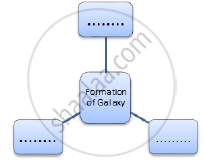
(A3)
(a) Find out similar words from the passage. 01
(i) mass (ii) happenings
(b) Give the verb form of the given words. 01
(i) classified (ii) directions
(A4) Identify and name the clause. 02
Scientists believe that the galaxies were formed from the lumps of matter.
(A5) Can there be life in another galaxy? Give reasons for your answer. 02
(B) Read the passage given in Q. 4 (A) and write the summary of it. Suggest a suitable title to your summary. (05)
Read the following extract and complete the note given below :
The small village of Somnathpur contains an extraordinary temple, built around 1268 A.D by the Hoyasalas of Karnataka - one of the most prolific temple builders. Belur and Helebid are among their better-known works. While these suffered during the invasion of the 14th century, the Somnathpur temple stands more or less intact in near-original condition. The small temple captivates with the beauty and vitality of its detailed sculpture, covering almost every inch of the walls, pillars and even ceilings. It has three Shikhars and stands on a star-shaped raised platform with 24 edges. The outer walls have a profusion of detailed carvings: the entire surface run over by carved plaques of stone: There were vertical panels covered by exquisite figures of God and Goddesses, with many incarnations being depicted. There were nymphs too some carrying an ear of maize, a symbol of plenty and prosperity. The elaborate ornamentation, very characteristic of Hoyasala sculptures was a remarkable feature. On closer look and it is worth it-the series of friezes on the outer walls revealed intricately carved caparisored elephants, charging horsemen, stylized flowers and warriors.
Somnathpur Temple
(1) Location : ___________
(2) Year : 1268 A.D.
(3) Built by : ___________
(4) Captivates with : ___________
(5) Structural features :
(i) Three Shikhars
(ii) Star-shaped platform with 24 edges
(iii) Outer wall carvings, ___________
charging horsemen, __________ and warriors.
(iv) Nymphs-symbol of ___________
Read the given case-based passage carefully and answer the questions that follow.
|
Case study of museums |
|
| 1. |
We don’t go to museums. We prefer malls, cinema halls, and restaurants. Visiting a museum is best left to schools which makes it mandatory. After all, it is an academic exercise. And what entertainment can these places possibly offer? India doesn’t boast the greatest of museums, but one can’t doubt the collection of artefacts in these repositories of heritage, even for a second. Our eventful history has handed down us numerous masterpieces, but unfortunately, we don’t find them compelling enough. A cultural historian and museologist Jyotindra Jain says that the habit of going to museums has just not been inculcated in us. One of the best museums in the country, the National Museum in Delhi charges a mere Rs. 20. According to Joyoti Roy, outreach consultant, National Museum, it receives between 6,00,000 to 7,00,000 visitors each year and anything between 2,500 and 3,000 per day. The mix includes Indians, foreigners, and school students. For an Indian museum, it is an astounding figure, but still nowhere close to the footfalls museums, we consider the finest, get. |
| 2. | It has not been many days since the National Gallery of Modern Art, Bangalore, hosted A. Ramachandran’s expansive retrospective covering five decades of his artistic journey. As we sat outside the first-floor gallery after Ramachandran walked me through his sketches, sculptures, and paintings, the senior artist, a bit disappointed said, “Had an exhibition of this scale taken place abroad, people would have come in thousands.” There were about three-five visitors inside the gallery at that time. Jain, who has also helmed institutions like the Crafts Museum and Indira Gandhi National Centre for the Arts in Delhi, puts the onus on museums. “We developed the museums but didn’t evolve the infrastructure around it. And it is the museum’s responsibility to do it. When you know, people are not going to come to you, you must go to them. Crafts Museum shares its wall with India Trade Promotion Organisation. It receives lakhs of people during the trade fair. I fought tooth and nail to get that door opened during my tenure (1984-89) so that the visitors spill over to the Crafts Museum as well. Museums need to rethink their strategies and outreach should be a major point of concern for them.” |
| 3. | In 2010, UNESCO brought out a report on the terrible conditions at India’s top eight museums, citing substandard maintenance, lighting, and signage, among other issues. The Ministry of Culture put together a 14 - point museum reforms agenda and things have moved forward since then. Dr Bhau Daji Lad Museum, the oldest museum in Mumbai has received 3,00,000 visitors over the past year. On average, the museum witnesses 500 visitors every day, with an average of 2,000 visitors over weekends. Not big numbers again, but impressive enough in the Indian context. And this is when the museum re-emerged after a revamp in 2008 with an extensive exhibition programme. Collaborations, screenings of movies of different genres, and workshops for adults and children contributed to the increase in the number of footfalls. The public-private partnership model of the museum is unique and can be replicated in other cases as well. |
| 4. | Robust publicity of exhibitions and creating links between different art spaces can also fetch the audience. Different art institutions located in proximity can host a series of events to be held in each one of them simultaneously. Museums also need to transform their cafes, upgrade their museum shops, and most importantly, invest in their human resource. So, what do we do until then? Let’s go and explore these storehouses of history, culture, and knowledge because unless and until we claim them, they will remain indifferent to our needs. |
After studying the case study of museums, answer the following questions.
- What according to the author is the reason for fewer footfalls in the museums in India?
- What measures are suggested in the passage to multiply the visitors to the museums?
- What was the proposition given by A. Ramachandran during his tenure at Crafts Museum?
- Between the National Museum of Delhi and Dr. Bhau Daji Lad Museum, which museum has more footfall on daily basis? Justify using statistics provided in the study.
Read the passage given below.
| 5 | Changing food preferences have brought about rapid changes in the structure of the Indian diet. The rapid proliferation of multinational fast food companies and the influence of Western culture have replaced traditional home-cooked meals with ready-to-eat, processed foods thus increasing the risk of chronic diseases in urban Indians. Therefore, nurturing healthy eating habits among Indians from an early age would help to reduce health risks. |
| 10 | To date, little is known about the quality and quantity of foods and beverages consumed by urban Indian adolescents. This lack of evidence is a significant barrier to the development of effective nutrition promotion and disease prevention measures. |
|
15
20
|
Therefore, a self-administered, semi-quantitative, 59-item meal-based food frequency questionnaire (FFQ) was developed to assess the dietary intake of adolescents. A total of 1026 students (aged 14-16 years) attending private, English-speaking schools in Kolkata completed the survey. A sample percentage of the food consumption pattern is displayed.
The survey results report poor food consumption patterns and highlight the need to design healthy eating initiatives. Interestingly, while there were no gender differences in the consumption of legumes and fried snacks, the survey found more females consumed cereals, vegetables and fruits than their male counterparts. |
| 25 | In conclusion, the report suggested that schools ought to incorporate food literacy concepts into their curriculum as they have the potential of increasing the fruit and vegetable intake of teenagers. Additionally, healthy school canteen policies with improved availability, accessibility, variety and affordability of healthy food choices would support the consumption of nutritious food in students. |

Based on your understanding of the passage, answer the questions given below.
- What does the researcher mean by ‘changing food preferences'?
- Why was this survey on the food consumption of adolescents undertaken?
- With reference to the above figure, write one conclusion about students' consumption of energy-dense drinks.
- What can be concluded from the ‘no intake’ data of fruit consumption versus energy-dense snacks, with reference to the above figure?
- There were gender differences observed in the consumption of healthy foods, according to the survey. Substantiate.
- Why is ‘affordability’ recommended as a significant feature of a school canteen policy?
- Identify a word from lines 9-18 indicating that the questionnaire was specifically designed to be completed by a respondent without the intervention of the researcher collecting the data.
Read the following passage and answer the questions that follow:
| (1) | Hiking is a great source of pleasure to us besides being beneficial for health. Once we leave the crowded streets of a city and go out for a walking tour away from the mad world, we really feel free. The open air has a bracing effect on the mind. The congestion of the city, the uproar and tumult, the intolerable noise of traffic, the hectic daily routine, all these are forgotten and the mind is at ease. We then feel like running, leaping, singing and laughing. We travel merrily mile after mile in the company of friends and associates. |
| (2) | Hiking takes us in the midst of nature. The sight of waterfalls, flowers, streams, trees and bushes is pleasing. A connect is established between us and nature. Various sounds of nature, like the murmur of a brook or the song of a bird, acquire a new meaning and significance of us. |
| (3) | You enjoy the beauty of nature. Minute observations like a snake casting its slough, a mouse peeping out of its hole, a squirrel leaping about on the branches of a tree, a bird flying past as, all these are noticed and they arouse our interest. We have no business worries, no fear of the examination, no anxiety about the home. We have leisure to stand, to walk and talk. It is more thrilling and pleasurable to hike. in a mountainous region than in the plains. The excitement of climbing up to the top of a hill, the adventure of corning down a slope, the grandeur of sunset behind a mountain - All these sights. lend a rare charm and interest to our journey. |
| (4) | We walk along a zigzag motor road or cut across a mountain path in search of adventure. We may have bright sunny weather or might get caught in a shower of rain. We may look below us into the yawning chasm or up at the mountain peak. The feeling of unlimited freedom makes our hearts leap with joy. |
| (5) | Hiking is one of the healthiest sports. It ensure a complete escape from the urgent and busy activities of life and therefore gives solace to our brain. It regains its lost energy and is able to do twice as much work as before. |
| (6) | The fresh air, beautiful mountains, majestic trees, chirping sound of birds make one's mind and soul at peace with nature. |
Based on your understanding of the passage, answer the questions below:
- To go out for a walking tour is ______. (1)
- to stroll.
- to ramble.
- to hike.
- to saunter.
- Why does the writer say that the mind is at ease when you hike? (1)
- because hiking is an inexpensive activity.
- because it brings families together
- because of intolerable noise of traffic.
- because the depressing daily routine is forgotten.
- Complete the following with a phrase: (1)
The various sounds of nature acquire ______. - Infer one reason for the following based on information in paragraph 2. (1)
A contact is established between us and nature. - Complete the following analogy correctly with a word from paragraph 2. (1)
Aroma : cooking : fragrance : ______. - Given one reason why it is a pleasure to hike in the mountains than in the plains. (1)
- because observation is sharpened.
- because of the excitement of climbing up and adventure of coming down.
- because it is leisure to stand, to walk.
- because there are no worries.
- Hiking gives the brain, the rest it needs because ______. (1)
- it is a short time activity.
- it is one of the heathiest sports.
- it makes up sleep peacefully.
- it is an escape from our busy schedule.
- List any two example of minute observations you make while on a hike. (1)
- Supply one point to justify the following: (1)
Hiking gives us a feeling of unlimited joy. - Substitute the word 'leap with joy' with one word similar in meaning in the following sentence from the passage. (1)
The feeling of unlimited freedom makes our hearts leap with joy.
Read the extract and complete the activities given below:
|
This is what Camus meant when he said that "what gives value to travel is fear"-disruption, in other words, (or emancipation) from circumstance, and all the habits behind which we hide. And that is why many of us travel not in search of answers, but of better questions. I, like many people, tend to ask questions of the places I visit, and relish most the ones that ask the most searching questions back of me: "The ideal travel book," Christopher Isherwood once said, "should be perhaps a little like a crime story in which you're in search of something." And it's the best kind of something, I would add, if it's one that you can never quite find. I remember, in fact, after my first trips to Southeast Asia, more than a decade ago, how I would come back to my apartment in New York, and lie in my bed, kept up by something more than jet lag, playing back, in my memory, over and over, all that I had experienced, and paging wistfully through my photographs and reading and re-reading my. diaries, as if to extract some mystery from them. Anyone witnessing this strange scene would have drawn the right conclusion: I was in love. When we go abroad is that we are objects of scrutiny as much as the people we scrutinize, and we are being consumed by the cultures we consume, as much on the road as when we are at home. At the very least, we are objects of speculation (and even desire) who can seem as exotic to the people around us as they do to us. All, in that sense, believed in "being moved" as one of the points of taking trips, and "being transported" by private as well as public means; all saw that "ecstasy" ("ex-stasis") tells us that our highest moments come when we're not stationary, and that epiphany can follow movement as much as it precipitates it. |
A1. Read and rewrite the following sentences and state whether they are True or False: (2)
-
- A traveller may sink in love with his travel-memoirs.
- One gets inspected as he inspects the world around him.
- Quest for something may end in more mystery.
- Staying in comfort at home gives one more happiness than travelling.
A2. Match the persons given in column 'A' with opinions/ characteristics given in column 'B': (2)
| Column 'A' | Column 'B' |
|
(1) Narrator
|
a) ideal travel should be like a crime story. |
|
(2) Camus
|
b) in love with his memoirs. |
|
(3) Isherwood
|
c) more happy when on move. |
| (4) Traveller | d) fear gives value to travel. |
A3. Give reasons: (2)
"We are objects of scrutiny," because
- ______
- ______
A4. "Travelling is an interesting teacher." Write your views in 3-4 sentences. (2)
A5. Do as directed: (2)
- I like to ask questions of the places I visit. (Choose the correct tense form of the above sentence from the following options and rewrite.)
- Simple past tense
- Simple present tense
- Past perfect tense
- Present perfect tense
- I would come back to my apartment in New York. (Choose the correct option using 'used to' for the given sentence and rewrite.
- I use to come back to my apartment in New York.
- I have used to come back to my apartment in New York.
- I used to come back to my apartment in New York.
- I had used to come back to my apartment in New York.
A6. Find out the words from passage which mean: (2)
- reminiscence
- exhilaration
