Advertisements
Advertisements
प्रश्न
A Read the first activity, read the extract and then do all the activities :
A1. Complete :
Complete the following sentences :
(1) The two organizations that conducted the research to develop a smartphone-based optical bio-sensor are _______ and __________ .
(2) The _________ and _________ methods were used in the research instead of the differential method.
|
Urea is a major product of nitrogen metabolism in humans. It is eliminated from the body mainly by the kidneys through urine. Urea levels in body fluids, such as blood and saliva, rise drastically under certain kidney dysfunctions. Heart failure, hypovolemic shock, gastrointestinal bleeding, and severe infections can also lead to a rise. Thus urea in blood and saliva provides key information on renal function and helps diagnose various disorders. Most methods for estimating urea in body fluids are based on colorimetry. These methods are time-consuming and involve painful blood extraction. Collecting saliva is non-evasive and research has correlated salivary and blood urea levels. Recently scientists from the IIT-D and the AIIMS, New Delhi successfully developed a smartphone-based optical biosensor to detect urea in saliva. To fabricate the sensor, they directly immobilised the urease enzyme with a pH indicator on a filter paper-based strip. As a response to the urea on saliva, the paper strip changes colour. The red, green and blue levels help measure urea concentration. The scientists used the slope method, sensor response change per unit time, instead of the differential method, the difference in sensor response between two-time intervals, to increase sensitivity and eliminate interference by variations in ambient light. The team clinically validated spiked saliva samples and samples from healthy volunteers. The smartphone application with paper strip can even be operated by non-professional with limited training. This saves time and cost spent on bulky spectroscopic procedures. The report can revolutionise the medical screening of large populations. And such mass screening of diseases would boost national health. |
A2. Complete the following sentence using the correct alternatives from those given below :
Two objectives to conduct the research are ___________ .
(i) The colorimetry method used to estimate urea in body fluids consumes more time.
(ii) Information obtained from the presence of urea in blood and saliva is not helpful to diagnose various diseases.
(iii) Collecting samples of saliva is a non-invasive procedure.
(iv) Blood extraction is the easiest and less painful exercise.
A3. Write two benefits of the smartphone-based optical biosensor.
A4. Find out similar-meaning words from the extract for the following words :
(1) specimen (2) extremely (3) focus (4) remove
A5. Personal Response :
'Research revolutionises the lifestyle of people in all spheres of life'-
Do you agree? Explain with an example in about 25 words.
A6. Grammar :
Rewrite the following sentences in the ways instructed :
(1) These methods are time consuming and painful.
(Rewrite the sentence using 'as well as'.)
(2) The smartphone application with paper-strip can be operated.
(Begin the sentence with 'They ___ .)
(B) Summerise the above extract with the help of the points given and suggest a suitable title::
Research by the organisations - methods adopted - reasons for the research - advantages.
Advertisements
उत्तर
A1.
(1) The two organisation that conducted the research to develop a smartphone-based optical biosensor are IIT-D and AIIMS New Delhi.
(2) The slope method and sensor response change per unit time methods were used in the research instead of the differential method.
A2. Two objectives to conduct the research are.
(i) The colorimetry method used to estimate urea in body fluids consumes more time.
(ii) Collecting samples of saliva is a non-invasive procedure.
A3. Benefits of the smartphone-based optical biosensor are.
(1) Non - professionals with limited training can also use it.
(2) It saves time and cost spent on bulky spectroscopic procedures.
A4.
| (1) specimen | sample |
| (2) extremely | drastically |
| (3) focus | concentrate |
| (4) remove | extract/eliminate |
A5. Yes, I agree. The inventions resulting from research. like the mobile phone and the Internet, have added to the comfort. They have helped people at all levels and changed their lives for the better. Research has also helped in curing diseases like TB and cancer and improving the quality of life.
A6.
(1) These methods are time-consuming as well as painful.
(2) They can operate the smartphone application with a paper-strip.
B
BREAKTHROUGH IN THE ESTIMATION OF UREA IN BODY FLUIDS
| Urea levels in blood and saliva provide important information on renal function and help diagnose various disorders. The methods used earlier were time-consuming and painful. Hence, scientists from IIT-D and the AIIMS, New Delhi, successfully developed a smartphone-based optical biosensor to detect urea in saliva. They used the slope method, sensor response change per unit time, etc. for this, instead of the differential method. This smartphone application, with a pH indicator on a filter paper-based strip, saves time, avoids painful blood extraction and can even be operated by non-professionals. |
APPEARS IN
संबंधित प्रश्न
B1. Choose
Choose the correct alternatives and complete the sentences (2)
(1) The narrator is :
(a) an astronaut
(b) an engineer studying in BITS Pilani
(c) in the team of astronauts.
(2) Armstrong said, 'That's one small step for a man, one giant leap for mankind which means:
(a) one step on the moon means, many steps on the earth.
(b) he felt like a giant on the moon.
(c) one moon mission had opened up many avenues in science and technology for mankind.
It was late evening of July 20. 1969, when we turned up the hostel radio. I was an engineering student at BITS, Pilani. I still remember the feverish excitement that gripped us from July 16 when Apollo 11. the US space rocket, took off from Cape Kennedy, Florida. Neil Armstrong and his team of astronauts, Edwin "Buzz" Aldrin and Michael Collins, were to land on moon, for the first time in human history. We listened 'with rapt attention when Armstrong declared: "That's one small step for a man, one giant leap for mankind."
His death on Saturday, August 25, is a moment to salute the romance of space science that Apollo 11 unleashed. It has changed forever the way we look at our planet Earth and its satellite, the moon.
Standing on powdery moondust, Armstrong put up his thumb, shut one eye and found his thumb blotting out the Earth. "It suddenly struck me that that tiny pea, pretty and blue, was the Earth” he said later. "I felt very, very small." But behind that humbling realisation stood a giant truth:
The effort to explore the universe united mankind in technology and knowledge. Each moon mission, about 110 till date, provided more confidence to take on bolder projects.
B2. Complete (2)
(1) Armstrong describes the earth as ……………
(2) The effort to explore the universe has ………………
(3) Apollo 11 unleashed and changed forever ………………
(4) The author came to know about Apollo 11 mission when he …………..
B3. Solve
Solve the crossword with the clues given below. Refer to the passage for your answers: (2)

Down : (1) The area beyond the earth's atmosphere .
(2) The name of the spacecraft that Armstrong travelled.
Across : (3) A person trained to travel in space.
(4) Y A natural satellite of the earth.
B4. Begin the sentence
(i) With-For the first time .......and rewrite [1]
Neil Armstrong, Edwin Aldrin and Michael Collins were, to land on the moon for the first time.
(ii) Insert 'that' appropriately and rewrite. [1]
Armstrong found his thumb blotting out the Earth.
B5. Personal Response
Would you like to be an astronaut? Give reasons.
AI. Who said to whom
(i) "Is he going to live, sir?"
(ii) "______ the struggle is too hard at the end ______.”
The doctor said to himself, "If my word can save his life, he shall not die.
The will be damned." He called, "Gopal, listen." This was the first time he was going to do a piece of acting before a patient, simulate a feeling and conceal his Judgement. He stooped over the patient and said, with deliberate emphasis, "Don't worry about the will now. You are going to live. Your heart is absolutely sound."
A new glow suffused the patient's face as he heard it. Be asked in a tone of relief,
"Do you say so? If it comes from your lips it must be true............ . "
The doctor said, "Quite right. You are improving ever second. Sleep in peace. You must not exert yourself on any account. You must sleep very soundly.
I will see you in the morning." The patient looked at him gratefully for a moment and then closed his eyes. The doctor picked up his bag and went out, shutting the door softly behind him.
On his way home he stopped for a moment at his hospital, called out his assistant and said, "That Lawley Extension case. You might expect the collapse any second now. Go there with a tube of .....................................'in hand, and give it in case the struggle is too hard at the end. Hurry up.”
Next morning he was back at Lawley Extension at ten. From his car he made a dash for the sick bed. The patient was awake and looked very well. The assistant reported satisfactory pulse. The doctor put his tube to his heart, listened for a while and told the sick man's wife, "Don't look so unhappy, lady. Your husband will live to be a ninety.’’ When they were going back to the hospital, the assistant sitting beside him in the car asked, "Is he going to live, sir?"
"I will bet on it. He will live to be ninety. He has turned at corner. How he has survived this attack will be a puzzle to me all my life," replied the doctor.
A2. Web
Complete the web:

A3. Personal Response
What is your opinion about the doctor and his behaviour?
The natural life span of a domesticated horse is about 25 – 30 years, 10 years down from what it was in the wild. You can tell a horse’s age from the number of teeth he has. They get all their teeth by the age of 5, after which those teeth just get longer. Horses have close to 360 degree all round vision. The only place they cannot see is directly behind or right in front of themselves, which is why it’s dangerous to stand behind a horse. If they later I it also means that they cannot see a jump once they are about four feet from it, and have to rely on memory as to its height and shape! Each of the horse’s two eyes work independently wherever a horse’s ear points is where the horse is looking. A horse is able to sleep standing up as he is able to lock his leg muscles so that he dosen’t fall asleep. Nor do all horses in the same field ever lie down at once – one animal always stands “on look out” duty.
1) What is the life span of a wild horse?
(2) Why do the horse owners cover their horse’s eyes with blinkers?
(3) What prevents a horse from falling while asleep?
(4)
(a) Falls /shorter/ the mane/ on the/ side/ legged.[Rearrange the words to make a meaningful sentence]
(b) Form antonyms by adding a prefix :
(i) able
(ii) direct
(5)
(a) They get all their teeth by the age of five. [Pick out the prepositions]
(b) If they feel something behind them they may kick. [Rewrite using ‘unless’]
(6) How have horses helped man through the ages?
Nicholas chorier is not your usual photographer. He is a kite aerial photographer. He uses a kite to hoist his camera into the skies and clicks photographs while the camera dangles precariously mid – air.
As a teenager, Nicholas had two passions – photography and kite flying. During’ a trip to India to make a photo report on kite making, he learnt about this unique style of photography. Fascinated, he literally tied his two hobbies together for a living.
Nicholas learnt to make a strong modelled on the Japanese kites, Rokkaku that could endure harsh winds. A novice in his chosen field, he then set out to train himself. Today he is one of the most well – known aerial photographers in the world.
The technique is to tie a cradle containing the photography equipment to the string of the kite and then fly it, thus launching the camera into air. From the ground, Nicholas manipulates the angles of the camera with a remote. An air – to – ground video link enables him to see the view from the kite’s vantage point. Once satisfied with the frame, he clicks a picture.
However, the job does have its pitfalls too. Once, his kite disappeared in the Yamuna river, with his expensive camera in tow.
He is especially fond of India, having made a couple of trips and taken many spectacular photos. “India is too vast and beautiful a country to be captured through the lenses in one life” he says.
He recently released a book, Kite’s Eye View: India between Earth and sky. Though it includes photographs of oft takes sites like the Taj Mahal, it shows them from a totally different perspective.
(1) What were Nicholas’s two passions?
(2) How does Nicholas take aerial photographs?
(3) What is ‘Rokkaku’?
(4)
(a) Pick out words from the passage which mean :
(i) To tolerate
(ii) Costly
(b) Nicholas has two passions. [Start the sentence with ‘Nicholas was …….using the adjective form of passion]
(a) India is too vast a country to be captured through the lenses. [Remove too ………. And rewrite] (b) Nicholas learnt to make strong kites. [Rewrite using past perfect tense]
(6) What risks do aerial photographers face?
The hopping kangaroo is a familiar sight in every snapshot relating to Australia. Members of the kangaroo family can be as small as a rat or as big as a man. Kangaroos are found mainly in Australia, Tasmania and New Guinea. Kangaroos, which are big-footed marsupials that evolved in Australia, use their short front legs like arms. The man-sized kangaroos of Australia are capable of speeding up to 88 km/hr for short distances, their means of locomotion being their powerful hind legs, which carry them over the ground in jumps of 9 m or more at a time.
Weighing around 70 kg, they have an average lifespan of around six to eight years and a maximum lifetime of 20 years. When bothered by predators, kangaroos often head for the water, standing submerged to the chest and attempting to drown the attacker by holding him under water. Another defensive technique is to get their back to a tree and kick at their adversary with their clawed hind feet, sometimes with sufficient force to kill a man. Normally shy animals, they alert other kangaroos to danger by beating on the ground with their hind feet. This loud alarm signal carries over a long distance.
The tail is important for kangaroos. It holds them in balance and supports them when they sit or fight against other kangaroos. The kangaroo uses its short legs as arms. With them it scratches itself, cleans its fur and holds branches when it eats leaves. Kangaroos are marsupials and the females carry newborns in a pouch in front of their abdomens. The babies are born small and climb up into safety of the pouch. There, for the next 225 days or so, they eat, sleep and grow. Once they reach full development, they leave the pouch. A young kangaroo that leaves the pouch is called a ‘joey’. To keep from getting too hot, the kangaroos take naps in the afternoon and do most of their grazing at night. But the best stay-cool secret of these creatures is the spit bath! Kangaroos drool and lick saliva all over their faces and bodies to cool down.
On the basis of your reading of the above passage, complete the following sentences with appropriate words/phrases:
(a) When followed by predators, kangaroos submerge ____________ and _________________.
(b) The powerful hind legs help kangaroos to __________________.
(c) Kangaroos are mainly found in Australia and are ____________________.
(d) They use their front legs to ___________________.
(e) Kangaroos warn others of danger by _______________________.
(f) The secret of kangaroos to stay cool is ______________________.
(g) They use their tails to _________________________.
(h) Before becoming ‘joeys’, the young ones stay in the ______________ and ________________.
He holds him with his skinny hand,
“There was a ship,” quoth he.
i. Who does ‘He’ refer to in the above extract?
ii. What do we know about the speaker’s feelings?
iii. Why is his hand called ‘skinny’?
Q1 Read the following passage and answer the questions that follow:
1. Too many parents these days can't say no, As a result, they find themselves raising 'children' who respond greedily to the advertisements aimed right at them. Even getting what they want doesn't satisfy some kids; they only want more. Now, a growing number of psychologists, educators, and parents think it's time to stop the madness and start teaching kids about what's really important: values like hard work, contentment, honesty, and compassion. The struggle to set limits has never been tougher ‒ and the stakes have never been higher. One recent study of adults who were overindulged as children paints a discouraging picture of their future: when given too much too soon, they grow up to be adults who have difficulty coping with life's disappointments. They also have a distorted sense of entitlement that gets in the way of success in the workplace and in relationships.
2. Psychologists say that parents who overindulge their kids set them up to be more vulnerable to future anxiety and depression. Today's parents themselves raised on values of thrift and self-sacrifice, grew up in a culture where no was a household word. Today's kids want much more, partly because there is so much more to want. The oldest members of this generation were born in the late 1980s, just as PCs and video games were making their assault on the family room. They think of MP3 players and flat-screen TV as essential utilities, and they have developed strategies to get them. One survey of teenagers found that when they crave something new, most expect to ask nine times before their parents give in. By every measure, parents are shelling out record amounts. In the heat of this buying blitz, even parents who desperately need to say no find themselves reaching for their credit cards.
3. Today's parents aren't equipped to deal with the problem. Many of them, raised in the 1960s and '70s, swore they'd act differently from their parents and have closer relationships with their own children. Many even wear the same designer clothes as their kids and listen to the same music. And they work more hours; at the end of a long week, it's tempting to buy peace with 'yes' and not mar precious family time with conflict. Anxiety about the future is another factor. How do well-intentioned parents say no to all the sports gear and arts and language lessons they believe will help their kids thrive in an increasingly competitive world? Experts agree: too much love won't spoil a child. Too few limits will.
4. What parents need to find, is a balance between the advantages of an affluent society and the critical life lessons that come from waiting, saving, and working hard to achieve goals. That search for balance has to start early. Children need limits on their behaviour because they feel better and more secure when they live within a secure structure. Older children learn self-control by watching how others, especially parents act. Learning how to overcome challenges is essential to becoming a successful adult. Few parents ask kids to do chores. They think their kids are already overburdened by social and academic pressures. Every individual can be of service to others, and life has meaning beyond one's own immediate happiness. That means parents eager to teach values have to take a long, hard look at their own.
(a) Answer the following:
- What values do parents and teachers want children to learn?
- What are the results of giving the children too much too soon?
- Why do today's children want more?
- What is the balance which the parents need to have in today's world?
- What is the necessity to set limits for children?
(b) Pick out words from the passage that mean the same as the following:
- a feeling of satisfaction (para 1)
- valuable (para 3)
- important (para 4)
Read the following passage:
In India, eating organic food is more of a style statement than due to health worries because the stuff is expensive. But people who can, do indulge in not only organic vegetables but even organic eggs laid by 'happy hens', who are allowed to roam around freely whereas 'unhappy hens' are kept in coops. Then there are companies that have installed music channels in their cowsheds and the milk from those sheds are sold at a marked up price since it has more nutritional value because the animals are happy thanks to lilting 24×7 music. We don't know yet any farmer using music to improve his crop quality, but then you never know : plants are known to respond to music.
Why such pickiness about food ? These days, the huge number of TV shows and articles that we see and read on food provide bread and butter for the specialist. But instead of decoding food, its sources and what has gone into growing it, isn't it much better to enjoy what's on the plate ?
Complete the statements given below by choosing the correct options from those that follow:
(a) According to a Stanford University study, organic food in relation to conventional food is________.
(i) less nutritious
(ii) more nutritious
(iii) very conventional
(iv) as nutritious
(b) The study will not be welcomed by _________.
(i) farmers of conventional food
(ii) makers of pesticides
(iii) all sectors
(iv) exporters of organic food
(c) We can save some hard cash by _________.
(i) buying organic food
(ii) not buying organic food
(iii) going to the shop
(iv) not buying food with pesticides
(d) Music channels are installed in the cowshed because the _________.
(i) cows then give more milk
(ii) milk is sold at a higher price
(iii) milk becomes more pure
(iv) workers becomes happy
(e) In the second paragraph, the author's attitude to the people who eat food sourced from 'happy' animals is that he _________.
(i) is happy with them
(ii) is unhappy with them
(iii) is laughing at them
(iv) wants crops to be grown similarly
(f) One benefit of organic food is that __________.
(i) it is fashionable to eat
(ii) only rich people can afford it
(iii) it is less contaminated with pesticides
(iv) even poor people can afford it
(g) The word 'contaminated' means ________.
(i) adulterated
(ii) for adults
(iii) containing
(iv) not healthy
Read the extract given below and answer the questions that follow:
These meadows aren't worth much to me. They only come to five dessiatins, and are worth perhaps 300 roubles, but I can't stand unfairness. Say what you will, I can't stand unfairness.
(a) Who speaks the above lines and to whom?
(b) How much are the meadows worth?
(c) Find a word in the extract the means 'not based on what is just.'
Read the extract given below and answer the questions that follow:
I even considered fleeing to my hometown, where I could have been a real lawyer right away, without going through this unpleasant training period
(a) Who is 'I'?
(b) How did 'I' suffer during the training period?
(c) What does the word, 'fleeing' mean?
Read the passage given below :
1. When you grow up in a place where it rains five months a year, wise elders help you to get acquainted with the rain early. They teach you that it is ignorant to think that it is the same rain falling every day. Oh no, the rain is always doing different things at different times. There is rain that is gentle, and there is also rain that falls too hard and damages the crops. Hence, the prayer for the sweet rain that helps the crops to grow.
2. The monsoon in the Naga hills goes by the native name, khuthotei (which means the rice-growing season). It lasts from May to early or mid-October. The local residents firmly believe that Durga Puja in October announces the end of rain. After that, one might expect a couple of short winter showers, and the spring showers in March and April. Finally, comes the "big rain" in May; proper rainstorms accompanied by heart-stopping lightning and ear-splitting thunder. I have stood out in storms looking at lightning are across dark skies, a light-and-sound show that can go on for hours.
3. This is the season when people use the word sezuo or süzu to refer to the week-long rains, when clothes don't dry and smell of mould, when fungus forms on the floor and when you can't see the moon or the stars because of the rainclouds. But you learn not to complain. Rain, after all, is the farmer's friend and brings food to the table. Rituals and festivals centre around the agricultural rhythm of life, which is the occupation of about 70 percent of the population.
4. The wise learn to understand its ways. I grew up hearing my grandfather say. "It's very windy this year. We'll get good rain." If the windy season was short and weak, he worried there might not be enough rain for the crops. I learned the interconnectedness of the seasons from childhood, and marvelled at how the wind could bring rain. Another evening, many rainy seasons ago, my paternal aunt observed the new moon and worried, "Its legs are in the air, we're in for some heavy rain." She was right. That week, a storm cut off power lines and brought down trees and bamboos.
5. Eskimos boast of having a hundred names for snow. Norwegians in the north can describe all kinds of snow by an equal amount of names : pudder, powder snow, wet snow, slaps, extra wet snow, tight snowfall, dry snow, and at least 95 more categories of snow. Likewise, in India we have names and names for rain. Some are common, some are passing into history.
6. The rains are also called after flowering plants and people believe that the blossoming of those plants draws out rain. Once the monsoons set in, field work is carried out in earnest and the work of uprooting and transplanting paddy in flooded terrace fields is done. The months of hard labour are June, July and August. In August, as the phrogü plant begins to bloom, a rain will fall. this August rain, also called phrogü, is a sign that the time for cultivation is over. If any new grain seeds are sown, they may not sprout; even if they do sprout, they are not likely to bear grain. The rain acts as a kind of farmer's almanac.
7. The urban population of school-goers and office-goers naturally dislikes the monsoon and its accompanying problems of landslides, muddy streets and periodic infections. For non-farmers, the month of September can be depressing, when the rainfall is incessant and the awareness persists that the monsoons will last out till October. One needs to have the heart of a farmer to remain grateful for the watery days, and be able to observe – from what seems to the inexperienced as a continuous downpour – the many kinds of rain. Some of the commonly known rain-weeks are named after the plants that alternately bloom in August and September. The native belief is that the flowers draw out the rain.
8. Each rain period has a job to fulfil : October rain helps garlic bulbs to form, while kümünyo rain helps the rice bear grain. Without it, the ears of rice cannot form properly. End October is the most beautiful month in the Naga hills, as the fields turn gold and wild sunflowers bloom over the slopes, all heralding the harvest. Prayers go up for protecting the fields from storms, and the rains to retreat because the grain needs to stand in the sun and ripen. The cycle nears completion a few weeks before the harvest, and the rain does retreat so thoroughly from the reaped furrows that the earth quickly turns hard. The months of rain become a distant memory until it starts all over again.
On the basis of your understanding of the above passage, complete the statements given below with the help of options that follow:
a) The rains are called after flowering plants because
(ii) flowers grow in the rainy season.
(iii) it is believed that the plants bring the rain.
(iv) flowers grow all the year round.
b) The rain is like a calendar for farmers because
(ii) it tells them the birthdays of their children.
(iii) each month has a time for plantation.
(iv) different kinds of rain tell different things.
c) People who live in cities don't like rain because
(ii) they are not bothered about the farmers.
(iii) they don't like the plants that grow during the rain.
(iv) going shopping becomes difficult.
d) People pray asking the rain the retreat because
(ii) children don't get a chance to play.
(iii) the crops need the sun and heat to ripen.
(iv) they like to pray.
Answer the following questions briefly:
e) Why do the elders want you to understand the rains in the Naga hills?
f) What does Durga Puja mean to the farmers of the Naga hills?
g) What kind of rain is called sezuo?
h) What is the occupation of more than half the population of the Naga hills?
i) How is the heart of the farmer different from that of the city person?
j) When does rain becomes a memory in the minds of the of the Naga hills?
k) Find words from the passage which mean the same as the following:
(ii) nonstop (para 7)
Read the passage given below and answer the questions that follow:
The most alarming of man’s assaults upon the environment is the contamination of air, earth, rivers, and sea with lethal materials. This pollution is for the most part irrevocable; the chain of evil it initiates is for the most part irreversible. In this contamination of the environment, chemicals are the sinister partners of radiation in changing the very nature of the world; radiation released through nuclear explosions into the air, comes to the earth in rain, lodges into the soil, enters the grass or corn, or wheat grown there and reaches the bones of a human being, there to remain until his death. Similarly, chemicals sprayed on crops lie long in soil, entering living organisms, passing from one to another in a chain of poisoning and death. Or they pass by underground streams until they emerge and combine into new forms that kill vegetation, sicken cattle, and harm those who drink from once pure wells.
It took hundreds of millions of years to produce the life that now inhabits the earth and reached a stage of adjustment and balance with its surroundings. The environment contained elements that were hostile as well as supporting. Even within the light of the sun, there were short wave radiations with power to injure. Given time, life has adjusted and a balance reached. For time is the essential ingredient, but in the modern world is no time.
The rapidity of change and the speed with which new situations are created follow the heedless pace of man rather than the deliberate pace of nature. Radiation is no longer the bombardment of cosmic rays; it is now the unnatural creation of man’s tampering with the atom. The chemicals to which life is asked to make adjustments are no longer merely calcium and silica and copper and all the rest of the minerals washed out of the rocks and carried in the rivers to the sea; they are the synthetic creations of man’s inventive mind, brewed in his laboratories, and having no counterparts in nature.
(a) On the basis of your understanding of the above passage make notes on it using headings and sub-headings. Use recognizable abbreviations (wherever necessary-minimum four) and a format you consider suitable. Also supply a title to it.
(b) Write a summary of the passage in about 80 words.
Read the passage given below :
1. To ensure its perpetuity, the ground is well held by the panther both in space and in time. It enjoys a much wider distribution over the globe than its bigger cousins and procreates sufficiently profusely to ensure its continuity for all time to come.
(ii) in the branches of the trees
(iii) behind the tree trunks
(iv) at its heels
(ii) trains its cubs
(iii) watches the progress of the mother
(iv) is impulsive and impatient
Answer the following questions briefly :
(ii) came down / fell (para 7)
Read the passage given below :
1. We often make all things around us the way we want them. Even during our pilgrimages we have begun to look for whatever makes our heart happy, gives comfort to our body and peace to the mind. It is as if external solutions will fulfil or needs, and we do not want to make any special efforts even in our spiritual search. Our minds is resourceful − it works to find shortcuts in simple and easy ways.
2. Even pilgrimages have been converted into tourism opportunities. Instead, we must awaken our conscience and souls and understand the truth. Let us not tamper with either our own nature of that of the Supreme.
3. All our cleverness is rendered ineffective when nature does a dance of destruction. Its fury can and will wash away all imperfection. Indian culture, based on Vedic treatises, assists in human evolution, but we are not using our entire energy in distorting these traditions according to our convenience instead of making efforts to make ourselves worthy of them.
4. The irony is that humans are not even aware of the complacent attitude they have allowed themselves to sink to. Nature is everyone's Amma and her fierce blows will sooner or later corner us and force us to understand this truth. Earlier, pilgrimages to places of spiritual significance were rituals that were undertaken when people became free from their worldly duties. Even now some seekers take up this pious religious journey as a path to peace and knowledge. Anyone travelling with this attitude feels and travels with only a few essential items that his body can carry. Pilgrims traditionally travelled light, on foot, eating light, dried chickpeas and fruits, or whatever was available. Pilgrims of olden days did not feel the need to stay in special AC bedrooms, or travel by luxury cars or indulge themselves with delicious food and savouries.
5. Pilgrims traditionally moved ahead, creating a feeling of belonging towards all, conveying a message of brotherhood among all they came across whether in small caves, ashrams or local settlements. They received the blessings and congregations of yogis and mahatmas in return while conducting the dharma of their pilgrimage. A pilgrimage is like penance or sadhana to stay near nature and to experience a feeling of oneness with it, to keep the body healthy and fulfilled with the amount of food, while seeking freedom from attachments and yet remaining happy while staying away from relatives and associates.
6. This is how a pilgrimage should be rather than making it like a picnic by taking a large group along and living in comfort, packing in entertainment, and tampering with environment. What is worse is giving a boost to the ego of having had a special darshan. Now alms are distributed, charity done while they brag about their spiritual experiences!
7. We must embark on our spiritual journey by first understanding the grace and significance of a pilgrimage and following it up with the prescribed rules and rituals − this is what translates into the ultimate and beautiful medium of spiritual evolution. There is no justification for tampering with nature.
8. A pilgrimage is symbolic of contemplation and meditation and acceptance, and is a metaphor for the constant growth or movement and love for nature that we should hold in our hearts.
9. This is the truth!
One the basis of your understanding of the above passage answer the questions that follow with the help of given options:
(a) How can a pilgrim keep his body healthy?
(i) By travelling light
(ii) By eating small amount of food
(iii) By keeping free from attachments
(iv) Both (i) and (ii)
(b) How do we satisfy our ego?
(i) By having a special darshan
(ii) By distributing alms
(iii) By treating it like a picnic
(iv) Both (i) and (ii)
Answer the following as briefly as possible:
(c) What change has taken place in our attitude towards pilgrimages?
(d) What happens when pilgrimages are turned into picnics?
(e) Why are we complacent in our spiritual efforts?
(f) How does nature respond when we try to be clever with it?
(g) In olden days with what attitude did people go on a pilgrimage?
(h) What message does the passage convey to the pilgrims?
(i) Find words from the passage which mean the same as the following:
(i) made/turned (para 3)
(ii) very satisfied (para 4)
Read the following extract and answer the questions given
below:
Prominent among the urges that inspire and drive a person in life, is the mge to be a somebody. It is quite human, especially in the early stages of life, to want to do something to win laurels and admiration of all around. There's a pitfall though - the very process of becoming a somebody may subtly reduce yon to a nobody.
American poet Emily Dickinson, who lived in obscurity, has an interesting poem on this theme. "I'm nobody!" she declares, with apparent pride.
"Who are you?
Are you nobody, too?"
Why should anybody be happy about being nobody?
The poem explains :
"How dreaiy to he somebody!
How public, like a frog
To tell your name the livelong day
To an admiring bog!
The word 'bog' is significant. When you become a somebody, you invite adulation :
this then begins to bog you down. The moment you think you have arrived, you begin to stagnate, or, worse, your downslide begins. An endless list of writers, artists, sportsmen, politicians ..... fit this pattern of personal history.
To sustain your development in absolute terms, to become a true somebody, it is important to remain a temporal nobody. Even if destiny makes you a temporal somebody,
you should be able to see yourself as merely an agent of a superior power; no more. This requires an exercise of will. You have to constantly watch out and talk to yourself morning and evening.
(1) What is the main idea of the extract? (1)
(2) Why is it important for one to remain a temporal nobody? How? (1)
(3) What does Emily Dickinson declare with pride? Why? (2)
(4) What would you like to be in your life - Somebody or nobody? Why? (2)
(5) Rewrite the following sentences in the ways instructed
(i) This requires an exercise of will.
(Rewrite it using the Simple Future tense.) (1)
(ii) You have to constantly watch out and talk to yourself.
(Rewrite it using another modal auxiliary showing 'compulsion'.) (1)
(iii) You begin to stagnate.
(Rewrite it using the noun form of the word underlined.) (1)
(6) Find out the words from the extract which mean -
(i) danger (1/2)
(ii) praise (1/2)
Read the following extract and answer the questions given below:
We commemorate so many special days such as Republic Day, Independence Day, Mother's Day and so on. Well, here is one day that deserves not only a commemoration but our total dedication - Earth Day, 22 April. At Sanctuary, we live our lives like every day is Earth Day, but we all believe that it would be, fantastic to remind our relatives, friends, neighbours, teachers, and elders on this day that protecting Mother Earth can end up making us both happy and safe.
Will you do something this Earth Day? Here's a handy list of things you can do-
(1) Cut Consumption: Consume as little as possible on Earth Day. This 'is a day·when you ca!l Refuse (to buy new things), Repair and Reuse (old stuff), Recycle (what you cannot reuse), Reject (stuff that is toxic or dangerous to the environment) and Renew (your purpose and resolve to protect the planet).
(2) Cut Energy: (a) Ditch the old incandescent bulbs and shift to CFLs or LEDs (Google both to find out more). (b) Walk or use public transport, try not to use private cars to save fuel. Carpool. Cut down on trips. Use Skype· instead of traveling for meetings. (c) Switch off unnecessary gadgets. (don't just use the remote .... walk to the mains!).
(3) Cut Waste: Start a waste segregation system in your building, school or neighbourhood. Compost organic waste, sell what you can to the raddi-wallah and give him a small token of.. appreciation also for he is protecting your world. Collect unused papers from old notebooks and make new ones from them.
(4) Cut out plastic: Speak to at least five shopkeepers in your area and tell them you and your friends will only use their shops if they move away from wasteful plastic packaging, particularly thin plastic bags.
(1) What do you understand from this extract?
(2) What steps can we take to keep our environment clean?
(3) Why should we commemorate Earth Day?
(4) What is your opinion regarding shifting to CFLs or LEDs?
(5) Rewrite the following sentences in the ways instructed :
(i) Earth Day deserves a commemoration and our total dedication.
(Use 'not only - but also'.)
(ii) Start a Waste Segregation System in your building.
(Rewrite it beginning with 'Let'.)
(iii) You can sell waste to the raddi-wallah and give him a
small token of appreciation.
(Replace the modal auxiliary by another showing 'obligation'.)
(6) What do the following words in the extract mean?
(i) resolve
(ii) toxic
Read the following extract and answer the questions given below :
Early risers clearly have the edge in life. By the time most of us wake up, they've been through their morning rituals, enjoyed their walk, had their tea and read the daily news. They're also likely to have made long-distance calls before dawn to those similarly inclined. Thus, by the time the sun warms up they're likely to have discussed all varieties of 'men, matters, and affairs' with a dozen people.
The upshot of these varying tendencies is that such extreme contrasts often exist in the same household. Weeks pass before the younger lot (typically late risers) and the older lot (normally early birds) come face to face. It's almost as if they live in different time zones and different countries.
All over the country, things are likely to be pretty much the same in this respect, one would think. If the man of the house, any house, decides to take a day off from work, he'd probably find his son emerging from his room at about I0 a.m. and that too in a 'rubbing-eyes' mode. After fooling around for a while the lad would probably dash off to college in a rush whilst simultaneously zipping up his jeans and sending text messages on his phone. His father would undoubtedly be left shaking his head and burying himself deeper into his newspaper.
(1) What is the extract about?
(2) How do the early risers get a headstart in life?
(3) What kind of lifestyle of the young son is reflected in the extract?
(4) According to you, why do the youngsters rise up late?
(5) Rewrite the following sentences in the ways instructed:
(i) He goes for his morning walk at 1 p.m.
(Rewrite it in the Present Perfect Continuous Tense.)
(ii) They live in different time zones.
(Make it a complex sentence.)
(iii) The man decides to take a day off from work.
(Rewrite it using the noun form of the underlined word.)
(6) Find out the words from the extract which mean:
(i) have a slight advantage over
(ii) coming out
Read the following extract and answer the questions given below:
Questions :
(2) What sort of patients did the doctor have?
(3) What were the reasons for the doctor's indigestion?
(4) “A doctor should have a pleasing personality and good manners.” Do you agree? Explain.
(ii) unsewn
Read the following extract and answer the questions given below:
So what is a city? It's a dense amalgamation of buildings and people. A city must provide equity and also be sustainable. As an architect who has been closely connected with Delhi and its planning, my wish list is more about the direction we need to take so that future generations don 't end up living in chaotic dysfunctional cities.
The first requirement for a city is a pragmatic plan. Many of our cities such.as Delhi and Bhubaneswar and even Port Blair in the Andamans have reasonably good master plans. Many also have City Development Plans which have been made an essential requirement to draw funds. from the government's Urban Renewal Programme (JNNURM). But they should be updated frequently based on the changing needs of its people.
And let's not forget its citizens - they need to be more pro-actively involved when evolving master plans. But often, there's lack of planning and inadequate implementation systems. This applies to all essential components of a city-streets, public transport system, traffic management, affordable housing, cars and parking, drainage. water supply, sewerage, and garbage. Any deficiency in these will lead to poor quality cities that won't be able to handle the pressure of increased population and changing needs.
The second require1nent of a good city is good social infrastructure such as parks and places for leisure such as rivers and seafronts. It needs to preserve and protect its heritage. We are a nation with a rich diversity in culture, arts, and crafts.
Questions:
(1) What issue is raised in the above extract?
(2) What are the requirements for a good city?
(3) Why is it necessary to update our city development plan?
(4) Do you think unplanned cities make the life of its people
miserable? How?
(5) Rewrite the following sentences in the ways instructed :
(i) A city must provide equity and also be sustainable.
(Rewrite the sentence using 'not only ...... but also'.)
(ii) Many of our cities have good master plans.
(Frame a Wh-question to get the underlined part as its answer.)
(iii) It needs to preserve and protect its heritage.
(Identify the tense used in the sentence.)
(6) Find out from the extract the words which mean:
(i) practical
(ii) blend
Read the following extract and answer the questions given below:
|
We often hear this statement that “many of our young people spend more time before their T.V. sets, than they do in their classrooms or with their textbooks. “A bit exaggerated though it may sound, it is nearly true and our teenagers are being considerably influenced by the electronic media, particularly the T.V. The television has become the single most powerful influence in the lives of many of our youngsters today. Too often this happens to us much before we realise it ourselves. I am in no way trying to deny the many advantages of T.V. or minimise its manifold contributions to our world. On the other hand, I consider T.V. as one of the greatest scientific achievements of our times, bringing people closer than ever before. Television’s use of the modern satellite technology brings today even the remotest regions of the world to us in seconds, making the world a small (global) village. As we know, television also provides us with a fuller and more impressive coverage of current events than any other media. The T.V. does serve. In addition, as medium of education as well as entertainment. Besides, helping us to learn subjects taught in schools, college in greater depth, it enables us (National Geographic, Discovery channel etc.) to see and appreciate from close quarters (without having to go there, which is very expensive or even impossible for most of us) the wonders of God’s creation in any part of the world. |
- Our young people spend more time before their T.V. set than in their classrooms. (1)
(Rewrite it using positive degree) - The T.V. does serve as medium of education as well as an entertainment. (1)
(Rewrite it using ‘not only ..... but also’) - I consider T.V. as one of the greatest scientific achievements of our times. (1)
(Rewrite it using the noun form of the underlined word.)
Read the following extract carefully. (4)
Read the following extract and answer the questions given
below :
In 1945 in Bay Roberts, Canada, a 12-year-old boy saw something in a shop window that set his heart racing. But the price -five dollars-was far beyond Reuben Earle's means. Five dollars would buy almost a week's groceries for his family.
Reuben couldn't ask his father for the money. Everything Mark Earle made by fishing, Reuben's mother, Dora, stretched like elastic to feed and clothe their five children.
Nevertheless, he opened the shop's weathered door and went inside. Standing proud and straight in his flour-sack shirt and washed out trousers, he told the shopkeeper what he wanted, adding, "but I don't have the money now. Can you please hold it for me?" ·
"I will try," the shopkeeper smiled. ''Folks around here don't usually have that kind of money to spend on things. It should keep for a while.,.
Reuben respectfully touched his worn cap and walked out into the May sunlight. The bay rippled in a freshening wind that ruffled his short hair. There was purpose in his loping stride. He
would raise the five dollars and not tell anybody.
Hearing the sound of hammering from a side street, Reuben had an idea.
He ran towards the sound and stopped at a construction site. People built their own homes in Bay Roberts, using nails purchased in burlap sack from a local factory. Sometimes the sacks were discarded in the flurry of buildings, and Reuben knew he could sell them back to the factory for five cents a piece.
(1) What did Reuben decide to do to raise the required amount?
(2) How much money did Reuben need? Why?
(3) Why couldn't Reuben ask his father for the money?
(4) What is special about the gifts which are given on special occasions?
(5) Rewrite the following sentences as directed :
(i) Reuben couldn't ask his father for the money.
(Rewrite the sentence using ' be able to'.)
(ii) Hearing the sound of hammering from a side street, Reuben had an idea.
(Rewrite the sentence using 'and'.)
(iii) He could sell them back to the factory.
·(Rewrite the sentence beginning with: 'They ..... ')
(6) Match the words in column 'A' with their meanings in
column 'B':
| column 'A' | column 'B' |
| folk | natural harbour |
| bay | sticks |
| people |
Read the following passage and do the activities.
Galaxies are vast clusters of thousands of millions of stars, planets, gases and dust, which are held together by gravity. There are over one thousand million galaxies, and each is a very long way from its nearest neighbour.
Galaxies were formed during the Big Bang explosion about 15,000 million years ago. When this phenomenon occurred, everything that was in the universe flew out in different directions. Scientists believe that the galaxies were formed from lumps of matter that resulted. However, the process is nowhere near complete. The universe is still expanding, galaxies are still moving away from each other, new stars are still being created.
Galaxies are classified according to their shapes. There are three main types. The most common type of galaxy is The Spiral. This has several spiral arms radiating out from the center. Spiral galaxies have a large cluster of stars in their nucleus. The second type is the Barred spiral. In this type of galaxy, the spiral arms curve away from the opposite ends of a sort of bar going through the middle of the nucleus. These contain large amounts of gas and dust as well stars. The third type of galaxy is electrical. These consist almost entirely of stars and contain very little gas or dust. Some galaxies have irregular, uneven shapes and cannot be classified.
(A1) State whether the following statements are true or false. 02
(1) The most common type of galaxy is the barred spiral.
(2) Galaxies are clusters, held by gravity.
(3) Scientists do not believe in the Big Bang explosion.
(4) Galaxies are moving from each other.
(A2) Complete the web chart. 02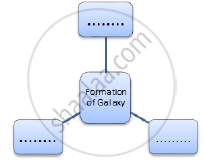
(A3)
(a) Find out similar words from the passage. 01
(i) mass (ii) happenings
(b) Give the verb form of the given words. 01
(i) classified (ii) directions
(A4) Identify and name the clause. 02
Scientists believe that the galaxies were formed from the lumps of matter.
(A5) Can there be life in another galaxy? Give reasons for your answer. 02
(B) Read the passage given in Q. 4 (A) and write the summary of it. Suggest a suitable title to your summary. (05)
Read the following extract and complete the note given below :
The small village of Somnathpur contains an extraordinary temple, built around 1268 A.D by the Hoyasalas of Karnataka - one of the most prolific temple builders. Belur and Helebid are among their better-known works. While these suffered during the invasion of the 14th century, the Somnathpur temple stands more or less intact in near-original condition. The small temple captivates with the beauty and vitality of its detailed sculpture, covering almost every inch of the walls, pillars and even ceilings. It has three Shikhars and stands on a star-shaped raised platform with 24 edges. The outer walls have a profusion of detailed carvings: the entire surface run over by carved plaques of stone: There were vertical panels covered by exquisite figures of God and Goddesses, with many incarnations being depicted. There were nymphs too some carrying an ear of maize, a symbol of plenty and prosperity. The elaborate ornamentation, very characteristic of Hoyasala sculptures was a remarkable feature. On closer look and it is worth it-the series of friezes on the outer walls revealed intricately carved caparisored elephants, charging horsemen, stylized flowers and warriors.
Somnathpur Temple
(1) Location : ___________
(2) Year : 1268 A.D.
(3) Built by : ___________
(4) Captivates with : ___________
(5) Structural features :
(i) Three Shikhars
(ii) Star-shaped platform with 24 edges
(iii) Outer wall carvings, ___________
charging horsemen, __________ and warriors.
(iv) Nymphs-symbol of ___________
Read the extract and do the activities that follow:
My mother was still managing Green's, even though its days were numbered. The day after my return I joined her in the small office, where she sat behind her over-large desk, telephone on her right and the latest paperback western before her, ready to be taken up when noting much was happening – which was fairly often. My mother enjoyed reading westerns-particularly Luke Short, Max Brand, and Clarence E Mulfordmuch in the same way that I enjoyed detective fiction. Both genres were freely available in cheap collins ‘White Circle’, edition published during and just after the War.
We discussed the affair of the skeleton in the cupboard, but as there was no longer any mystery about it, there was nothing for me to investigate. However, armed with the key to the store room, I went down to the basement on my own and made a thorough search of all the old furniture, on the offchance that another skeleton moght tumble out of a cupboard or be found jammed into a drawer or trunk. I did find some old tennis rackets, back numbers of Punch, a cracked china chamber-pot, some old postcards of Darjeeling and Simla, and a framed photograph of King Edward the Seventh. I took the copies of ‘Punch’ to my room and read the reviews of all the plays that had been running in London between 1926 and 1930, thus becoming an authority on the theatre in England of that period.
A1. True/False
State whether the following statements are true or false:
(i) The narrator found one skeleton jammed into a drawer
(ii) The narrator did not like to read detective fiction
(iii) The narrator's mother was managing the Green's hotel
(iv) The narrator wanted to be an authority on the English theatre of that period
A2. Write a gist :
Write a gist of the above given extract in about 50 words.
Read the passage given below and answer the questions that follow:
| 1 |
As a novelist and storyteller, I have always drawn upon my memories of places that I have known and lived in over the years. More than most writers, perhaps, I find myself drawing inspiration from the past — my childhood, adolescence, youth, early manhood ... But to talk of my early inspiration I must go back to my very beginnings, to the then small, princely state of Jamnagar, tucked away in the Gulf of Kutch. Here my father started a small palace school for princesses. I was there till the age of six, and I still treasure vivid memories of Jamnagar's beautiful palaces and sandy beaches. |
| 2 | Some of these landmarks are preserved for me in photographs taken by my father, which I have to this day. An old palace with pretty windows of coloured glass remained fixed in my memory and many years later gave me the story, “The Room of Many Colours”, which also inspired an episode in a TV serial called Ek Tha Rusty. I spent a memorable year and a half with him in New Delhi, then still a very new city — just the capital area designed by Edwin Lutyens and Connaught Place, with its gleaming new shops and restaurants and cinemas. I saw Laurel and Hardy films and devoured milkshakes at the Milk Bar, even as the Quit India Movement gathered momentum. |
| 3 | When I was seventeen, I was shipped off to the UK to “better my prospects” as my mother put it. Out of longing for India and the friends I had made in Dehra came my first novel — The Room on the Roof — featuring the life and loves of Rusty, my alter ego. In the 1950s everyone travelled by sea, as air services were still in their infancy. A passenger liner took about three weeks from Southampton to Bombay (now Mumbai). After docking in Bombay, I took a train to Dehra, where I stepped onto the platform of the small railway station and embarked on the hazardous journey of a freelance writer. Railway stations! Trains! Platforms! I knew as long as these were there I would never run out of stories. |
| 4 | I also looked for inspiration in tombs and monuments and the ever-expanding city, but did not find it, and my productivity dropped. Escape from Delhi had become a priority for me. I felt drawn to the hills above Dehra. On the outskirts of Mussoorie I found a small cottage, surrounded by oak and maple trees where the rent, thankfully, was nominal. : |
| 5 |
I'm of the opinion that every writer needs a window. Preferably two Is the house, the room, the situation ... important for a writer? A good wordsmith should be able to work anywhere. But to me, the room you live in day after day is all-important. The stories and the poems float in through my window, float in from the magic mountains, and the words appear on the page without much effort on my part. Planet Earth belongs to me. And at night, the stars are almost within reach. |
1. On the basis of your understanding of the above passage, answer any four of the following questions in 30 - 40 words each:
- What does the writer remember about Jamnagar?
- How did he spend time in Delhi?
- What was the inspiration for the first novel and why?
- What was the importance of trains and railway stations in his life?
- What was the importance of a window in the writer’s life?
2. On the basis of your understanding of the above passage, fill in any two of the following blanks with appropriate words/phrases:
- He was shipped off to UK for ______.
- Everyone travelled by sea because ______.
- The productivity dropped because ______.
3. Find out words/phrases from the passage that mean the same as the following. Attempt any two.
- gulped down/swallowed (para 2)
- early stage (para 3)
- attracted to (para 4)
Read the following extract and answer the questions given
below:
Another relative has no plans of joining this league though.
She is rather μnabashed about waking up past noon on a daily basis. To be fair, her husband is a media personality who typically arrives home from work past midnight. That does indeed give them sufficient justification to stay longer in slumber-land each morning. This practice does lead to certain oddities though. He goes for his 'morning' walk at 1 pm, heatwaves and appalled onlookers notwithstanding. They once returned from a night out only to meet the neighbour's son who was off on an early morning jog!
Early risers clearly have the edge in life. By the time most
of us wake up, they've been through their morning rituals, enjoyed their walk, had their tea and read the daily news. They're also likely to have made long-distance calls before dawn to those similarly inclined. Thus, by the time the sun warms up they're likely to have discussed all varieties of 'men, matters, and affairs' with a dozen people.
The upshot of these varying tendencies is that such extreme
contrasts often exist in the same household. Weeks pass before
the younger lot (typically late risers) and the older lot (normally early birds) come face to face. It's almost as if they live in different time zones and different countries.
Questions:
(1) What information does the extract give about the typical
routine of a media person?
(2) According to the writer, who are the early risers and the late risers?
(3) Why does the writer say that early risers clearly have the edge in life?
(4) Do you rise early or late? Why?
(5) Rewrite the following sentences in the ways instructed:
- They live in different time zones and different countries.
(Rewrite the sentence using 'not only- but also'.) - That gives them sufficient justification.
(Rewrite the sentence using the Present Perfect tense.) - She is rather unabashed about waking up past noon on a daily basis.
(Rewrite the sentence using 'infinitive' form of
the underlined word.)
(6) Find out from the extract the words which mean:
(i) frightened
(ii) sleep
Read the following extract and answer the questions given below:
Researchers recently announced the earth could actually withstand up to 200,000 times the current population. They arrived at this figure by calculating the amount of heat a human body emits, and only at 1.3 million billion would the earth be too hot to be habitable. And though it would feel like being in a can of sardines if that figure were ever reached, the earth is capable of comfortably sustaining a population several times the current 6.5 billion.
In fact, fertility is actually on the decline worldwide. Though the population has grown, the rate of growth has fallen sharply. Twenty years ago, the UN projected that the population would reach 11.16 billion in 2050, today they say it will reach only 9.3 billion. Moreover, the human population will stabilize at about 11.5 billion. While this figure is almost twice the current one, it is hardly claustrophobic.
True, the demands on resources are heavy even now, but this is more due to the manner in which these resources are being used. In fact, figures show that a bigger population does not amount to greater consumption. Over 20% of the world's people in the highest-income countries account for 86% of total private consumption expenditure - the poorest 20% a tiny 1.3%. With just 5% of the world's population, the US consumes about 40% of the world's resources. Would you say the US is overpopulated?
Concerns on the scarcity of food are equally baseless. In fact, global food production has actually kept up with population growth.
(1) What is the main idea of the first paragraph?
(2) What is the relationship between the population and the available resources?
(3) Why do the researchers claim that the earth is capable of sustaining a bigger population?
(4) What, according to you, are the problems caused by the increasing population?
(5) Rewrite the following sentences in the ways instructed :
(i) The earth would be too hot to be habitable. (Remove 'too'.)
(ii) Though the population has grown, the rate of growth has fallen sharply. (Rewrite it using 'but')
(iii) Moreover, the human population will stabilize at about 11.5 billion. (Make it 'less definite'.)
(6) Find out the words from the extract which mean :
(i) natural capacity to produce (ii) shortage
Read the extract and do the activities that follow :
When Rosalind heard about Orlando's wound and saw the handkerchief stained with his blood, she also fainted; and later she told Oliver that she was really Rosalind, and loved Orlando dearly. Oliver had already fallen in love with gentle Celia, and he persuaded the two girls to accompany him to Duke Senior's court. Rosalind, however, wanted to play one more trick as Ganymede, so she made Oliver promise not to tell anyone that the young shepherd boy and his sister Aliena were really Rosalind and Celia.
And so Aliena and Ganymede were introduced to the old Duke, and he did not recognize his daughter, although he remarked on Ganymede's likeness to Rosalind.
Then the "shepherd boy" told Orlando and the Duke that he could find Rosalind and would bring her to them, making the Duke promise that he would allow his daughter to marry Orlando. she and Celia ran quickly to the shepherd's cottage, changed into their own clothes and removed the brown stains from their faces. Then they returned to the Duke, where they were welcomed with great rejoicing.
'To you, I give myself, for I am yours,' Rosalind said to the Duke, her father. Then she turned to Orlando and said: 'To you, I give myself, for I am yours.'
Rosalind and Orlando were married at once in the forest and on the same day Oliver who was no longer selfish and wicked, married Celia. Just as they were going to be married, a messenger came to ask Duke Senior to go back to his dukedom. Celia's father, Duke Frederick, had mended his wicked ways and asked his brother to return.
A1. True/False :
Choose the true statements from those given below and write them down :
(i) Rosalind played the role of a shepherd boy Ganymede.
(ii) Senior Duke recognised his daughter, Celia.
(iii) Oliver married Rosalind.
(iv) Duke Frederick had mended his wicked ways.
A2. Convert into a dialogue :
Convert the above extract into a dialogue form.
Read the following extract and answer the questions given
below:
So what is a city? It's a dense amalgamation of buildings and people. A city must provide equity and also be sustainable. As an architect who has been closely connected with Delhi and its planning, my wish list is more about the direction we need to take
so that future generations don't end up living in chaotic dysfunctional cities.
The first requirement for a city is a pragmatic plan. Many of our cities such as Delhi and Bhubaneshwar and even Port Blair in the Andamans have reasonably good master plans. Many also have City Development Plans which have been made an essential
requirement to draw funds from the government's Urban Renewal Programme (JNNURM). But they should be updated frequently based on the changing needs of its people.
And let's not forget its citizens-they need to be more proactively involved when evolving master plans. But often, there's a lack of planning and inadequate implementation systems. This applies to all essential components of city-streets, public transport system, traffic management, affordable housing, cars and parking, drainage, water supply, sewerage, and garbage. Any deficiency in these will lead to poor quality cities which won't be able to handle the pressure of increased population and changing needs.
The second requirement of a good city is good social infrastructure such as parks and places for leisure such as river and sea fronts. It needs to preserve and protect its heritage.
(1) What does a city require to emerge as a good city?
(2) What is the second requirement of a good city?
(3) What are the basic requirements to draw funds from the government's-Urban Renewal programme (JNNURM)?
(4) What suggestions will you give to make your city ideal?
(5) Rewrite the following sentences in the ways instructed:
(i) It's a dense amalgamation of buildings and people.
(Rewrite it using 'as well as'.)
(ii) A city must provide equity and also be sustainable.
(Rewrite it using another modal auxiliary showing "advice".)
(iii) The first requirement for a city is a pragmatic plan.
(Frame a 'Wh' ·question to get the underlined part as an answer.)
(6) Match the words in column 'A' with their meaning in 'B':
| Column A | Column B |
| 1 pragmatic | 1 blend |
| 2 amalgamation | 2 fantastic |
| 3 realistic | |
| 4 ancient |
Read the passage given below :
Globalization
Globalization is the way to open businesses, improve technological growth, economy, etc, at the international level for all countries. It is the way in which manufacturers and producers of the products or goods sell their products globally without any restriction. It provides huge profits to the businessmen as they get 1ow cost labor in poor countries easily. It provides a big opportunity for companies to„ deal with the worldwide market.
Globalization helps to consider the whole world 'as a single market. Traders are extending their areas of business by treating the world as a global village. Earlier till the 1990s, there was a restriction on importing certain products that were already manufactured in India like agricultural products, engineering goods, food items, and toiletries. However, during the 1990s there was pressure from. the rich countries on the poor and developing countries to allow them to spread their businesses by opening their markets. In India, the globalization and liberalization process was started in 1991.
After many years, globalization brought about a major revolution in the Indian market when multinational brands came to India and started delivering a wide range of quality products at cheap prices. Prices of good quality products came down because of the cutthroat competition in the market.
Globalization and liberalization of the businesses in India have flooded the market with quality foreign products but have affected the local Indian industries adversely to a great extent resulting in job loss to poor and uneducated workers. Globalization has been a bonanza for the consumers, however, a loss to the small-scale Indian producers.
Globalization has had some very positive effects on the Indian consumer in all sectors of society. It has affected the Indian students and education sector to a great extent by making study books and a lot of information available over the internet. The collaboration of foreign universities with Indian universities has brought about a huge change in the field of education.
Globalization of trade in the agricultural sector has brought varieties of quality seeds that have disease resistati8e; property. However, it is not good for the poor Indian farmers because the seeds and agricultural technologies are costly.
It has brought about a huge revolution in the employment sector by the spread of businesses like cottage, handloom, carpet, artisan carving, ceramic, jewelry, and glassware, etc
(a) What is globalization?
(b) Write any two advantages of globalization.
(c) What was the pressure from the rich countries in the 1990s?
(d) What is the effect of multinational brands entering the Indian market?
(e) How are the prices of quality products affected due to globalization?
(f) How have foreign products affected the local industry adversely?
(g) What has been the impact of globalization on Indian students?
(h) Why has globalization had a negative effect on the poor Indian farmer?
(i) How has the cottage industry benefited from globalization?
Read the passage given below :
Success
Everybody wants to succeed in life. For some, success means achieving whatever they desire or dream. For many, it is the name, fame, and social position. Whatever be the meaning of success, it is a success that makes a man popular.
All great men have been successful. They are remembered for their great achievements. But it is certain that success comes to those who are sincere, hardworking, loyal, and committed to their goals.
Success has been man's greatest motivation. It is very important for all. Success has a great effect on life. It brings pleasure and pride. It gives a sense of fulfillment. It means all-around development. Everybody hopes to be successful in life. But success smiles on those who have a proper approach, planning, vision, and stamina. A proper and timely application of all these things is bound to bear fruit. One cannot be successful without cultivating these certain basic things in life. It is very difficult to set out on a journey without knowing one's goals and purposes. The clarity of the objective is a must to succeed in life. A focused approach with proper planning is certain to bring success. Indecision and insincerity are big obstacles on the path to success.
One should have the capability, capacity, and resources to turn one's dreams into reality. Mere desire cannot bring you success. The desire should be weighed against factors like capability and resources. This is the basic requirement of success. The next important thing is the eagerness, seriousness, and the urge to be successful. It is the driving force that decides success. It is the first step on the ladder of success.
One needs to pursue one's goals with all one's sincerity and passion. One should always be in high spirits. Lack of such spirit leads to an inferiority complex which is a big obstruction on the path to success. Time is also a deciding factor. Only the punctual and committed have succeeded in life. The lives of great men are examples of this. They had all these qualities in plenty which helped them rise to the peak of success.
Hard labor is one of the basic requirements of success. There is no substitute for hard labor. It alone can take one to the peak of success. Every success has a ratio of five percent inspiration and ninety-five percent perspiration. It is patience, persistence, and perseverance which play a decisive role in achieving success. Failures are the pillars of success as they are our stepping-stones and we must get up and start again and be motivated.
2.1 On the basis of your reading of the passage, answer any four of the following questions in 30-40 words each:
(a) To whom does success come certainly?
(b) What are the basic things in life we need to achieve success?
(c) What did great men have in plenty to rise to the peak of success? Give any two examples
(d) What is the one basic requirement of success?
(e) Explain: "Failures are pillars of success."
2.2 On the basis of your reading of the passage, fill in any two of the following blanks with appropriate words/phrase :
(a) ________________ plays a decisive role in achieving success.
(b) Goals have to be pursued with ________________ and ________________
(c) Ratio of success is ________________ inspiration.
2.3 Find out the words from the passage that mean the same as the following :
(a) endurance (para 2)
(b) obstruction (para 4)
(c) motivation (para 5)
Read the passage carefully:
|
2.1 On the basis of your understanding of the above passage, answer the following questions in 30-40 words each:
- Write one advantage and one disadvantage of allowing every family member to be part of the decision-making process.
- In today’s world, what are parents asking their kids?
- Which two pieces of advice does the writer give to the parents?
- The passage supports the parents. How far do you agree with the author’s views? Support your view with a reason.
2.2 On the basis of your reading of the above passage, answer the following:
- The synonym of ‘hurt’ as given in paragraph 2 is ______.
- The word, which means the same as a style or method of cooking in paragraph 4, is:
- cuisine
- gourmet
- gastric
- science
- The antonym of ‘agreeable’ as given in paragraph 5 is ______.
- The antonym of ‘simple’ as given in paragraph 6 is:
- difficult
- complicated
- easy
- tricky
Read the following passage carefully.
1. Few guessed that this quiet, parentless girl growing up in New York City would one day become the First Lady of the United States. Even fewer thought she would become an author and lecturer and a woman much admired and loved by people throughout the world.
2. Born Anna Eleanor Roosevelt in 1884 to wealthy, but troubled parents who both died while she was young, Roosevelt was cared for by her grandmother and sent to school in England. In 1905, she married her distant cousin, Franklin Delano Roosevelt. She and her husband had six children. Although they were wealthy, her life was not easy and she suffered several personal tragedies. Her second son died when he was a baby. In 1921, her strong athletic husband was stricken with polio, which left him physically disabled for life.
3. Eleanor Roosevelt was a remarkable woman who had great intelligence and tremendous strength of character. She never let things get her down. She nursed her husband back to good health and encouraged him to remain in politics. She then helped him to become Governor of New York, and in 1933, President of the United States.
4. While her husband was President, she took a great interest in all the affairs of the country. She became her husband's legs and eyes; she visited prisons and hospitals; she went down into mines, up scaffoldings, and into factories. Roosevelt was tireless and daring. During the depression, she travelled all over the country bringing goodwill, reassurance, and help to people without food and jobs. During World War II she visited American soldiers in camps all over the world. The United States had never known a First Lady like her.
5. Roosevelt also kept in touch with the American people through a daily newspaper column called 'My Day'. She broadcast on the radio and delivered lectures, all first for a First Lady.
1.1 On the basis of your understanding of the above passage answer the following questions: (any eight)
(a) How was Eleanor Roosevelt's personality in contrast to what she became?
(b) Apart from being the First Lady what else did she have to her credit?
(c) What challenges did she face in her personal life but remained unfazed?
(d) Eleanor was a strong woman who helped her husband become the President of America. How?
(e) What does the statement: 'she became her husband's legs and eyes' mean?
(f) What was her special contribution during the depression?
(g) How did she motivate soldiers during World War II?
(h) What did she do for the first time for a First Lady?
(i) What side of her personality is reflected in this passage?
Read of the following passage and answer the questions:
When I casually mentioned this to a friend, he casually replied that I had better get one in the Tigris marshes, for there they were as common as mosquitoes, and were often tamed by the Arabs. We were going to Basra to the Consulate-General to collect and answer our mail from Europe. At the Consulate-General we found that my friend's mail had arrived but that mine had not.
Questions :
(a) What was 'they'?
(b) Where could the author get 'one'?
(c) Find the exact word from the extract which means 'domesticated.'
(d) What did the author find at the Consulate-General?
A. Read the following passage and do the given activities:
A1. List the benefits of Yoga (02)
- ______
- ______
- ______
- ______
We give undue importance to our health and the treatment of diseases. A large number of medicines treat only the symptoms of the disease, and not the root cause. In fact, the cause of many chronic ailments is still being researched. It is here that Yoga therapy comes to our assistance. Yoga emphasizes the treatment of the root cause of an ailment. It works in a slow, subtle and miraculous manner. Modern medicine can claim to save a life at a critical stage, but, for complete recovery and regaining of normal health, one must believe in the efficiency of Yoga therapy.
The Yogic way of life includes a code of ethics, regulations, discipline, combined with prayer and meditation. Even a discussion of these subjects helps one relieve mental tensions and change attitudes. Simple Asana has helped to stretch and relax the whole body and release tensions. The sincere practice of Yoga postures is beneficial, for the mind and body.
The continued practice of Yoga has a profound effect on the inner dimensions of life. Yoga aims at developing mental, physical, spiritual, and emotional facilities. Other forms of physical exercises, like aerobics, assure only physical well-being. They have little to do with the development of the soul and mind.
A2. Complete the following statement according to the passage: (02)
- One must believe in the ________
- Aerobics assure only __________
A3. Fill up the word-formation chart: (02)
| Noun | Verb | Adjective |
| development | ______ | ______ |
| ______ | believe | ______ |
A4.
- Yoga emphasizes the treatment of the root cause of an ailment.
(Frame ‘Wh-‘ Question to get the underlined part as an answer) (02) - We give undue importance to our health.
(Begin with Undue importance......) (02)
A5. Do you believe Yoga Asanas are better than physical exercises? Justify your answer.
B. Summary Writing (5)
Write a short summary of the passage given in above and suggest a suitable title.
Read the passage given below and answer the questions that follow:
| 1. | A fisherman, enfeebled with age, could no longer go out to sea so he began fishing in the river. Every morning he would go down to the river and sit there fishing the whole day long. In the evening he would sell whatever he had caught, buy food for himself and go home. It was a hard life for an old man. One hot afternoon while he was trying to keep awake and bemoaning his fate, a large bird with silvery feathers alighted on a rock near him. It was Kaha, the heavenly bird. “Have you no one to care for you, grandpa?” asked the bird. “Not a soul.” “You should not be doing such work at your age,” said the bird. “From now on I will bring you a big fish every evening. You can sell it and live in comfort.” True to her word, the bird began to drop a large fish at his doorstep every evening. All that the fisherman had to do was take it to the market and sell it. As big fish were in great demand, he was soon rolling in money. He bought a cottage near the sea, with a garden around it and engaged a servant to cook for him. His wife had died some years earlier. He had decided to marry again and began to look for a suitable woman. |
| 2. | One day he heard the royal courtier make an announcement. Our king has news of a great bird called Kaha,” said the courtier. “Whoever can give information about this bird and help catch it, will be rewarded with half the gold in the royal treasury and half the kingdom!” The fisherman was sorely tempted by the reward. Half the kingdom would make him a prince! |
| 3. | “Why does the king want the bird,” he asked. “He has lost his sight,” explained the courtier. “A wise man has advised him to bathe his eyes with the blood of Kaha. Do you know where she can be found?” “No…I mean …no, no…” Torn between greed and his sense of gratitude to the bird, the fisherman could not give a coherent reply. The courtier, sensing that he knew something about the bird, informed the king. The king had him brought to the palace. |
| 4. | “If you have information about the bird, tell me”, urged the king. “I will reward you handsomely and if you help catch her, I will personally crown you king of half my domain.” “I will get the bird for you,” cried the fisherman, suddenly making up his mind. “But Kaha is strong. I will need help. The king sent a dozen soldiers with him. That evening when the bird came with the fish, the fisherman called out to her to wait. “You drop the fish and go and I never get a chance to thank you for all that you‘ve done for me," he said. “Today I have laid out a feast for you inside. Please alight and come in. Kaha was reluctant to accept the invitation but the fisherman pleaded so earnestly that she finally gave in, and alighted. The moment she was on the ground, the fisherman grabbed one of her legs and shouted to the soldiers hiding in his house to come out. They rushed to his aid but their combined effort could not keep Kaha down. |
| 5. | She rose into the air with the fisherman still clinging to her leg. By the time he realised he was being carried away, the fisherman was too high in the air to let go. He hung on grimly, and neither he nor Kaha was ever seen again. |
Based on your understanding of the above passage, answer the questions.
- Why did the fisherman start fishing in the river?
- How did the fisherman spend the day before he met Kaha?
- How did the fisherman betray Kaha?
- Why was the fisherman doubtful about revealing information about Kaha to the courtier?
Read the given case-based passage carefully and answer the questions that follow.
|
Case study of museums |
|
| 1. |
We don’t go to museums. We prefer malls, cinema halls, and restaurants. Visiting a museum is best left to schools which makes it mandatory. After all, it is an academic exercise. And what entertainment can these places possibly offer? India doesn’t boast the greatest of museums, but one can’t doubt the collection of artefacts in these repositories of heritage, even for a second. Our eventful history has handed down us numerous masterpieces, but unfortunately, we don’t find them compelling enough. A cultural historian and museologist Jyotindra Jain says that the habit of going to museums has just not been inculcated in us. One of the best museums in the country, the National Museum in Delhi charges a mere Rs. 20. According to Joyoti Roy, outreach consultant, National Museum, it receives between 6,00,000 to 7,00,000 visitors each year and anything between 2,500 and 3,000 per day. The mix includes Indians, foreigners, and school students. For an Indian museum, it is an astounding figure, but still nowhere close to the footfalls museums, we consider the finest, get. |
| 2. | It has not been many days since the National Gallery of Modern Art, Bangalore, hosted A. Ramachandran’s expansive retrospective covering five decades of his artistic journey. As we sat outside the first-floor gallery after Ramachandran walked me through his sketches, sculptures, and paintings, the senior artist, a bit disappointed said, “Had an exhibition of this scale taken place abroad, people would have come in thousands.” There were about three-five visitors inside the gallery at that time. Jain, who has also helmed institutions like the Crafts Museum and Indira Gandhi National Centre for the Arts in Delhi, puts the onus on museums. “We developed the museums but didn’t evolve the infrastructure around it. And it is the museum’s responsibility to do it. When you know, people are not going to come to you, you must go to them. Crafts Museum shares its wall with India Trade Promotion Organisation. It receives lakhs of people during the trade fair. I fought tooth and nail to get that door opened during my tenure (1984-89) so that the visitors spill over to the Crafts Museum as well. Museums need to rethink their strategies and outreach should be a major point of concern for them.” |
| 3. | In 2010, UNESCO brought out a report on the terrible conditions at India’s top eight museums, citing substandard maintenance, lighting, and signage, among other issues. The Ministry of Culture put together a 14 - point museum reforms agenda and things have moved forward since then. Dr Bhau Daji Lad Museum, the oldest museum in Mumbai has received 3,00,000 visitors over the past year. On average, the museum witnesses 500 visitors every day, with an average of 2,000 visitors over weekends. Not big numbers again, but impressive enough in the Indian context. And this is when the museum re-emerged after a revamp in 2008 with an extensive exhibition programme. Collaborations, screenings of movies of different genres, and workshops for adults and children contributed to the increase in the number of footfalls. The public-private partnership model of the museum is unique and can be replicated in other cases as well. |
| 4. | Robust publicity of exhibitions and creating links between different art spaces can also fetch the audience. Different art institutions located in proximity can host a series of events to be held in each one of them simultaneously. Museums also need to transform their cafes, upgrade their museum shops, and most importantly, invest in their human resource. So, what do we do until then? Let’s go and explore these storehouses of history, culture, and knowledge because unless and until we claim them, they will remain indifferent to our needs. |
After studying the case study of museums, answer the following questions.
- What according to the author is the reason for fewer footfalls in the museums in India?
- What measures are suggested in the passage to multiply the visitors to the museums?
- What was the proposition given by A. Ramachandran during his tenure at Crafts Museum?
- Between the National Museum of Delhi and Dr. Bhau Daji Lad Museum, which museum has more footfall on daily basis? Justify using statistics provided in the study.
Read the following passage and do the activities.
|
November 4, 1851. Dear Brother John Honston, When I came to Charleston day before yesterday, I learned that you were anxious to sell the land where you live, and move to Missouri. I have been thinking of this ever since, and cannot but say such an idea is quite foolish. What can you do in Missouri better than here? Is the land any richer? Can you, there, any more than here, raise com and wheat without work? Will anybody there, any more than here, do your work for you? If you intend to go to work, there is no better place than right where you are; if you do not intend to work, you cannot get along anywhere. Crawling about from place to place can do you no good. You have raised no crop this year. What you really want is to sell the land, get the money and spend it. Part with the land you have and my life upon it-never after will you own a spot big enough to bury you. Half of what you will get for the land, you will spend in moving to Missouri, and the other hall you will eat, drink, wear out and no foot of land will be brought. Now I feel it my duty to have no hand in such a piece of foolery. Now do not misunderstand this letter. I do not write it in any unkindness. I write it in order, if possible, to get you to face the truth which truth is, you are poor and needy because you have idled away your time. Your thousand excuses for not getting along better are all nonsense. They deceive nobody but yourself. To go to work is the only cure for your case. Affectionately, |
A1. Answer the following whether True or False:
- Writer came to Charleston
- Writer is Abraham Lincoln
- Letter is for sister Honston
- No crop was raised
A2. How, according to Lincoln, would his brother spend the money coming from selling the land?
A3.
- Find out two words with prefix from the passage.
- Write two different words on your own by using the same prefix.
A4. Do as directed:
- Rewrite the sentence using 'Not only .......... but also'.
She forgot to wish me on my birthday and did not even apologize. - Change the voice:
The workers built the dome.
A5. Lincoln wishes to have no hand in selling the land Justify.
Read the passage and write a summary of it in a paragraph. Suggest a suitable title.
|
Vegetarianism promotes a natural way of life. But despite its implicit message of universal love and nonviolence, it has not spread as it should have. This may be because it usually is an inward looking habit and is best cultivated in the mind. Leading a vegetarian way of life helps the animal kingdom to coexist with man. The animals supply milk, manure and energy. This has been central to Indian culture for thousands of years. A vegetarian lifestyle is natural, multifaceted and helps preservation in a healthy way. Food and health are closely related. Vegetarians are of various types. There are lacto-vegetarians who consume dairy products; Lacto-ovo-vegetarians include eggs in addition to dairy products. Vegans are pure vegetarians who do not consume any food derived from animals. The Western science of food considers food as something to sustain only the human body, whereas Indian science considers food as something which sustains not only the body but also maintains the purity of heart, mind and the soul. Thus, an item of food that is injurious to the mind is not considered to be fit for consumption, even if it is otherwise beneficial to the body or satisfies the taste. Indian food science does not give so much importance to protein or even to a balanced diet but it gives importance to food that increases the strength of the body and its vitality. Vegetarian foods provide an infinite variety of flavours whereas non-vegetarian foods have hardly any taste of their own. In fact, non-vegetarian foods have to be seasoned with ingredients from the vegetable kingdom to make them palatable. |
Read the passage given below.
| 1 | It is generally accepted that leadership development should be a part of the education system's responsibility for preparing individuals to participate in a democratic and progressive society. Many schools, colleges and universities, across nations, provide their students with leadership courses, curricular programs and co-curricular programs that are designed to develop students’ formal knowledge about leadership as well as opportunities and experiences to develop students as leaders and actually practise leadership. Yet, only a handful of studies have sought to understand leader development from the students’ point of view, with students describing their own experiences and what they learned from them in their own words. | ||||||||||||||||||||||||||||||||||||||||||||||||||||||||
| 2 |
A 2014 descriptive study sought to understand student leadership with research through key events via the following research questions:
|
||||||||||||||||||||||||||||||||||||||||||||||||||||||||
| 3 | This study described the rich array of leadership lessons that students are learning through their experiences. It revealed that student leaders are learning foundational leadership skills and competencies that have positively impacted how to accomplish work, how to work with others and how to be both supported by and support others. |
Based on your understanding of the passage, answer the questions given below.
(i) Does the following statement agree with the information given in paragraph 1? (1)
The researcher believes that educational institutions have ideal resources to study impact of leadership skills on young adults.
Select from the following:
- True - if the statement agrees with the information
- False - if the statement contradicts the information
- Not Given - if there is no information on this
(ii) Do you think the researchers of the study aimed to change the students’ outlook towards the development of leadership skills, directly or indirectly? Support your answer with reference to the text. (1)
(iii) Select the option that displays the most likely reason for including Research Question 3 in the 2014 study. (1)
In order to find out if...
- learning opportunities shape students’ overall personality.
- leadership lessons are the result of the designed learning opportunities.
- all learning opportunities cater to a specific lesson.
- certain lessons are common in more than one learning opportunity.
(iv) Complete the sentence based on the following statement. (1)
More than 50% of the identified student respondents were keen to participate in the 2014 study.
We can say this because ______.
(v) Select the option that displays the key event designed with “Balancing Roles” (Table 1) as the objective. (1)
- Students will be able to debate the issue at hand, with different teams.
- Students will be able to manage the responsibilities of a mentor, planner researcher and presenter.
- Students will be able to surmount minor problems and focus on the final goal.
- Students will be able to explain concepts and clarify them for peers.
(vi) Complete the given sentence by selecting the most appropriate option. (1)
The 2014 study attempts to understand student leadership by focussing on ______
- experiences that shaped students’ overall personality.
- lessons gained by students as they grew up.
- relationship of key events with particular lessons.
- students in leadership roles.
(vii) The lessons for ‘Individual competencies’ had a range of responses. (1)
Give one reason why having the least number of responses for ‘Decision Making’, is a matter that needs attention.
(viii) Complete the given sentence by selecting the most appropriate option. (1)
The concluding sentence of the text makes a clear case for ______ by listing it as a core competency for student leadership.
- collaboration
- flexibility
- hard work
- observation
(ix) Complete the sentence appropriately with one/two words. (1)
In the context of “Working with Others” in Table 1, the lesson of ‘Conflict’ refers to ______.
(x) Based on the reading of the text, state a point to challenge the given statement. (1)
When theoretical knowledge about leadership suffices, it is a waste of funds by educational organisations, to organise leadership camps and programmes.
Read the passage given below-
| (1) | Milkha Singh, also known as The Flying Sikh, was an Indian track and field sprinter who was introduced to the sport while serving in the Indian Army. He is the only athlete to win gold in 400 metres at the Asian Games as well as the Commonwealth Games. He also won gold medals in the 1958 and 1962 Asian Games. He represented India in the 1956 Summer Olympics in Melbourne, the 1960 Summer Olympics in Rome and the 1964 Summer Olympics in Tokyo. He was awarded the Padma Shri, India's fourth-highest civilian honour, in recognition of his sporting achievements. |
| (2) | The race for which Singh is best remembered is his fourth-place finish in the 400 metres final at the 1960 Olympic Games. He led the race till the 200 m mark before easing off, allowing others to pass him. Singh's fourth-place time of 45.73 seconds was the Indian national record for almost 40 years. |
| (3) | From beginning that saw him orphaned and displaced during the partition of India, Singh became a sporting icon in the country. In 2008, journalist Rohit Brijnath described Singh as "the finest athlete India has ever produced". |
| (4) | He was disappointed with his debut performance at the 1956 Melbourne Olympics. "I returned to India, chastened by my poor performance in Melbourne. I had been so excited by the prospects of being part of the Indian Olympics team, but, hadn't realized how strong and professional the competition would be. My success in India had filled me with a false sense of pride and it was only when I was on the track that I saw how inconsequential my talents were when pitted against superbly fit and seasoned athletes. It was then that I understood what competition actually meant, and that if I wanted to succeed on the international arena, I must be prepared to test my mettle against the best athletes in the world." |
| (5) | Then he decided to make sprinting the sole focus of his life. "Running had thus become my God, my religion and my beloved". "My life during those two years was governed by strict rules and regulations and a self-imposed penance. Every morning I would rise at the crack of dawn, get into my sports kit and dash off to the track, where I would run two or three miles cross-country in the company of my coach." |
| (6) | On how he pushed himself through the tough days of vigorous training. "I practiced so strenuously that often I was drained of all energy, and there were times when I would increase my speed to such an extent that after my rounds, I would vomit blood or drop down unconscious through sheer exercise. My doctors and coaches warned me, asked me to slow down to maintain my health and equilibrium but my determination was too strong to give up. My only focus was to become the best athlete in the world. But then images of a packed stadium filled with cheering spectators, wildly applauding me as I crossed the finishing line, would flash across my mind and I would start again, encouraged by visions of victory." |
Based on your reading answer any five questions from the six given below: (5)
- What is Milkha Singh known as? What realization did Milkha Singh have when he was on the track during the Melbourne Olympics?
- List any two of Milkha Singh's achievements.
- What strict rules and regulations did Milkha Singh follow?
- State two consequences of his hard and strenuous practice.
- What motivated Milkha Singh to become the best athlete in the world?
- Explain the phrase 'I would start again' in the last sentence.
Read the following passage and answer the questions that follow:
| 1. |
Too many parents these days can't say no, As a result, they find themselves raising 'children' who respond greedily to the advertisements aimed right at them. Even getting what they want doesn't satisfy some kids; they only want more. Now, a growing number of psychologists, educators, and parents think it's time to stop the madness and start teaching kids about what's really important: values like hard work, contentment, honesty, and compassion. The struggle to set limits has never been tougher and the stakes have never been higher. One recent study of adults who were overindulged as children paints a discouraging picture of their future: when given too much too soon, they grow up to be adults who have difficulty coping with life's disappointments. They also have a distorted sense of entitlement that gets in the way of success in the workplace and in relationships. |
| 2. |
Psychologists say that parents who overindulge their kids set them up to be more vulnerable to future anxiety and depression. Today's parents themselves raised on values of thrift and self-sacrifice, grew up in a culture where no was a household word. Today's kids want much more, partly because there is so much more to want. The oldest members of this generation were born in the late 1980s, just as PCs and video games were making their assaults on the family room. They think of MP3 players and flat-screen TV as essential utilities, and they have developed strategies to get them. One survey of teenagers found that when they crave something new, most expect to ask nine times before their parents give in. By every measure, parents are shelling out record amounts. In the heat of this buying blitz, even parents who desperately need to say no find themselves reaching for their credit cards. |
| 3. |
What parents need to find, is a balance between the advantages of an affluent society and the critical life lessons that come from waiting, saving, and working hard to achieve goals. That search for balance has to start early. Children need limits on their behaviour because they feel better and more secure when they live within a secure structure. |
| 4. |
Older children learn self-control by watching how others, especially parents act. Learning how to overcome challenges is essential to becoming a successful adult. Few parents ask kids to do chores. They think their kids are already overburdened by social and academic pressures. Every individual can be of service to others, and life has meaning beyond one's own immediate happiness. That means parents eager to teach values have to take a long, hard look at their own. |
Based on your understanding of the passage, answer any eight questions from the nine given below:
- What is challenging for today's parents?
- What will be the consequence of over indulging children?
- Why do parents get caught in the buying blitz?
- How do children learn critical life lessons?
- What is the impact of advertisements on children?
- Why do children need limits on their behaviour?
- How do older children learn self-control?
- Find a word in the passage which means 'research'. (Paragraph 2)
- Find a word in the passage which means 'wealthy'. (Paragraph 3)
Read the extract given below:
| (1) | Necessity is indeed the mother of invention. When areas in and around Leh began to experience water shortages, life didn't grind to a halt. Why? Because a retired civil engineer in the Jammu and Kashmir Government came up with the idea of artificial glaciers. |
| (2) | Ladakh, a cold desert at an altitude of 3,000 - 3,500 meters above sea level, has a low average annual rainfall rate of 50 mm. Glaciers have always been the only source of water. Agriculture is completely dependent on glacier melt, unlike the rest of river/monsoon-fed India. But over the years, with increasing effects of climate change, rainfall and snowfall patterns have been changing, resulting in severe shortage and drought situations. Given the extreme winter conditions, the window for farming is usually limited to one harvest season. |
| (3) | It is located between the natural glacier above and the village below. The one closer to the village and lowest in altitude melts first, providing water during April-May, the crucial sowing season. Further, layers of ice above melt with the increasing temperature, thus ensuring continuous supply to the fields.
Therefore, farmers have been able to manage two crops instead of one. It costs about 1,50,000 and above to create a glacier. |
| (4) |
Fondly called the glacier man, he has designed over 15 artificial glaciers in and around Leh since 1987. In recognition of his pioneering effort, he was conferred the Padma Shri by The President of India. |
| (5) |
There are a few basic steps followed while creating an artificial glacier. River or stream water at high altitude is diverted to a shaded area of the hill, facing north, where the winter sun is blocked by a ridge or a mountain range. At the start of winter ie., in November, the diverted water is made to flow on sloping hills facing distribution channels. Stone embankments are built at regular intervals which impede the flow of water, making shallow pools which freeze, forming a cascade of ice along the slope. Ice formation continues for 3-4 months resulting in a large accumulation of ice which is referred to as an ‘artificial glacier’. |

Based on your understanding of the extract, answer the questions below:
- Infer one reason for, the following, based on information in paragraph 1. (1)
Areas in and around Leh began to experience water shortage but life didn't grind to a halt. - Select from the passage the appropriate option to fill in the blanks: (1)
Agriculture is completely dependent on ______ unlike the rest of river/monsoon-fed India.- rainfall pattern
- climate change
- glaciers melt
- extreme winter conditions
- Complete the following analogy correctly with a word/phrase from paragraph 3: (1)
Icing : cake :: layers : ______. - Select the correct option to complete the following sentence: (1)
At the start of winter the diverted water is made to flow ______.- on sloping hills facing distribution channels.
- on high altitude.
- on ice-cold water level.
- on mountain range.
- From the chart select the months of water surplus. (1)
- January, February.
- November, December.
- July, August, September.
- March, April
- Fill in the blank by selecting from the passage the correct option: (1)
The ______ have been the only source of water in areas in and around Ladakh.
- glaciers
- rivers
- streams
- water springs
- The word 'located' in paragraph 3 means: (1)
- found
- locally found
- situated
- adapted
- Write any two steps followed while creating the glaciers. (1)
- List one reason why artificial glaciers seem the best option. (1)
- Select the most suitable title from the following for the passage: (1)
- Water Shortage.
- New Ways Pool Water.
- Artificial Glacier.
- River Beds.
Read the passage given below:
|
- Infer one reason for the following based on information in paragraph 1. (1)
The 'blackout' phase is significant ______. - Choose the appropriate option to fill in the blank. (1)
From paragraph 1 & 2, we can infer that there will be ______.
1. no communication with the people.
2. blackout phase.
3. satellite will get no communication.
4. the moon will block the earth.
5. the communication break will be for 15 days.- 1, 2 & 3
- 1, 3 & 4
- 2, 3 & 5
- 3, 4 & 5
- The communication with the satellite will break for approximately ______ days. (1)
- 10
- 15
- 20
- 25
- Complete the following analogy correctly with a word/phrase from paragraph 2: (1)
aroma : cooking : : ______ : space research
(Clue - just like aroma is integral to cooking, similarly __ is/are integral to space research.) - According to ISRO official till 8th July, when Sun will block Mars, ______ signal/signals per day will be sent to the spacecraft. (1)
- no
- considerable
- indefinite
- only for few
- Select the correct option to complete the following sentence: (1)
The ISRO officials are ______ about their control over the spacecraft after the blackout phase.
- doubtful
- apprehensive
- confident
- jittery
- The spacecraft's life was extended by six months because of ______. (1)
- extra fuel
- incomplete work
- lack of communication amongst ISRO officials
- technical problems in its landing
- Read the following sentences: (1)
(A) The blackout was a sudden development.
(B) Because of this, the officials are very nervous about the success of the spacecraft.
- Both (A) & (B) are true.
- Both (A) & (B) are false.
- (A) is true and (B) is false.
- (A) is false and (B) is true.
- Substitute the word 'nonpareil' with one word similar in meaning in the following sentence from paragraph 5. (1)
India managed to get into the nonpareil club of Mars spacecraft in orbit. - The word scarcity in the passage means the opposite of: (1)
- excess
- plenty
- inadequacy
- surplus
Read the following text.
|
|
Arthur lay in his cabin, still trying to piece together the events of the last few hours. He had watched his home planet of Earth be demolished to make way for a hyperspace bypass, been saved by his friend Ford, and then whisked away on a ship that was powered by an "infinite improbability drive." It was all too much for him. |
|
5. |
Just then, Ford stuck his head around the door. |
|
10 |
"What's that?" asked Arthur. |
|
15 |
"I don't know," said Arthur. "I don't think I really understand anything anymore. Why is a mouse the ship's computer?" |
|
20 |
Arthur was about to say something, but at that moment the ship's intercom crackled to life. |
|
25 |
"Eddie, would you mind shutting up?" said Arthur. |
|
30 |
"It's me," said the voice. "Marvin." |
|
35 |
Arthur looked down and saw a small, metal figure shuffling across the floor. It was about three feet tall, with a round head and a body that looked like it had been cobbled together from spare parts. Its eyes were a dull red, and its voice was a monotone. |
Answer the following questions, based on the passage above.
- Select the option that classifies Arthur's confusion about drastic events such as the destruction of his home planet and the introduction of new technologies, correctly. (1)
- Routine and boredom
- Adventure and excitement
- Loss and change
- Calm and relaxation
- What is the significance of the white lab mouse in the control room of the Heart of Gold spaceship? (1)
- It is the captain of the ship
- It serves as the ship's computer
- It is a pet of the crew
- It is used for scientific experiments
- Share evidence from the text, in about 40 words to support the view that the writer’s writing style is descriptive and humourous. (2)
- Complete the sentence appropriately with a characteristic or its description. (1)
Based on the information given in the excerpt, one can infer that the mice who built the Earth are ______. - Select the option that is similar in meaning to Ford’s expression, “Pretty neat, huh?". (1)
- Easy, isn’t it?
- Could be worse, no?
- Impressive, yes?
- Too difficult for you?
- Explain, in about 40 words, why the name "The Paranoid Android" is considered ironic. (2)
- In the line, “…a body that looked like it had been cobbled together from spare parts…”, what comparison does the word “cobbled” refer to? (1)
- How does the following, impact the reader, even though they know Marvin is just an android? (2)
"I've been waiting for someone to talk to me for over two million years," said Marvin. Answer in about 40 words. - Read the five headlines (a) -(e), given below: (1)
(a) HUMANITY'S JOURNEY WITNESSED BY A DEPRESSED ROBOT
(b) HITCHHIKING THROUGH SPACE: A COMICAL TAKE ON THE END OF THE WORLD
(c) NEW STUDY FINDS ALIENS LIVING AMONG US
(d) GROUNDBREAKING TECHNOLOGY WILL SOON ENABLE TIME TRAVEL
(e) INTERGALACTIC TRAVEL VIA NEW INFINITE IMPROBABILITY DRIVE
Identify the option that displays the headline/s that DOES/ DO NOT correspond with occurrences in the passage.- Only (a)
- (b) (c) and (d)
- Only (e)
- (a) and (e)
Read the following text.
| (1) | In recent years, there has been a surge in both group and solo travel among young adults in India. A survey conducted among young adults aged 18-25 aimed to explore the reasons behind their travel preferences and recorded the percentage variation for 10 common points that influence travel choices. |
| (2) | Among those who prefer solo travel, the most common reason cited was the desire for independence and freedom (58%), followed closely by the opportunity for introspection and self-discovery (52%). Additionally, solo travellers appreciated the ability to customize their itinerary to their preferences (44%) and the chance to meet new people on their own terms (36%). |
| (3) | On the other hand, those who prefer group travel often cited the desire for socializing and making new friends (61%) as their primary reason. Group travel also provided a sense of security and safety in unfamiliar places (52%) and allowed for shared experiences and memories with others (48%). Additionally, group travellers enjoyed the convenience of having pre-planned itineraries and organized transportation (38%). |
| (4) | Interestingly, both groups had similar levels of interest in exploring new cultures and trying new experiences (40% for solo travellers, 36% for group travellers). Similarly, both groups valued the opportunity to relax and escape from the stresses of everyday life (36% for solo travellers, 32% for group travellers). |
| (5) | However, there were also some notable differences between the two groups. For example, solo travellers placed a higher priority on budget-friendly travel options (38%) compared to group travellers (24%). Conversely, group travellers were more likely to prioritize luxury and comfort during their travels (28%) compared to solo travellers (12%). |
| (6) | Overall, the survey results suggest that both group and solo travel have their own unique advantages and appeal to different individuals, based on their preferences and priorities. |
Answer the following questions, based on given passage.
- Infer two possible ways that the survey, mentioned in paragraph (1) could be beneficial. Answer in about 40 words. (2)
- Which travel choice point of the survey would influence tour operators to incorporate group dinners, social events, and shared accommodations in their itinerary? (1)
- Freedom to customise itinerary
- Luxury and comfort
- Security and safety
- Desire for making new friends
- What do the top choices in the survey, for travelling solo and in a group suggest about young adults? (1)
- Identify the solo traveller from the following three travellers: (1)
- Reshma- I don’t want to keep hunting for rickshaws or taxis. A pre-booked vehicle is perfect.
- Nawaz-I’m happy sharing a room in a hostel. I don’t need hotel accommodation.
- Deepak-I’m not worried about my well-being, even while exploring remote areas.
- Which of the following is an example of an opportunity for self-discovery, as mentioned in paragraph 2? (1)
- Trying new cuisine
- Hiring a tour guide
- Purchasing local artifacts
- Advance booking travel tickets
- How might the differences in budget priorities between solo and group travellers impact the types of accommodations and activities offered by the travel industry in India? (2)
- Complete the sentence appropriately. The similarities in the percentage of both solo and group travellers who are interested in exploring new cultures and trying new experiences may be due to ______. (1)
- State TRUE or FALSE. (1)
The title, "Wanderlust: The Solo Travel Trend Among Young Adults in India", is appropriate for this passage.
Read the passage given below.
|
Most cities, may not be prohibit hawking as a profession, but do place restrictions on the use of urban space. Therefore, a comprehensive study was conducted in 1998-99 on street vending, to provide concrete data for furthering the cause of the hawkers. Eight cities were selected - Mumbai, Ahmedabad, Kolkata, Imphal, Patna, Bhubaneswar and Bangalore. Three points were important while selecting respondents –hawkers were from different parts of a city; sold a variety of goods and adequate numbers of women were covered. The questionnaire was included questions on personal details, details regarding the work and the hazards faced. Table: Results of the survey
It is fair to say that hawkers cannot be removed, because apart from their own livelihood, their services benefit the common urban dweller. |

Based on your understanding of the passage, answer the given questions.
- Fill in the blank by selecting the appropriate option. 1
The study aims to ______ the practice of street vending in urban spaces.
- support
- discourage
- understand
- prove
- Jagan goes door to door with his basket of goods to sell bananas in the city. What action from his end would lead to a prohibition on hawking? 1
- State TRUE or FALSE. 1
The following question could have been a part of the study survey.
What are the challenges presented by the security guards? - Complete the sentence appropriately. 1
The most preferred form of source of capital, according to the survey table, exposes the hawkers to exploitation because ______. - State a point in support for the given opinion: 1
Street vending must be legalised as a profession.
Read the following report and answer the questions by choosing the correct/most appropriate option:
 |
|
| (1) |
How bird hits happen, why they are a concern? New Delhi June 20 At least two bird strike incidents happened on Sunday. Both aircrafts returned to their airports of origin and were grounded for maintenance. An ABC aircraft, which took off from Guwahati towards Delhi, suffered damage to its left engine following a bird hit at 1600 feet. The pilots returned to Guwahati. The other strike happened on another flight from Patna to Delhi. The pilots of the aircraft suspected a bird strike during the take-off roll but continued to climb. Following the take-off rotation, they were informed by the cabin crew of sparks emanating from the left engine. Subsequently, the pilots were also informed by air traffic control of smoke coming out of one of the engines. The pilots declared an emergency and returned to Patna. |
| (2) |
Why are bird strikes a concern? Bird strikes are among the most common threats to aircraft safety, and they typically occur during take-off or landing. Dozens of bird-strikes happen each day but some can be more dangerous than others. Typically, when birds collide with an aircraft's airframe, it is unlikely to cause significant problems for the pilots flying. But there are instances when the aircraft engine ingests the birds. This can lead to a loss of thrust for the engine and cause manoeuvrability problems for the crew. In these cases, where a jet engine ingests a bird, procedures would generally call for pilots to land the plane at the closest airport. While most airframe bird strikes are not considered critical to air safety, if a collision cracks a window or a wind screen, pilots will look to land as early as possible. |
| (3) |
How critical are bird strikes to air safety? Smaller planes would generally be more susceptible to the dangers of bird strikes than larger ones. However, given that bird strikes mostly happen during take-off and landing, these incidents could distract the pilots during what are highly critical phases of flights that demand the complete attention of the crew. |
| (4) |
What causes bird-strikes? The presence of birds around an aircraft increases the chances of a bird strike. In the monsoon, as water puddles emerge on open grounds attracting insects to breed, the presence of birds increases. In some cases, bird hits also happen at higher altitudes when a plane is cruising. These are more dangerous than the low-altitude hits, given that they can cause rapid depressurization of cabins. Other reasons for bird activity around the airfield could be presence of landfills or waste disposal sites that can attract a large number of birds. |
- Does the following statement agree with the information given in paragraph 1? (1)
When an airplane is hit by a bird or is suspected to have been hit, the passengers must be asked to get down at once.
Select from the following:
True: If the statement agrees with the information.
False: If the statement contradicts the information.
Not Given: If there is no information on this. - Select the option that displays the most likely reason for bird hits. (1)
- when the aircraft is overloaded
- at the time of landing or taking off
- when the crew become negligent
- when the passengers become panicky
- Complete the sentence appropriately with one word. (1)
Smaller planes are generally more ______ than larger ones. - Complete the sentence by selecting the most appropriate option: (1)
When the window or the windscreen of the airplane is cracked due to a bird hit ______.- the crew must rush to the cockpit
- the pilot must land at the earliest airport
- the pilot must inform the maintenance engineer
- the pilot must get instructions from the aviation wing on what should do in emergency
- Based on the reading of the text, state a point to further the statement. (1)
Dozens of bird hits take place every day ______.
- but only a few are dangerous
- all of them are fatal
- but after every bird hit it is imperative to land the aircraft
- the pilot should ignore them
- Complete the sentence based on the following statement: (1)
Complete attention of the crew is demanded during take-off and landing.
We can say this because ______. - Complete the sentence appropriately with one/two words. (1)
In cases where the aircraft engine infests the bird, it leads to the loss of thrust and causes problems in ______. - Which are the areas more prone to bird hits? (1)
- Based on the reading of the text, state a point to challenge the given statement: (1)
The area around air fields should be clear of any waste disposal sites. - Look at the graph. It shows that between 2016 and 2021, whereas air flights have come down, the bird-hits have gone up. This implies that the incidence of bird hits has: (1)
- decreased
- increased
- remained constant
- been alarming
Read the following extract and Complete the activities given below:
|
Love is a great force in Private life; it is indeed the greatest of all things, but love in public affairs does not work. It has been tried again and again; by the people of the Middle Ages, and also by the French Revolution, a secular movement which reasserted the Brotherhood of Man, And it has always failed. The idea that nations should love one another, or that business concerns or marketing boards should love one another or that a man in Portugal should love a man in Peru of whom he has never heard — it is absurd, unreal, dangerous. ‘Love is what is needed,” we chant, and then sit back and the world goes on as before. The fact is we can only love what we know personally. And we cannot know much. In public affairs, in the rebuilding of civilization, something much less dramatic and emotional is needed, namely tolerance. Tolerance is a very dull virtue. It is boring. It is negative. It merely means putting up with people, being able to stand things. No one has ever written an ode to tolerance or raised a statute to her. Yet this is the quality which will be most needed after the war. This is the sound state of mind which we are looking for. This is the only force which will enable different races and classes and interests to settle down together to the work of reconstruction. The world is very full of people— appallingly full; it has never been so full before and they are all tumbling over each other. Most of these people one doesn’t know, and some of them doesn't like. Well, what is one to do? If you don't like people, put up with them as well as you can. Don't try to love them; you can't. But try to tolerate them. On the basis of that tolerance, a civilized future may be built. Certainly, I can see no other foundation for the post-war world. |
A1. Choose two correct alternatives which define the theme of the extract: (2)
- Love is a greater force in private as well as in public affairs.
- To rebuild civilization we need tolerance more than love.
- Patience is the solution in any sort of confrontation.
- When you do not like people, nations or civilizations, you need to love them to change them.
A2. Complete the following table with the help of the extract: (2)
Give one merit and one demerit of ‘Love’ and ‘Patience.’
| Love | (i) ______ |
| (ii) ______ | |
| Patience | (i) ______ |
| (ii) ______ |
A3. Write how we can build up a civilized society; with the help of the extract: (2)
A4. ‘Love and tolerance are the true indicators of a civilized person.’ Justify. (2)
A5. Do as directed: (2)
- It has been tried again and again.
(Identify the Active Voice of the above sentence from the given options and rewrite.)
- They had tried it again and again.
- They has tried it again and again.
- They tried it again and again.
- They have tried it again and again.
- It is the sound state of mind which we are looking for.
(Identify the correct simple sentence from the given options and rewrite.)- It is the sound state of mind and we are looking for it.
- We are looking for the sound state of mind.
- We are looking for it but it is the sound state of mind.
- The sound state of mind is looked for.
A6. Match the words in column ‘A’ with their meanings in column ‘B’. (2)
| Column ‘A’ | Column ‘B’ |
| (i) Secular | (a) feeling of great friendship and understanding between people. |
| (ii) Absurd | (b) a society which has its own highly developed culture and ways of life. |
| (iii) Civilization | (c) not connected with any religion. |
| (iv) Brotherhood | (d) not at all logical or sensible. |
Read the following passage carefully:
|
(1) Rotation of crops is a universal phenomenon which is practised by most of the farmers of the tropical and temperate countries. The main objective of rotation of crops is to obtain higher agricultural returns on the one hand, and to maintain the soil fertility on the other. (2) In other words, the rotation of crops helps in making agriculture more sustainable. The importance of crop rotation is more in the areas where farmers grow two, or more than two crops in the same field in a year. Irrigation facilities have also been appreciably developed in the country during the last three decades. The availability of water to the arable land has helped in the intensification of agriculture. (3) In the areas such as Punjab and Haryana, where the Green Revolution is a big success, one soil exhaustive crop (rice) is followed by another soil exhaustive crop (wheat). Subsequently, the field vacated by wheat is devoted to either rice or maize or cotton. Thus, in one year, the farmers are harvesting three soil exhaustive crops from the same field. Such a rotation of crops may fetch more income to the farmers, but depletes the soil fertility at a faster pace. (4) A number of field studies were conducted to assess the traditional crop rotation pattern. One such field study about the changes in the rotation of crops was conducted in the village Banhera (Tanda), Haridwar district. The main rotation of crops of the village is shown in the table below. |
| Traditional Rotation of Crops (1960-65) in Banhera (Tanda) | ||||
| Year | Kharif (mid-June to mid-October) | Rabi (mid-October mid-April) | Zaid (April to June) | No. of days land left fallow |
| 1960 | Millet/fodder/rice | Gram | Fallow | 90 |
| 1961 | Fallow | Wheat | Fallow | 210 |
| 1962 | Millet/fodder/rice | Gram | Fallow | 90 |
| 1963 | Fallow | Wheat | Fallow | 210 |
| 1964 | Millet mixed with urad/fodder/rice | Gram | Fallow | 90 |
| 1965 | Fallow | Wheat | Fallow | 210 |
Answer the following questions, based on the above passage:
- Fill in the blanks with the appropriate option from those given in brackets, based on your understanding of para 2.
One of the reasons that there has been an intensification of agriculture in the country is the development of irrigation facilities is a/an ______ (fact/opinion) because it is a/an ______ (subjective judgement/objective detail). - Based on your understanding of paras 1 and 2, state whether the following statement is true or false.
If proper irrigation facility is provided, higher agricultural returns can be obtained by making crop rotation more sustainable. - Justify the following in about 40 words.
Crop rotation may fetch more income to the farmers, but depletes the soil fertility at a faster pace. - Based on the table, mention the years when the land was left fallow for maximum number of days.
- The study conducted in village Banhera (Tanda) reflects that during the years 1960 to 1965, from April to June, the land was left fallow or uncultivated throughout. State any one inference that can be drawn from this.
- Select the option that correctly states the significance of crop rotation as given below:
- Crop rotation is done to obtain higher agricultural returns.
- Higher agricultural returns can be obtained by harvesting soil-exhaustive crops.
- Crop rotation demands that land should be left fallow for a few months to increase the fertility of soil.
- Better irrigation facility to the arable land has helped in the intensification of agriculture.
- If crops to be harvested are chosen wisely, crop rotation can help in maintaining fertility of soil.
- (1), (2) and (4)
- (1) only
- (3) and (5)
- (1) and (5)
- Crop rotation is helping in making agriculture more sustainable. Mention one benefit and one drawback of crop rotation. (Answer in about 40 words)
- Which of the following is the main takeaway from the study mentioned in the passage?
- The study needs to include more valid data to support the practice of crop rotation
- Crop rotation is a sustainable practice that can transform the agricultural sector.
- The impact of crop rotation on farmer’s upliftment has been thoroughly explained.
- Crop rotation is independent of the type of crops harvested and availability of water for irrigation.
