हिंदी

Fast-Moving Consumer Goods (FMCG) are products that sell quickly at relatively low cost. FMCG is the fourth-largest sector in the Indian economy. There are three main segments in the sector - English Core

Advertisements
Advertisements

प्रश्न

Read the passage given below:

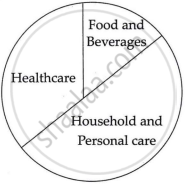
(1) Fast-Moving Consumer Goods (FMCG) are products that sell quickly at relatively low cost. FMCG is the fourth-largest sector in the Indian economy. There are three main segments in the sector – food and beverages, which accounts for 19% of the sector; healthcare, which accounts for 31% of the share; and household and personal care, which accounts for the remaining 50% share. The urban segment contributes to about 55% of the revenue share, while the rural segment accounts for 45%. Rise in rural consumption will drive the FMCG market. The Indian processed food market is projected to expand to US\[\$\] 470 billion by 2025, up from US\[\$\] 263 billion in 2019-20.
(2) The Indian FMCG industry grew by 16% in 2021, a 9-year high, despite nationwide lockdowns, supported by consumption-led growth and value expansion from higher product prices, particularly for staples. Real household spending is projected to increase 9.1% after 2021, after a decrease of 9.3% in 2020 due to the economic impact of the pandemic. Price increases across product categories will offset the impact of rising raw material prices, along with volume growth and a resurgence of demand for discretionary items.
(3) The FMCG sector has received good investments and support from the Government in the recent past. The sector witnessed healthy FDI inflows from April 2000-March 2022. Furthermore, as per the Union Budget 2022-23, a substantial amount has been allocated to the Department of Consumer Affairs, and an increased amount has been allocated to the Department of Food and Public Distribution. In 2021-22, the Government approved the Production-Linked Incentive Scheme for the Food Processing Industry (PLISFPI) with an outlay of a larger amount to help Indian brands of food products in the international markets.
(4) The Government's Production-Linked Incentive (PLI) Scheme gives companies a major opportunity to boost exports. The future outlook of the FMCG rural sector looks on track now. Rural consumption has increased, led by a combination of increasing income and higher aspiration levels. There is an increased demand for branded products in rural India. The growth of the organised sector in FMCG is expected to rise with an increased level of brand consciousness, augmented by the growth in modem retail.
Table. FMCG Products
1. Processed foods: Cheese products, cereals
2. Prepared meals: Ready-to-eat meals
3. Beverages: Bottled water, aerated drinks, and juices
4. Baked goods: Biscuits, bread
5. Fresh foods, frozen foods, and dry goods: Fruits, vegetables, milk, butter, frozen food, and nuts
6. Medicines: Aspirin, pain relievers, and over-the-counter medication that can be purchased without a prescription
7. Cleaning products: Baking soda, washing powder
8. Cosmetics and toiletries: Beauty products, soaps, toothpaste
9. Office supplies: Pens, pencils

Based on your understanding of the passage, answer the questions given below:

  1. Does the following statement agree with the information given in para 1? (1)
    Food and beverages segment dominates the Global FMCG market and is expected to retain its dominance.
    Select from the following:
    1. True - If the statement agrees with the information.
    2. False - If the statement contradicts the information.
    3. Not Given - If there is no information on this.
  2. What do you think gives opportunities to boost exports? (1)
  3. Select the option that displays the most likely reason for FMCG rural sector being on track. (1)
    1. FMCG sector has been unable to get investments from the government.
    2. PLI schemes don't reach the rural sector.
    3. Gross Merchandise Value (GMV) of the online grocery segment in India is expected to double in the next five years.
    4. There is a desire to buy branded products in the villages too.
  4. Complete the sentence based on the following statement: (1)
    The Indian FMCG industry grew by 16% in 2021, a 9-year high, despite nationwide lockdowns because ______.
  5. From the given pie chart, which segment of FMCG accounts for the maximum percentage of the sector? (1)
  6. Complete the given sentence by selecting the most appropriate option: (1)
    The combination of increasing income and higher aspiration levels in the rural areas has led to ______.
    1. the Government taking a direct interest
    2. the demand for branded products
    3. price increases across product categories
    4. the fall of supply in urban areas
  7. How is the Government trying to help Indian brands of food products in the international markets? (1)
  8. Complete the given sentence by selecting the most appropriate option: (1)
    The concluding paragraph of the passage makes a clear case ______.
    1. that the rural people also want branded products
    2. that the FMCG industry will not focus on brand consciousness
    3. for the role of data analytics in the FMCG industry
    4. for the Government's role by providing incentives
  9. What will be the impact of the increased level of brand consciousness? (1)
  10. Based on the reading of the passage, correct the following statement: (1)
    The urban segment contributes to about 45% of the revenue share, while the rural segment accounts for 55%.
संक्षेप में उत्तर
Advertisements

उत्तर

  1. False - If the statement contradicts the information.
  2. The government's Production-Linked Incentive (PLI) Scheme provides businesses with a significant chance to increase exports.
  3. There is a desire to buy branded products in the villages too.
  4. The Indian FMCG industry grew by 16% in 2021, a 9-year high, despite nationwide lockdowns because it was supported by consumption-led growth and value expansion from higher product prices, particularly for staples.
  5. Household and Personal care segment
  6. The combination of increasing income and higher aspiration levels in the rural areas has led to the demand for branded products.
  7. In 2021-22, the government approved the Production-Linked Incentive Scheme for Food Processing Industry (PLISFPI) with a greater budget to assist Indian food companies in worldwide markets.
  8. The concluding paragraph of the passage makes a clear case for the Government's role by providing incentives.
  9. The expansion of the organised sector in FMCG is predicted to accelerate with an increase in brand consciousness, aided by the growth of modern retail.
  10. The urban segment contributes to about 55% of the revenue share, while the rural segment accounts for 45%.
shaalaa.com
Unseen Passage Comprehension
  क्या इस प्रश्न या उत्तर में कोई त्रुटि है?
2022-2023 (March) Delhi Set 1

संबंधित प्रश्न

Look at the balloons. Which are the qualities inculcated in the author by her teacher? Write them. (2)

Sister Monica, however, wasn't quite as lenient as that, and spent most of the time telling me about the importance of regularity and hard work. She made me realise that success is, like genius, 99 per cent perspiration and 1 per cent inspiration. It's a lesson that has stood me in good stead.
The teachers I'm most grateful to, though, are not those who have taught me the most, but those who have simply been friends to me, believed me and believed in me. Prominent among them is Sudha Ramasubramanium-Rambo, as we used to call her. I didn't know her too well. She taught me in college, and apart from being incredible in class unless one missed class, she also believed that I actualIy had a Problem when I developed an injury (which several doctors found difficult to diagnose). Despite my missing an exam-the HSC, of all exams- she was the only person who told me to concentrate on my health and assured me that I could take the exam off the top of my head any time I wanted to.
I'm not even certain she remembers it, but at the time, it felt like one of the only rays of hope in an extremely dark tunnel. Perhaps few teachers realize how far their influence extends or how much of a difference their actions and words can make. A number of my teachers have unfortunately taught me kindness and tolerance and patience by being precisely the opposite, and quite obviously, they aren't the people I like to think about. But many of my teachers have been extraordinary people, who have not only taught me in class but also helped mould me and my character in every other way. I only hope that I live up to what their endeavors were undoubtedly mean to create.

B2.Answer
(1) What kind of teachers are disliked by the author?                                                                (1)
(2) What was Sudha Ramasubramanium's advice to the author when she was going to miss her HSC exam. ?                                                                                                                                 (1)

B3. Match :
Match the words with their appropriate meanings :                                                                     (2)

‘A’ ‘B’
(i) Prominent (a) Treatment
(ii) Incredible (b) Natural
(iii) Diagnose (c) Unbelievable
(iv) Endeavours (d) Noticeable
  (e) Efforts
  (f) Identify a disease

B.4(i) ‘Wh question’
She made me realize that success is, like genius.                                                                  (1)
(Frame a ‘Wh’ question to get the underlined part as an answer)

(ii) She taught me in college.                                                                                                (1)
(Begin the sentence with ‘I’ and rewrite).

B5. Personal Response
Do you agree that a teacher should also be your good friend? Justify your answer.                    (2)


The natural life span of a domesticated horse is about 25 – 30 years, 10 years down from what it was in the wild. You can tell a horse’s age from the number of teeth he has. They get all their teeth by the age of 5, after which those teeth just get longer. Horses have close to 360 degree all round vision. The only place they cannot see is directly behind or right in front of themselves, which is why it’s dangerous to stand behind a horse. If they later I it also means that they cannot see a jump once they are about four feet from it, and have to rely on memory as to its height and shape! Each of the horse’s two eyes work independently wherever a horse’s ear points is where the horse is looking. A horse is able to sleep standing up as he is able to lock his leg muscles so that he dosen’t fall asleep. Nor do all horses in the same field ever lie down at once – one animal always stands “on look out” duty.

1) What is the life span of a wild horse?
(2) Why do the horse owners cover their horse’s eyes with blinkers?
(3) What prevents a horse from falling while asleep?
(4)
(a) Falls /shorter/ the mane/ on the/ side/ legged.[Rearrange the words to make a meaningful sentence]
(b) Form antonyms by adding a prefix :
(i) able
(ii) direct 
(5)
(a) They get all their teeth by the age of five. [Pick out the prepositions]
(b) If they feel something behind them they may kick. [Rewrite using ‘unless’]
(6) How have horses helped man through the ages?


Read the following passage:

It's Beginning to Bite
 
In these trying times, when buying ordinary food stuff can burn a hole in your pockets, comes the news that can actually help us save some hard cash when we go out to shop the next time. According to a Stanford University study, the first of its kind in the world, there is no evidence to suggest that there are more nutritional benefits from expensive organic food than those grown by conventional methods. The researchers add that there is no difference in protein and fat content between organic and conventional milk and the vitamin count is similar in both types. The only benefit is that organic foods are not contaminated with pesticides but then before you chew on the plate of organic okra with roti made from organic wheat, they are not 100% pesticide free either. In India, organic food has been growing at 20-22% and the export market is valued at Rs. 1,000 crore. Obviously, the study is not good news for that sector and for people who are big on organic food.


In India, eating organic food is more of a style statement than due to health worries because the stuff is expensive. But people who can, do indulge in not only organic vegetables but even organic eggs laid by 'happy hens', who are allowed to roam around freely whereas 'unhappy hens' are kept in coops. Then there are companies that have installed music channels in their cowsheds and the milk from those sheds are sold at a marked up price since it has more nutritional value because the animals are happy thanks to lilting 24×7 music. We don't know yet any farmer using music to improve his crop quality, but then you never know : plants are known to respond to music.

Why such pickiness about food ? These days, the huge number of TV shows and articles that we see and read on food provide bread and butter for the specialist. But instead of decoding food, its sources and what has gone into growing it, isn't it much better to enjoy what's on the plate ?

(Adapted from The Hindustan Times)


Complete the statements given below by choosing the correct options from those that follow:

(a) According to a Stanford University study, organic food in relation to conventional food is________.
  (i) less nutritious
  (ii) more nutritious
  (iii) very conventional
  (iv) as nutritious

(b) The study will not be welcomed by _________.
  (i) farmers of conventional food
  (ii) makers of pesticides
  (iii) all sectors
  (iv) exporters of organic food

(c) We can save some hard cash by _________.
  (i) buying organic food
  (ii) not buying organic food
  (iii) going to the shop
  (iv) not buying food with pesticides

(d) Music channels are installed in the cowshed because the _________.
  (i) cows then give more milk
  (ii) milk is sold at a higher price
  (iii) milk becomes more pure
  (iv) workers becomes happy

(e) In the second paragraph, the author's attitude to the people who eat food sourced from 'happy' animals is that he _________.
  (i) is happy with them
  (ii) is unhappy with them
  (iii) is laughing at them
  (iv) wants crops to be grown similarly

(f) One benefit of organic food is that __________.
  (i) it is fashionable to eat
  (ii) only rich people can afford it
  (iii) it is less contaminated with pesticides
  (iv) even poor people can afford it

(g) The word 'contaminated' means ________.
  (i) adulterated
  (ii) for adults
  (iii) containing
  (iv) not healthy


Read the passage given below :

1. When you grow up in a place where it rains five months a year, wise elders help you to get acquainted with the rain early. They teach you that it is ignorant to think that it is the same rain falling every day. Oh no, the rain is always doing different things at different times. There is rain that is gentle, and there is also rain that falls too hard and damages the crops. Hence, the prayer for the sweet rain that helps the crops to grow.

2. The monsoon in the Naga hills goes by the native name, khuthotei (which means the rice-growing season). It lasts from May to early or mid-October. The local residents firmly believe that Durga Puja in October announces the end of rain. After that, one might expect a couple of short winter showers, and the spring showers in March and April. Finally, comes the "big rain" in May; proper rainstorms accompanied by heart-stopping lightning and ear-splitting thunder. I have stood out in storms looking at lightning are across dark skies, a light-and-sound show that can go on for hours.

3. This is the season when people use the word sezuo or süzu to refer to the week-long rains, when clothes don't dry and smell of mould, when fungus forms on the floor and when you can't see the moon or the stars because of the rainclouds. But you learn not to complain. Rain, after all, is the farmer's friend and brings food to the table. Rituals and festivals centre around the agricultural rhythm of life, which is the occupation of about 70 percent of the population.

4. The wise learn to understand its ways. I grew up hearing my grandfather say. "It's very windy this year. We'll get good rain." If the windy season was short and weak, he worried there might not be enough rain for the crops. I learned the interconnectedness of the seasons from childhood, and marvelled at how the wind could bring rain. Another evening, many rainy seasons ago, my paternal aunt observed the new moon and worried, "Its legs are in the air, we're in for some heavy rain." She was right. That week, a storm cut off power lines and brought down trees and bamboos.

5. Eskimos boast of having a hundred names for snow. Norwegians in the north can describe all kinds of snow by an equal amount of names : pudder, powder snow, wet snow, slaps, extra wet snow, tight snowfall, dry snow, and at least 95 more categories of snow. Likewise, in India we have names and names for rain. Some are common, some are passing into history.

6. The rains are also called after flowering plants and people believe that the blossoming of those plants draws out rain. Once the monsoons set in, field work is carried out in earnest and the work of uprooting and transplanting paddy in flooded terrace fields is done. The months of hard labour are June, July and August. In August, as the phrogü plant begins to bloom, a rain will fall. this August rain, also called phrogü, is a sign that the time for cultivation is over. If any new grain seeds are sown, they may not sprout; even if they do sprout, they are not likely to bear grain. The rain acts as a kind of farmer's almanac.

7. The urban population of school-goers and office-goers naturally dislikes the monsoon and its accompanying problems of landslides, muddy streets and periodic infections. For non-farmers, the month of September can be depressing, when the rainfall is incessant and the awareness persists that the monsoons will last out till October. One needs to have the heart of a farmer to remain grateful for the watery days, and be able to observe – from what seems to the inexperienced as a continuous downpour – the many kinds of rain. Some of the commonly known rain-weeks are named after the plants that alternately bloom in August and September. The native belief is that the flowers draw out the rain.
8. Each rain period has a job to fulfil : October rain helps garlic bulbs to form, while kümünyo rain helps the rice bear grain. Without it, the ears of rice cannot form properly. End October is the most beautiful month in the Naga hills, as the fields turn gold and wild sunflowers bloom over the slopes, all heralding the harvest. Prayers go up for protecting the fields from storms, and the rains to retreat because the grain needs to stand in the sun and ripen. The cycle nears completion a few weeks before the harvest, and the rain does retreat so thoroughly from the reaped furrows that the earth quickly turns hard. The months of rain become a distant memory until it starts all over again.

On the basis of your understanding of the above passage, complete the statements given below with the help of options that follow:
a) The rains are called after flowering plants because

(i) heavy rains kill plants.
(ii) flowers grow in the rainy season.
(iii) it is believed that the plants bring the rain.
(iv) flowers grow all the year round.


b) The rain is like a calendar for farmers because

(i) it tells them when to sow and when to harvest.
(ii) it tells them the birthdays of their children.
(iii) each month has a time for plantation.
(iv) different kinds of rain tell different things.


c) People who live in cities don't like rain because

(i) it brings mud and sickness with it.
(ii) they are not bothered about the farmers.
(iii) they don't like the plants that grow during the rain.
(iv) going shopping becomes difficult.


d) People pray asking the rain the retreat because

(i) the fungus and mould need to dry.
(ii) children don't get a chance to play.
(iii) the crops need the sun and heat to ripen.
(iv) they like to pray.


Answer the following questions briefly:
e) Why do the elders want you to understand the rains in the Naga hills?

f) What does Durga Puja mean to the farmers of the Naga hills?

g) What kind of rain is called sezuo?

h) What is the occupation of more than half the population of the Naga hills?

i) How is the heart of the farmer different from that of the city person?

j) When does rain becomes a memory in the minds of the of the Naga hills?

k) Find words from the passage which mean the same as the following:

(i) flowering (para 6)
(ii) nonstop (para 7)

Read the passage given below and answer the questions that follow:          
 1. Thackeray reached Kittur along with a small British army force and a few of his officers. He thought that the very presence of the British on the outskirts of Kittur would terrorise the rulers and people of Kittur and that they would lay down their arms. He was quite confident that he would be able to crush the revolt in no time. He ordered that tents be erected on the eastern side for the fighting forces and a little away on the western slopes tents be put up for the family members of the officers who had accompanied them. During the afternoon and evening of 20thOctober, the British soldiers were busy making arrangements for these camps.
 

2. On the 21st morning, Thackeray sent his political assistants to Kittur fort to obtain a written assurance from all the important officers of Kittur rendering them answerable for the security of the treasury of Kittur. They, accordingly, met Sardar Gurusiddappa and other officers of Kittur and asked them to comply with the orders of Thackeray. They did not know that the people were in a defiant mood. The commanders of Kittur dismissed the agent’s orders as no documents could be signed without sanction from Rani Chennamma.
 
3. Thackeray was enraged and sent for his commander of the Horse Artillery, which was about 100 strong, ordered him to rush his artillery into the fort and capture the commanders of the Desai’s army. When the Horse Artillery stormed into the fort, Sardar Gurusiddappa, who had kept his men on full alert, promptly commanded his men to repel and chase them away. The Kittur forces made a bold front and overpowered the British soldiers.
 
4. In the meanwhile, the Desai’s guards had shut the gates of the fort and the British Horse Artillery men, being completely overrun and routed, had to get out through the escape window. Rani’s soldiers chased them out of the fort, killing a few of them until they retreated to their camps on the outskirts.
 
5. A few of the British had found refuge in some private residences, while some were hiding in their tents. The Kittur soldiers captured about forty persons and brought them to the palace. These included twelve children and a few women from the British officers’ camp. When they were brought in the presence of the Rani, she ordered the soldiers to be imprisoned. For the women and children she had only gentleness, and admonished her soldiers for taking them into custody. At her orders, these women and children were taken inside the palace and given food and shelter. Rani came down from her throne, patted the children lovingly and told them that no harm would come to them.
 
6. She, then, sent word through a messenger to Thackeray that the British women and children were safe and could be taken back any time. Seeing this noble gesture of the Rani, he was moved. He wanted to meet this gracious lady and talk to her. He even thought of trying to persuade her to enter into an agreement with the British to stop all hostilities in lieu of an inam (prize) of eleven villages. His offer was dismissed with a gesture of contempt. She had no wish to meet Thackeray. That night she called Sardar Gurusiddappa and other leading Sardars and after discussing all the issues came to the conclusion that there was no point in meeting Thackeray who had come with an army to threaten Kittur into submission to British sovereignty.

On the basis of your understanding of the above passage complete the statements given below with the help of options that follow:
(a) Thackeray was a/an :
(i) British tourist
(ii) army officer
(iii) adviser to Rani of Kittur
(iv) treasury officer
 
(b) British women and children came to Kittur to :
(i) visit Kittur
(ii) enjoy life in tents
(iii) stay in the palace
(iv) give company to officers
 
Answer the following questions briefly:
(c) Why did Thackeray come to Kittur?
(d) Why did the Kittur officials refuse to give the desired assurance to Thackeray?
(e) What happened to the Horse Artillery?
(f) How do we know that the Rani was a noble queen?
(g) How in your opinion would the British women have felt after meeting the Rani?
(h) Why did the Rani refuse to meet Thackeray?
(i) Find words from the passage which mean the same as the following :
i. entered forcibly (para 3)
ii. aggressive/refusing to obey (para 2)

Read the passage given below and answer the questions that follow:           

The most alarming of man’s assaults upon the environment is the contamination of air, earth, rivers, and sea with lethal materials. This pollution is for the most part irrevocable; the chain of evil it initiates is for the most part irreversible. In this contamination of the environment, chemicals are the sinister partners of radiation in changing the very nature of the world; radiation released through nuclear explosions into the air, comes to the earth in rain, lodges into the soil, enters the grass or corn, or wheat grown there and reaches the bones of a human being, there to remain until his death. Similarly, chemicals sprayed on crops lie long in soil, entering living organisms, passing from one to another in a chain of poisoning and death. Or they pass by underground streams until they emerge and combine into new forms that kill vegetation, sicken cattle, and harm those who drink from once pure wells.

It took hundreds of millions of years to produce the life that now inhabits the earth and reached a stage of adjustment and balance with its surroundings. The environment contained elements that were hostile as well as supporting. Even within the light of the sun, there were short wave radiations with power to injure. Given time, life has adjusted and a balance reached. For time is the essential ingredient, but in the modern world is no time.

The rapidity of change and the speed with which new situations are created follow the heedless pace of man rather than the deliberate pace of nature. Radiation is no longer the bombardment of cosmic rays; it is now the unnatural creation of man’s tampering with the atom. The chemicals to which life is asked to make adjustments are no longer merely calcium and silica and copper and all the rest of the minerals washed out of the rocks and carried in the rivers to the sea; they are the synthetic creations of man’s inventive mind, brewed in his laboratories, and having no counterparts in nature.

(a) On the basis of your understanding of the above passage make notes on it using headings and sub-headings. Use recognizable abbreviations (wherever necessary-minimum four) and a format you consider suitable. Also supply a title to it.

(b) Write a summary of the passage in about 80 words.


Read the passage given below and answer the questions that follow:           

The most alarming of man’s assaults upon the environment is the contamination of air, earth, rivers, and sea with lethal materials. This pollution is for the most part irrevocable; the chain of evil it initiates is for the most part irreversible. In this contamination of the environment, chemicals are the sinister partners of radiation in changing the very nature of the world; radiation released through nuclear explosions into the air, comes to the earth in rain, lodges into the soil, enters the grass or corn, or wheat grown there and reaches the bones of a human being, there to remain until his death. Similarly, chemicals sprayed on crops lie long in soil, entering living organisms, passing from one to another in a chain of poisoning and death. Or they pass by underground streams until they emerge and combine into new forms that kill vegetation, sicken cattle, and harm those who drink from once pure wells.

It took hundreds of millions of years to produce the life that now inhabits the earth and reached a stage of adjustment and balance with its surroundings. The environment contained elements that were hostile as well as supporting. Even within the light of the sun, there were short wave radiations with power to injure. Given time, life has adjusted and a balance reached. For time is the essential ingredient, but in the modern world is no time.

The rapidity of change and the speed with which new situations are created follow the heedless pace of man rather than the deliberate pace of nature. Radiation is no longer the bombardment of cosmic rays; it is now the unnatural creation of man’s tampering with the atom. The chemicals to which life is asked to make adjustments are no longer merely calcium and silica and copper and all the rest of the minerals washed out of the rocks and carried in the rivers to the sea; they are the synthetic creations of man’s inventive mind, brewed in his laboratories, and having no counterparts in nature.

(a) On the basis of your understanding of the above passage make notes on it using headings and sub-headings. Use recognizable abbreviations (wherever necessary-minimum four) and a format you consider suitable. Also supply a title to it.

(b) Write a summary of the passage in about 80 words


Read the passage given below :

It is surprising that sometimes we don't listen to what people say to us. We hear them, but we don't listen to them. I was curious to know how hearing is different from listening. I had thought both were synonyms, but gradually, I realised there is a big difference between the two words.

Hearing is a physical phenomenon. Whenever somebody speaks, the sound waves generated reach you, and you definitely hear whatever is said to you. However, even if you hear something, it doesn't always mean that you actually understand whatever is being said. Paying attention to whatever you hear means you are really listening. Consciously using your mind to understand whatever is being said is listening.

Diving deeper, I found that listening is not only hearing with attention, but is much more than that. Listening is hearing with full attention, and applying our mind. Most of the time, we listen to someone, but our minds are full of needles chatter and there doesn't seem to be enough space to accommodate what is being spoken.

We come with a lot of prejudices and preconceived notions about the speaker or the the subject on which he is talking. We pretend to listen to the speaker, but deep inside, we sit in judgement and are dying to pronounce right or wrong, true or false, yes or no. Sometimes, we even come prepared with a negative mindset of proving the speaker wrong. Even if the speaker says nothing harmful, we are ready pounce on him with our own version of things.

What we should ideally do is listen first with full awareness. Once, we have done that, we can decide whether we want to make a judgement or not. Once we do that, communication will be perfect and our interpersonal relationship will become so much better. Listening well doesn't mean one has to say the right thing at the right moment. In fact, sometimes if words are left unspoken, there is a feeling of tension and negativity. Therefore, it is better to speak out your mind, but do so with awareness after listening to the speaker with full concentration.

Let's look at this in another way. When you really listen, you imbibe not only what is being spoken, but you also understand what is not spoken as well. Most of the time we don't really listen even to people who really matter to us. That's how misunderstandings grow among families, husbands and wives, brothers and sisters.

(A) On the basis of your reading of the above passage make notes on it, using heading and sub-headings. Use recognizable abbreviations (wherever necessary − minimum four) and a format you consider suitable. Also supply an appropriate title to it.

(B) Write a summary of the passage in about 80 words.


(A) Read the following extract and answer the questions given below:
   Chronic floods during the monsoon, on average, affect more than 30 million Indians annually Ironically, 60% of India's farmland, 66% of its livestock and its entire forest area depend on rains for survival.
   According to a recently released Central Water Commission (CWC) report, on an average, 7·21 million hectares (roughly 72,000 sq. km.) go under floodwater. This water typically ravages 3·78 million hectares of agricultural land, damaging crops worth Rs. 1, 118 crores annually.
   Heavy rains and floods account for nearly 1,700 lives lost annually. Apart from this, I ·25 lakh houses are annually damaged by torrential rains that also wipe out nearly 96,000 livestock.
   Floods are the most recurrent natural calamity, hitting India almost every year. According to the CWC's report on financial aspects of flood control, anti-sea erosion and drainage projects, it is not possible to provide absolute protection instantly to all flood-prone areas. It says that such an attempt will neither be practical nor economically viable.
   The CWC's analysis of floods in India from 1953 to 2011 shows a marginal decline in flood-affected areas over the years, the data shows 1977 1978 and 1979 were the worst-hit. The 1977 floods killed over 11,000 people, six-time the average for the 59 years, between 1953 and 2011. In terms of area and population affected, the floods of 1978 were the most destructive.
  In terms off the financial loss, recent floods have been far more destructive. The total loss of crops, houses and public utilities in 2009 was Rs. 32541 crores, the highest for any year.

Question
(1) What is the above extract about?

(2) How do floods adversely affect India?

(3) Why is it not possible to provide absolute protection to all flood-prone areas?

(4) How would you help the flood-affected people?

(5) Rewrite the following sentences in the ways instructed :
(i) The floods of 1978 were the most destructive.
(Change the sentence into the 'positive degree'.)
(ii) Floods are the most recurrent natural calamity hitting India almost every year.
(Make it a complex sentence.)
(iii) Floods have been far more destructive.
(Rewrite the sentence using the Simple Present tense.)

(6) Give the meanings of:
(i) entire
(ii) calamity

(B) Write a brief summary of the above extract with the help of the points given below and suggest a suitable title.
Floods - natural, recurrent calamity in India - destroy life and property - no absolute protection - neither practical nor economically viable- floods in 1977 and 1978. 


Read the following extract and answer the questions given
below: 

        Today, at 29, \.1.ichael has discovered the power of another good idea that has helped him rise in just a few years from teen to tycoon.He has become the fourth largest manufacturerof personal computers in America and the youngest man ever to head Fortune 500 Corporation.
             Growing up in Houston, Texas. Michael and his two brothers were imbued by their parents. Alexander and Lorraine - he anorthodontist, she a stockbroker- with the desire to learn and the drive to work hard. Even so, stories about the middle boy began to be told early.
                 Like the time a saleswoman came asking to speak to "Mr. Michael Dell" about his getting a high school equivalency diploma. Moments later. eight-year-old Michael was explaining that he thought it might be a good idea to get high school out of the way. 
               A few years later Michael had another good idea, to trade stamps by advertising in stamp magazines. With the $2000 he made, he bought his first personal computer. Then he took it apart to figure out how it worked.
             In high school Michael had a job selling newspaper subscriptions. Newlyweds, he figured, were the best prospects, so he hired friends to copy rhe names and addresses of recent recipients of marriage licences. These he entered into his computer, then sent a personalized letter offering each couple a free two-week subscription.
              This time Dell made $ 18,000 and bought an expensive BMW car. The car salesman was flabbergasted when the 17-ycar-oJd paid cash. 

(I) What details does the writer give about Dell's family in the
extract?   (1)
(2) How did Dell succeed in earning S2QOQ? (2)
(3) Why was the car salesman flabbergasted?  (2)
(41 What do you think you can learn from Dell's story? (2)
{5) Rewrite the following sentences in the ways instmcted:
{i) "He has discovered the power of another good idea."
(Rewrite it beginning with 'The power of another good 
idea ...... ... .'.) (1)
.(if) "If you think you have a good idea, try it. "
(Use 'Unless' .) (1)
(iii) '"This time Dell made $18,000 and bought an expensive
BMW car."     (1)
(Make it a simple sentence.)
CM Find out the words from the extract which mean :
(i) filled with a quality.    (1/2)
(ii) understand.        (1/2)


Read the following extract and answer the questions given below:
Dairy farming is a major livelihood followed by many households in rural areas. This includes rearing milk cattle - cows, buffaloes, goats, and sheep. There is a shortage of milk in the country as consumption in both urban and rural areas has risen sharply.
 
Dairying is an important source of subsidiary income to marginal farmers and agricultural labours. They play a very important role in milk production of the country. In 1986 - 87, about 73 percent of rural households owned livestock. According to the National Sample Survey of 1993 - 94, the livestock sector produces regular employment to about 9.8 million persons in principal status and 8.6 million in subsidiary status, which constitutes about 5 percent of the total workforce.
 
The Manure from animals provides a good source of organic matter for improving soil fertility and crop yields. The gas obtained by processing dung is used as a fuel for domestic purposes and also for running engines to draw water from wells. The surplus fodder and agricultural by-products are gainfully utilized for feeding the animals. Since agriculture is mostly seasonal, there is a possibility of finding employment throughout the year for many persons through dairy farming.
 
The milk processing industry is a small one. Only 10 percent of all the milk produced is delivered to some 400 dairy plants. A specific Indian phenomenon is the unorganized sector of milkmen and vendors, which handles around 65 - 70 percent of the national milk production. They collect milk from local producers and sell it in both urban and non - urban areas.
1. What is the main theme of the extract?
2. How is dairy farming beneficial for farmers besides getting milk?
3. What information does the National Sample Survey of 1993 - 94 provide?
4. How, according to you, can dairy farming improve the financial condition of farmers?
5. Rewrite the following sentences in the ways instructed:
(i) The gobar gas obtained by processing dung is used as fuel.
(Rewrite the sentence beginning with 'People…………')
(ii) The consumption of milk in both urban and rural areas has risen sharply.
(Rewrite the sentence using the past perfect tense)
(iii) The milk processing industry is a small one.
(Make is a complex sentence)
6. Form the antonyms of the following words by adding prefixes.
(i) fertility x 
(ii) possibility x 

Read the following passage and do the activities.

The Delhi Metro is a metro system serving Delhi and its satellite cities of Bahadurgarh, Ballabhgarh, Faridabad, Ghaziabad, Gurgaon and Noida in the National Capital Region of India. Delhi Metro Rail Corporation Limited
(DMRC), a State-owned company with equal equity participation from the Government of India and the Government of Delhi, built and operates the Delhi
Metro. It is the second oldest metro in India after the Kolkata Metro.
The Delhi Metro is the largest and busiest metro in India, and the world’s 9th longest metro system in length and 16th largest in ridership. A member of CoMET, the network consists of eight colour-coded regular lines, with a total
length of 317 kilometres, serving 231 stations including 6 on Airport Express line and interchange stations. The system has a mix of underground, at-grade, and elevated stations using both broad-gauge and standard-gauge. DMRC operates over 2,700 trips daily. In the financial year 2016–17, the Delhi Metro had an average daily ridership of 2.76 million passengers and served 100 crore (1.0 billion) riders.
         The Delhi Metro Rail Corporation was certified by the United Nations in 2011 as the first metro rail and rail-based system in the world to get “carbon credits for reducing greenhouse gas emissions” and helping in reducing pollution levels in the city by 630,000 tonnes every year. Planning for the metro started in 1984 when the Delhi Development Authority and the Urban Arts Commission came up with a proposal for developing a multi-modal transport system for the city. Delhi Metro Rail Corporation (DMRC) was incorporated in May 1995, construction started in 1998, and the first section, on the Red Line, opened in 2002. The development of the network was divided into phases, Phase I containing 3 lines was completed by 2006, and Phase II in 2011. Phase III is scheduled to be mostly complete by 2018.

(A1) Name the following.
(a) The Government authority which built and operates the Delhi Metro -
(b) The first and the oldest Metro in India -
(c) The satellite cities nearby Delhi -
(d) The largest and busiest metro in India -

(A2) The salient features of Delhi Metro are -

(A3) Find out antonyms from the passage for the following.
(i) shortest ´ (ii) increasing ´
(iii) irregular ´ (iv) ended ´

(A4) The Delhi Metro is the largest and busiest metro in India.
(Complete the following sentences with the help of the given sentence.)
(i) No other metro................................
(ii) The Delhi Metro is larger.......................

(A5) “Transportation is the backbone of Indian economy’’ - Elaborate

(B) Read the passage given in Q. 4 (A) and write the summary of it. Suggest a suitable title to your summary.


     We were an argrarian people. And my main hobby in my early teens was to wander through paddy field to see the different kinds of birds and how they nest. On the outskirts of the paddy fields, there had been many coconut trees and black palm trees. Beautifully crafted nests of the weaver-birds thookkanaam kuruvikal-would be seen dangling from the ends of palm leaves. Hundreds of these little birds would land on the paddy to squeeze the milk from the tender rice. They would come to the fields when the young stalks come out of the rise-plants. At this stage of the paddy, my father would send me to our field with a tin drum to scare these birds away. But often I have enjoyed the sight of these little birds balancing on the tender stalks and squeezing the milk out of the green rice. When the paddy is ripe enough to harvest, flocks of parrots would land there and cut the ripe stalks with their sharp beaks and fly away with the stalks dangling in their beaks. I have always liked to see this sight also.
       The nest of parrots were neatly crafted holes in the trunks of palm trees. I continued to wonder how they made chose holes on the hard trunks until I saw the patient work of the woodpeckers. They were the carpenters and their long, sharp and strong beaks, chisels. They make the holes (in search of worms inside the weak spots of the trunks) and the parrots occupy them. If I heard the sound tak, tak, tak. I knew it was a woodpeckers chiselling a had trunk. I would go after him. It seems that the woodpecker is the only bird which can walk perpendicularly on the tree trunks! How beautiful the sight was! Its strong legs, red crest, the dark red stripe on the face and black beak and the tak, tak, tak sound used to captivate me

A1. Complete the following table :Choose two sentence that appropriately mention the theme of the passage :

(i) The extract deals with the techniques to scare the birds away.
(ii) The extract depicts how parrots make holes on the tree trunks.
(iii) The extract depicts the writer’s love towards the birds.
(iv) The extract deals with the activities of different birds.

A2. Complete the flow-chart : 

A3. Complete the following table :

A4. Vocabulary -

Match the pairs of the words in column ‘A’ with their meaning in column ‘B’ :

Column ‘A’ Column ‘B’
(i) dangling (a) connected with farming
(ii) squeezing (b) attract the attention
(iii) agrarian (c) hanging freely
(iv) captivate (d) pressing firmly

A5. Personal response - 

Suggest two measures to increase the number of birds.

A6. Grammer -

Rewrite the following sentences in the way instructed
(i) The paddy is ripe enough to harvest
(Remove ‘enough’ and rewrite the sentence.)
(ii) How beautiful the sight was!
(Rewritte as an assertive sentence)


Read the following extract and complete the note given below :
The small village of Somnathpur contains an extraordinary temple, built around 1268 A.D by the Hoyasalas of Karnataka - one of the most prolific temple builders. Belur and Helebid are among their better-known works. While these suffered during the invasion of the 14th century, the Somnathpur temple stands more or less intact in near-original condition. The small temple captivates with the beauty and vitality of its detailed sculpture, covering almost every inch of the walls, pillars and even ceilings. It has three Shikhars and stands on a star-shaped raised platform with 24 edges. The outer walls have a profusion of detailed carvings: the entire surface run over by carved plaques of stone: There were vertical panels covered by exquisite figures of God and Goddesses, with many incarnations being depicted. There were nymphs too some carrying an ear of maize, a symbol of plenty and prosperity. The elaborate ornamentation, very characteristic of Hoyasala sculptures was a remarkable feature. On closer look and it is worth it-the series of friezes on the outer walls revealed intricately carved caparisored elephants, charging horsemen, stylized flowers and warriors.

                      Somnathpur Temple

(1) Location : ___________
(2) Year : 1268 A.D.
(3) Built by : ___________
(4) Captivates with : ___________
(5) Structural features :
    (i) Three Shikhars
    (ii) Star-shaped platform with 24 edges
   (iii) Outer wall carvings, ___________
    charging horsemen, __________ and warriors.
   (iv) Nymphs-symbol of ___________


Read the passage given below and answer the questions that follow:

1 Even before the independence of India, father of the nation, Mahatma Gandhi had said that, “Sanitation is more important than Independence.” He had emphasized the importance of cleanliness and sanitation in daily lives. However, he failed in his aim because of the incomplete participation of the people. After many years of independence of India, a most effective campaign of cleanliness has been launched to call people for their active participation and complete the mission of cleanliness. The President of India, Pranab Mukherjee while addressing the Parliament in June 2014 said, “For ensuring hygiene, waste management and sanitation across the nation, a Swachh Bharat Mission will be launched. This will be our tribute to Mahatma Ghandhi on his 150 birth anniversary to be celebrated in the year 2019.” In order to fulfil the vision of Mahatma Gandhi and make India an ideal country in the world, the Government of India initiated a campaign called ‘Swachh Bharat Abhiyan’ on the birthday of Mahatma Gandhi (2" of October). This campaign aims at completing the mission by 2019.
2 Through this campaign the Government of India would solve the problem of lack of sanitation by improving the waste management techniques. Clean India movement is completely linked with the economic strength of the country. The basic goal behind the launch of the ‘Swachh Bharat Abhiyan’ is to provide the country with enough sanitation facilities as well as to eliminate all the unhealthy practices of people in their daily routine. The completion of this mission would indirectly draw the attention of business investors to India, enhance the GDP growth, draw tourists from all over the world, create a variety of avenues of employment, reduce health costs, reduce death rate, and reduce fatal disease rate and many more. It has been requested that every Indian devote at least 100 hours per year to cleanliness in India which is sufficient to make this country a clean country by 2019. The cleanliness drive also ensures cleanliness in the official buildings. Spitting paan, gutka and other tobacco products in the government offices has been banned.

On the basis of your understanding of the above passage, answer any eight of the following questions: 

  1. What is the passage about?
  2. What was the result of incomplete participation of the people in the mission?
  3. Why has 2019 been kept as the target year of completion?
  4. What did Gandhiji say about sanitation?
  5. How can the problem of lack of sanitation be solved?
  6. How will it impact our economy?
  7. What has been banned in the offices?
  8. What request has been made to Indians to accomplish it?
  9. What does ‘Swachh Bharat Abhiyan’ aim at?

Read the following extract and answer the questions given below:

In 1945 in Bay Roberts, Canada, a 12- year old boy saw something in a shop window that set his heart racing. But the price - five dollars- was far beyond Reuben Earle's means. Five dollars would buy almost a week's groceries for his family.

Reuben couldn't ask his father for the money. everything Mark Earle made fishing. Reuben's mother. Dora, stretched like elastic to feed and clothe their five children.

Nevertheless, he opened the shop's weathered door and went inside. Standing proud and straight in his flour-sack shirt and washed out trousers, he told the shopkeeper what he wanted, adding, "but I don't have the money now. can you please hold it for me?"

"I will try," the shopkeeper smiled. "Folks around here don't usually have that kind of money to spend on things. It should keep for a while."

Reuben respectfully touched his worn cap and walked out into the May sunlight. The bay rippled in a freshening wind that ruffled his short hair. There was purpose in his loping stride. He would raise the five dollars and not tell anybody.

Hearing the sound of hammering from a side street. Reuben had an idea.

He ran towards the sound and stopped at a construction site. People built their own homes in Bay Roberts, using nails purchased in burlap sacks from a local factory. Sometimes the sacks were discarded is the flurry of building, and Reuben knew he could sell them back to the factory for five cents apiece.

Questions: 

(1) What is the passage about?

(2) What did Reuben ask the shopkeeper? What was the shopkeeper's reply?

(3) Why could not Reuben ask his father for five dollars?

(4) How do you express your love and respect for your parents?

(5) Rewrite the following sentences in the ways instructed:

i. He opened the shop's weathered door and went inside. (Make it simple)

ii. "I will try."
(Rewrite the sentence using another modal Auxiliary showing 'obligation'.)

iii. People built their own homes in Bay Roberts.
(Frame a Wh question to get the underlined part as ita answer)

(6) Give the opposite words of:

(i) respectfully 

(ii) Usually 


Read the following extract and answer the questions given below:

        But being named an 'AdarshGaon' is far from easy. Villages had to give a proposal after which a committee headed by Mr. Pawar inspected the villages. "The Villages had to show dedication in the struggle to fight mediocrity. They had to follow all the conditions of becoming an 'AdarshGaon'. We chose villages with a revolutionary spark, "Mr. Pawar says.

        Villages need to follow strict rules. The process begins with effective water management through the watershed technique and water auditing. taking responsibility for the village's natural resources-planting trees and stopping grazing. contributing labour for the village work, and then expanding to bring about behavioral changes in the people for harboring social change. Hiware Bazaar is free of any kind of addiction and there are no liquor or tobacco shops in the village. Vasectomy has been made compulsory, as is the pre-marital HIV test. 

        The 'AdarshGaon' model prides itself on being based on the joint decisions made by the Gram Sabha, where all the villagers are present. Even while selecting the new villages under the scheme, Mr. Pawar made sure that the decision to become an ideal village was taken by the entire village together.

        The greatest victory for Hiware Bazaar so far has been the reverse migration that the village has witnessed since 1989. As many as 93 families have come back to the village," from the slums in Mumbai and Pune," Mr. Pawar says.

Questions:

(1) What features of 'Adarsh Gaon' are given in this extract? 

(2) What is the procedure for selecting 'Adarsh Gaon'?

(3) What is the greatest victory for Hiware Bazaar?        

(4) Do you think all villages in Maharashtra should follow the ideals of Hiware Bazaar? why?

(5) Rewrite the following sentences in the ways instructed :

 i.  Mr. Pawar inspected the villages. 

    (Rewrite it using the noun form of the word underlined.)     

ii. Vasectomy has been made compulsory by the villagers.

   (Rewrite it beginning with-"The villagers........".)

iii. There are no liquor or tobacco shops in the village.

   (Rewrite it using 'neither......nor'.)

(6) Find out the words from the extract which mean: 

(i) causing a great change 

(ii) the quality of being average


Read the following extract and answer the questions given below :

Reuben arrived at the factory. The sack buyer was about to lock up.
"Mister! Please don't close up yet." The man turned and saw Reuben, dirty and sweat-stained.
"Come back tomorrow, boy."
"Please, Mister. I have to sell the sacks now-please." The man heard a tremor in Reuben's voice and could tell he was close to tears.
"Why do you need this money so badly?"
"It's a secret."
The man took the sacks, reached into his pocket and put four nickels into Reuben's hand. Reuben murmured a quiet thank-you and ran home.
Then, clutching the tin can, he headed for the store.
"I have the money" he solemnly told the owner, pouring his coins onto the counter.
The man went to the window and retrieved Reuben's treasure. He wiped the dust off and gently wrapped it in brown paper. Then he placed the parcel in Reuben's hands.
Racing home, Reuben burst through the front door. His mother was scrubbing the kitchen range. "Here Mum!Here!" Reuben exclaimed as he ran to her side. He placed a small box in her work-roughened hand.
She unwrapped it carefully, to save the paper. A blue-velvet jewel box appeared. Dora lifted the did, tears beginning to blur her vision.
In gold tettering on a small, almond-shaped brooch was the word 'Mother'
It was Mother's Day, 1946
Dora had never received such a gift; she had no finery except her wedding ring. Speechless, she smiled radiantly and gathered her son into her arms.

(1) Why did Reuben insist on the sack buyer to buy his sacks that day only?
(2) How did the mother react when Reuben gave her the gift?
(3) In what way was Reuben's gift special to his mother?
(4) What do you plan to do on Mother's Day?
(5) Rewrite the following sentences in the ways instructed :
(i) I have to sell the sacks.
(Rewrite it replacing the underlined part with the modal auxiliary showing 'compulsion'.)
(ii) She smiled radiantly and gathered her son into her arms. (Use 'As soon as'.)
(iii) She unwrapped it carefully.
(Rewrite the sentences using the noun form of the underlined word.)
(6) Find out the words/phrases from the extract which mean:
(i) showing joy (ii) got back


Read the following extract and complete the table given below:

Children are perpetually asking questions. As adults, we are awkward with questions. We link the act of asking questions to ignorance. It indicates that we do not know; hence, we may look stupid while asking questions. 

Children have no shame, whereas adults suffer from layers and layers of shame. Because children have no shame, they are more capable of failing at something and moving on from it. Our sense of shame makes us inhibited. So we do not try new things at work.

Children quickly make friends with strangers. Put two small kids alongside a few toys and they will start playing before they care to know about each other’s antecedents. As adults, we seek the false comfort of known relationships before we agree to play with each other.

Children freely express their emotions; adults learn to suppress their emotional side. We come to the workplace and are frequently counselled, “Do not get emotional.”

Children play. They find play in everything. Adults shun play and consider it the opposite of “serious work”. To a child, every act is an act of play.

Traits Delinking Childhood and Adulthood:

  Traits Children Adults
1

Asking Questions

Perpetually ask questions freely

(1) Feet awkward with questions

(2) ___________

2

Feeling Shame

(1) Feel no shame

(2) ____________

(1) Suffer from shame

(2) Inhibited to try new things at work

3

Making friends

(1) Quick in making friendship without knowing each other

(1) ____________

4

Expressing emotions

(1) ____________

(1) Suppress emotions.


A Read the first activity, read the extract and then do all the activities :

A1. Complete :

Complete the following sentences :

(1) The two organizations that conducted the research to develop a smartphone-based optical bio-sensor are _______ and __________ .

(2) The _________ and _________ methods were used in the research instead of the differential method.

Urea is a major product of nitrogen metabolism in humans. It is eliminated from the body mainly by the kidneys through urine. Urea levels in body fluids, such as blood and saliva, rise drastically under certain kidney dysfunctions. Heart failure, hypovolemic shock, gastrointestinal bleeding, and severe infections can also lead to a rise. Thus urea in blood and saliva provides key information on renal function and helps diagnose various disorders.

Most methods for estimating urea in body fluids are based on colorimetry. These methods are time-consuming and involve painful blood extraction. Collecting saliva is non-evasive and research has correlated salivary and blood urea levels.

Recently scientists from the IIT-D and the AIIMS, New Delhi successfully developed a smartphone-based optical biosensor to detect urea in saliva. To fabricate the sensor, they directly immobilised the urease enzyme with a pH indicator on a filter paper-based strip. As a response to the urea on saliva, the paper strip changes colour. The red, green and blue levels help measure urea concentration.

The scientists used the slope method, sensor response change per unit time, instead of the differential method, the difference in sensor response between two-time intervals, to increase sensitivity and eliminate interference by variations in ambient light.

The team clinically validated spiked saliva samples and samples from healthy volunteers.

The smartphone application with paper strip can even be operated by non-professional with limited training. This saves time and cost spent on bulky spectroscopic procedures. The report can revolutionise the medical screening of large populations. And such mass screening of diseases would boost national health.

A2. Complete the following sentence using the correct alternatives from those given below :

Two objectives to conduct the research are ___________ .

(i) The colorimetry method used to estimate urea in body fluids consumes more time.

(ii) Information obtained from the presence of urea in blood and saliva is not helpful to diagnose various diseases.

(iii) Collecting samples of saliva is a non-invasive procedure.

(iv) Blood extraction is the easiest and less painful exercise.

A3. Write two benefits of the smartphone-based optical biosensor.

A4. Find out similar-meaning words from the extract for the following words :

(1) specimen (2) extremely (3) focus (4) remove

A5. Personal Response : 

'Research revolutionises the lifestyle of people in all spheres of life'-

Do you agree? Explain with an example in about 25 words.

A6. Grammar :
Rewrite the following sentences in the ways instructed :

(1) These methods are time consuming and painful.
(Rewrite the sentence using 'as well as'.)

(2) The smartphone application with paper-strip can be operated.
(Begin the sentence with 'They  ___ .) 

(B) Summerise the above extract with the help of the points given and suggest a suitable title::
Research by the organisations - methods adopted - reasons for the research - advantages.


Read the extract and do the activities that follow :

When Rosalind heard about Orlando's wound and saw the handkerchief stained with his blood, she also fainted; and later she told Oliver that she was really Rosalind, and loved Orlando dearly. Oliver had already fallen in love with gentle Celia, and he persuaded the two girls to accompany him to Duke Senior's court. Rosalind, however, wanted to play one more trick as Ganymede, so she made Oliver promise not to tell anyone that the young shepherd boy and his sister Aliena were really Rosalind and Celia.

And so Aliena and Ganymede were introduced to the old Duke, and he did not recognize his daughter, although he remarked on Ganymede's likeness to Rosalind.

Then the "shepherd boy" told Orlando and the Duke that he could find Rosalind and would bring her to them, making the Duke promise that he would allow his daughter to marry Orlando. she and Celia ran quickly to the shepherd's cottage, changed into their own clothes and removed the brown stains from their faces. Then they returned to the Duke, where they were welcomed with great rejoicing.

'To you, I give myself, for I am yours,' Rosalind said to the Duke, her father. Then she turned to Orlando and said: 'To you, I give myself, for I am yours.'

Rosalind and Orlando were married at once in the forest and on the same day Oliver who was no longer selfish and wicked, married Celia. Just as they were going to be married, a messenger came to ask Duke Senior to go back to his dukedom. Celia's father, Duke Frederick, had mended his wicked ways and asked his brother to return.

A1. True/False :

Choose the true statements from those given below and write them down :

(i) Rosalind played the role of a shepherd boy Ganymede.
(ii) Senior Duke recognised his daughter, Celia.
(iii) Oliver married Rosalind.
(iv) Duke Frederick had mended his wicked ways.

A2. Convert into a dialogue :

Convert the above extract into a dialogue form.


Read the extract and do the activities that follow :

Two weeks later, I wrote: "Dear Mum, thanks for the socks. But I wish you had sent me a food parcel instead. How about some guava cheese? And some mango pickle. They don't give us pickle in school. Headmaster's wife says it heats the blood."

"About that skeleton. If a dead body was hidden in that cupboard after 1930- must have been, if the newspapers of that year were under the skeleton - it must have been someone who disappeared around that time or a little later. Must have been before Tirloki joined the hotel, or he'd remember. What about the registers- would they give us a clue?"

Received a parcel containing guava cheese, strawberry jam, and mango pickle. HEadmaster confiscated the pickle. Maybe he needed it to heat his blood.

A note enclosed with parcel read: "Old hotel registers missing. Must have been thrown out. Or perhaps Mr. Green took them away when he left. Tirloki says a German spy stayed in the hotel just before the War broke out. The spy used to visit the Gurkha Lines and the armaments factory. He was passing information on to a dentist who visited Germany every year. When war broke out, the dentist was kept in a prisoner-of-war camp. The spy disappeared-some say to Tibet. Could the spy have been silenced and put away in the cupboard? But I keep forgetting it was a woman's skeleton. Tirloki says the spy was a man. But a clever spy may have been a woman dressed as a man. But a clever spy may have been a woman dressed as a man. what do you think? "

It was the football season, and I wasn't doing much thinking. Chasing a football in the monsoon mist and slush called for single-minded endurance, especially when we were being beaten 5-0 by Simla Youngs, a team of junior clerks from the government offices. Not the ideal training for a boy-detective. The winter holidays were still four months distant, and the case of the unidentified skeleton appeared to be resolving itself with a little help from my mother and her friends.

B1. Complete :
Complete the following sentences :

(1) The narrator's football team was beaten 5-0 by ___________ .
(2) Headmaster's wife says that ___________ .
(3) Things that the narrator received in the parcel are __________ .
(4) The German spy was passing information ___________ .

B2. Write a gist :

Write a gist of the extract in about 50 words.


Read the following extract and answer the questions given
below:

So what is a city? It's a dense amalgamation of buildings and people. A city must provide equity and also be sustainable. As an architect who has been closely connected with Delhi and its planning, my wish list is more about the direction we need to take
so that future generations don't end up living in chaotic dysfunctional cities.

The first requirement for a city is a pragmatic plan. Many of our cities such as Delhi and Bhubaneshwar and even Port Blair in the Andamans have reasonably good master plans. Many also have City Development Plans which have been made an essential
requirement to draw funds from the government's Urban Renewal Programme (JNNURM). But they should be updated frequently based on the changing needs of its people.

And let's not forget its citizens-they need to be more proactively involved when evolving master plans. But often, there's a lack of planning and inadequate implementation systems. This applies to all essential components of city-streets, public transport system, traffic management, affordable housing, cars and parking, drainage, water supply, sewerage, and garbage. Any deficiency in these will lead to poor quality cities which won't be able to handle the pressure of increased population and changing needs.
The second requirement of a good city is good social infrastructure such as parks and places for leisure such as river and sea fronts. It needs to preserve and protect its heritage.

(1) What does a city require to emerge as a good city?

(2) What is the second requirement of a good city?

(3) What are the basic requirements to draw funds from the government's-Urban Renewal programme (JNNURM)?

(4) What suggestions will you give to make your city ideal?

(5) Rewrite the following sentences in the ways instructed:

(i) It's a dense amalgamation of buildings and people.
(Rewrite it using 'as well as'.)
(ii) A city must provide equity and also be sustainable.
(Rewrite it using another modal auxiliary showing "advice".)
(iii) The first requirement for a city is a pragmatic plan.
(Frame a 'Wh' ·question to get the underlined part as an answer.)

(6) Match the words in column 'A' with their meaning in 'B':

Column A Column B
1 pragmatic 1 blend
2 amalgamation 2 fantastic
  3 realistic
  4 ancient

Read the passage carefully:

  1. As the family finally sets off from home after many arguments, there is a moment of lull as the car takes off. “Alright, so where are we going for dinner now?” asks the one at the driving wheel. What follows is chaos as multiple voices make as many suggestions.
  2. By the time order is restored and a decision is arrived at, tempers have risen, feelings injured, and there is at least one person grumbling.
  3. Twenty years ago, you would step out of home, the decision of meal and venue already made with no arguments or opposition, and everybody looked forward to the meal with equal enthusiasm. The decision was made by the head of the family, and the others fell in line. Today, every member of the family has a say in every decision, which also promotes a sense of togetherness and bonding.
  4. We empower our kids to take their own decisions from a very early age. We ask them the cuisine they prefer, the movie they want to see, the holiday they wish to go on, and the subjects they wish to study.
  5. It’s a closely connected world out there where children consult and guide each other. A parent’s well-meaning advice can sound like nothing more than unnecessary preaching. How then do we reach our children through all the conflicting views and make the voice of reason be heard? Children today question choices and prefer to go with the flow.
  6. What then is the best path to take? I would say the most important thing one can do is to listen. Listen to your children and their silences. Ensure that you keep some time aside for them, insist that they share their stories with you. Step into their world. It is not as complicated as it sounds; just a daily half an hour of the quality time would do the trick

2.1 On the basis of your understanding of the above passage, answer the following questions in 30-40 words each:

  1. Write one advantage and one disadvantage of allowing every family member to be part of the decision-making process.
  2. In today’s world, what are parents asking their kids?
  3. Which two pieces of advice does the writer give to the parents?
  4. The passage supports the parents. How far do you agree with the author’s views? Support your view with a reason.

2.2 On the basis of your reading of the above passage, answer the following:

  1. The synonym of ‘hurt’ as given in paragraph 2 is ______.
  2. The word, which means the same as a style or method of cooking in paragraph 4, is:
    1. cuisine
    2. gourmet
    3. gastric
    4. science
  3. The antonym of ‘agreeable’ as given in paragraph 5 is ______.
  4. The antonym of ‘simple’ as given in paragraph 6 is:
    1. difficult
    2. complicated
    3. easy
    4. tricky

Read the passage given below carefully and answer the questions that follow.

1. Overpowering prey is a challenge for creatures that do not have limbs. Some species like Russell's viper inject poison. Some others opt for an alternative non-chemical method – rat snakes, for instance, catch and push their prey against the ground, while pythons use their muscle power to crush their prey to death. But snakes can't be neatly divided into poisonous and non-poisonous categories.

2. Even species listed as non-poisonous aren't completely free of poison. The common Sand Boa, for instance, produces secretions particularly poisonous to birds. So the species doesn't take any chance – it crushes its prey) and injects poison as an extra step.

3. Do vipers need poison powerful enough to kill hundreds of rats with just one drop? After all, they eat only one or two at a time.

4. While hunting animals try their worst to kill most efficiently, their prey uses any trick to avoid becoming a meal, such as developing immunity to poison.) For instance, Californian ground squirrels are resistant to Northern Pacific rattlesnake poison.

5. Competition with prey is not the only thing driving snakes to evolve more and more deadly poison. Snakes also struggle to avoid becoming prey themselves.

6. Some snake killers have partial immunity to poison. Famously, mongooses are highly resistant to cobra poison, and with their speed and agility, kill snakes fearlessly. It would be the death of cobras as a species if they didn't evolve a more deadly poison to stop mongooses.

7.  Poison has another important role. It's an extreme meat softener, specific enzymes break up the insides of the prey. Normally, a reptile depends on the sun's warm rays to aid digestion.

8. But I wonder if we cannot use venom in our favour. In remote parts of India, local hospitality often involves leather tough meat. I chew and chew until my jaws ache. If I spit it out or refuse, our hosts would be offended, I swallow like a python stuffing a deer down its throat and hope I don't choke. If only I had poison.

2.1 Read the questions given below and answer any four in 30-40 words each.
(a) Russell viper and rat snake have different methods to attack prey. How?
(b) How does Sand Boa kill its prey?
(c) There is a constant tussle between the hunting animal and its prey? Why?
(d) What makes mongoose a snake predator?
(e) What difficulty does the writer face when he is entertained in the remote parts of India?

2.2 On the basis of your reading of the above passage fill in any two of the following blanks.
i. Overpowering __________ is a challenge for creatures that do not have limbs.
a. a killer
b. humans
c. a python
d. prey
 
ii. Poison  ____________ meat.
a. enhances taste of
b. hardens
c. softens
d. breaks down

iii. Californian squirrels are  ______________  rattlesnake poison.
a. afraid of
b. helpless against
c. resistant to
d. indifferent to

2.3 Find words from the passage which mean the same as (any two)
a. Another (para 1)
a. Liquid substances released from glands (para 2)
c. Particular (para 7)

A. Read the following passage and do the given activities:-

A1. Answer in one word or two:- (02)

  1. The Queen of the spices.
  2. The areas of cultivation of the first type of cardamom.
  3. Anyone area of cultivation of the second type of cardamom
  4. The small variety of cardamom is known for-

Cardamom, the Queen of all spices, has a history as old as the human race. It is the dried fruit of a herbaceous perennial plant. Warm humid climate, loamy soil rich in organic matter, distributed rainfall and special cultivation and processing methods all combine to make Indian cardamom truly unique in aroma, flavour, size and it has a parrot green colour.

Two types of cardamom are produced in India. The first type is the large one, which has not much significance as it is not traded in the international market. It is cultivated in the North-eastern area of the country. The second type is produced in the Southern states and these are traded in the international market. These are mainly cultivated in Kerala, Tamil Nadu, and Karnataka. As per the international market rules, only 7 mm quality was previously traded in exchanges. But later, it relaxed its norms, and now 6 mm quality is also traded in the exchanges. Special to Indian taste buds, cardamom is not only unique to our land but also to our senses. The addition of this fragrant spice can add layers of taste to your tea, food, and overall dining experience.

The small variety is known for its exotic quality throughout the world. Traditional auction markets also exist for trading in small cardamom in the country.

A2. Provide information: Indian cardamom is said to be unique in aroma, flavor, size, and colour due to -- (02)

  1. ______
  2. ______
  3. ______
  4. ______

A3. Write the synonyms for the following from the passage :- (02)

  1. unusual
  2. pleasant smell
  3. importance
  4. holding moisture

A4. Do as directed:- (02)

  1. The first type is the large one, which has not much significance.
    (Identify the subordinate clause)
  2. Cardamom is not only unique to our land but also to our senses.
    (Rewrite the sentence using ‘as well as’)

A5. Indian food is incomplete without spices. State your view. (02)

B. Write a short summary of the passage given in above and suggest a suitable title. (05)


Read the following passage and complete the activities:

Time is the most valuable resource available to every individual.

Time is a resource to measure quantitatively but its nature is unclear. Time is a fleeting, limited, and intangible human resource which is always calculated and used accordingly. The time of the day is as shown on the clock or announced on the media like radio, television constantly guides us in carrying out daily activities, distribution of time for work, rest, entertainment and checking the progress during the day.
The secret of time management lies in successfully identifying and eliminating time-wasting activities with effective and efficient utilization of time. In order to be a good time manager, grab the time, utilize it properly and invest it into productive work. Do not allow the time to flow and pass away without offering any result.
The importance of time management is self-evident. Every individual has twenty-four hours a day to use. One must be aware of the available time and time needed to complete the daily routine. Everyone must remember that time cares only for those who take care of time. So, for the achievement of goals, proper planning and utilization of time are very important which is definitely possible only through time management.

A1. State whether the following statements are True or False.  (02)

  1. Time is the most valueless resource.
  2. The importance of time management is self-evident.
  3. Allow the time to flow and pass away.
  4. Time’s nature is clear.

A2. What are the secrets of a good time manager?    (02)

A3. 

  1. Pick out two adverbs from the given passage.
  2. Write the root word for the following:
    1. utilization
    2. entertainment

A4. Do as Directed:   (02)

  1. Rewrite the sentence using ‘Not only ……. But also’
    For the achievement of goals, proper planning and utilization of time are important.
  2. Do not allow the time to flow.  (Make the sentence assertive)

A5. “Time once lost, is lost forever.” Justify   (02)


Read the following excerpt from a case study.

Impacts of Festivities on Ecology
5 Festivals are synonymous with celebration, ceremony and joy. However, festivals bring to the fore the flip side of celebrations – pollution – air, water, soil and noise. This led to the need of assessing the awareness level among people about ecological pollution during festivals. So, a study was conducted by scholars of an esteemed university in India. This study was titled Awareness Towards Impact of Festivals on Ecology.
10 There were two main objectives of the study. The first one was to assess the awareness level among people about ecological protection during festivities. Exploring solutions to bring awareness about celebrating festivals without harming ecology was the second objective. The method used to collect data was a simple questionnaire containing 6 questions, shared with 50 respondents across four selected districts of a state in the southern region of India.
15

The research began by understanding the socio-economic conditions of the respondents before sharing the questionnaire. Once the responses were received, the data collected were tabulated (Table 1), for analysis. 

Table-1: Awareness level among respondents

QUESTIONS YES % NO % CAN’T SAY%
1. Do you feel that bursting crackers is a must during festivities? 46 54 0
2. Do you think most people abuse environmental resources during the celebration of festivals? 72 28 0
3. Do you think that celebrations & festivities result in uniting people? 64 32 4
4. Do you enjoy bursting crackers for amusement? 68 32 0
5. Do you feel pressured to burst crackers during festivals as an expectation of your social status? 82 12 6
6. Are you aware of waste segregation & disposal guidelines for better ecology? 56 40 4
20 The study recommended the imposition of strict rules and regulations as opposed to a total ban on all festive activities which have a drastic impact on our environment. The researchers believed that such measures would help in harnessing some ill-effects that add to the growing pollution and suggested further studies be taken up across the country to assess awareness about ecological degradation.
25  The observations made in the study pointed to the environmental groups and eco-clubs fighting a losing battle due to city traffic issues, disposal of plastics, garbage dumping and all sorts of ecological degradation. The researchers stressed that the need of the hour is increasing awareness among people to reduce environmental pollution which can be facilitated by celebrating all festivals in an eco-friendly manner.

On the basis of your understanding of the passage, answer the questions given below.

  1. Why do the researchers call pollution the ‘flip side’ of festivals?
  2. Comment on the significance of the second objective of the study with reference to lines 7-12.
  3. Justify the researchers’ recommendation for limiting the drastic impact of festival pollution on the environment with reference to lines 16-21.
  4. Why do the researchers feel that environmental groups and eco-clubs are fighting a losing battle in the given scenario?
  5. Even though a larger number of people say ‘no’ to bursting crackers than those who say ‘yes’, festival pollution persists. How does evidence from table 1 support this statement?
  6. What purpose does the ‘Can’t Say’ column serve in the questionnaire (table 1)?

Read the passage given below.


5

I saw ‘Jaws’, the popular shark movie, the summer it came out, in 1975 and became paranoid about sharks. Though I kept swimming after Jaws, it was always with the vague fear that a shark’s teeth could tug on my leg at any moment. Never mind that there’d been only two shark bites since 1900 on the Connecticut coast, where I lived.
10 So, when I got this assignment for the National Geographic magazine, I decided to accept and do what I’d never wanted to do: swim with the sharks. I had to go to a place in the Bahamas known as Tiger Beach and dive with tiger sharks, the species responsible for more recorded attacks on humans than any shark except the great white. It was to be my first dive after getting certified-which meant it would be my first dive anywhere other than a swimming pool or a quarry-and without a diver’s cage. Most people who got wind of this plan thought I was either very brave or very stupid.

15


But I just wanted to puncture an illusion. The people who know sharks intimately tend to be the least afraid of them, and no one gets closer to sharks than divers. The divers who run operations at Tiger Beach speak lovingly of the tiger sharks and the way people talk about their children or their pets. In their eyes, these sharks aren’t man-eaters any more than dogs are.

20


25

The business of puncturing illusions is never just black and white. My fellow divers had hundreds of dives under their belt and on the two-hour boat ride to the site on the morning of our first dive, they kept saying things like, “Seriously, I really can’t believe this is your first dive.” All this was okay with me until I reached the bottom and immediately had to fend off the first tiger shark, I had ever laid eyes on. However, when I watched the other divers feeding them fish and steering them gently, it became easy to see the sharks in a very benign light.
30 I think it would be unfair not to mention that tiger sharks are apex predators. They act as a crucial balancing force in ocean ecosystems, constraining the numbers of animals like sea turtles and limiting their behaviour by preventing them from overgrazing the seagrass beds. Furthermore, tiger sharks love warm water, they eat almost anything, have a huge litter and are the hardiest shark species. If the planet and its oceans continue to warm, some species will be winners and others will be losers, and tiger sharks are likely to be winners.

Based on your understanding of the passage, answer the questions given below.

  1. Cite a point in evidence, from the text, to suggest that the writer's post-Jaws fear was not justified.
  2. State any one trait of the writer that is evident from lines 5-10 and provide a reason for your choice.
  3. People thought the writer was ‘either brave or very stupid’. Why did some people think that he was ‘very stupid’?
  4. Why does the writer say that people who know sharks intimately tend to be least afraid of them?
  5. Rewrite the given sentence by replacing the underlined phrase with another one, from lines 10-20.
    Some academicians think that reward, as a form of discipline, is a simple right or wrong issue.
  6. What does the use of the phrase ‘benign light’ suggest in the context of the writer’s viewpoint about tiger sharks?
  7. Select a suitable phrase from lines 15-25 to complete the following sentence appropriately.
    I agree the team will find this experience tough, but competing will be easier next time after they get this tournament ______
  8. Apex predators serve to keep prey numbers in check. How can we say that tiger sharks are apex predators?
  9. Analyse why having a large litter is one of the features that empower tiger sharks to emerge, winners, if global warming persists.

Read the passage given below.

5 Changing food preferences have brought about rapid changes in the structure of the Indian diet. The rapid proliferation of multinational fast food companies and the influence of Western culture have replaced traditional home-cooked meals with ready-to-eat, processed foods thus increasing the risk of chronic diseases in urban Indians. Therefore, nurturing healthy eating habits among Indians from an early age would help to reduce health risks.
10 To date, little is known about the quality and quantity of foods and beverages consumed by urban Indian adolescents. This lack of evidence is a significant barrier to the development of effective nutrition promotion and disease prevention measures.

15


20


Therefore, a self-administered, semi-quantitative, 59-item meal-based food frequency questionnaire (FFQ) was developed to assess the dietary intake of adolescents. A total of 1026 students (aged 14-16 years) attending private, English-speaking schools in Kolkata completed the survey.

A sample percentage of the food consumption pattern is displayed.

The survey results report poor food consumption patterns and highlight the need to design healthy eating initiatives. Interestingly, while there were no gender differences in the consumption of legumes and fried snacks, the survey found more females consumed cereals, vegetables and fruits than their male counterparts.

25 In conclusion, the report suggested that schools ought to incorporate food literacy concepts into their curriculum as they have the potential of increasing the fruit and vegetable intake of teenagers. Additionally, healthy school canteen policies with improved availability, accessibility, variety and affordability of healthy food choices would support the consumption of nutritious food in students.

Based on your understanding of the passage, answer the questions given below.

  1. What does the researcher mean by ‘changing food preferences'?
  2. Why was this survey on the food consumption of adolescents undertaken?
  3. With reference to the above figure, write one conclusion about students' consumption of energy-dense drinks.
  4. What can be concluded from the ‘no intake’ data of fruit consumption versus energy-dense snacks, with reference to the above figure?
  5. There were gender differences observed in the consumption of healthy foods, according to the survey. Substantiate.
  6. Why is ‘affordability’ recommended as a significant feature of a school canteen policy?
  7. Identify a word from lines 9-18 indicating that the questionnaire was specifically designed to be completed by a respondent without the intervention of the researcher collecting the data.

Read the following passage and complete the activities:

A1. Complete the chart on the life stages of fireflies:  (2)


Fireflies are beetles and go through several life stages, starting out as an egg, then hatching into larvae. At the juvenile stage, they turn into pupae and then, finally adults. Fireflies spend most of their lives in a larval stage, hidden away. There are 2000 different species of fireflies. But they all go through a long juvenile stage and a short adult life, which is mainly about courtship, mating and reproduction. The juveniles living underground or underwater, are very different though-they're hunters, they eat snails and soft-bodied insects and they have very different habitats.

Conserving them is essential for human life as fireflies are a key part of the food web. They are predators of agricultural pests. In turn, they are prey for spiders and other insects. They are completely enmeshed in the web of life. In addition, about 70 years ago, scientists unravelled the mystery of fireflies' light-producing talents. Since then, the bio-chemical reactions that fireflies experience have been used in detecting bacterial contamination in foods, testing drugs against cancer, developing drought-resistant crops. They have been used in space exploration. So fireflies give us beauty and inventions. Fireflies carry oxygen, calcium, magnesium and a natural chemical called luciferin. These react together to produce the photons. This is how the fireflies glow.

Firefly tourism is growing across the world. In Maharashtra, for example, a particular species monsoon fireflies, emerge before the rains. They're beautiful and a festival is held in Purushwadi, encouraging firefly tourism. Its wonderful that people around the world go to see fireflies in their natural habitat. We need to be cautious. Too many people can disturb adult and larval habitats. Fireflies need darkness to communicate with each other and we need fireflies because they are harbingers of hope.

A2. Write two reasons for the conservation of fireflies. (2)

A3. Make antonyms of the following words using prefix: (2)

  1. different × ______
  2. experience × ______
  3. bacterial × ______
  4. natural × ______

A4. Do as directed:   (2)

(i) Too many people can disturb adult and larval habitat.
(Rewrite using 'as well as')

(ii) These react together to produce photons.
(Pick out the infinitive from the given sentence)

A5. Can you think of any other insect that teaches us some values of life? Explain with examples.  (2)


Read the following passage and do the activities.

November 4, 1851.

Dear Brother John Honston,

When I came to Charleston day before yesterday, I learned that you were anxious to sell the land where you live, and move to Missouri. I have been thinking of this ever since, and cannot but say such an idea is quite foolish. What can you do in Missouri better than here? Is the land any richer? Can you, there, any more than here, raise com and wheat without work? Will anybody there, any more than here, do your work for you? If you intend to go to work, there is no better place than right where you are; if you do not intend to work, you cannot get along anywhere. Crawling about from place to place can do you no good. You have raised no crop this year. What you really want is to sell the land, get the money and spend it. Part with the land you have and my life upon it-never after will you own a spot big enough to bury you. Half of what you will get for the land, you will spend in moving to Missouri, and the other hall you will eat, drink, wear out and no foot of land will be brought. Now I feel it my duty to have no hand in such a piece of foolery.

Now do not misunderstand this letter. I do not write it in any unkindness. I write it in order, if possible, to get you to face the truth which truth is, you are poor and needy because you have idled away your time. Your thousand excuses for not getting along better are all nonsense. They deceive nobody but yourself. To go to work is the only cure for your case.

Affectionately,
Your brother,
Abraham Lincoln.

A1. Answer the following whether True or False:

  1. Writer came to Charleston
  2. Writer is Abraham Lincoln
  3. Letter is for sister Honston
  4. No crop was raised

A2. How, according to Lincoln, would his brother spend the money coming from selling the land?

A3.

  1. Find out two words with prefix from the passage.
  2. Write two different words on your own by using the same prefix.

A4. Do as directed:

  1. Rewrite the sentence using 'Not only .......... but also'.
    She forgot to wish me on my birthday and did not even apologize.
  2. Change the voice:
    The workers built the dome.

A5. Lincoln wishes to have no hand in selling the land Justify.


Read the following passage and do the activities.

A1. Fill in the blanks.

  1. ______ is the effect of excessive humour.
  2. ______ and ______ are the qualities of a humorous person.

You are endowed with certain naughtiness as a child. Keep it alive. Humour will lighten all tough situations. One who has humour can sail through any conflict. Humour is buffer that saves you from humiliation. Humour brings everyone together, while humiliation tears them apart. In a society tom with humiliation and inSult, humour is like a breath of fresh air.

Humour should be coupled with care and concern. Humour can keep the spirit high, yet if overdone, it leaves a bad taste. Humour without wisdom is shallow.

Humour without sensitivity is satire-it comes back to you with more problems. The wise use humour to bring wisdom and to lighten situations. The intelligent use humour as a sword to insult others. The irresponsible use humour to escape from responsibility. And fools take humour too seriously!

How does one cultivate a sense of humour? Humour is not just words, it is the lightness of your being. You do not have to read and repeat jokes. Humour can be cultivated by taking life not too seriously (because you will never come out of it alive), having a sense of belonging with everybody, including those who are not friendly, practising Yoga and meditation, having unshakable faith in the Divine and in the laws of Karma, being in the company of those who live in knowledge and have a sense of humour.

A2. How does humour help in building harmony in society?

A3. State the meaning of the following:

  1. Satire
  2. To be shallow

A4. Add a question tag to the following sentences.

  1. You are endowed with certain naughtiness as a child.
  2. Humour can be cultivated by taking life not too seriously.

A5. How do you think can humour help you to develop a better personality?


II. Read the passage given below.

1 The North-East of India is a melting pot of variegated cultural mosaic of people and races, an ethnic tapestry of many hues and shades. Yet, these states are lesser explored as compared to the rest of the country. The new generations of travellers who are ‘money rich and time poor’ are increasingly looking for unique experiences --a phenomenon being called the emergence of the ‘experience economy’. For this new and growing breed of tourists, the North-East with its variety and uniqueness holds immense attraction.
2 A study conducted in 2020 by Dr. Sherap Bhutia, revealed that the foreign tourist arrival in the North-East increased from 37,380 persons in 2005 to 118,552 in 2014. The overall growth rate of tourists (both domestic and foreign) in the North-East was as high as 26.44% during 2005-06. High and positive growth of 12.53% was registered in foreign tourist visits to North-East States of India during 2012 from 2011, which further rose to register a growth of 27.93% during 2013 from 2012. Foreign tourist arrivals in the North-East witnessed a growth of 39.77% during 2014 from 2013, according to data provided from the Ministry of Tourism, Government of India.
3 The study recommendations for tourism planners included the need to concentrate on some key areas like enhancement of tourist facilities, tourism financing, focus on community involvement and others for the formulation of a sustainable tourism strategy in the North-East States of India.

i. Infer one reason for the following, based on information in paragraph 1.  (1)

The rate of tourism in the North-East of India puzzles tourism officials.

ii. Select the appropriate option to fill in the blanks.  (1)

From paragraph 1, we can infer that the ______ and ______ of the North-Eastern states aid attracting the ‘money rich and time poor’ tourists.

1. distinctiveness
2. conventionality
3. diversity
4. uniformity
5. modernity

  1. 1 & 3
  2. 2 & 4
  3. 2 & 5
  4. 1 & 4

iii. Complete the following analogy correctly with a word/ phrase from paragraph 1:  (1)

aroma : cooking : : ______ : painting
(Clue: Just like aroma is integral to cooking, similarly, ______ is/ are integral to painting)

iv. Select the correct option to complete the following sentence:  (1)

Travellers advocating the ‘experience economy’ seek a holiday package with ______ (Paragraph 1)

  1. grand facilities, expensive hotels and excellent services to pamper them.
  2. a wholesome experience within the budget they have planned for.
  3. places and cities to buy things from and opportunities to spend money.
  4. cost-effective services, affordable accommodation and many days of touring.

v. Select the chart that appropriately represents the trend of foreign tourist travels in the North-East, from 2011-2014, as per paragraph 2.  (1)

(1) (2) (3) (4)
  1. Option 1
  2. Option 2
  3. Option 3
  4. Option 4

vi. Fill in the blank by selecting the correct option.  (1)

The study of tourist travel statistics in the North-East, from 2005 to 2014 showed ______ results.

  1. expected
  2. encouraging
  3. inconsistent
  4. questionable

vii. Substitute the word ‘witnessed’ with one word similar in meaning, in the following, sentence from paragraph 2:  (1)

Foreign tourist arrivals in the North-East witnessed a growth of...

viii. List any 2 examples of ‘tourist facilities’ as referred to, in Paragraph 3.  (1)

ix. List one reason why the researchers recommend that the formulation of a tourism strategy in the North-Eastern States of India be sustainable.  (1)

x. Select the option that titles paragraphs 1-3 appropriately, with reference to information in the text.  (1)

  1. 1. Full Speed Ahead!
    2. Ups and Downs
    3. Cause for Concern
  2. 1. Winds of Change
    2. Numbers Don't Lie
    3. Time for Action
  3. 1. Inspecting Trends
    2. Statistically Speaking
    3. Let's Investigate
  4. 1. Cause and Effect
    2. Dynamic Data
    3. Dependable Facts

Based on the careful reading of the passage given below, answer any four out of five questions that follow:

Climate change and global warming are the biggest threats of the present time and how the world manages to control pollution will define our future. Rising industrialization, urbanization, deforestation etc., are endangering the natural ecosystem. Since 1880, the earth’s temperature has been rising at a rate of 0.14° F (0.08° C) per decade and the rate of increase has doubled since 1981 at 0.32° F (0.18° C) per decade. The 10 warmest years on record have occurred since 2015, with 2020 recorded as the second-warmest year as per the National Oceanic and Atmospheric Administration (NOAA).

With growing economies, global carbon measurements have been rapidly rising for the last 15 years. As per recent data, in January 2022, carbon dioxide (CO2) measurement stood at 418 parts per million, up around 11% from 378 parts per million recorded since 2007.

(a) What is the key to defining our future?

  1. The means employed to control pollution.
  2. The means employed to control resources.
  3. The means employed to control state policies.
  4. The means employed to educate masses.

(b) Which of the following elements are not responsible for endangering natural ecosystem?

  1. Deforestation
  2. Inflation
  3. Industrialization
  4. Urbanization

(c) According to the passage, economy, and carbon emissions have been ______ to each other for last 15 years.

  1. Inversely proportionate
  2. Directly proportionate
  3. Not related
  4. Disproportionate

(d) Name the institution responsible for observing and recording earth’s temperature over the years.

  1. National Organic and Atmospheric Administration
  2. National Oceanic and Atmospheric Administration
  3. North Organic and Atmospheric Administration
  4. National Offshore and Atmospheric Administration

(e) Carbon dioxide measurement stood at ______ parts per million in 2007.

  1. 387
  2. 378
  3. 481
  4. 418

Read the passage given below.

1 Ghost nets aren’t supernatural, but they are legitimately scary. A ghost net is a fishing net that’s been lost or abandoned in the ocean. They are one particularly appalling part of the global ghost fishing problem, which includes fishing gear abandoned in the water. Any net or line left in the ocean can pose a threat to marine life. Just because a net is no longer used by fishers doesn’t mean it stops working. These nets continue to trap everything in their path, presenting a major problem for the health of our oceans and marine life.
2 Ghost nets entangle sea turtles, dolphins and porpoises, birds, sharks, seals and more, apart from catching fish. The nets keep animals from moving freely, cause injuries and keep mammals and birds from rising to the surface for air. Since hundreds of animals can be caught in a single net, this threat is monumental. The ghost nets harm coral reefs too — breaking corals, exposing them to disease and even blocking the reefs from needed sunlight.
3 Ghost nets are also a major contributor to the ocean plastics crisis. Most modern nets are made of nylon or other plastic compounds that can last for centuries. According to a 2018 study in Scientific Reports, ghost nets make up at least 46 percent of the Great Pacific Garbage Patch. Those abandoned fishing lines and nets that do breakdown never go away; they just become smaller pieces of plastic. Marine animals mistake this microplastic for food and eat it, which can harm internal organs, keep them from eating and expose them to toxic chemicals.
4 Exorcising ghost nets from our oceans will require commitment, cooperation and innovation. Many groups are working to remove ghost nets from the sea and are collaborating with local fishers and governments around the world to identify target areas and remove as many nets as possible. In 2015, a single World Wildlife Fund for Nature (WWF)-led mission in the Baltic Sea hauled up 268 tons of nets, ropes and other material.
5 To stop these nets from becoming ghosts in the first place, conservation organisations advocate for fishing gear that can be traced to its owner so anyone dumping nets can be fined and refundable deposits on nets to encourage returning or recycling rather than littering. Tools like sonar reflectors that can make ghost nets easier to find and working with small-scale fisheries to develop more sustainable fishing gear and practices are other suggestions. It is only by attacking this problem from all sides, together with conservation partners, fishers and supporters, can we banish ghost nets and protect our oceans.

Based on your understanding of the passage, answer the questions given below.

(i) Complete the sentence by choosing an appropriate option. (1)

Ghost nets have been named so because they ______

  1. cause much harm to the marine life.
  2. are functional though not in use by fishers.
  3. are not owned by anyone.
  4. act as a snare for all animals in oceans.

(ii) Comment on the writer’s reference to the ghost nets in paragraph one, as a health problem for the oceans. (1)

(iii) List the two ways being entangled in a ghost net is likely to impact a walrus. (1)
(Clue: Think about the type of animal a walrus is)

(iv) Select the option that conveys the opposite of ‘negligible’, from words used in paragraph two. (1)

  1. unimpressive
  2. monumental
  3. exposing
  4. threat

(v) The writer would agree with the given statements based on paragraph three, EXCEPT: (1)

  1. Most ghost nets take a few years to completely disintegrate.
  2. Ghost nets contribute to the Great Pacific Garbage Patch.
  3. Most ghost nets provide nutrition to marine animals, upon disintegration.
  4. Ghost nets can curtail freedom of marine animals.

(vi) Some records share that fishing nets used to be made of common rope using natural fibres, prior to the 1960s. Based on your understanding of paragraph three, list one major advantage that these had over the fishing nets being used in present times. (1)

(vii) Why is it fair to say that commitment and innovation have to go hand-in-hand to rid the oceans of ghost nets? (1)

(viii) Complete the given sentence with an appropriate inference, with respect to the following: (1)   

The writer quotes the example of the WWF-led mission in the Baltic Sea (Paragraph 4), in order to ______.

(ix) How can the solutions, suggested in paragraph five, best be described? (1)

  1. practical
  2. presentable
  3. popular
  4. prejudiced

(x) Select the most suitable title for the above passage. (1)

  1. The Scary Side of Ghost Nets
  2. Ghost Nets – A Result of Human Dominance
  3. Ghost Nets – A Menace to Marine Life
  4. Ways to Tackle the Problem of Ghost Nets

Read the following excerpt from a Case Study. J.K. Rowling - A Journey.

The story of Joanne Kathleen Rowling's near magical rise to fame is almost as well known as the characters she creates.

Rowling was constantly writing and telling stories to her younger sister Dianne. "The first story I ever wrote down was about a rabbit called Rabbit." Rowling said in an interview. "He got measles and was visited by his friends including a giant bee called Miss Bee. And ever since Rabbit and Miss Bee, I have always wanted to be a writer, though I rarely told anyone so.

However, my parents, both of whom come from impoverished backgrounds and neither of whom had been to college, took the view that my overactive imagination was an amusing personal quirk that would never pay a mortgage or secure a pension.

A writer from the age of six, with two unpublished novels in the drawer, she was stuck on a train when Harry walked into her mind fully formed. She spent the next five years constructing the plots of seven books, one for every year of his secondary school life.

Rowling says she started writing the first book, Harry Potter and the Sorcerer's Stone, in Portugal, where she was teaching English.

At first nobody wanted to publish Harry Potter. She was told that plot was too complex. Refusing to compromise, she found a publisher.

In 1997 Rowling received her first royalty cheque. By book three, she had sky rocketed to the top of the publishing world. A row of zeroes appeared on the author's bank balance and her life was turned upside down. Day and night she had journalists knocking on the unanswered door of her flat.

Rowling's quality control has become legendary, as her obsession with accuracy. She's thrilled with Stephen Fry's taped version of the books and outraged that an Italian dust jacket showed Harry minus his glasses. "Don't they understand that the glasses are the clue to his vulnerability."

Annual earnings of J.K. Rowlin from 2010 to 2019

On the basis of your understanding of the passage answer any five of the six questions given below.  (5)

  1. Explain J. K. Rowling's 'near magical rise to fame'.
  2. What reason did the publishers give for rejecting Rowling's book?
  3. What was the drawback of achieving fame?
  4. Why was Rowling outraged with the Italian dust jacket?
  5. Find a word in the last para that means the same as 'insecure/helpless'.
  6. According to the graph, how many years did it take Rowling to become very successful?

Read the following passage and do the given activities:

A1. Match the columns A with B correctly:  (2)

A B
(i) Rocket programming (a) IIT (Bombay)
(ii) Graduation (b) ISRO
(iii) Masters in Engineering (c) S. T. Hindu College
(iv) Ph.D (d) IISC


The humble son of a farmer from Sarakkalvilai village in Tamil Nadu's Kanyakumari district, Dr. K. Sivan as Indian Space Research Organization (ISRO) chairman was leading the Chandrayaan-2 mission to the moon. Sivan studied in a Tamil medium government school. After graduating from S.T. Hindu College in Nagercoil, Sivan completed a Master's in Engineering from IISC in 1982. In 2006, he received Ph.D in Aerospace Engineering from IIT Bombay.

Sivan is the first graduate in his family. His brother and two sisters were unable to complete higher education due to their poverty.  "When I was in college, I used to help my father in the field. That was the reason he got me admitted to a college near our house." Sivan told TOI, "Only when I had completed my B.Sc. (Mathematics) with 100% marks his mind changed." Sivan said he had spent his childhood days without a shoe or sandal. I continued wearing a vesti (dhoti) till college. I wore pants for the first time when I entered MIT." He joined ISRO in 1982 and worked on almost all rocket programmes. Before taking charge as an ISRO chairman in January 2018, he was the director, of Vikram Sarabhai Space Centre (VSSC) which develops rockets. He is known as ISRO's 'Rocket Man'.

A2. Answer the following questions in a few words. (One or two words)    (2)

  1. What is Dr. Sivan known as?
  2. In which subject Dr. Sivan scored 100% marks in B.Sc.?
  3. When did Dr. Sivan join ISRO?
  4. In which space centre Dr. Sivan was the director?

A3. Match the word connectors from the passage and use one of the connectors in your own sentence:  (2)

A B
(i) Tamil (a) School
(ii) Government (b) Medium
  (c) Centre

A4. Do as directed:   (2)

  1. Sivan is the first graduate in his family.    (Rewrite as a negative sentence)
  2. His brother and two sister were unable to complete higher education due to their poverty.
    (Rewrite the above sentence using 'neither ____nor')

A5. Personal Response:   (2)

What inspiration can we draw from Dr. Sivan's success?


Read the following passage and do the activities:

Sachin Ramesh Tendulkar who was born on 24th April 1973 in Mumbai is a former Indian International Cricketer and a former captain of the Indian National Team. He is regarded as one of the greatest batsmen of all time and is often referred as the ‘God of cricket’ by Indian Cricket followers. He made his debut on 15th November 1989 against Pakistan in ‘Karachi’ at the age of sixteen. He is the only player to have scored one hundred international centuries and only player to complete more than 30,000 runs in international cricket. He was trained under the able guidance of Ramakant Achrekar Sir. He received the Arjuna Award in 1994, Rajiv Gandhi Khel Ratna Award in 1997, Padma Shri and Padma Vibhushan Awards in 1999 and 2008 respectively, fourth and second highest civilian awards of India. He was also awarded the Bharat Ratna, highest civilian award of India in 2013. He is a devotee of the deity Ganesha.

A1. Complete the following sentences from the passage:  (2)

  1. Sachin was born on _____.
  2. Sachin is a devotee of the deity ______.
  3. He was trained under the able guidance of ______.
  4. He made debut on ______.

A2. Complete the web diagram:  (2)

A3. Match the ‘Synonyms’:  (2)

  ‘A’   ‘B’
i. debut a. previous
ii. received b. God
iii. former c. got
iv. deity d. first performance

A4. Do as directed:  (2)

  1. He made his debut. (Make ‘Simple Future Tense’.)
  2. He received the Arjuna Award. (Choose the correct Q-tag.)
    1. did he?
    2. didn’t he?
    3. doesn’t he?

A5. Do you like to play games? Why?  (2)


Read the following passage and answer the questions that follow:

  1. Mankind's fascination with gold is as old as civilization itself. The ancient Egyptians held gold in high esteem. Gold had religious significance for them, and King Tutankhamen was buried in a solid gold coffin 3300 years ago. The wandering Israelites worshipped a golden calf, and the legendary King Midas asked that whatever he touched be turned into gold. 
  2. Not only is gold beautiful, but it is virtually indestructible. It will not rust or corrode. Gold coins and products fabricated from the metal have survived undamaged for centuries. Gold is extremely easy to work with. One ounce, which is about the size of a cube of sugar, can be beaten into a sheet nearly 100 square feet in size, and becomes so thin that light can pass through it. An ounce of gold can also be stretched into a wire 50 miles long. Gold conducts electricity better than any other substance except copper and silver, and it is particularly important in modern electronic industry.
  3. People have always longed to possess gold. Unfortunately, this longing has also brought out the worst in human character. The Spanish conquerors robbed palaces, temples and graves and killed thousands of people in their ruthless search for gold. Even today, the economy of South Africa's gold mines depend largely on the employment of black labourers who are paid about 40 pounds a month, plus boarding and lodging. They work in conditions that can only be described as cruel. About 400 miners die in South Africa each year.
  4. Much of the gold's value lies in its scarcity. Only about 80,000 tons have been mined in the history of the world. All of it can be stored in a vault 60 feet square, or a super tanker. Great Britain was the first country to adopt the gold standard, when the Master of the Mint, Sir Issac Newton, established a fixed price for gold in 1717. The discovery of gold in the last half of the nineteenth century in California (1848) and later in Australia and South Africa changed everything. Before the discovery there wasn't enough gold around for all the trading nations to link their currencies to the precious metal.
  5. An out-of-work prospector named George Harrison launched South Africa into the gold age in 1886 when he discovered the metal on a farm near what is now Johannesburg. Harrison was given a 12 pounds as a reward by the farmer. He then disappeared and was eaten by a lion.
  6. One of the biggest gold mining areas in the Soviet Union is the Kolyma River region, once infamous for its prison camp. The camp has gone, but in a way nothing has changed. Many ex-prisoners have stayed on to work in the mines and are supervised by ex-guards.
  7. Despite the current rush to buy gold, 75 percent of the metal goes into making jewellery. Italy is the biggest consumer of gold for this purpose, and many Italian jewellers even tear up their wooden floors and bum them to recover the tiny flecks of gold. Historically, the desire to hoard gold at home has been primarily an occupation of the working and peasant classes, who have had no faith in paper money. George Bernard Shaw defended their instincts eloquently, "You have to choose between trusting the natural stability of the honesty and intelligence of the members of the government," he said "and with due respect to these gentlemen, I advise to vote for gold."

Based on your understanding of the passage, answer the questions given below:

  1. When was King Tutankhamen burled?      (1)
    1. 1717
    2. 1886
    3. 3300 years ago
    4. 1848
  2. Why did Egyptians hold gold in great esteem?      (1)
    1. because it is a good conductor of electricity.
    2. because of its religious significance.
    3. for lovely gold ornaments.
    4. because it is indestructible.
  3. According to the passage, which of the following statements is NOT true?       (1)
    1. Gold is the best conductor of electricity.
    2. Apart from gold, copper and silver are good conductors of electricity.
    3. Gold can be easily beaten, hence it is easy to work with.
    4. Gold plays an important role in the modern electronics industry.
  4. Select the option that displays what the writer projects, with reference of the following:      (1)
    The wandering Israelites worshipped a golden calf ______.
    1. importance of religion
    2. importance of the metal
    3. good conductor
    4. can replace money
  5. How were the black labourers exploited?         (1)
  6. Complete the following with the phrase from paragraph 1:    (1)
    Opinion Reason
      King Tutankhamen was buried in
    a solid gold coffin 3300 years ago.
  7. Based on your reading of the text list 2 reasons why the writer says that,
    Not only is gold beautiful but it is virtually indestructible.      (1)
  8. Who launched South Africa into the gold age?      (1)
    1. Issac Newton
    2. George Harrison
    3. George Bernard Shaw
    4. A farmer
  9. Select the option that corresponds to the following:    (1)
    The ancient Egyptians and the modern electronic industry both hold gold in high esteem.
    1. The hardworking student came first because of his diligent practice.
    2. Honesty is underrated whereas strategy is appreciated.
    3. The vibrant colours made the interiors look luminous.
    4. The steaming food was both appetizing and tasty.
  10. Supply one point to justify the following:     (1)
    The desire to hoard gold at home has been primarily an occupation of the working and peasant classes.

Read the following passage.

A Dirshti was young woman who had always been fascinated by the supernatural. She had read countless books and watched numerous documentaries about ghosts and otherworldly beings. So, when she heard about an abandoned hotel on the outskirts of town that was said to be haunted, she knew she had to investigate.
B One night, Dirshti decided to sneak into the dilapidated hotel with a few of her friends. As they made their way through the dark, eerie corridors, they heard strange noises and felt cold spots. They were convinced that they were not alone.
C Suddenly, they came across a room that was different from the rest. It was filled with old cooking equipment and strange symbols etched into the walls. Drishti felt a chill run down her spine as she entered the room. She knew that this was where the most paranormal activity occurred. As they were examining the room, they heard a loud bang coming from the hallway. They froze in fear, not knowing what was coming their way. They could hear footsteps approaching, and they knew they had to hide.
D They quickly ducked behind some old shelves as the footsteps grew louder. The sound of breathing was getting closer and closer until finally, they saw a figure appear in the doorway. It was a man wearing a chef’s hat, with a face that was twisted in a sinister smile. Drishti and her friends felt their blood run cold as the man approached them. They could feel his cold breath on their faces as he leaned in, whispering in a deep voice, "You shouldn't be here."
E Dirshti and her friends were frozen with fear as they stared into the chef's eyes. But suddenly, the lights flickered on and the figure disappeared. They looked around the room, and everything seemed normal. They had been so scared that they hadn't realized they were in a room with faulty wiring
F Disappointed, they realized that their ghost hunt had been a bust. They left the hotel feeling deflated and let down. They had hoped for an exciting, spine-tingling adventure, but all they got was a scary moment caused by faulty wiring. As they drove home, they couldn't help but feel foolish for getting so worked up over nothing. They had been so convinced that they would find evidence of the paranormal that they had overlooked the simple explanation for the noises they had heard.
G Dirshti learned an important lesson that night. Sometimes, the scariest things are the ones that we create in our own minds. She realized that she didn't need to chase after the supernatural to experience thrills and excitement. The world around her was full of mystery and wonder, and she was content to experience it without the need for ghosts and ghouls.

Answer the following questions, based on the passage above.

(i) How does the setting contribute to the overall mood and atmosphere of the story?    (1)

    1. It creates a sense of nostalgia.
    2. It provides a sense of false security.
    3. It adds to the suspense in the story.
    4. It presents a contrast with the real world.

(ii) List two ways, how the disappointment that Drishti and her friends felt after their ghost hunt is analogous to the feeling of waking up from a dream. Answer in 30 -40 words.    (2)

(iii) What is the main flaw in Drishti's approach to investigating the haunted hotel?   (1)

  1. She was too focused on finding evidence of the paranormal.
  2. She was too skeptical and refused to believe in the possibility of ghosts.
  3. She relied too heavily on other people's accounts of the supernatural.
  4. She didn't take enough precautions to ensure her safety.

(iv) After which paragraph of the story, would the following paragraph most likely be placed?   (1)
They commenced walking through the hotel, Drishti’s torchlight barely illuminating the darkness around her. Suddenly, they heard a loud creaking noise behind them. Drishti whipped around, pointing her flashlight in the direction of the noise. Nothing. Shaken, they all quickened their pace.

(v) Briefly explain (in 30-40 words) any two elements that classify the story as scary  (2)

(vi) Substitute the underlined word in the following sentence with a word/ phrase from paragraphs 4- 6, that means the same.     (1)

The sound of the footsteps outside the door left her petrified and the rasping breathing added to her horror.

(vii) What is the most significant lesson that Drishti learns from her experience in the haunted hotel?   (1)

  1. The importance of avoiding risk-taking.
  2. The need to be more sceptical of the supernatural.
  3. The value of evaluating your weaknesses
  4. The power of imagination to create suspense.

(viii) Complete the following appropriately.   (1)

Based on the use of the word "dilapidated" to describe the hotel in Paragraph 2, we can infer that its condition was ______.

(ix) Complete the sentence appropriately.   (1)

If the title, The Hotel Haunting is given to this passage, it would be an inappropriate title, as compared to The Unsettling Encounter at the Abandoned Hotel because ______.

(x) State whether the given assertion is TRUE or FALSE.   (1)

The reason Drishti and her friends visited the abandoned hotel was to prove the existence of ghosts.


Read the following table displaying the details of five House Captains.

Name Motto Participation in activities Achievements Awards Personal Qualities Drawbacks Other notable things
Rohit "Together we can achieve greatness" Debate club, Quiz club 1st prize in Science Olympiad Best Student Diligent, confident, empathetic Sometimes tends to be overly competitive Volunteer at a local NGO
Sanya "Service before self" Social service club, Drama club 1st prize in Debate competition Best Orator Compassionate, organized, responsible Can be overly self critical at times Participated in a Model United Nations conference
Rajat "Never give up, always rise up" Sports club, Music club 2nd position in Chess competition Best Sportsperson Perseverant, team player, adaptable Can sometimes be indecisive Plays in a local band
Aryan "Success through hard work" Photography club, Science club 1st prize in a Photography competition Budding Innovator Creative, curious, detail oriented Can sometimes procrastinate Built a working model of a wind turbine for a science fair
Ananya "Strive for excellence" "Dance club, Art club 1st prize in Art competition Creative Mind Confident, hardworking, imaginative Tends to overthink things Published her own poetry collection

Answer the following questions, based on the table above.

(i) Identify the person who is likely to ask many "why" questions, and support your choice with one reason.    (2)

(ii) Which house captain is most likely to struggle the most with handling stress during the school's annual inter-house sports tournament?   (1)

  1. Rohit
  2. Sanya
  3. Rajat
  4. Ananya

(iii) Give two justifications for Sanya being the best fit to lead a school-wide initiative to promote mental health and well-being among students.   (2)

(iv) Select the correct option to fill the blank and complete the analogy.   (1)

______ : paint brush :: Rajat : tabla

  1. Rohit
  2. Sanya
  3. Aryan
  4. Ananya

(v) Based on the personal qualities of the House Captains, why is Rajat the most likely to be a collaborative worker?   (1)

(vi) Complete the given sentence with the appropriate reason, with reference to the information in the table.   (1)

We can infer that Aryan’s overall performance may be negatively impacted by his weakness in time management because ______.

(vii) Explain briefly why situation (b), from the three situations given below, showcases Ananya's motto, "Lead by example"?   (1)

  1. During a group project, Ananya assigns each team member specific tasks and sets a high standard for the project's quality. She tells them to actively participate in the project and take it to fruition.
  2. During a house debate competition, Ananya notices that a few of her house members are struggling to articulate their arguments effectively. Ananya takes the time to listen to their concerns and provides constructive feedback and support.
  3. During a fundraising event, Ananya volunteers to be in charge of organizing and coordinating the event but she frequently delegates tasks to others and attends to her school assignment while her team completes the task successfully.

(viii) Select the option that correctly matches the House Captains (a) -(c), to the trophies (i)-(v).     (1)

House Captains (a) Rajat (b) Ananya (c) Aryan


(i) (ii) (iii) (iv) (v)
  1. (a) - (ii) , (b) - (i) , (c) - (iii)
  2. (a) - (i) , (b) - (v) , (c) - (iv)
  3. (a) - (v) , (b) - (iii) , (c) - (ii)
  4. (a) - (iii) , (b) - (iv) , (c) - (i)

Read the following text.

(1) As a high school student, studying poetry can be a rollercoaster ride. This journey is punctuated by moments of profound appreciation for simpler pieces and intermittent frustration with more complex works. Let's be real here -some poems are just plain confusing and no amount of re-reading seems to help decipher the intended meaning. The puzzlement that results from such instances can be both vexing and demotivating. If solving a riddle is what was intended, then playing Sudoku is a better option. One is led to ponder if obscurity was the goal.
(2) Conversely, some pieces resonate with the reader's soul. Stirring feelings of warmth, happiness, and connection to the world. Often, these compositions centre on themes that are universally understood, such as love, nature, or faith. Being able to actually understand what the poet is trying to say can feel like a little victory and is a welcome relief after grappling with more perplexing poetry.
(3) Then there are poems that are emotionally charged; the ones that make the reader curl up in a ball and cry or jump up and down with joy. One is left in awe of the poet's ability to convey emotion through words. Let’s not forget the downright weird poems. These are the ones that defy categorization and leave the reader to their own devices in attempting to interpret meaning. The author's use of figurative language and unconventional imagery can create a sense of bewilderment that is either intriguing or off-putting. Regardless, the reader can appreciate the uniqueness of the work.
(4) Despite the wide range of emotions and reactions that come with studying poetry, it can be a rewarding pursuit. Not only does reading poetry allow one to appreciate the artistic beauty of the written word but also enables one to develop crucial critical thinking and analytical skills. The process of unlocking a poem's meaning can feel like cracking a code or solving a puzzle but the sense of accomplishment derived from mastering a challenging piece can be deeply gratifying. Finally, impressing an English teacher with a well-analysed poem can be a source of pride and validation.
(5) Overall, studying poetry is like a box of mixed chocolates, you never know what you're going to get. But whether it's complex, emotional, simple, or just downright weird, there's always something to be gained from the experience. So, let's applaud all the poets out there, for making us laugh, cry, scratch our heads, and occasionally feel like a genius.

Answer the following questions based on the passage above.

i. Which of the following statements best describes the author's attitude towards studying poetry?   (1)

    1. Finds poetry to be a frustrating and meaningless endeavor.
    2. Believes that the emotional rollercoaster of studying poetry is not worth the effort.
    3. Recognizes the challenges of studying poetry but also acknowledges the rewards it offers.
    4. Feels that poetry is too obscure and abstract for the average person to appreciate.

ii. What is the tone of the writer in the given lines from paragraph (1)? Rationalise your response in about 40 words.    (2)

If solving a riddle is what was intended, then playing Sudoku is a better option. One is led to ponder if obscurity was the goal.

iii. Complete the sentence appropriately.   (1)

The author's use of vivid imagery in the paragraph (3), such as "curl up in a ball and cry" and "jump up and down with joy", greatly affects the reader because ______.

iv. The passage includes some words that are opposites of each other. From the sets (a) - (e) below, identify two sets of antonyms:    (1)

(a) intriguing and off-putting (b) deciphering and interpreting
(c) appreciate and applaud (d) simple and challenging
(e) emotions and feelings

v. Complete the sentence appropriately.   (1)

We can say that the author's tone becomes more neutral and objective when discussing weird poems, compared to other types of poetry because ______.

vi. Based on the reading of the passage, examine, in about 40 words, how studying poetry can be like exploring a new city.    (2)

vii. What is the message conveyed by Hina’s experience, in the following case?   (1)

Hina spends hours trying to analyze a poem for her assignment and finally feels a sense of accomplishment and pride, once she understands.

  1. Only those with natural talent for poetry should engage with it.
  2. Persistence makes studying poetry a rewarding pursuit.
  3. Study of poetry is guaranteed to impress others.
  4. The efforts of studying poetry is inversely proportional to the rewards gained.

viii. State whether the following lines display an example of a simple/complex/emotionally charged/downright weird poem.   (1)

The sun rises in the east,
A new day begins, a fresh start.
Birds chirp, nature wakes up,
A peaceful feeling in my heart.

Read the following text.

(1) Reduction in green areas has caused various environmental problems. People squeezed between concrete structures are looking for various ways to meet their longing for green. One of the ways to do so, is vertical gardens and green walls. Vertical gardening is a unique method of gardening where plants are grown in a vertical position or upward, rather than in the traditional method of planting them on the ground.
(2) The purpose of vertical gardens and green walls, which arises from the studies of different disciplines (landscape architects, architects, engineers, etc.), is to close the cold image of concrete and increase the visual value. In these systems, nature and structures are integrated, and thus, urban areas and the desired environment have become intertwined.
(3) Vertical garden case studies often show that, though functionality should be in the foreground when vertical gardens are planned, they are generally made as aesthetic elements in the city's underpasses and city squares and decorative elements in residences without seeking functionality.
(4) Experts support that the visual quality and evaluation of landscape architecture are determined based on the satisfaction of the users. Hence, a survey questionnaire was prepared for residents of varied age groups from of a metropolitan city. The given Table 1, displays these responses:
 
Table 1 - Total number of participants : 400
No. Survey statements Strongly agree Agree Neutral Disagree Strongly disagree
Vertical gardens -
1 improve quality of life of people in urban areas 191 138 43 9 19
2 reduce noise pollution 128 164 77 25 6
3 increase air quality -indoors and outdoors 172 147 51 28 2
4 reduce energy and water consumption 58 47 125 68 2
5 positively impact global warming 114 144 106 30 6
6 have a relaxing and calming effect 161 177 44 7 11
7 cost too much 86 107 152 42 13
8 make plants look beautiful 195 139 44 6 16
9 add naturalness to the environs 135 173 55 25 12
10 are among the determining factor to visiting a place 59 133 141 54 13
11 are inconvenient indoors 9 84 123 126 48
12 can be applied in every place 71 132 97 77 23
13 have a functional feature 81 207 100 10 2
14 distract drivers 34 101 106 131 28
15 funds are best used for social issues 57 72 100 130 41
(5) The study acknowledged that vertical gardening has the potential to transform urban spaces into green, sustainable areas, and further research should explore the impact of vertical gardening on the environment and human well-being.

Answer the following questions, based on the passage above.

i. Complete the following analogy appropriately, based on your understanding of paragraphs 1 & 2.   (1)

We can say that the situation of people living in concrete structures is comparable with a fish living in a fishbowl, and the need for vertical gardens to the need for decorations in the fishbowl because ______.

ii. Fill the blanks with the appropriate option from those given in brackets, based on your understanding of paragraph 2.   (1)

The statement that urban spaces have become more closely connected with the desired natural surroundings through the incorporation of nature and structures in vertical gardens and green walls is a _______ (fact/ opinion) because it is a _______ (subjective judgement/ objective detail).

iii. Justify the following, in about 40 words.   (2)

While the survey results suggest that vertical gardens may be effective in improving the quality of life in urban areas, further research and evaluation may be necessary to fully understand their effectiveness and potential drawbacks.

iv. Based on the survey results, which two concerns should a city government, looking to install vertical gardens, address?   (1)

v. In Table 1, statement 3, "Vertical gardens increase air quality - indoors and outdoors," received the most neutral responses from participants, with 51 respondents indicating a neutral stance. State any one inference that can be drawn from this.   (1)

vi. Select the option that correctly displays what ‘intertwined’ signifies. (Reference-Paragraph 2)   (1)

(i) (ii) (iii) (iv) (v)
  1. (i), (iv) and (v)
  2. Only (ii)
  3. Only (iii)
  4. (ii) and (v)

vii. Infer one benefit and one drawback of vertical gardening in comparison to other solutions, such as community gardens or parks. (Answer in about 40 words)      (2)

viii. Which of the following is the main takeaway from the study mentioned in the passage?     (1)

  1. Vertical gardening has minimal impact on the environment or human well-being.
  2. Vertical gardening is a sustainable practice that can transform urban spaces into green areas.
  3. The impact of vertical gardening on the environment and human well-being has already been thoroughly explored.
  4. The study needs to include experts from horticultural firms to offer any recommendations for further research.

Read the passage given below:

  1. Starting Monday, the country's low-cost Mars mission with the red planet for an extended period will enter the "blackout" phase snapping communication with the satellite. From June 8 to 22 the Sun will block Mars from the Earth snapping communication with the satellite.
  2. A senior Indian Space Research Organisation official said. "This will be for the first time that there will be a communication break for such a long period of about 15 days. During this period, there will be no communication with the satellite", he added.
  3. Expressing confidence about regaining control over the satellite once the blackout phase is over, he said, "the scenario has been tested and the line of communication will be established." The spacecraft's life has been extended for another six months in March due to surplus fuel.
  4. Stating that the spacecraft has been "configured" for the blackout, the ISRO official said, "we are not sending any commands to the spacecraft now, till 8th June few hours of signals will be sent by the spacecraft that will be for about two to three hours per day". In May next year, the mission will have to go through a similar phase once again, if there is another extension of mission life when the Earth will come between the Sun and Mars.
  5. Scripting space history, India on September 24 last successfully placed its low-cost Mars spacecraft in orbit around the red planet in its very first attempt, breaking into an elite club of three countries.
  1. Infer one reason for the following based on information in paragraph 1.  (1)
    The 'blackout' phase is significant ______.
  2. Choose the appropriate option to fill in the blank.    (1)
    From paragraph 1 & 2, we can infer that there will be ______.
    1. no communication with the people.
    2. blackout phase.
    3. satellite will get no communication.
    4. the moon will block the earth.
    5. the communication break will be for 15 days.
    1. 1, 2 & 3
    2. 1, 3 & 4
    3. 2, 3 & 5
    4. 3, 4 & 5
  3. The communication with the satellite will break for approximately ______ days.    (1)
    1. 10
    2. 15
    3. 20
    4. 25
  4. Complete the following analogy correctly with a word/phrase from paragraph 2:     (1)
    aroma : cooking : : ______ : space research
    (Clue - just like aroma is integral to cooking, similarly __ is/are integral to space research.)
  5. According to ISRO official till 8th July, when Sun will block Mars, ______ signal/signals per day will be sent to the spacecraft.     (1)
    1. no
    2. considerable
    3. indefinite
    4. only for few
  6. Select the correct option to complete the following sentence:    (1)
    The ISRO officials are ______ about their control over the spacecraft after the blackout phase.
    1. doubtful
    2. apprehensive
    3. confident
    4. jittery
  7. The spacecraft's life was extended by six months because of ______.       (1)
    1. extra fuel
    2. incomplete work
    3. lack of communication amongst ISRO officials
    4. technical problems in its landing
  8. Read the following sentences:    (1)
    (A) The blackout was a sudden development.
    (B) Because of this, the officials are very nervous about the success of the spacecraft.
    1. Both (A) & (B) are true.
    2. Both (A) & (B) are false.
    3. (A) is true and (B) is false.
    4. (A) is false and (B) is true.
  9. Substitute the word 'nonpareil' with one word similar in meaning in the following sentence from paragraph 5.    (1)
    India managed to get into the nonpareil club of Mars spacecraft in orbit.
  10. The word 'instinct' in the passage means the same as:    (1)
    1. lack
    2. impulse
    3. inability
    4. incapacity

Read the passage given below.

Most cities, may not be prohibit hawking as a profession, but do place restrictions on the use of urban space. Therefore, a comprehensive study was conducted in 1998-99 on street vending, to provide concrete data for furthering the cause of the hawkers.

Eight cities were selected - Mumbai, Ahmedabad, Kolkata, Imphal, Patna, Bhubaneswar and Bangalore.

Three points were important while selecting respondents –hawkers were from different parts of a city; sold a variety of goods and adequate numbers of women were covered. The questionnaire was included questions on personal details, details regarding the work and the hazards faced.

Table: Results of the survey

It is fair to say that hawkers cannot be removed, because apart from their own livelihood, their services benefit the common urban dweller.

Based on your understanding of the passage, answer the given questions.

  1. Fill in the blank by selecting the appropriate option.        1
    The study aims to ______ the practice of street vending in urban spaces.
    1. support
    2. discourage
    3. understand
    4. prove
  2. Jagan goes door to door with his basket of goods to sell bananas in the city. What action from his end would lead to a prohibition on hawking?       1
  3. State TRUE or FALSE.      1
    The following question could have been a part of the study survey.
    What are the challenges presented by the security guards?
  4. Complete the sentence appropriately.       1
    The most preferred form of source of capital, according to the survey table, exposes the hawkers to exploitation because ______.
  5. State a point in support for the given opinion:      1   
    Street vending must be legalised as a profession.

Read the passage given below:

(1) Seagulls, as you know, never falter, never stall. To stall in the air is for them a disgrace and a dishonour. But Jonathan Livingston Seagull, unashamed, stretching his wings again in that trembling hard curve – slowing, slowing, and stalling once more –was no ordinary bird. Most gulls don't bother to learn more than the simplest facts of flight – how to get from shore to food and back again. For most gulls, it is not flying that matters, but eating. For this gull, though, it was not eating that mattered, but flight. More than anything else, Jonathan Livingston Seagull loved to fly.
(2) This kind of thinking, he found, is not the way to make oneself popular with other birds. Even his parents were dismayed as Jonathan spent the whole day alone, making hundreds of low-level gliders, experimenting. "Why, Jon, why?" his mother asked. "Why is it so hard to be like the rest of the flock, Jon? Why can't you leave low flying to the pelicans, the albatross? Why don't you eat? Son, you're bone and feathers!" "I don't mind being bone and feathers, Mom. I just want to know what I can do in the air and what I can't, that's all. I just want to know." "See here Jonathan," said his father, not unkindly. "Winter isn't far away. Boats will be few, and the surface fish will be swimming deep. If you must study, then study food, and how to get it. This flying business is all very well, but you can't eat a glide, you know. Don't you forget that the reason you fly is to eat?"
(3) Jonathan nodded obediently. For the next few days, he tried to behave like the other gulls; he really tried, screeching and fighting with the flock around the piers and fishing boats, diving on scraps of fish and bread. But he couldn't make it work. It wasn't long before Jonathan Gull was off by himself again, far out at sea, hungry, happy, learning. The subject was speed and in a week's practice he learned more about speed than the fastest gull alive. Time after time it happened. Careful as he was, working at the very peak of his ability, he lost control at a high speed. The key, he thought at last, dripping wet, must be to hold the wings still at high speeds – to flap up to fifty and then hold the wings still.
(4) From two thousand feet he tried again, rolling into his dive, beak straight down, wings full out and stable from the moment he passed fifty miles per hour. It took tremendous strength, but it worked. In ten seconds he had blurred ninety miles per hour. Jonathan had set a world speed record for seagulls! But victory was short-lived. The instant he began his pullout, the instant he changed the angle of his wings, he snapped into the same uncontrollable disaster, and at ninety miles per hour, it hit him like dynamite. Jonathan Seagull exploded in midair and smashed down into a brick-hard sea. As he sank low in the water, a strange hollow voice sounded within him. There's no way around it. I am a seagull. I am limited by my nature. If I were meant to learn so much about flying, I'd have charts for brains. If I were meant to fly at speed, I'd have a falcon's short wings. Short wings. A falcon's short wings! That's the answer! What a fool I've been! All I need is a tiny little wing, all I need is to fold most of my wings and just fly on the tips along. Short wings!

Based on your understanding of the passage, answer the questions given below:

  1. Complete the sentence by choosing an appropriate option: (1)
    Majority of seagulls fly only short distances as ______.
    1. they are more interested in food than flight
    2. they don't have energy
    3. they are not meant to fly low
    4. food is not available at high speed
  2. Why were Jonathan Livingston's parents' dismayed? (1)
  3. Give two reasons for Jonathan's unconventional behaviour. (1)
    (Clue: think about Jonathan's point of view.)
  4. Select the option that conveys the opposite of 'glory' from the words used in paragraph 1. (1)
    1. disgrace
    2. dishonour
    3. learning
    4. unashamed
  5. The writer would not agree with the given statements based on paragraph 2, EXCEPT (1)
    1. Jonathan could not fly but only glide.
    2. Jonathan wanted to be popular with other birds.
    3. Jonathan realised that even the albatross flew at high altitudes.
    4. The reason seagulls flew was to find food.
  6. Jonathan was different, from other seagulls. Based on your understanding of paragraph 2, list what Jonathan wanted to know. (1)
  7. What was the mother's concern about Jonathan? (1)
  8. Complete the given sentence with an appropriate inference with respect to the following: (1)
    Father reminds Jonathan that he 'can't eat a glide' in order to ______.
  9. It, wasn't long before Jonathan Gull was off by himself again, far out at sea. Which trait of Jonathan does this statement reveal? (1)
    1. practical bird
    2. persistent learner
    3. lonely and sad
    4. carefree and irresponsible
  10. Was it fair to fly like a falcon when he was just a seagull? Why does he say so? (1)

Read the extract and complete the activities given below:

This is what Camus meant when he said that "what gives value to travel is fear"-disruption, in other words, (or emancipation) from circumstance, and all the habits behind which we hide. And that is why many of us travel not in search of answers, but of better questions. I, like many people, tend to ask questions of the places I visit, and relish most the ones that ask the most searching questions back of me: "The ideal travel book," Christopher Isherwood once said, "should be perhaps a little like a crime story in which you're in search of something." And it's the best kind of something, I would add, if it's one that you can never quite find.

I remember, in fact, after my first trips to Southeast Asia, more than a decade ago, how I would come back to my apartment in New York, and lie in my bed, kept up by something more than jet lag, playing back, in my memory, over and over, all that I had experienced, and paging wistfully through my photographs and reading and re-reading my. diaries, as if to extract some mystery from them. Anyone witnessing this strange scene would have drawn the right conclusion: I was in love.

When we go abroad is that we are objects of scrutiny as much as the people we scrutinize, and we are being consumed by the cultures we consume, as much on the road as when we are at home. At the very least, we are objects of speculation (and even desire) who can seem as exotic to the people around us as they do to us.

All, in that sense, believed in "being moved" as one of the points of taking trips, and "being transported" by private as well as public means; all saw that "ecstasy" ("ex-stasis") tells us that our highest moments come when we're not stationary, and that epiphany can follow movement as much as it precipitates it.

A1. Read and rewrite the following sentences and state whether they are True or False:   (2)

    1. A traveller may sink in love with his travel-memoirs.
    2. One gets inspected as he inspects the world around him.
    3. Quest for something may end in more mystery.
    4. Staying in comfort at home gives one more happiness than travelling.

A2. Match the persons given in column 'A' with opinions/ characteristics given in column 'B':    (2)

Column 'A' Column 'B'
(1) Narrator
a) ideal travel should be like a crime story.
(2) Camus
b) in love with his memoirs.
(3) Isherwood
c) more happy when on move.
(4) Traveller d) fear gives value to travel.

A3. Give reasons:      (2)

"We are objects of scrutiny," because

  1. ______
  2. ______

A4. "Travelling is an interesting teacher." Write your views in 3-4 sentences.     (2)

A5. Do as directed:   (2)

  1. I like to ask questions of the places I visit. (Choose the correct tense form of the above sentence from the following options and rewrite.)
    1. Simple past tense
    2. Simple present tense
    3. Past perfect tense
    4. Present perfect tense
  2. I would come back to my apartment in New York. (Choose the correct option using 'used to' for the given sentence and rewrite.
    1. I use to come back to my apartment in New York.
    2. I have used to come back to my apartment in New York.
    3. I used to come back to my apartment in New York.
    4. I had used to come back to my apartment in New York.

A6. Find out the words from passage which mean:     (2)

  1. reminiscence
  2. exhilaration

Read the following extract and Complete the activities given below:

Love is a great force in Private life; it is indeed the greatest of all things, but love in public affairs does not work. It has been tried again and again; by the people of the Middle Ages, and also by the French Revolution, a secular movement which reasserted the Brotherhood of Man, And it has always failed. The idea that nations should love one another, or that business concerns or marketing boards should love one another or that a man in Portugal should love a man in Peru of whom he has never heard — it is absurd, unreal, dangerous. ‘Love is what is needed,” we chant, and then sit back and the world goes on as before.

The fact is we can only love what we know personally. And we cannot know much. In public affairs, in the rebuilding of civilization, something much less dramatic and emotional is needed, namely tolerance. Tolerance is a very dull virtue. It is boring. It is negative. It merely means putting up with people, being able to stand things. No one has ever written an ode to tolerance or raised a statute to her. Yet this is the quality which will be most needed after the war. This is the sound state of mind which we are looking for. This is the only force which will enable different races and classes and interests to settle down together to the work of reconstruction. 

The world is very full of people— appallingly full; it has never been so full before and they are all tumbling over each other.

Most of these people one doesn’t know, and some of them doesn't like. Well, what is one to do? If you don't like people, put up with them as well as you can. Don't try to love them; you can't. But try to tolerate them. On the basis of that tolerance, a civilized future may be built. Certainly, I can see no other foundation for the post-war world.

A1. Choose two correct alternatives which define the theme of the extract:     (2)

  1. Love is a greater force in private as well as in public affairs.
  2. To rebuild civilization we need tolerance more than love.
  3. Patience is the solution in any sort of confrontation.
  4. When you do not like people, nations or civilizations, you need to love them to change them.
  1.  

A2. Complete the following table with the help of the extract:     (2)

Give one merit and one demerit of ‘Love’ and ‘Patience.’

Love (i) ______
(ii) ______
Patience (i) ______
(ii) ______

A3. Write how we can build up a civilized society; with the help of the extract:   (2)

A4. ‘Love and tolerance are the true indicators of a civilized person.’ Justify.      (2)

A5. Do as directed:        (2)

  1. It has been tried again and again.
    (Identify the Active Voice of the above sentence from the given options and rewrite.)
    1. They had tried it again and again.
    2. They has tried it again and again.
    3. They tried it again and again.
    4. They have tried it again and again.
  2. It is the sound state of mind which we are looking for.
    (Identify the correct simple sentence from the given options and rewrite.)
    1. It is the sound state of mind and we are looking for it.
    2. We are looking for the sound state of mind.
    3. We are looking for it but it is the sound state of mind.
    4. The sound state of mind is looked for.

A6. Match the words in column ‘A’ with their meanings in column ‘B’.    (2)

Column ‘A’ Column ‘B’
(i) Secular (a) feeling of great friendship and understanding between people.
(ii) Absurd (b) a society which has its own highly developed culture and ways of life.
(iii) Civilization (c) not connected with any religion.
(iv) Brotherhood (d) not at all logical or sensible.

Read the following passage carefully:

(1) Plastic pollution has become one of the most pressing environmental issues, as rapidly increasing production of disposable plastic products overwhelms the world’s ability to deal with them. Plastic pollution is most visible in developing Asian and African nations, where garbage collection systems are often inefficient or nonexistent. But the developed world, especially in countries with low recycling rates, also has trouble properly collecting discarded plastics. Plastic trash has become so ubiquitous that it has prompted efforts to write a global treaty negotiated by the United Nations.

(2) Plastics made from fossil fuels are just over a century old. Production and development of thousands of new plastic products accelerated after World War II. It transformed the modern age so much that life without plastics is unrecognizable today. Plastics revolutionized medicine with life-saving devices, made space travel possible, lightened cars and jets-saving fuel and pollution- and saved lives with helmets, incubators, and equipment for clean drinking water.

(3) The conveniences plastics offer, however, led to a throw-away culture that reveals the material’s dark side: today, single-use plastics account for 40 percent of the plastic produced every year. Many of these products, such as plastic bags and food wrappers, have a lifespan of mere minutes to hours, yet they may persist in the environment for hundreds of years.

(4) Most of the plastic trash in the oceans, Earth’s last sink, flows from land. Trash is also carried to sea by major rivers, which act as conveyor belts, picking up more and more trash as they move downstream. Once at sea, much of the plastic trash remains in coastal waters. But once caught up in ocean currents, it can be transported around the world.

(5) Millions of animals are killed by plastics every year, from birds to fish to other marine organisms. Nearly 700 species, including endangered ones, are known to have been affected by plastics. Nearly every species of seabirds eats plastics. Most of the deaths of animals are caused by entanglement or starvation. Seals, whales, turtles, and other animals are strangled by abandoned fishing gear or discarded six-pack rings.

(6) The solution is to prevent plastic waste from entering rivers and seas in the first place, many scientists and conservationists – including the National Geographic Society – say. This could be accomplished with improved waste management systems and recycling, better product design that takes into account the short life of disposable packaging, and reduction in manufacturing of unnecessary single-use plastics.

Answer the following questions, based on the above passage:

  1. Which of the following statements best describes the reason why plastic pollution has become one of the most pressing environmental issues?
    1. Plastic trash collection systems have become inefficient or nonexistent.
    2. Rapidly increasing production of disposable plastic products overwhelms the world’s ability to deal with them.
    3. Some plastics have a lifespan of mere minutes to hours, yet they may persist in the environment for hundreds of years.
    4. The developed world, especially in countries with low recycling rates, has trouble properly collecting plastics.
  2. What is the tone of the writer in the given lines from paragraph 2? Rationalise your response in about 40 words.
    ‘It transformed the modern age so much that life without plastics is unrecognizable today.'
  3. The passage includes some words that are opposites of each other. From the sets (A) – (E) below, identify two sets of synonyms.
    1. garbage and trash
    2. starvation and strangled
    3. disposable and reductio
    4. persist and downstream
    5. transformed and revolutionized
  4. Complete the sentence appropriately:
    The writer says that most of the plastic trash is found in the Earth’s last sink and the reason it is transported around the world is _______.
  5. Based on the reading of the passage, examine, in about 40 words, the downside of the convenience that plastic offers.
  6. Complete the sentence appropriately:
    According to conservationists, the two ways in which most of the deaths of animals are caused are _______.
  7. Based on the passage, how can we contribute to the reduction of plastic waste?
    1. by internationalising the waste management system
    2. by minimizing the use of single-use plastics
    3. by not abandoning fishing gear
    4. by not using helmets made of plastic
  8. State one reason why plastic pollution is most visible in developing Asian and African nations.

Read the following passage carefully:

(1) Rotation of crops is a universal phenomenon which is practised by most of the farmers of the tropical and temperate countries. The main objective of rotation of crops is to obtain higher agricultural returns on the one hand, and to maintain the soil fertility on the other.

(2) In other words, the rotation of crops helps in making agriculture more sustainable. The importance of crop rotation is more in the areas where farmers grow two, or more than two crops in the same field in a year. Irrigation facilities have also been appreciably developed in the country during the last three decades. The availability of water to the arable land has helped in the intensification of agriculture.

(3) In the areas such as Punjab and Haryana, where the Green Revolution is a big success, one soil exhaustive crop (rice) is followed by another soil exhaustive crop (wheat). Subsequently, the field vacated by wheat is devoted to either rice or maize or cotton. Thus, in one year, the farmers are harvesting three soil exhaustive crops from the same field. Such a rotation of crops may fetch more income to the farmers, but depletes the soil fertility at a faster pace.

(4) A number of field studies were conducted to assess the traditional crop rotation pattern. One such field study about the changes in the rotation of crops was conducted in the village Banhera (Tanda), Haridwar district. The main rotation of crops of the village is shown in the table below.


Traditional Rotation of Crops (1960-65) in Banhera (Tanda)
Year Kharif (mid-June to mid-October) Rabi (mid-October mid-April) Zaid (April to June) No. of days land left fallow
1960 Millet/fodder/rice Gram Fallow 90
1961 Fallow Wheat Fallow 210
1962 Millet/fodder/rice Gram Fallow 90
1963 Fallow Wheat Fallow 210
1964 Millet mixed with urad/fodder/rice Gram Fallow 90
1965 Fallow Wheat Fallow 210

Answer the following questions, based on the above passage:

  1. Fill in the blanks with the appropriate option from those given in brackets, based on your understanding of para 2.
    One of the reasons that there has been an intensification of agriculture in the country is the development of irrigation facilities is a/an ______ (fact/opinion) because it is a/an ______ (subjective judgement/objective detail).
  2. Based on your understanding of paras 1 and 2, state whether the following statement is true or false.
    If proper irrigation facility is provided, higher agricultural returns can be obtained by making crop rotation more sustainable.
  3. Justify the following in about 40 words.
    Crop rotation may fetch more income to the farmers, but depletes the soil fertility at a faster pace.
  4. Based on the table, mention the years when the land was left fallow for maximum number of days.
  5. The study conducted in village Banhera (Tanda) reflects that during the years 1960 to 1965, from April to June, the land was left fallow or uncultivated throughout. State any one inference that can be drawn from this.
  6. Select the option that correctly states the significance of crop rotation as given below:
    1. Crop rotation is done to obtain higher agricultural returns.
    2. Higher agricultural returns can be obtained by harvesting soil-exhaustive crops.
    3. Crop rotation demands that land should be left fallow for a few months to increase the fertility of soil.
    4. Better irrigation facility to the arable land has helped in the intensification of agriculture.
    5. If crops to be harvested are chosen wisely, crop rotation can help in maintaining fertility of soil.
      1. (1), (2) and (4)
      2. (1) only
      3. (3) and (5)
      4. (1) and (5)
  7. Crop rotation is helping in making agriculture more sustainable. Mention one benefit and one drawback of crop rotation. (Answer in about 40 words)
  8. Which of the following is the main takeaway from the study mentioned in the passage?
    1. The study needs to include more valid data to support the practice of crop rotation
    2. Crop rotation is a sustainable practice that can transform the agricultural sector.
    3. The impact of crop rotation on farmer’s upliftment has been thoroughly explained.
    4. Crop rotation is independent of the type of crops harvested and availability of water for irrigation.

Share
Notifications

Englishहिंदीमराठी


      Forgot password?
Use app×