Advertisements
Advertisements
प्रश्न
Read the following extract and answer the questions given below :
But being named an 'AdarshGaon · is far from easy. Villages had to give a proposal after Which a committee headed by Mr. Pawar inspected the villages. "The villages had to show dedication in the struggle to fight mediocrity. They had to follow all the conditions of becoming an 'AdarshGaon '. We chose villages with a revolutionary spark." Mr. Pawar says.
Villages need to follow strict rules. The process begins with effective water managc1nent through the watershed technique and Water auditing. taking responsibility for the village's natural resources -phmting trees and stopping grazing, contributing labour for the village Work, and then expanding to bring about behavioral changes in the people for harbouring social change. Hiware Bazaar is free of any kind of addiction and there are no liquor or tobacco shops in the village. Vasectomy has been made co1npulsory. as is the pre-marital HIV test.
The 'AdarshGaon · n1odcl prides itself of being based on the joint decisions made by the (Gram Sabha, Where all the villagers are present. Even while selecting the new villages under the scheme, Mr. Pawar made sure that the decision to become an ideal village was taken by the entire village together.
The greatest victory for Hiware Bazaar so far has been the reverse migration that the village has witnessed since 1989. As many as 93 families have come back to the village, "from the slums in Mumbai and Pune." Mr. Pawar says.
(1) What features of 'AdarshGaon' are given in this extract?
(2) What is the procedure for selecting 'AdarshGaon'?
(3) What is the greatest victory for Hiware Bazaar?
(4) Do you think all villages in Maharashtra should follow the ideals of Hiware Bazaar? Why?
(5) Rewrite the following sentences in the Ways instructed :
(i) Mr. Pawar inspected the villages.
(Rewrite it using the noun form of the word underlined.)
(ii) Vasectomy has been made compulsory by the villagers.
(Rewrite it beginning with -"The villagers ........ ".)
(iii) There are no liquor or tobacco shops in the village.
(Rewrite it using 'neither ........ nor'.)
(6) Find out the words from the extract which mean :
(i) causing a great change
(ii) the quality of being average
Advertisements
उत्तर
(1)
The measure made to preserving natural resources, preventing people from addiction and looking after a public hearth is the main feature of 'Adarsh Gaon' Which is mentioned in this extract.
(2)
Villages are expected to give a proposal, after which a committee headed by Mr. Pawar would inspect the villages.
(3)
(4)
Conserving natural resources is our duty. So, I think not only me but also every one of us supports the villages which are changing towards the goodness of nature. All villages in Maharashtra should follow the ideals of Hiware Bazar. The progress made in terms of water management, preservation of natural resources and other social reforms regarding, alcohol, tobacco and birth control are remarkable and an appreciated one.
(5)
(i)
The inspection of the village was done by Mr. Pawar
OR
Mr. Pawar did the inspection of the villages.
(ii) The villagers have made vasectomy compulsory.
(iii) There are neither liquor or tobacco shops in the village.
(6)
APPEARS IN
संबंधित प्रश्न
 During the devastating July 2005 floods that hit Mumbai, Rajen Dutia received an urgent call from a relative, Lopa Vyas late in the evening. “A friend’s mother is stranded near your home, Rajen. Can you please take her home? Her name is Rashmi,” Vyas told him.
Mumbai had come to a halt and people were trapped everywhere. Despite power failure and raging rain, Dutia stepped out and made his way to the spot, where he found Rashmi as well as a dozen other people. They were stranded in the dark, shivering in the rain. They all lived far away and had no place to go for the night.
Rajen took all of them to his one-bedroom flat, where he served them dinner and invited them to spend the night.
"By doing so," says Rajen, "I was simply fulfilling my karma, paying the universe back for the good it had done for me."
"God is kind. My daughter had just started her new job that day, and had gone for her training. She was stranded too. While she was trying to get to our relatives, she almost drowned, but a young stranger saved her. He and his friends even dropped her to my relative's place and phoned me to say she was safe. One good turn deserves another."
A2. Order
Look at the following sentences from the passage and put them in the correct sequence: (2)
(a) He took them to his one-bedroom flat.
(b) Rajen found Rashmi as well as a dozen other people shivering in the rain.
(c) Mumbai had come to a halt and people were trapped everywhere.
(d) Rajen Dutia received an urgent call.
A3
During the devastating July 2005 floods that hit Mumbai, Rajen Dutia received an urgent call from a relative, Lopa Vyas late in the evening. “A friend’s mother is stranded near your home, Rajen. Can you please take her home? Her name is Rashmi,” Vyas told him.
Mumbai had come to a halt and people were trapped everywhere. Despite power failure and raging rain, Dutia stepped out and made his way to the spot, where he found Rashmi as well as a dozen other people. They were stranded in the dark, shivering in the rain. They all lived far away and had no place to go for the night.
Rajen took all of them to his one-bedroom flat, where he served them dinner and invited them to spend the night.
"By doing so," says Rajen, "I was simply fulfilling my karma, paying the universe back for the good it had done for me."
"God is kind. My daughter had just started her new job that day, and had gone for her training. She was stranded too. While she was trying to get to our relatives, she almost drowned, but a young stranger saved her. He and his friends even dropped her to my relative's place and phoned me to say she was safe. One good turn deserves another."
A2. Order
Look at the following sentences from the passage and put them in the correct sequence: (2)
(a) He took them to his one-bedroom flat.
(b) Rajen found Rashmi as well as a dozen other people shivering in the rain.
(c) Mumbai had come to a halt and people were trapped everywhere.
(d) Rajen Dutia received an urgent call.
A3(i). Fill in the blanks :
Select the words given in the passage (1)
(i) Thousands Of pilgrims were …………….. due to the cloud burst in Uttarakhand.
(ii) The tiger was ……………… by the hunter.
(ii). Antonyms:
Select the correct antonyms for the given words from the alternatives :
(1) Please :
(a) unplease (b) displease (c) misplease
(2) Safe: '
(a) insafe (b) safeless (c) unsafe
A4(i) Tags :
Select the correct tag for the alternatives given below :
One good turn deserves another.
(a) Doesn’t it? (b) don’t it (c) does it?
(ii). Guess:
Choose the correct answer : (1)
Rajen can you please take her home? ‘Can’ indicates :
(a) Obligation (b) ability (c) permission
A5. Personal Response :
‘ one good turn
Deserves another.’
Explain with an
example of your own.
B1. Choose
Choose the correct alternatives and complete the sentences (2)
(1) The narrator is :
(a) an astronaut
(b) an engineer studying in BITS Pilani
(c) in the team of astronauts.
(2) Armstrong said, 'That's one small step for a man, one giant leap for mankind which means:
(a) one step on the moon means, many steps on the earth.
(b) he felt like a giant on the moon.
(c) one moon mission had opened up many avenues in science and technology for mankind.
It was late evening of July 20. 1969, when we turned up the hostel radio. I was an engineering student at BITS, Pilani. I still remember the feverish excitement that gripped us from July 16 when Apollo 11. the US space rocket, took off from Cape Kennedy, Florida. Neil Armstrong and his team of astronauts, Edwin "Buzz" Aldrin and Michael Collins, were to land on moon, for the first time in human history. We listened 'with rapt attention when Armstrong declared: "That's one small step for a man, one giant leap for mankind."
His death on Saturday, August 25, is a moment to salute the romance of space science that Apollo 11 unleashed. It has changed forever the way we look at our planet Earth and its satellite, the moon.
Standing on powdery moondust, Armstrong put up his thumb, shut one eye and found his thumb blotting out the Earth. "It suddenly struck me that that tiny pea, pretty and blue, was the Earth” he said later. "I felt very, very small." But behind that humbling realisation stood a giant truth:
The effort to explore the universe united mankind in technology and knowledge. Each moon mission, about 110 till date, provided more confidence to take on bolder projects.
B2. Complete (2)
(1) Armstrong describes the earth as ……………
(2) The effort to explore the universe has ………………
(3) Apollo 11 unleashed and changed forever ………………
(4) The author came to know about Apollo 11 mission when he …………..
B3. Solve
Solve the crossword with the clues given below. Refer to the passage for your answers: (2)

Down : (1) The area beyond the earth's atmosphere .
(2) The name of the spacecraft that Armstrong travelled.
Across : (3) A person trained to travel in space.
(4) Y A natural satellite of the earth.
B4. Begin the sentence
(i) With-For the first time .......and rewrite [1]
Neil Armstrong, Edwin Aldrin and Michael Collins were, to land on the moon for the first time.
(ii) Insert 'that' appropriately and rewrite. [1]
Armstrong found his thumb blotting out the Earth.
B5. Personal Response
Would you like to be an astronaut? Give reasons.
AI. Who said to whom
(i) "Is he going to live, sir?"
(ii) "______ the struggle is too hard at the end ______.”
The doctor said to himself, "If my word can save his life, he shall not die.
The will be damned." He called, "Gopal, listen." This was the first time he was going to do a piece of acting before a patient, simulate a feeling and conceal his Judgement. He stooped over the patient and said, with deliberate emphasis, "Don't worry about the will now. You are going to live. Your heart is absolutely sound."
A new glow suffused the patient's face as he heard it. Be asked in a tone of relief,
"Do you say so? If it comes from your lips it must be true............ . "
The doctor said, "Quite right. You are improving ever second. Sleep in peace. You must not exert yourself on any account. You must sleep very soundly.
I will see you in the morning." The patient looked at him gratefully for a moment and then closed his eyes. The doctor picked up his bag and went out, shutting the door softly behind him.
On his way home he stopped for a moment at his hospital, called out his assistant and said, "That Lawley Extension case. You might expect the collapse any second now. Go there with a tube of .....................................'in hand, and give it in case the struggle is too hard at the end. Hurry up.”
Next morning he was back at Lawley Extension at ten. From his car he made a dash for the sick bed. The patient was awake and looked very well. The assistant reported satisfactory pulse. The doctor put his tube to his heart, listened for a while and told the sick man's wife, "Don't look so unhappy, lady. Your husband will live to be a ninety.’’ When they were going back to the hospital, the assistant sitting beside him in the car asked, "Is he going to live, sir?"
"I will bet on it. He will live to be ninety. He has turned at corner. How he has survived this attack will be a puzzle to me all my life," replied the doctor.
A2. Web
Complete the web:

A3. Personal Response
What is your opinion about the doctor and his behaviour?
The hopping kangaroo is a familiar sight in every snapshot relating to Australia. Members of the kangaroo family can be as small as a rat or as big as a man. Kangaroos are found mainly in Australia, Tasmania and New Guinea. Kangaroos, which are big-footed marsupials that evolved in Australia, use their short front legs like arms. The man-sized kangaroos of Australia are capable of speeding up to 88 km/hr for short distances, their means of locomotion being their powerful hind legs, which carry them over the ground in jumps of 9 m or more at a time.
Weighing around 70 kg, they have an average lifespan of around six to eight years and a maximum lifetime of 20 years. When bothered by predators, kangaroos often head for the water, standing submerged to the chest and attempting to drown the attacker by holding him under water. Another defensive technique is to get their back to a tree and kick at their adversary with their clawed hind feet, sometimes with sufficient force to kill a man. Normally shy animals, they alert other kangaroos to danger by beating on the ground with their hind feet. This loud alarm signal carries over a long distance.
The tail is important for kangaroos. It holds them in balance and supports them when they sit or fight against other kangaroos. The kangaroo uses its short legs as arms. With them it scratches itself, cleans its fur and holds branches when it eats leaves. Kangaroos are marsupials and the females carry newborns in a pouch in front of their abdomens. The babies are born small and climb up into safety of the pouch. There, for the next 225 days or so, they eat, sleep and grow. Once they reach full development, they leave the pouch. A young kangaroo that leaves the pouch is called a ‘joey’. To keep from getting too hot, the kangaroos take naps in the afternoon and do most of their grazing at night. But the best stay-cool secret of these creatures is the spit bath! Kangaroos drool and lick saliva all over their faces and bodies to cool down.
On the basis of your reading of the above passage, complete the following sentences with appropriate words/phrases:
(a) When followed by predators, kangaroos submerge ____________ and _________________.
(b) The powerful hind legs help kangaroos to __________________.
(c) Kangaroos are mainly found in Australia and are ____________________.
(d) They use their front legs to ___________________.
(e) Kangaroos warn others of danger by _______________________.
(f) The secret of kangaroos to stay cool is ______________________.
(g) They use their tails to _________________________.
(h) Before becoming ‘joeys’, the young ones stay in the ______________ and ________________.
He holds him with his skinny hand,
“There was a ship,” quoth he.
i. Who does ‘He’ refer to in the above extract?
ii. What do we know about the speaker’s feelings?
iii. Why is his hand called ‘skinny’?
Q1 Read the following passage and answer the questions that follow:
1. Too many parents these days can't say no, As a result, they find themselves raising 'children' who respond greedily to the advertisements aimed right at them. Even getting what they want doesn't satisfy some kids; they only want more. Now, a growing number of psychologists, educators, and parents think it's time to stop the madness and start teaching kids about what's really important: values like hard work, contentment, honesty, and compassion. The struggle to set limits has never been tougher ‒ and the stakes have never been higher. One recent study of adults who were overindulged as children paints a discouraging picture of their future: when given too much too soon, they grow up to be adults who have difficulty coping with life's disappointments. They also have a distorted sense of entitlement that gets in the way of success in the workplace and in relationships.
2. Psychologists say that parents who overindulge their kids set them up to be more vulnerable to future anxiety and depression. Today's parents themselves raised on values of thrift and self-sacrifice, grew up in a culture where no was a household word. Today's kids want much more, partly because there is so much more to want. The oldest members of this generation were born in the late 1980s, just as PCs and video games were making their assault on the family room. They think of MP3 players and flat-screen TV as essential utilities, and they have developed strategies to get them. One survey of teenagers found that when they crave something new, most expect to ask nine times before their parents give in. By every measure, parents are shelling out record amounts. In the heat of this buying blitz, even parents who desperately need to say no find themselves reaching for their credit cards.
3. Today's parents aren't equipped to deal with the problem. Many of them, raised in the 1960s and '70s, swore they'd act differently from their parents and have closer relationships with their own children. Many even wear the same designer clothes as their kids and listen to the same music. And they work more hours; at the end of a long week, it's tempting to buy peace with 'yes' and not mar precious family time with conflict. Anxiety about the future is another factor. How do well-intentioned parents say no to all the sports gear and arts and language lessons they believe will help their kids thrive in an increasingly competitive world? Experts agree: too much love won't spoil a child. Too few limits will.
4. What parents need to find, is a balance between the advantages of an affluent society and the critical life lessons that come from waiting, saving, and working hard to achieve goals. That search for balance has to start early. Children need limits on their behaviour because they feel better and more secure when they live within a secure structure. Older children learn self-control by watching how others, especially parents act. Learning how to overcome challenges is essential to becoming a successful adult. Few parents ask kids to do chores. They think their kids are already overburdened by social and academic pressures. Every individual can be of service to others, and life has meaning beyond one's own immediate happiness. That means parents eager to teach values have to take a long, hard look at their own.
(a) Answer the following:
- What values do parents and teachers want children to learn?
- What are the results of giving the children too much too soon?
- Why do today's children want more?
- What is the balance which the parents need to have in today's world?
- What is the necessity to set limits for children?
(b) Pick out words from the passage that mean the same as the following:
- a feeling of satisfaction (para 1)
- valuable (para 3)
- important (para 4)
1. Why does a person become overconfident? The reason lies in over assessment of his capabilities. Sometimes people over assess their competence and jump into situations that are beyond their control.
2. Napoleon Bonaparte who became Emperor of France would say that the word 'impossible' was common only amongst fools. The overconfident Napoleon invaded Russia in the winter of 1812. This proved to be a big disaster.
3. Overconfidence generally leads people into misadventures, endangering their chances in life. It is wisely said that any achievement is a result of two factorsone's personal planning and support from the external world. People, take into account only their planning, generally ignoring external factors. As a result they are unable to foresee future developments. Hence, a great risk of failure.
4. Then there is the question: how can one manage overconfidence? The formula is very simple. Before taking a decision discuss the matter with other informed people with an objective mind and when it is proved that you are about to go off the path, accept reality and say without delay, "I was wrong'.
5. Overconfidence is a flaw characterizing people who lack the virtue of modesty. Modesty makes you a realist; you become a person who is cut down to size. People of this kind become very cautious; before taking an action they assess the whole situation. They adopt a realistic approach.
6. Overconfident people live within their own thoughts. They know themselves but they are unaware of others. Living inside their own cell they are unable to make use of the experiences of others. This kind of habit is highly damaging to all concerned
7. There is a saying that the young man sees the rule and the old man sees the exception, with a slight change, I would like to say that the overconfident person sees the rule and the confident person sees the exception. Overconfident people are always at risk. It is said that taking risk is good but it must be well calculated otherwise it becomes very dangerous.
1) Answer the following :(8)
a. Why does a person become overconfident?
b. What does overconfidence generally lead people into?
c. How can one manage overconfidence?
d. What kind of person does 'modesty' make you?
2)Find meanings of the words given below with the help of the options that follow :(4)
a. Misadventure (Para 3)
(i) Mishap (ii) Unlucky (iii) Unhappy (iv) Unpleasant
b. Endangering (Para 3)
(i) Reckless (ii) Imperil (iii) Risky (iv) Threatening
c. Assess (Para 5)
(i) Assemble (ii) Acquire (iii) Evaluate (iv) Accept
d. Objective (Para 4)
(i) Obedient (ii) Servile (iii) Honest (iv) Impartial
Read the extract given below and answer the questions that follow:
These meadows aren't worth much to me. They only come to five dessiatins, and are worth perhaps 300 roubles, but I can't stand unfairness. Say what you will, I can't stand unfairness.
(a) Who speaks the above lines and to whom?
(b) How much are the meadows worth?
(c) Find a word in the extract the means 'not based on what is just.'
Read the extract given below and answer the questions that follow :
When I got to New Mullion, my eager expectations of a sweet and simple country village were severely disappointed. Its streets were rivers of mud, with rows of wooden shops, either painted a sour brown, or bare of any paint at all.
(a) Who is 'I'?
(b) Why was 'I' disappointed?
(c) What does the word 'expectations' mean ?
Read the passage given below :
1. To ensure its perpetuity, the ground is well held by the panther both in space and in time. It enjoys a much wider distribution over the globe than its bigger cousins and procreates sufficiently profusely to ensure its continuity for all time to come.
(ii) in the branches of the trees
(iii) behind the tree trunks
(iv) at its heels
(ii) trains its cubs
(iii) watches the progress of the mother
(iv) is impulsive and impatient
Answer the following questions briefly :
(ii) came down / fell (para 7)
(A) Read the fo llowing extract and answer the questions given below :
Kalpana Chawla was extremely proud other birth-place and made every effort to bring it into the lime-light. During space flights she vit, (mid prondk point it out to her Fellow-astronauts. Once, during the second Hight she remembered her closest friend, Dais Chawla, who died in a road accident. In fact, despite her celebrity status, she took pains to track down her former teachers, classmates and friends in India and showed a keen desire to stay in touch with them.
Her affectionate and humble nature won the hearts of all who came in contact with her. Although Kalpana had a strong desire to go to Mars, fly over its canyons she was equally concerned about the well-being of the earth. She always urged young people to listen to the sounds of nature and take care of our fragile planet. During, her space trips, she took many breatlitakilig photographs of the earth for various terrestrial studies later on the ground. When she was in space, she always felt a sense of connection with everyone on the earth.
It was Kalpana's cherished desire to visit India again. But that was not to be. A few months after her tragic death, Harrison visited India. He went to her school and college, met her family, teachers and friends and scattered her ashes over the Himalayas.
(1) What is the extract about? (1)
(2) How was Kalpana connected with India and Indians? (2)
(3) How was Kalpana concerned about the well-being of the earth? (2)
(4) What would you like to do For India? (2)
(5) Rewrite the following sentences in the ways instructed:
(i) She took many breathtaking photographs of the earth.
(Rewrite it using the Present Perfect Continuous tense.) (1)
(ii) He scattered her ashes over the Himalayas.
(Rewrite it beginning with 'Her ashes ...... ')(1)
(iii) Kalpana was extremely proud of her birth-place and made every effort to bring it into limelight.
(Rewrite it using 'not only ...... but also'.)(1)
( 6) Give the antonyms from the extract for -
(i) collected (1/2)
(ii) forgot (1/2)
(B) Summary :
Write a summary of the above extract with the help of the following
points and suggest a suitable title :
Points : Kalpana's affection towards India and Indians her humble - nature her love for the earth Harrison's visit to India. (4)
Read the following extract and answer the questions given below :
One day, I saw the tree was being cut. I rushed to the site and begged the tree cutters to spare the trunk as it wast the home of many a parrot. But I was laughed at and the tree fell with a great thud. I ran to the top end to see two just hatched chicks thrown out of their nest and smashed to death. I looked into all the nests and saw smashed eggs in two of them and one little chick in the other one. Fortunately, the little one survived the fall. I brought it home. The chick can be identified as a parrot only by the shape and colour of its beak. No feathers had come out. 1 carefully fed it with milk and within two weeks it began to eat bananas; and two months later, it started to fly and I let him fly away. But he would not fly long. He used to liner on the coconut trees in our compound and when I reached home from school, he would fly down and land on my head!
I would show him my finger and he would jump on to it from my head and drink the milk I offered him in a little plate. By putting the sharp end of the upper beak stationaty in the plate, he would drink the milk by moving his tongue and lower beak to and fro. Then he would fly on to my shoulder and eat paddy from mypahn.
(1) What is the extract about? (1)
(2) Describe how did the boy save the life of a chick ? (2)
(3) What was the parrot's daily routine at the author's home? (2)
(4) Do you think, we have deprived the birds of their natural habitats? What are its effects? (2)
(5) Rewrite the following sentences in the ways instructed :
(i) I rushed to the site. (Rewrite the sentence using 'used to'.) (1)
(ii) The tree was being cut. (Rewrite it beginning with 'They .... .' (1)
(iii) I looked into all the nests and saw smashed eggs in two of them. (Rewrite the sentence using the word 'when'. (1)
(6) Find out the words from the extract which mean -
(i) neatly (1/2)
(ii) stay for longer (1/2)
Read the following extract and answer the questions given below:
One day, King Amrit and Chandan were taking a walk on the terrace of the palace. The terrace offered a beautiful view of the surroundings, and they could see far into the distance. They spotted the weekly market from up there, with people in colourful clothes buying and selling all kinds of things. There was plenty to buy and people had money to buy too. There were no poor people to be seen anywhere. The King watched with a smile on his face. He was delighted to see the prosperity of his kingdom. Like any good ruler, he was happy ·when his people were happy.
He turned to Chandan and said, ''See how contented my people are. But I want to check this first-hand by talking to them. Tomorrow, summon people from all walks of life to the court, and I will ask them myself how they are doing.'' Chandan was used to the king's strange requests and went off to carry out this order.
The next day, the King arrived in the court humming a happy tune to himself. Seeing all the people gathered there waiting for him, he was even more pleased. He cleared his throat and said in a loud voice, ''I have called you here to ask you a very important question. As your king, I need to know if all of you are contented. Do you have enough for your needs? Do you know anyone who is not happy about anything?''.
(1) What do you understand about the King from this extract?
(2) Why did the King want to talk to his people?
(3) How did the King come to know about the prosperity of his kingdom?
(4) According to you, what should the Government do for the bettennent of the poor people?
(5) Rewrite the following sentences in the ways instructed :
(i) He was delighted to see the prosperity of his kingdom.
(Make it a rhetorical question.)
(ii) Summon people from all walls of life to the court
(Rewrite it beginning with 'Let ..... ')
(iii) As soon as the King arrived in the court humming a
happy tune to himself, he cleared his throat.
(Rewrite it using 'No sooner .... than'.)
(6) Find out the words from the extract which mean:
(i) development
(ii) examine
Read the following extract and answer the questions given below:
Researchers recently announced the earth could actually withstand up to 200,000 times the current population. They arrived at this figure by calculating the amount of heat a human body emits, and only at 1·3 million billion would the earth be too hot to be habitable. And though it would feel like being ina can of sardines if that figure were ever reached, the earth is capable of comfortably sustaining a population several times the current 6·5 billion.
In fact, fertility is actually on the decline worldwide. Though the population has grown, the rate of growth has fallen sharply. Twenty years ago, the UN projected that the population would reach 11·I6 billion in 2050, today they say it will reach only 9·3 billion. Moreover, the human population will stabilize at about 11·5 billion. While this figure is almost twice the current one, it is hardly claustrophobic.
True, the demands on resources are heavy even now, but this is more due to the manner in which these resources are being used. In fact, figures show that a bigger population does not amount to greater consumption. Over 20% of the world's people in the highest-income countries account for 86% of total private consumption expenditure - the poorest 20% a tiny 1·3%. With just 5% of the world's population, the US consumes about 40% of the world's resources. Would you say the US is overpopulated?
Concerns on the scarcity of food are equally baseless. In fact, global food production has actually kept up with population growth. If people starve in many countries it is not because food is becoming scarce; it is because those people cannot afford it.
Questions:
(1) What conclusions did the researchers arrive at?
(2) How does the writer explain that fertility is on the decline?
(3) What does the extract predict about the fear of scarcity of food?
(4) How will the population become a gift in the global market scene?
(5) Rewrite the following sentences in the ways instructed:
(i) The earth could withstand up to 200,000 times the current population.
(Rewrite the sentence using the modal auxiliary showing 'certainty'.)
(ii) The earth would be too hot to be habitable.
(Remove 'too' and rewrite the sentence.)
(iii) These resources are being used.
(Rewrite the sentence beginning with, 'We ........... .')
(6) Write the antonyms of:
(i) habitable
(ii) stabilize
Read the following extract and answer the questions given below.
| A | B |
| (i) valedictorian | (a) feeling of annoyance |
| (ii) frustration | (b) dunce |
| (c) school topper | |
|
(d) validity
|
Read the following extract and answer the questions given
below :
In 1945 in Bay Roberts, Canada, a 12-year-old boy saw something in a shop window that set his heart racing. But the price -five dollars-was far beyond Reuben Earle's means. Five dollars would buy almost a week's groceries for his family.
Reuben couldn't ask his father for the money. Everything Mark Earle made by fishing, Reuben's mother, Dora, stretched like elastic to feed and clothe their five children.
Nevertheless, he opened the shop's weathered door and went inside. Standing proud and straight in his flour-sack shirt and washed out trousers, he told the shopkeeper what he wanted, adding, "but I don't have the money now. Can you please hold it for me?" ·
"I will try," the shopkeeper smiled. ''Folks around here don't usually have that kind of money to spend on things. It should keep for a while.,.
Reuben respectfully touched his worn cap and walked out into the May sunlight. The bay rippled in a freshening wind that ruffled his short hair. There was purpose in his loping stride. He
would raise the five dollars and not tell anybody.
Hearing the sound of hammering from a side street, Reuben had an idea.
He ran towards the sound and stopped at a construction site. People built their own homes in Bay Roberts, using nails purchased in burlap sack from a local factory. Sometimes the sacks were discarded in the flurry of buildings, and Reuben knew he could sell them back to the factory for five cents a piece.
(1) What did Reuben decide to do to raise the required amount?
(2) How much money did Reuben need? Why?
(3) Why couldn't Reuben ask his father for the money?
(4) What is special about the gifts which are given on special occasions?
(5) Rewrite the following sentences as directed :
(i) Reuben couldn't ask his father for the money.
(Rewrite the sentence using ' be able to'.)
(ii) Hearing the sound of hammering from a side street, Reuben had an idea.
(Rewrite the sentence using 'and'.)
(iii) He could sell them back to the factory.
·(Rewrite the sentence beginning with: 'They ..... ')
(6) Match the words in column 'A' with their meanings in
column 'B':
| column 'A' | column 'B' |
| folk | natural harbour |
| bay | sticks |
| people |
Read the following passage and do the activities.
In the early days of farming, people did not understand how plants obtained essential nutrients. It so happened that wood ash, fish remains and slaughterhouse waste were thrown on vacant land just to get rid of them. Then, people started to notice that the grass, bushes and shrubs on this vacant land began to grow very well. They reasoned that if their farmland were similarly treated, the growth of their crops would also improve. People gradually began to realize that the nutrients required by plants came from the soil and that the amount of nutrients could be increased by the application of such organic remains to the soil. Thus started the manuring process in farming.
The practice of manuring has been practised as early since the seventeenth century. However, the importance of manuring was not properly understood until scientists began to study the nutritional needs of plants and gave birth to fertilizers. Thus, gradually, the use of fertilizers became accepted by farmers.
There are many types of manure and fertilizer currently being used. Manure is a substance derived from animals and plants. The most important advantage of using manure is the fact that they not only supply a wide range of plant
nutrients, but also improve the structure of the soil. It cements together the soil particles to form soil crumbs. The crumb structure is a desirable condition of cultivated soil. The addition of manure to soil will increase the inorganic and humus content which helps to prevent soil erosion and loss of plant nutrients when it rains. The common manure used in farming consists of farmyard manure, compost, blood meal, bone meal and fish meal.
Unlike manure, fertilizers are inorganic substances which do not improve the structure of the soil. They only supply extra amounts of nutrients to the growing plants when applied to the soil. The commercial fertilizers commonly used today
can be classified into three major categories; namely, nitrogen (N), phosphate and potash fertilizers.
Besides knowing the type of fertilizer to use, a farmer also needs to know when to apply the fertilizer and how to apply it. The fertilizer should be applied at the time when the plants need a particular nutrient most. The time and method
of application will determine how profitably the fertilizers have been used in farming. Fertilizers which have not been properly applied cannot be absorbed in large quantities by plant roots. These fertilizers may be washed away by rain
or they may kill the plants. This would mean a definite financial loss for the farmer.
(A1) Choose the correct option and rewrite the sentences.
(a) What did the people not understand in the early days of farming ? (1/2)
(i) how farming is done
(ii) how plants obtained essential nutrients
(iii) how grass, shrubs and bushes grow.
(b) What is manure ? (1/2)
(i) a substance derived from animals and plants.
(ii) the soil particles to form soil crumbs.
(iii) a combination of nitrogen, phosphate and potash.
(c) When should fertilizers be applied ? (1/2)
(i) When the plants get dried.
(ii) When the plants need a particular nutrient most.
(iii) In the early days of farming.
(d) What determines the profitability of the fertilizers ? (1/2)
(i) grass, bushes and shrubs
(ii) nitrogen, phosphate and potash.
(iii) The time and method of application.
(A2) How did the process of adding manure to the soil begin? (2)
(A3) Find out similar words from the passage. (2)
(i) necessary (ii) comprise
(iii) step by step (iv) ascertain
(A4)
(i) They supply extra amount of nutrients to the growing plants (Begin the sentence with ‘Extra amount of.......... ’.)(1)
(ii) It cements together the soil particles to form soil crumbs.
(Choose the correct option to name the tense.)(1)
(i) Simple present tense
(ii) Simple past tense
(iii) Simple future tense
(A5) ‘Agriculture plays important role in Indian economy’. Explain. (2)
(B) Read the passage given in Q. 4 (A) and write the summary of it. Suggest a suitable title to your summary. (5)
Read the following passage and do the activities.
The Delhi Metro is a metro system serving Delhi and its satellite cities of Bahadurgarh, Ballabhgarh, Faridabad, Ghaziabad, Gurgaon and Noida in the National Capital Region of India. Delhi Metro Rail Corporation Limited
(DMRC), a State-owned company with equal equity participation from the Government of India and the Government of Delhi, built and operates the Delhi
Metro. It is the second oldest metro in India after the Kolkata Metro.
The Delhi Metro is the largest and busiest metro in India, and the world’s 9th longest metro system in length and 16th largest in ridership. A member of CoMET, the network consists of eight colour-coded regular lines, with a total
length of 317 kilometres, serving 231 stations including 6 on Airport Express line and interchange stations. The system has a mix of underground, at-grade, and elevated stations using both broad-gauge and standard-gauge. DMRC operates over 2,700 trips daily. In the financial year 2016–17, the Delhi Metro had an average daily ridership of 2.76 million passengers and served 100 crore (1.0 billion) riders.
The Delhi Metro Rail Corporation was certified by the United Nations in 2011 as the first metro rail and rail-based system in the world to get “carbon credits for reducing greenhouse gas emissions” and helping in reducing pollution levels in the city by 630,000 tonnes every year. Planning for the metro started in 1984 when the Delhi Development Authority and the Urban Arts Commission came up with a proposal for developing a multi-modal transport system for the city. Delhi Metro Rail Corporation (DMRC) was incorporated in May 1995, construction started in 1998, and the first section, on the Red Line, opened in 2002. The development of the network was divided into phases, Phase I containing 3 lines was completed by 2006, and Phase II in 2011. Phase III is scheduled to be mostly complete by 2018.
(A1) Name the following.
(a) The Government authority which built and operates the Delhi Metro -
(b) The first and the oldest Metro in India -
(c) The satellite cities nearby Delhi -
(d) The largest and busiest metro in India -
(A2) The salient features of Delhi Metro are -
(A3) Find out antonyms from the passage for the following.
(i) shortest ´ (ii) increasing ´
(iii) irregular ´ (iv) ended ´
(A4) The Delhi Metro is the largest and busiest metro in India.
(Complete the following sentences with the help of the given sentence.)
(i) No other metro................................
(ii) The Delhi Metro is larger.......................
(A5) “Transportation is the backbone of Indian economy’’ - Elaborate
(B) Read the passage given in Q. 4 (A) and write the summary of it. Suggest a suitable title to your summary.
Read the following passage and do the activities.
Galaxies are vast clusters of thousands of millions of stars, planets, gases and dust, which are held together by gravity. There are over one thousand million galaxies, and each is a very long way from its nearest neighbour.
Galaxies were formed during the Big Bang explosion about 15,000 million years ago. When this phenomenon occurred, everything that was in the universe flew out in different directions. Scientists believe that the galaxies were formed from lumps of matter that resulted. However, the process is nowhere near complete. The universe is still expanding, galaxies are still moving away from each other, new stars are still being created.
Galaxies are classified according to their shapes. There are three main types. The most common type of galaxy is The Spiral. This has several spiral arms radiating out from the center. Spiral galaxies have a large cluster of stars in their nucleus. The second type is the Barred spiral. In this type of galaxy, the spiral arms curve away from the opposite ends of a sort of bar going through the middle of the nucleus. These contain large amounts of gas and dust as well stars. The third type of galaxy is electrical. These consist almost entirely of stars and contain very little gas or dust. Some galaxies have irregular, uneven shapes and cannot be classified.
(A1) State whether the following statements are true or false. 02
(1) The most common type of galaxy is the barred spiral.
(2) Galaxies are clusters, held by gravity.
(3) Scientists do not believe in the Big Bang explosion.
(4) Galaxies are moving from each other.
(A2) Complete the web chart. 02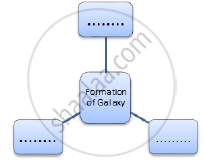
(A3)
(a) Find out similar words from the passage. 01
(i) mass (ii) happenings
(b) Give the verb form of the given words. 01
(i) classified (ii) directions
(A4) Identify and name the clause. 02
Scientists believe that the galaxies were formed from the lumps of matter.
(A5) Can there be life in another galaxy? Give reasons for your answer. 02
(B) Read the passage given in Q. 4 (A) and write the summary of it. Suggest a suitable title to your summary. (05)
On this historic moment, I stand here to thank Pandit Jawaharlal Nehru. India’s present epoch maker has come over here to bless the state of Maharashtra which is definitely going to last forever. On behalf of thousands of common people, I express my deep sense of gratitude to him for blessing us. We Maharashtrians love him, worship him. And once again, I wish to declare that this state of Maharashtra, recently formed, will work for the betterment of the common people of Maharashtra, but if it comes to sacrifice, whatever best and grand we have, it will be done primarily for India. This is so, because, we believe from the beginning, that Maharashtra depends on India; its greatness depends on the greatness of India. All Maharashtrians believe that both India and Maharashtra can progress only when there is oneness of interest. And, therefore, I have made this clear by bringing to your notice the significance of certain symbols, for example, the Himalayas stand for lndia and the Sahyadri, for Maharashtra. The snowy Himalayas with the highest mountain ranges symbolise India and the Sahyadri with the blackest rock structure and with 200-300 inches rainfall symbolise Maharashtra. I promise you that if the Himalayas are in jeopardy, the Sahyadri of Maharashtra will use its black rock structure like a shield to protect the Himalayas.
‘Hard labour’ is the watch word of our times. And, Panditji, you have given us the message of building Maharashtra and our nation by hard labour. We are going to inscribe this valuable message on our minds and try our best to look at your blessings and your guidance, as the blessings and guidance of an epoch maker.
A1 . Read the following statements. Find out the correct statements and write them down : (2)
(i) Both India and Maharashtra can progress if they have different interests.
(ii) Hard work is the only way to build the future of India and Maharashtra.
(iii) The sacrifice of the best and grand in Maharashtra will be made for the state of Maharashtra.
(iv) In times of great calamity the Sahyadri will protect the Himalayas, like a shield.
A2. Complete the following statements : (2)
(i) The interest of Maharashtra and that of India should be one for the progress of Maharashtra state, because ................
(ii) Maharashtra depends on India, because ................
A3.Complete the table : (2)
| The name of the mountain | Stands for | The reason |
| The Himalayas The Sahyadri |
A4. Vocabulary - (2)
Give antonyms of the following words by adding prefixes :
(i) gratitude
(ii) clear
(iii) believe
(iv) significance
A5. Personal response - (2)
Give your suggestions that will help the people to make Maharashtra prosperous.
A6. Grammar - (2)
Rewrite the following sentences in the ways instructed :
(i) India and Maharashtra can progress only when there is oneness of interest.
(Rewrite it using ‘unless’)
(ii) This state of Maharashtra will work for the betterment of the common people of Maharashtra.
(Rewrite it using modal auxiliary showing ‘obligation’)
Read the following extract and complete the note given below :
The small village of Somnathpur contains an extraordinary temple, built around 1268 A.D by the Hoyasalas of Karnataka - one of the most prolific temple builders. Belur and Helebid are among their better-known works. While these suffered during the invasion of the 14th century, the Somnathpur temple stands more or less intact in near-original condition. The small temple captivates with the beauty and vitality of its detailed sculpture, covering almost every inch of the walls, pillars and even ceilings. It has three Shikhars and stands on a star-shaped raised platform with 24 edges. The outer walls have a profusion of detailed carvings: the entire surface run over by carved plaques of stone: There were vertical panels covered by exquisite figures of God and Goddesses, with many incarnations being depicted. There were nymphs too some carrying an ear of maize, a symbol of plenty and prosperity. The elaborate ornamentation, very characteristic of Hoyasala sculptures was a remarkable feature. On closer look and it is worth it-the series of friezes on the outer walls revealed intricately carved caparisored elephants, charging horsemen, stylized flowers and warriors.
Somnathpur Temple
(1) Location : ___________
(2) Year : 1268 A.D.
(3) Built by : ___________
(4) Captivates with : ___________
(5) Structural features :
(i) Three Shikhars
(ii) Star-shaped platform with 24 edges
(iii) Outer wall carvings, ___________
charging horsemen, __________ and warriors.
(iv) Nymphs-symbol of ___________
Read the extract and do the activities that follow:
My mother was still managing Green's, even though its days were numbered. The day after my return I joined her in the small office, where she sat behind her over-large desk, telephone on her right and the latest paperback western before her, ready to be taken up when noting much was happening – which was fairly often. My mother enjoyed reading westerns-particularly Luke Short, Max Brand, and Clarence E Mulfordmuch in the same way that I enjoyed detective fiction. Both genres were freely available in cheap collins ‘White Circle’, edition published during and just after the War.
We discussed the affair of the skeleton in the cupboard, but as there was no longer any mystery about it, there was nothing for me to investigate. However, armed with the key to the store room, I went down to the basement on my own and made a thorough search of all the old furniture, on the offchance that another skeleton moght tumble out of a cupboard or be found jammed into a drawer or trunk. I did find some old tennis rackets, back numbers of Punch, a cracked china chamber-pot, some old postcards of Darjeeling and Simla, and a framed photograph of King Edward the Seventh. I took the copies of ‘Punch’ to my room and read the reviews of all the plays that had been running in London between 1926 and 1930, thus becoming an authority on the theatre in England of that period.
A1. True/False
State whether the following statements are true or false:
(i) The narrator found one skeleton jammed into a drawer
(ii) The narrator did not like to read detective fiction
(iii) The narrator's mother was managing the Green's hotel
(iv) The narrator wanted to be an authority on the English theatre of that period
A2. Write a gist :
Write a gist of the above given extract in about 50 words.
Read the following passage and do the given activities :
A1. Fill up the blanks with virtues of dogs : (2)
(1) __________
(2) __________
(3) __________
(4) __________
| Human and dogs are inseparable for thousands of years and they are dependent on each other for protection and survival. Relationship between humans and dogs is often characterized by strong emotional bonds which run both way. Dogs are very popular as pets and companions. Dog is the ‘Man’s Best Friend’ and a family member. The dog is one of the most loyal, faithful and devotee animal. In earlier days dogs were kept mainly for hunting and guarding; now they are kept for companionship, protection and showmanship. There are millions of people all over the world who are dog lovers Puppies need more attention at the, early age. As much as possible try many methods of socialization, such as playing with them, taking them for walk, expose them to crowds, make them to obey the orders etc. |
A2. Methods of socialization of puppies are : (2)
(1) …......................
(2) …......................
(3) …......................
(4) …......................
A3. Cross out the odd man : (2)
(i) Inseparable, dependent, protection, popular.
(ii) Hunting. guarding, playing, petting.
(iii) Earlier, human, relationship, family
(iv) Often, mainly, now, emotional
A4.
(1) There are millions of people all over the world. (1)
(Pick out the determiners and write them)
(2) Puppies need more attention. (1)
(Rewrite the sentence without changing its meaning beginning with : Puppies don’t ….....)
A5. Should we ban keeping pets ? Justify. (2)
Read the passage given below and answer the questions that follow:
| 1 |
As a novelist and storyteller, I have always drawn upon my memories of places that I have known and lived in over the years. More than most writers, perhaps, I find myself drawing inspiration from the past — my childhood, adolescence, youth, early manhood ... But to talk of my early inspiration I must go back to my very beginnings, to the then small, princely state of Jamnagar, tucked away in the Gulf of Kutch. Here my father started a small palace school for princesses. I was there till the age of six, and I still treasure vivid memories of Jamnagar's beautiful palaces and sandy beaches. |
| 2 | Some of these landmarks are preserved for me in photographs taken by my father, which I have to this day. An old palace with pretty windows of coloured glass remained fixed in my memory and many years later gave me the story, “The Room of Many Colours”, which also inspired an episode in a TV serial called Ek Tha Rusty. I spent a memorable year and a half with him in New Delhi, then still a very new city — just the capital area designed by Edwin Lutyens and Connaught Place, with its gleaming new shops and restaurants and cinemas. I saw Laurel and Hardy films and devoured milkshakes at the Milk Bar, even as the Quit India Movement gathered momentum. |
| 3 | When I was seventeen, I was shipped off to the UK to “better my prospects” as my mother put it. Out of longing for India and the friends I had made in Dehra came my first novel — The Room on the Roof — featuring the life and loves of Rusty, my alter ego. In the 1950s everyone travelled by sea, as air services were still in their infancy. A passenger liner took about three weeks from Southampton to Bombay (now Mumbai). After docking in Bombay, I took a train to Dehra, where I stepped onto the platform of the small railway station and embarked on the hazardous journey of a freelance writer. Railway stations! Trains! Platforms! I knew as long as these were there I would never run out of stories. |
| 4 | I also looked for inspiration in tombs and monuments and the ever-expanding city, but did not find it, and my productivity dropped. Escape from Delhi had become a priority for me. I felt drawn to the hills above Dehra. On the outskirts of Mussoorie I found a small cottage, surrounded by oak and maple trees where the rent, thankfully, was nominal. : |
| 5 |
I'm of the opinion that every writer needs a window. Preferably two Is the house, the room, the situation ... important for a writer? A good wordsmith should be able to work anywhere. But to me, the room you live in day after day is all-important. The stories and the poems float in through my window, float in from the magic mountains, and the words appear on the page without much effort on my part. Planet Earth belongs to me. And at night, the stars are almost within reach. |
1. On the basis of your understanding of the above passage, answer any four of the following questions in 30 - 40 words each:
- What does the writer remember about Jamnagar?
- How did he spend time in Delhi?
- What was the inspiration for the first novel and why?
- What was the importance of trains and railway stations in his life?
- What was the importance of a window in the writer’s life?
2. On the basis of your understanding of the above passage, fill in any two of the following blanks with appropriate words/phrases:
- He was shipped off to UK for ______.
- Everyone travelled by sea because ______.
- The productivity dropped because ______.
3. Find out words/phrases from the passage that mean the same as the following. Attempt any two.
- gulped down/swallowed (para 2)
- early stage (para 3)
- attracted to (para 4)
Read the following extract and answer the questions given below:
In 1945 in Bay Roberts, Canada, a 12- year old boy saw something in a shop window that set his heart racing. But the price - five dollars- was far beyond Reuben Earle's means. Five dollars would buy almost a week's groceries for his family.
Reuben couldn't ask his father for the money. everything Mark Earle made fishing. Reuben's mother. Dora, stretched like elastic to feed and clothe their five children.
Nevertheless, he opened the shop's weathered door and went inside. Standing proud and straight in his flour-sack shirt and washed out trousers, he told the shopkeeper what he wanted, adding, "but I don't have the money now. can you please hold it for me?"
"I will try," the shopkeeper smiled. "Folks around here don't usually have that kind of money to spend on things. It should keep for a while."
Reuben respectfully touched his worn cap and walked out into the May sunlight. The bay rippled in a freshening wind that ruffled his short hair. There was purpose in his loping stride. He would raise the five dollars and not tell anybody.
Hearing the sound of hammering from a side street. Reuben had an idea.
He ran towards the sound and stopped at a construction site. People built their own homes in Bay Roberts, using nails purchased in burlap sacks from a local factory. Sometimes the sacks were discarded is the flurry of building, and Reuben knew he could sell them back to the factory for five cents apiece.
Questions:
(1) What is the passage about?
(2) What did Reuben ask the shopkeeper? What was the shopkeeper's reply?
(3) Why could not Reuben ask his father for five dollars?
(4) How do you express your love and respect for your parents?
(5) Rewrite the following sentences in the ways instructed:
i. He opened the shop's weathered door and went inside. (Make it simple)
ii. "I will try."
(Rewrite the sentence using another modal Auxiliary showing 'obligation'.)
iii. People built their own homes in Bay Roberts.
(Frame a Wh question to get the underlined part as ita answer)
(6) Give the opposite words of:
(i) respectfully
(ii) Usually
Read the following extract and answer the questions given
below:
Another relative has no plans of joining this league though.
She is rather μnabashed about waking up past noon on a daily basis. To be fair, her husband is a media personality who typically arrives home from work past midnight. That does indeed give them sufficient justification to stay longer in slumber-land each morning. This practice does lead to certain oddities though. He goes for his 'morning' walk at 1 pm, heatwaves and appalled onlookers notwithstanding. They once returned from a night out only to meet the neighbour's son who was off on an early morning jog!
Early risers clearly have the edge in life. By the time most
of us wake up, they've been through their morning rituals, enjoyed their walk, had their tea and read the daily news. They're also likely to have made long-distance calls before dawn to those similarly inclined. Thus, by the time the sun warms up they're likely to have discussed all varieties of 'men, matters, and affairs' with a dozen people.
The upshot of these varying tendencies is that such extreme
contrasts often exist in the same household. Weeks pass before
the younger lot (typically late risers) and the older lot (normally early birds) come face to face. It's almost as if they live in different time zones and different countries.
Questions:
(1) What information does the extract give about the typical
routine of a media person?
(2) According to the writer, who are the early risers and the late risers?
(3) Why does the writer say that early risers clearly have the edge in life?
(4) Do you rise early or late? Why?
(5) Rewrite the following sentences in the ways instructed:
- They live in different time zones and different countries.
(Rewrite the sentence using 'not only- but also'.) - That gives them sufficient justification.
(Rewrite the sentence using the Present Perfect tense.) - She is rather unabashed about waking up past noon on a daily basis.
(Rewrite the sentence using 'infinitive' form of
the underlined word.)
(6) Find out from the extract the words which mean:
(i) frightened
(ii) sleep
Read the following extract and answer the questions given below :
Reuben arrived at the factory. The sack buyer was about to lock up.
"Mister! Please don't close up yet." The man turned and saw Reuben, dirty and sweat-stained.
"Come back tomorrow, boy."
"Please, Mister. I have to sell the sacks now-please." The man heard a tremor in Reuben's voice and could tell he was close to tears.
"Why do you need this money so badly?"
"It's a secret."
The man took the sacks, reached into his pocket and put four nickels into Reuben's hand. Reuben murmured a quiet thank-you and ran home.
Then, clutching the tin can, he headed for the store.
"I have the money" he solemnly told the owner, pouring his coins onto the counter.
The man went to the window and retrieved Reuben's treasure. He wiped the dust off and gently wrapped it in brown paper. Then he placed the parcel in Reuben's hands.
Racing home, Reuben burst through the front door. His mother was scrubbing the kitchen range. "Here Mum!Here!" Reuben exclaimed as he ran to her side. He placed a small box in her work-roughened hand.
She unwrapped it carefully, to save the paper. A blue-velvet jewel box appeared. Dora lifted the did, tears beginning to blur her vision.
In gold tettering on a small, almond-shaped brooch was the word 'Mother'
It was Mother's Day, 1946
Dora had never received such a gift; she had no finery except her wedding ring. Speechless, she smiled radiantly and gathered her son into her arms.
(1) Why did Reuben insist on the sack buyer to buy his sacks that day only?
(2) How did the mother react when Reuben gave her the gift?
(3) In what way was Reuben's gift special to his mother?
(4) What do you plan to do on Mother's Day?
(5) Rewrite the following sentences in the ways instructed :
(i) I have to sell the sacks.
(Rewrite it replacing the underlined part with the modal auxiliary showing 'compulsion'.)
(ii) She smiled radiantly and gathered her son into her arms. (Use 'As soon as'.)
(iii) She unwrapped it carefully.
(Rewrite the sentences using the noun form of the underlined word.)
(6) Find out the words/phrases from the extract which mean:
(i) showing joy (ii) got back
Read the extract and do the activities that follow :
When Rosalind heard about Orlando's wound and saw the handkerchief stained with his blood, she also fainted; and later she told Oliver that she was really Rosalind, and loved Orlando dearly. Oliver had already fallen in love with gentle Celia, and he persuaded the two girls to accompany him to Duke Senior's court. Rosalind, however, wanted to play one more trick as Ganymede, so she made Oliver promise not to tell anyone that the young shepherd boy and his sister Aliena were really Rosalind and Celia.
And so Aliena and Ganymede were introduced to the old Duke, and he did not recognize his daughter, although he remarked on Ganymede's likeness to Rosalind.
Then the "shepherd boy" told Orlando and the Duke that he could find Rosalind and would bring her to them, making the Duke promise that he would allow his daughter to marry Orlando. she and Celia ran quickly to the shepherd's cottage, changed into their own clothes and removed the brown stains from their faces. Then they returned to the Duke, where they were welcomed with great rejoicing.
'To you, I give myself, for I am yours,' Rosalind said to the Duke, her father. Then she turned to Orlando and said: 'To you, I give myself, for I am yours.'
Rosalind and Orlando were married at once in the forest and on the same day Oliver who was no longer selfish and wicked, married Celia. Just as they were going to be married, a messenger came to ask Duke Senior to go back to his dukedom. Celia's father, Duke Frederick, had mended his wicked ways and asked his brother to return.
A1. True/False :
Choose the true statements from those given below and write them down :
(i) Rosalind played the role of a shepherd boy Ganymede.
(ii) Senior Duke recognised his daughter, Celia.
(iii) Oliver married Rosalind.
(iv) Duke Frederick had mended his wicked ways.
A2. Convert into a dialogue :
Convert the above extract into a dialogue form.
(A) Read the following extract and answer the questions given below:
One afternoon in 1977, as his parents and two brothers fished in the Gulf of Mexico, 12-year old Michael Dell sat on the beach. painstakingly putting together a trotline - a maze of ropes to ''which several fish hooks could be attached."You're wasting your time," the rest of the family called to Michael, as they pulled in fish. "Grab a pole and join in the fun."
Michael kept working. It was dinner time when he finished, and everyone else was ready to call it a day. Still, the youngster
cast the trotline far into the water. anchoring it to a stick that he plunged deep in the sand.
Over dinner, his family teased young Michael about coming away empty-handed. But afterward, Michael reeled in his trotline, and on the hooks were more fish than the others had caught all together!
Michael Dell has always been fond of saying, "If you think you have a good idea, try it!" And today, at 29 he has discovered the power of another good idea that has helped him rise in just a few years from teen to a tycoon. He has become the fourth-largest manufacturer of personal computers in America and the youngest man ever to head a Fortune 500 corporation.
(1) What were Michael Dell’s achievements at his age of 29?
(2) What is the secret of Michael Dell’s Success?
(3) How did Michael surprise his family members?
(4) Do you think trying new ideas can make your life successful? How?
(5) Rewrite the following sentences in the ways instructed:
(i) He has discovered the power of another good idea.
(Rewrite the sentence beginning with 'The power of ...' )
(ii) Michael Dell sat on the beach.
(Rewrite it using past perfect continuous tense.)
(iii) The youngster cast the trotline.
(Frame a Wh-question to get the underlined part as
its answer.)
(6) 'Grab a pole and join in the fun'.
Pick out the contextual meaning of the underlined word from
the options are given below:
(i) smash
(ii) hold firmly
(iii) throw away
Read the passage given below :
Globalization
Globalization is the way to open businesses, improve technological growth, economy, etc, at the international level for all countries. It is the way in which manufacturers and producers of the products or goods sell their products globally without any restriction. It provides huge profits to the businessmen as they get 1ow cost labor in poor countries easily. It provides a big opportunity for companies to„ deal with the worldwide market.
Globalization helps to consider the whole world 'as a single market. Traders are extending their areas of business by treating the world as a global village. Earlier till the 1990s, there was a restriction on importing certain products that were already manufactured in India like agricultural products, engineering goods, food items, and toiletries. However, during the 1990s there was pressure from. the rich countries on the poor and developing countries to allow them to spread their businesses by opening their markets. In India, the globalization and liberalization process was started in 1991.
After many years, globalization brought about a major revolution in the Indian market when multinational brands came to India and started delivering a wide range of quality products at cheap prices. Prices of good quality products came down because of the cutthroat competition in the market.
Globalization and liberalization of the businesses in India have flooded the market with quality foreign products but have affected the local Indian industries adversely to a great extent resulting in job loss to poor and uneducated workers. Globalization has been a bonanza for the consumers, however, a loss to the small-scale Indian producers.
Globalization has had some very positive effects on the Indian consumer in all sectors of society. It has affected the Indian students and education sector to a great extent by making study books and a lot of information available over the internet. The collaboration of foreign universities with Indian universities has brought about a huge change in the field of education.
Globalization of trade in the agricultural sector has brought varieties of quality seeds that have disease resistati8e; property. However, it is not good for the poor Indian farmers because the seeds and agricultural technologies are costly.
It has brought about a huge revolution in the employment sector by the spread of businesses like cottage, handloom, carpet, artisan carving, ceramic, jewelry, and glassware, etc
(a) What is globalization?
(b) Write any two advantages of globalization.
(c) What was the pressure from the rich countries in the 1990s?
(d) What is the effect of multinational brands entering the Indian market?
(e) How are the prices of quality products affected due to globalization?
(f) How have foreign products affected the local industry adversely?
(g) What has been the impact of globalization on Indian students?
(h) Why has globalization had a negative effect on the poor Indian farmer?
(i) How has the cottage industry benefited from globalization?
Read the following passage carefully:
|
On the basis of your reading of the above passage, answer the following question:
- The Dancing Girl belongs to:
- Mohenjo-Daro
- Greek culture
- Homo sapiens
- Tibet
- In the museum she’s kept among:
- dancing figures
- bronze statues
- terracotta animals
- books
- Which information is not given in the passage?
- The girl is caged behind glass.
- She is a rare artefact.
- School books communicate the wealth of our heritage.
- She cannot be rediscovered as she’s bronze.
- ‘Great Art’ has power because:
- It appeals to us despite the passage of time.
- It is small and can be understood.
- It’s seen in pictures and sketches.
- It’s magnified a million times.
- The jewellery she wears:
- consists of only bangles of shell or ivory or thin metal.
- is a necklace with two pendants.
- both (i) and (ii) are correct.
- neither (i) nor (ii) is correct.
- She reminds us:
- of the never-say-die attitude of humans.
- why museums in our country are exciting.
- why she will make us come into money.
- of dancing figures.
- The synonym of the word “among” in para 1 is ______.
- The size of the dancing girl is equal to the length of the human palm. (True/False)
Read the passage carefully:
|
2.1 On the basis of your understanding of the above passage, answer the following questions in 30-40 words each:
- Write one advantage and one disadvantage of allowing every family member to be part of the decision-making process.
- In today’s world, what are parents asking their kids?
- Which two pieces of advice does the writer give to the parents?
- The passage supports the parents. How far do you agree with the author’s views? Support your view with a reason.
2.2 On the basis of your reading of the above passage, answer the following:
- The synonym of ‘hurt’ as given in paragraph 2 is ______.
- The word, which means the same as a style or method of cooking in paragraph 4, is:
- cuisine
- gourmet
- gastric
- science
- The antonym of ‘agreeable’ as given in paragraph 5 is ______.
- The antonym of ‘simple’ as given in paragraph 6 is:
- difficult
- complicated
- easy
- tricky
Read the passage given below carefully and answer the questions that follow.
1. Overpowering prey is a challenge for creatures that do not have limbs. Some species like Russell's viper inject poison. Some others opt for an alternative non-chemical method – rat snakes, for instance, catch and push their prey against the ground, while pythons use their muscle power to crush their prey to death. But snakes can't be neatly divided into poisonous and non-poisonous categories.
2. Even species listed as non-poisonous aren't completely free of poison. The common Sand Boa, for instance, produces secretions particularly poisonous to birds. So the species doesn't take any chance – it crushes its prey) and injects poison as an extra step.
3. Do vipers need poison powerful enough to kill hundreds of rats with just one drop? After all, they eat only one or two at a time.
4. While hunting animals try their worst to kill most efficiently, their prey uses any trick to avoid becoming a meal, such as developing immunity to poison.) For instance, Californian ground squirrels are resistant to Northern Pacific rattlesnake poison.
5. Competition with prey is not the only thing driving snakes to evolve more and more deadly poison. Snakes also struggle to avoid becoming prey themselves.
6. Some snake killers have partial immunity to poison. Famously, mongooses are highly resistant to cobra poison, and with their speed and agility, kill snakes fearlessly. It would be the death of cobras as a species if they didn't evolve a more deadly poison to stop mongooses.
7. Poison has another important role. It's an extreme meat softener, specific enzymes break up the insides of the prey. Normally, a reptile depends on the sun's warm rays to aid digestion.
8. But I wonder if we cannot use venom in our favour. In remote parts of India, local hospitality often involves leather tough meat. I chew and chew until my jaws ache. If I spit it out or refuse, our hosts would be offended, I swallow like a python stuffing a deer down its throat and hope I don't choke. If only I had poison.
(b) How does Sand Boa kill its prey?
(c) There is a constant tussle between the hunting animal and its prey? Why?
(e) What difficulty does the writer face when he is entertained in the remote parts of India?
2.2 On the basis of your reading of the above passage fill in any two of the following blanks.
b. humans
c. a python
d. prey
b. hardens
c. softens
d. breaks down
iii. Californian squirrels are ______________ rattlesnake poison.
a. afraid of
b. helpless against
c. resistant to
d. indifferent to
a. Liquid substances released from glands (para 2)
c. Particular (para 7)
Read the passage given below:
During our growing up years we as children were taught both at home and school-to worship the photos and idols of the gods of our respective religions. When we grow a little older, we were to read holy books like The Bhagwad Gita, Bible, and Quran; we were told that there are a lot of life lessons to be learned from these holy books. We were then introduced to stories from our mythologies which taught us about ethics and morality-what is good and what is bad I also learned to be respectful towards my parents who made my life comfortable with their hard work and love and care, and my teachers who guided me to become a good student and a responsible citizen.
Much later in life, I realised that though we learn much from our respective holy books, there is a lot to learn from our surroundings. This realization dawned upon me when I learned to enquire and explore. Everything around us- the sun, the moon, the stars, rain, rivers, stones, rocks, birds, plants, and animals-teach us many valuable life lessons.
No wonder that besides the scriptures in many cultures nature is also worshipped. The message that we get is to save our environment and maintain ecological balance. People are taught to live in harmony with nature and recognize that there is God in all aspects of nature.
Nature is a great teacher. A river never stops flowing. If it finds an obstacle in its way in the form of heavy rock, the river water fights to remove it from its path or finds an alternative path to move ahead. This teaches us to be progressive in life, and keep the fighting spirit alive.
Snakes are worshipped as they eat insects in the field that can hurt our crops, thus protecting the grains for us. In fact, whatever we worship is our helper and makes our lives easy for us. There are many such examples in nature, but we are not ready to learn a lesson, Overcome with greed, we are destroying nature. As a result, we face natural disasters like drought, floods, and landslides. We don't know that nature is angry with us.
However, it is never too late to learn. If we learn to respect nature the quality of our life will improve.
2.1 Answer briefly the following questions:
(a) What are we taught in our childhood and growing up years?
(b) Why should we respect our parents and teachers?
(c) What message do we get when we worship nature?
(d) How does a river face an obstacle that comes in its way?
2.2 Choose meanings of the words given below with the help of options that follow:
(e) guided
(i) answered
(ii) advised
(iii) fought
(iv) polished
(f) explore
(i) search
(ii) frequent
(iii) describe
(iv) request
(g) valuable
(i) proper
(ii) desirable
(iii) available
(iv) useful
(ii) friendship
(iii) discomfort
(iv) honesty
Read the passage given below and answer the questions that follow:
| 1. | A fisherman, enfeebled with age, could no longer go out to sea so he began fishing in the river. Every morning he would go down to the river and sit there fishing the whole day long. In the evening he would sell whatever he had caught, buy food for himself and go home. It was a hard life for an old man. One hot afternoon while he was trying to keep awake and bemoaning his fate, a large bird with silvery feathers alighted on a rock near him. It was Kaha, the heavenly bird. “Have you no one to care for you, grandpa?” asked the bird. “Not a soul.” “You should not be doing such work at your age,” said the bird. “From now on I will bring you a big fish every evening. You can sell it and live in comfort.” True to her word, the bird began to drop a large fish at his doorstep every evening. All that the fisherman had to do was take it to the market and sell it. As big fish were in great demand, he was soon rolling in money. He bought a cottage near the sea, with a garden around it and engaged a servant to cook for him. His wife had died some years earlier. He had decided to marry again and began to look for a suitable woman. |
| 2. | One day he heard the royal courtier make an announcement. Our king has news of a great bird called Kaha,” said the courtier. “Whoever can give information about this bird and help catch it, will be rewarded with half the gold in the royal treasury and half the kingdom!” The fisherman was sorely tempted by the reward. Half the kingdom would make him a prince! |
| 3. | “Why does the king want the bird,” he asked. “He has lost his sight,” explained the courtier. “A wise man has advised him to bathe his eyes with the blood of Kaha. Do you know where she can be found?” “No…I mean …no, no…” Torn between greed and his sense of gratitude to the bird, the fisherman could not give a coherent reply. The courtier, sensing that he knew something about the bird, informed the king. The king had him brought to the palace. |
| 4. | “If you have information about the bird, tell me”, urged the king. “I will reward you handsomely and if you help catch her, I will personally crown you king of half my domain.” “I will get the bird for you,” cried the fisherman, suddenly making up his mind. “But Kaha is strong. I will need help. The king sent a dozen soldiers with him. That evening when the bird came with the fish, the fisherman called out to her to wait. “You drop the fish and go and I never get a chance to thank you for all that you‘ve done for me," he said. “Today I have laid out a feast for you inside. Please alight and come in. Kaha was reluctant to accept the invitation but the fisherman pleaded so earnestly that she finally gave in, and alighted. The moment she was on the ground, the fisherman grabbed one of her legs and shouted to the soldiers hiding in his house to come out. They rushed to his aid but their combined effort could not keep Kaha down. |
| 5. | She rose into the air with the fisherman still clinging to her leg. By the time he realised he was being carried away, the fisherman was too high in the air to let go. He hung on grimly, and neither he nor Kaha was ever seen again. |
Based on your understanding of the above passage, answer the questions.
- Why did the fisherman start fishing in the river?
- How did the fisherman spend the day before he met Kaha?
- How did the fisherman betray Kaha?
- Why was the fisherman doubtful about revealing information about Kaha to the courtier?
Read the passage given below.
|
5 |
Technology is making advancements at a rapid rate but at the cost of a valued tradition - the crafts industry. The traditional crafts industry is losing a lot of its trained and skilled craftsmen. With that, the art of embellishing brass and copper utensils with fine engravings is also disappearing. The government has identified around 35 crafts as a languishing craft. |
|
10 |
The speciality of handcrafted items is their design, an association with long traditions belonging to a specific region. The word ‘handcrafted’ does not imply the involvement of dexterous human fingers or an agile mind with a moving spirit anymore. Lessening drudgery, increasing production and promoting efficiency have taken precedence. The labour-saving devices are taking the place of handcrafted tools and this has jeopardized the skills of these artisans. |
|
15 |
Mechanisation has made its way into everything - cutting, polishing, edging, designing etc. Ideally, the use of machinery should be negligible and the handicrafts should be made purely by hand with a distinguishable artistic appeal. However, with the exception of small-scale industries, the export units are mostly operated by machines. The heavily computerised designs contribute to faster production at lower costs. |
|
20 |
Although mechanization of crafts poses a challenge to safeguarding traditional crafts, the artisans are lured with incentives in order to impart handicrafts training. Some makers do see machines as a time-saving blessing since they are now able to accomplish difficult and demanding tasks with relative ease. These machines might give a better 25finesse to these products but they don’t stand out as handcrafted. The quantity has overtaken quality in this industry. |
|
30 |
A need to highlight the importance of the handmade aspect is required by both the government and private sectors, in order to amplify awareness and also support the culture of making handicrafts. A few artisans are still trying their best to rejuvenate and revive their culture and heritage but it’s an uphill task competing with the machine-made goods. A multitude of artisans have changed their professions and are encouraging their progeny to follow suit. There are others who have stayed their ground but are clearly inclined towards buying machines. |
|
35 |
Nearly two decades ago, there were around 65 lakh artisans in the country. Three years ago, when the government started the process of granting a unique number to the artisans based on the Aadhaar card, 25 lakhs were identified. Loss of traditional crafts is clearly a worrying issue, but it stands to reason that forcing any artisan to follow old ways when concerns of livelihood overrule other considerations, is unfair. |
Based on your understanding of the passage, answer the questions given below.
- What does the writer mean by calling handicrafts a ‘valued tradition’?
- Rewrite the following sentence by replacing the underlined phrase with a word that means the same from lines 5-15.
If it continues, the workcation (work + vacation) trend will be a powerful boost to domestic tourism operators failing to make progress in the economic slump caused due to the pandemic. - State any two reasons why artisans are choosing to work via machines rather than handcrafted tools.
- Why do the artisans need to be ‘lured with incentives’ to impart handicrafts training?
- List one likely impact of the support of government and private sectors towards the culture of making handicrafts.
- How does the writer justify an artist’s act of abandoning her/his traditional craft for a more lucrative option?
Read the passage given below.
| 5 | Changing food preferences have brought about rapid changes in the structure of the Indian diet. The rapid proliferation of multinational fast food companies and the influence of Western culture have replaced traditional home-cooked meals with ready-to-eat, processed foods thus increasing the risk of chronic diseases in urban Indians. Therefore, nurturing healthy eating habits among Indians from an early age would help to reduce health risks. |
| 10 | To date, little is known about the quality and quantity of foods and beverages consumed by urban Indian adolescents. This lack of evidence is a significant barrier to the development of effective nutrition promotion and disease prevention measures. |
|
15
20
|
Therefore, a self-administered, semi-quantitative, 59-item meal-based food frequency questionnaire (FFQ) was developed to assess the dietary intake of adolescents. A total of 1026 students (aged 14-16 years) attending private, English-speaking schools in Kolkata completed the survey. A sample percentage of the food consumption pattern is displayed.
The survey results report poor food consumption patterns and highlight the need to design healthy eating initiatives. Interestingly, while there were no gender differences in the consumption of legumes and fried snacks, the survey found more females consumed cereals, vegetables and fruits than their male counterparts. |
| 25 | In conclusion, the report suggested that schools ought to incorporate food literacy concepts into their curriculum as they have the potential of increasing the fruit and vegetable intake of teenagers. Additionally, healthy school canteen policies with improved availability, accessibility, variety and affordability of healthy food choices would support the consumption of nutritious food in students. |

Based on your understanding of the passage, answer the questions given below.
- What does the researcher mean by ‘changing food preferences'?
- Why was this survey on the food consumption of adolescents undertaken?
- With reference to the above figure, write one conclusion about students' consumption of energy-dense drinks.
- What can be concluded from the ‘no intake’ data of fruit consumption versus energy-dense snacks, with reference to the above figure?
- There were gender differences observed in the consumption of healthy foods, according to the survey. Substantiate.
- Why is ‘affordability’ recommended as a significant feature of a school canteen policy?
- Identify a word from lines 9-18 indicating that the questionnaire was specifically designed to be completed by a respondent without the intervention of the researcher collecting the data.
Read the following passage and do the activities.
A1. Complete the following sentences.
- Vegetarianism has not spread as desired because ______.
- Vegetarians are of various types ______.
|
Vegetarianism promotes a natural way of life. But despite its implicit message of universal love and nonviolence, it has not spread as it should have. This may be because it usually is an inward looking habit and is best cultivated in the mind. Leading a vegetarian way of life helps the animal kingdom to coexist with man. The animals supply milk, manure and energy. This has been central to Indian culture for thousands of years. A vegetarian lifestyle is natural, multifaceted and helps preservation in a healthy way. Food and health are closely related. Vegetarians are of various types. There are lacto-vegetarians who consume dairy products; Lacto-ovo-vegetarians include eggs in addition to dairy products. Vegans are pure vegetarians who do not consume any food derived from animals. The Western science of food considers food as something to sustain only the human body, whereas Indian science considers food as something which sustains not only the body, but also maintains the purity of heart, mind and soul. Thus, an item of food which is injurious to the mind is not considered to be fit for consumption, even if it is otherwise beneficial to the body or satisfies the taste. Indian food science does not give so much importance to protein or even to a balanced diet but it gives importance to food that increases the strength of the body and its vitality. Vegetarian foods provide an infinite variety of flavours whereas non-vegetarian foods have hardly any taste of their own. In fact, non-vegetarian foods have to be seasoned with ingredients from the vegetable kingdom to make them palatable. |
A2. What is the importance of eating vegetarian food?
A3.
- Pick out two adjectives from the given passage.
- Find words in the passage which mean the following:
- Indirect
- Tasty
A4. Convert the following sentence to negative without changing the meaning.
Leading a vegetarian way of life helps the animal kingdom to coexist with man.
A5. Why do you think vegetarianism is being promoted on a global level? Justify with your response.
Read the passage given below.
| 1 | Mountains have always been held in great awe by mankind. They have been a challenge to humans. Those brave among us have always wanted to conquer them. You see, the more incredible the mountains, the greater the thrill – a challenge to the bravery of the human race. Climbing mountains is an experience that is hard to put into words. You are in a beautiful environment and, when you reach the top, you feel incredible. But you also have to climb down, which is when most accidents happen – people are tired, it gets dark, it’s harder. So, mountain climbing is undoubtedly one of the most popular adventure sports along with being challenging and risky for the climber. |
| 2 | Without any perceived risk, there can’t be a feeling that any significant challenge has been surmounted. Fair, but we have to bear in mind that mountaineering is not a sport that can be embraced without preparation. The enthusiasts must develop in themselves the spirit of adventure, willingness to undertake hardships and risks, extraordinary powers of perseverance, endurance, and keenness of purpose before climbing a mountain. They should also know how to handle mountaineering equipment. Then comes the penance of the rigorous training. This could very well be the lifeline up there. It helps inculcate and hone survival instincts that allow the climber to negotiate perilous situations. There are numerous institutes in India and abroad that offer such training. |
| 3 | Mountain climbers are unanimous in agreeing that unpredictable weather is what they fear the most. There may be sunshine one moment and a snowstorm the other. At higher altitudes, snow is a regular feature and being decisive about setting up camps or proceeding further is crucial. The icy sheets after ice storms make walking treacherous, while the powdery snow makes a mountaineer sink deep into the snow. Up there, where the intention is to embrace Nature’s wonder, one realizes that it cannot be done without facing its formidable glory. A true mountaineer may challenge the mountain, yet is always respectful of the powerful forces of nature. |
| 4 | Summiting mountains carries its own health risks such as oxygen and altitude sickness problems, frost bites, swelling of hands and feet, fluid collection in brain or lungs and exhaustion. Yet, the gratification mountaineers feel from mastering something that is so frightening, urges them to undertake these endeavors. We may think that the mountaineers are fearless, experts say, “Not at all. It’s fear that keeps them so intrigued with such arduous journeys.” Impulse and brazenness can be deadly foes. In the words of the Indian mountaineer, Bachendri Pal, “The biggest risk ... is to not to take the risk at all. Remember that.” |
i. Why does the writer say that mountains inspire ‘awe’ in humans? (Paragraph 1) (1)
- They present us with opportunities for exciting sports.
- They evoke the wish in us, to master them.
- They inspire in us, deeds of valour.
- They represent peace and calm, to us.
ii. Select the option that corresponds to the following relation below: (1)
The more incredible the mountains - the greater the thrill (Paragraph 1)
- The higher the stamina - the lower the food intake
- The more you laugh - the lesser your illness
- The smaller the car - the bigger the advantage
- The heavier the luggage - the higher the penalty
iii. Select the option that displays what the writer projects, with reference to the following: (1)
So, mountain climbing is undoubtedly one of the most popular adventure sports (Paragraph 1)
- doubt
- caution
- conviction
- denial
iv. Complete the following with a phrase from paragraph 1. (1)
| Opinion | Reason |
| ______ | Best experienced rather than described |
v. The writer compares training to penance in the line - Then comes the penance of the rigorous training. (Paragraph 2) (1)
State 1 point of similarity between training and penance.
vi. Based on your reading of the text, list 2 reasons why the writer says that
“mountaineering is not a sport that can be embraced without preparation”. (Paragraph 2) (1)
- ____________
- ____________
vii. What connect does the writer draw out between unpredictable weather and setting up of camps? (Paragraph 3) (1)
viii. The writer says, “A true mountaineer may challenge the mountain, yet is always respectful to the powerful forces of nature.” (Paragraph 3) (1)
Select the reason the mountaineer is respectful to the forces of nature, up in the mountains.
- survival
- experience
- tradition
- directive
ix. justify the following: (1)
While mountain climbing, an impulsive mountaineer is either disaster-prone or as good as dead.
x. Evaluate the Inappropriate reason for the feeling of exhilaration on reaching a summit, that the mountain-climbers experience. (1)
- Achievement of a seemingly impossible feat
- Spectacular panoramic view
- Application of the inculcated survival instincts
- Opportunity to use sophisticated mountaineering equipment
Read the passage given below and answer the questions that follow:
|
1. The Higgs boson has been called, or miscalled, the God particle, enabling it to pass into the realm of popular scientific lore, like the discovery of the smallpox vaccine, the structure of DNA, or the theory of relativity. It would be difficult for most people to understand its significance, just as it would be to comprehend the notion of relativity, but such problems are overcome by locating science in personalities as well as cultural and national traditions. The first thing that you and I know about the Higgs boson is that it’s named after Peter Higgs, a physicist at Edinburgh University who made the discovery - although the original insight, in one of those recurrent back stories of science, was Philip Anderson’s. 2. Still, we have Higgs, and Edinburgh, and western civilisation to fall back on. The rest - “the Higgs boson is a hypothetical elementary particle predicted by the Standard Model of particle physics. It belongs to a class of particles known as bosons ...” - we needn’t worry too much about. But maybe we should worry just enough to ask, “What is a boson?” since the word tends to come up as soon as Higgs does. Is it, an ignoramus such myself would ask, akin to an atom or a molecule? It is, in fact, along with the fermion (named after Enrico Fermi), one of the two fundamental classes of subatomic particles. 3. From Bose The word must surely have some European genealogy. In fact, “boson” is derived from Satyendra Nath Bose, an Indian physicist from Kolkata who, in 1924, realised that the statistical method used to analyse most 19th-century work on the thermal behaviour of gases was inadequate. He first sent off a paper on quantum statistics to a British journal, which turned it down. He then sent it to Albert Einstein, who immediately grasped its immense importance, and published it in a German journal. Bose’s innovation came to be known as the Bose-Einstein statistics and became a basis of quantum mechanics. Einstein saw that it had profound implications for physics; that it had opened the way for this subatomic particle, which he named, after his Indian collaborator, “boson.” Still, science and the West are largely synonymous and coeval: they are words that have the same far-reaching meaning. Just as Van Gogh and Toulouse-Lautrec’s paintings digest the Japanese prints they were responding to so we don’t need to be aware of Japanese prints when viewing the post-impressionists, western science is pristine, and bears no mark of what’s outside itself. 4. Other Indian contributions The last Indian scientific discovery that is universally acknowledged is zero. Indians are very strong at maths, and the only modern Indian who’s remotely part of the western mythology of science is Srinivasa Ramanujan, equally well known for his Hindu idiosyncrasies and his agonised stay in Cambridge as he is for his mathematical genius. 5. Indians can be excellent geeks, as demonstrated by the tongue-tied astrophysicist Raj Koothrappalli in the U.S. sitcom Big Bang Theory; but the Nobel prize can only be aspired to by Sheldon Cooper, the super-geek and genius in the series, for whom Raj’s country of origin is a diverting enigma, and miles away from the popular myth of science on which Big Bang Theory is dependent. Bose didn’t get the Nobel Prize; nor did his contemporary and namesake, J.C. Bose, whose contribution to the fashioning of wireless predates Marconi’s. The only Indian scientist to get a Nobel Prize is the physicist C.V. Raman, for his work on a light at Kolkata University. Other Indians have had to become Americans to get the award. 6. Conditions have always been inimical to science in India, from colonial times to the present day; and despite that, its contributions have occasionally been huge. Yet non-western science (an ugly label engendered by the exclusive nature of western popular imagination) is yet to find its Rosalind Franklin, its symbol of paradoxical success. Unlike Franklin, however, scientists were never in a race that they lost; they simply came from another planet. |
Based on your reading of the passage, answer twelve out of fifteen questions that follow:
(a) What is the first thing which the narrator knows about Higgs Boson?
(b) What is Bose-Einstein statistics?
(c) How does Sheldon view Raj’s country of origin?
(d) What do Van Gogh’s paintings do to Japanese prints?
(e) Has India always got credit for its merit?
(f) What do Higgs Boson have in common with Smallpox vaccine?
- Both are used in medical radiography.
- Both are part of scientific myth and legends now.
- Both were met with scepticism on their discovery.
- Both fetched their teams a Nobel prize.
(g) Which statement is not true about Boson?
- They were not discovered by Enrico Fermi.
- They constitute one class of subatomic particle.
- It is named after an Indian Physicist.
- It was discovered by Satyendra Nath Bose.
(h) Choose the word which is an apt synonym of the word Ignoramus. (used in para 2)
- Idiot
- Intelligent
- Idealist
- Ingenious
(i) How are esoteric scientific concepts made understandable for people?
- By printing short introductory courses.
- By comparing it with other scientific discoveries.
- By locating science in personalities, social and cultural traditions. iv. By revising the country’s educational structure.
(j) Based on the reading of the passage, which statements are correct about Higgs Boson.
- They are called God’s particle.
- Philip Anderson’s study provided the original insight.
- This concept is easily understood by common people.
- A physicist from Edinburgh University made the discovery.
- It was discovered by Albert Einstein.
- 1, 2 & 3
- 2, 3 & 5
- 1, 4 & 5
- 1, 2 & 4
(k) Which field of Physics was SN Bose working on?
- Quantum Mechanics
- Electromagnetism
- Geophysics
- Acoustic
(l) Which scientist/mathematician out of the following won the Nobel prize?
- J C Bose
- C V Raman
- Srinivasa Ramanujan
- S N Bose
(m) What is Srinivasa Ramanujan known for in popular culture?
- Mathematical genius.
- For formulation of game theory.
- Hindu Idiosyncrasies.
- Troubled stay in Cambridge.
- For devising another explanation for chaos theory.
- 1, 2 & 3
- 1, 3 & 5
- 1, 3 & 4
- 1, 4 & 5
(n) The conclusion of third paragraph highlights that ______.
- Western art grants recognition to all its inspirations.
- Van Gogh painted Japanese prints.
- Western art subsumes all the influences under it.
- Van Gogh and Toulouse-Lautrec are post-impressionist painters.
(o) Why did JC Bose deserve a Nobel?
- He was an Indian physicist.
- He was the only one researching on wireless.
- His research & findings on wireless started before Marconi.
- He acquired American citizenship.
Based on the careful reading of the passage given below, answer any four out of five questions that follow:
|
Climate change and global warming are the biggest threats of the present time and how the world manages to control pollution will define our future. Rising industrialization, urbanization, deforestation etc., are endangering the natural ecosystem. Since 1880, the earth’s temperature has been rising at a rate of 0.14° F (0.08° C) per decade and the rate of increase has doubled since 1981 at 0.32° F (0.18° C) per decade. The 10 warmest years on record have occurred since 2015, with 2020 recorded as the second-warmest year as per the National Oceanic and Atmospheric Administration (NOAA). With growing economies, global carbon measurements have been rapidly rising for the last 15 years. As per recent data, in January 2022, carbon dioxide (CO2) measurement stood at 418 parts per million, up around 11% from 378 parts per million recorded since 2007. |
(a) What is the key to defining our future?
- The means employed to control pollution.
- The means employed to control resources.
- The means employed to control state policies.
- The means employed to educate masses.
(b) Which of the following elements are not responsible for endangering natural ecosystem?
- Deforestation
- Inflation
- Industrialization
- Urbanization
(c) According to the passage, economy, and carbon emissions have been ______ to each other for last 15 years.
- Inversely proportionate
- Directly proportionate
- Not related
- Disproportionate
(d) Name the institution responsible for observing and recording earth’s temperature over the years.
- National Organic and Atmospheric Administration
- National Oceanic and Atmospheric Administration
- North Organic and Atmospheric Administration
- National Offshore and Atmospheric Administration
(e) Carbon dioxide measurement stood at ______ parts per million in 2007.
- 387
- 378
- 481
- 418
Read the following passage and answer the questions that follow:
| 1. |
Too many parents these days can't say no, As a result, they find themselves raising 'children' who respond greedily to the advertisements aimed right at them. Even getting what they want doesn't satisfy some kids; they only want more. Now, a growing number of psychologists, educators, and parents think it's time to stop the madness and start teaching kids about what's really important: values like hard work, contentment, honesty, and compassion. The struggle to set limits has never been tougher and the stakes have never been higher. One recent study of adults who were overindulged as children paints a discouraging picture of their future: when given too much too soon, they grow up to be adults who have difficulty coping with life's disappointments. They also have a distorted sense of entitlement that gets in the way of success in the workplace and in relationships. |
| 2. |
Psychologists say that parents who overindulge their kids set them up to be more vulnerable to future anxiety and depression. Today's parents themselves raised on values of thrift and self-sacrifice, grew up in a culture where no was a household word. Today's kids want much more, partly because there is so much more to want. The oldest members of this generation were born in the late 1980s, just as PCs and video games were making their assaults on the family room. They think of MP3 players and flat-screen TV as essential utilities, and they have developed strategies to get them. One survey of teenagers found that when they crave something new, most expect to ask nine times before their parents give in. By every measure, parents are shelling out record amounts. In the heat of this buying blitz, even parents who desperately need to say no find themselves reaching for their credit cards. |
| 3. |
What parents need to find, is a balance between the advantages of an affluent society and the critical life lessons that come from waiting, saving, and working hard to achieve goals. That search for balance has to start early. Children need limits on their behaviour because they feel better and more secure when they live within a secure structure. |
| 4. |
Older children learn self-control by watching how others, especially parents act. Learning how to overcome challenges is essential to becoming a successful adult. Few parents ask kids to do chores. They think their kids are already overburdened by social and academic pressures. Every individual can be of service to others, and life has meaning beyond one's own immediate happiness. That means parents eager to teach values have to take a long, hard look at their own. |
Based on your understanding of the passage, answer any eight questions from the nine given below:
- What is challenging for today's parents?
- What will be the consequence of over indulging children?
- Why do parents get caught in the buying blitz?
- How do children learn critical life lessons?
- What is the impact of advertisements on children?
- Why do children need limits on their behaviour?
- How do older children learn self-control?
- Find a word in the passage which means 'research'. (Paragraph 2)
- Find a word in the passage which means 'wealthy'. (Paragraph 3)
Read the passage given below:
| (1) | Ratan, a global brand in Dairy products, works on a business model popularly known as, 'The Ratan Model'. This model aims to provide value for money to the customers and protect the interests of farmers simultaneously. | ||||||||||
| (2) | The Ratan model is a three-tiered structure that is implemented in its Dairy production: Firstly, Ratan acts as a direct link between milk producers and consumers that removes the middlemen. Secondly, farmers (milk producers) control procurement, processing and marketing. Thirdly, it is a professionally managed organization. | ||||||||||
| (3) | One can understand the Ratan Model better by taking cognizance of 'Ratan's Target Audience', where it has targeted the mass market of India with no premium offerings and works on providing the best quality products at affordable prices. | ||||||||||
| (4) | So Ratan formulates its pricing policy on the low cost price strategy which has attracted a lot of customers in the past and it continues to do so. | ||||||||||
| (5) | Another stance used by Ratan's Target Audience is based on customer-wise targeting and industry wise targeting. This strategy divides the target audience on the following two bases : | ||||||||||
| (6) |
The above table showcases how Ratan has a diversified customer base. |
||||||||||
| (7) | Industry Based Target Audience: Ratan has segmented milk for various industries such as ice-cream manufacturers, restaurants, coffee shops, and many similar industries. Further, it has segmented butter, ghee and cheese for bakeries, snack retailers, confectioneries, and many more. | ||||||||||
| (8) | The target audience study tells us that Ratan has a strong presence in both Business to Business and Businessto-Customers. | ||||||||||
| (9) | Ratan's marketing campaigns and strategies are implemented in a very attractive way. For example, the story of the 'Ratan Girl' is a popular 'ad' icon. It is a hand drawn cartoon of a young girl. | ||||||||||
Based on your understanding of the passage answer any Six out of the Seven questions given below:
- What does 'The Ratan Model' aim at?
- In dairy production how many tiers are there?
- Ratan acts as a direct link...? Explain.
- "Ratan Target audience is described as a diversified market. Explain with reference to the given table.
- Name the two basis on which Ratan divides the target audience.
- In which two spheres does Ratan have a strong presence?
- Which is the most loved ad icon of Ratan?
Read the following passage and do the given activities:
A1. Match the columns A with B correctly: (2)
| A | B |
| (i) Rocket programming | (a) IIT (Bombay) |
| (ii) Graduation | (b) ISRO |
| (iii) Masters in Engineering | (c) S. T. Hindu College |
| (iv) Ph.D | (d) IISC |
|
The humble son of a farmer from Sarakkalvilai village in Tamil Nadu's Kanyakumari district, Dr. K. Sivan as Indian Space Research Organization (ISRO) chairman was leading the Chandrayaan-2 mission to the moon. Sivan studied in a Tamil medium government school. After graduating from S.T. Hindu College in Nagercoil, Sivan completed a Master's in Engineering from IISC in 1982. In 2006, he received Ph.D in Aerospace Engineering from IIT Bombay. Sivan is the first graduate in his family. His brother and two sisters were unable to complete higher education due to their poverty. "When I was in college, I used to help my father in the field. That was the reason he got me admitted to a college near our house." Sivan told TOI, "Only when I had completed my B.Sc. (Mathematics) with 100% marks his mind changed." Sivan said he had spent his childhood days without a shoe or sandal. I continued wearing a vesti (dhoti) till college. I wore pants for the first time when I entered MIT." He joined ISRO in 1982 and worked on almost all rocket programmes. Before taking charge as an ISRO chairman in January 2018, he was the director, of Vikram Sarabhai Space Centre (VSSC) which develops rockets. He is known as ISRO's 'Rocket Man'. |
A2. Answer the following questions in a few words. (One or two words) (2)
- What is Dr. Sivan known as?
- In which subject Dr. Sivan scored 100% marks in B.Sc.?
- When did Dr. Sivan join ISRO?
- In which space centre Dr. Sivan was the director?
A3. Match the word connectors from the passage and use one of the connectors in your own sentence: (2)
| A | B |
| (i) Tamil | (a) School |
| (ii) Government | (b) Medium |
| (c) Centre |
A4. Do as directed: (2)
- Sivan is the first graduate in his family. (Rewrite as a negative sentence)
- His brother and two sister were unable to complete higher education due to their poverty.
(Rewrite the above sentence using 'neither ____nor')
A5. Personal Response: (2)
What inspiration can we draw from Dr. Sivan's success?
Read the following passage and do the activities:
|
Sachin Ramesh Tendulkar who was born on 24th April 1973 in Mumbai is a former Indian International Cricketer and a former captain of the Indian National Team. He is regarded as one of the greatest batsmen of all time and is often referred as the ‘God of cricket’ by Indian Cricket followers. He made his debut on 15th November 1989 against Pakistan in ‘Karachi’ at the age of sixteen. He is the only player to have scored one hundred international centuries and only player to complete more than 30,000 runs in international cricket. He was trained under the able guidance of Ramakant Achrekar Sir. He received the Arjuna Award in 1994, Rajiv Gandhi Khel Ratna Award in 1997, Padma Shri and Padma Vibhushan Awards in 1999 and 2008 respectively, fourth and second highest civilian awards of India. He was also awarded the Bharat Ratna, highest civilian award of India in 2013. He is a devotee of the deity Ganesha. |
A1. Complete the following sentences from the passage: (2)
- Sachin was born on _____.
- Sachin is a devotee of the deity ______.
- He was trained under the able guidance of ______.
- He made debut on ______.
A2. Complete the web diagram: (2)
A3. Match the ‘Synonyms’: (2)
| ‘A’ | ‘B’ | ||
| i. | debut | a. | previous |
| ii. | received | b. | God |
| iii. | former | c. | got |
| iv. | deity | d. | first performance |
A4. Do as directed: (2)
- He made his debut. (Make ‘Simple Future Tense’.)
- He received the Arjuna Award. (Choose the correct Q-tag.)
- did he?
- didn’t he?
- doesn’t he?
A5. Do you like to play games? Why? (2)
Read the following extract and complete the activities given below:
|
The government of India is encouraging medical tourism in the country by offering tax benefits and export incentives to the participating hospitals. Medical visas are being cleared quickly without any hassles. With a view to facilitating the growth of medical tourism industry, the Ministry of Health and Family Welfare along with the Ministry of Tourism has set up a task force to evaluate the opportunities in the industry. Efforts are being made to standardise procedures and to guide foreign patients to select the hospitals most suited to their needs. Meanwhile, several private hospitals are seeking to take advantage of the booming medical tourism industry and are investing hugely in acquiring equipments and skills. However, medical tourism carries some risks that locally provided medical care does not. Some countries like India, Malaysia and Thailand have very different infectious diseases rarely found in Europe and North America. Exposure to disease without having built-up natural immunity can be a hazard for weak individuals specially with respect to gastrointestinal diseases like Hepatitis A, amoebic dysentery etc., which could slow down the recovery process. Also, medical tourists may be at risk from mosquito-transmitted diseases, influenza and tuberculosis. The quality of post-operative care can also vary dramatically depending on the hospital and the country. Finally, after returning home, a patient has limited contact with their surgeon. This may make it difficult to deal with any complications that may arise later, such as a delayed infection. The concept of medical tourism raises some important questions regarding accessibility, affordability and ethics in medical care. It is unfortunate that a large section of the Indian population has little or no access to private health care. Public health care system is inadequate and lacks proper infrastructure and facilities. One wonders if it is sensible to make provisions for medical tourism in a democratic country like India, which has failed to provide nourishment, sanitation and health care to its masses. |
A1. Complete the web: (2)

A2. Complete the following statements with the help of information provided in the extract: (2)
- Building up natural immunity is must for all because ______.
- The concept of medical tourism can not be much successful in India because _______.
A3. Complete the following table with reference to the statement ‘Medical Tourism is a mixed blessing’: (2)
| Positive aspects of Medical Tourism | Hazard/Nagative aspects of Medical Tourism |
||
| 1. | 1. | ||
| 2. | 2. | ||
A4. ‘We need to promote the concept of Wildlife Tourism in India’. State whether you agree or disagree with the statement. Mention any two arguments. (2)
A5. Language study: (2)
(i) ‘Govt. of India is encouraging medical tourism in the country’. ...(Choose the correct present perfect form of the given statement.)
- Govt. of India is encouraged medical tourism in the country.
- Govt. of India had encouraged medical tourism in the country.
- Govt. of India has been encouraged medical tourism in the country.
- Govt. of India has encouraged medical tourism in the country.
(ii) ‘This may make it difficult to deal with any complication’. ...(Identify the replaced version of the statement using the auxiliary of certainty or definiteness.)
- This can make it difficult to deal with any complication.
- This might make it difficult to deal with any complication.
- This will make it difficult to deal with any complication.
- This have made it difficult to deal with any complication.
A6. Identify the words from the passage with the following meaning: (2)
- growing immensely
- threat
- obtaining
- able to approach/possible to approach
Read the following passage and answer the questions that follow:
|
Based on your understanding of the passage, answer the questions given below:
- When was King Tutankhamen burled? (1)
- 1717
- 1886
- 3300 years ago
- 1848
- Why did Egyptians hold gold in great esteem? (1)
- because it is a good conductor of electricity.
- because of its religious significance.
- for lovely gold ornaments.
- because it is indestructible.
- According to the passage, which of the following statements is NOT true? (1)
- Gold is the best conductor of electricity.
- Apart from gold, copper and silver are good conductors of electricity.
- Gold can be easily beaten, hence it is easy to work with.
- Gold plays an important role in the modern electronics industry.
- Select the option that displays what the writer projects, with reference of the following: (1)
The wandering Israelites worshipped a golden calf ______.- importance of religion
- importance of the metal
- good conductor
- can replace money
- How were the black labourers exploited? (1)
- Complete the following with the phrase from paragraph 1: (1)
Opinion Reason King Tutankhamen was buried in
a solid gold coffin 3300 years ago. - Based on your reading of the text list 2 reasons why the writer says that,
Not only is gold beautiful but it is virtually indestructible. (1) - Who launched South Africa into the gold age? (1)
- Issac Newton
- George Harrison
- George Bernard Shaw
- A farmer
- Select the option that corresponds to the following: (1)
The ancient Egyptians and the modern electronic industry both hold gold in high esteem.- The hardworking student came first because of his diligent practice.
- Honesty is underrated whereas strategy is appreciated.
- The vibrant colours made the interiors look luminous.
- The steaming food was both appetizing and tasty.
- Supply one point to justify the following: (1)
The desire to hoard gold at home has been primarily an occupation of the working and peasant classes.
Read the passage given below:
|
- Infer one reason for the following based on information in paragraph 1. (1)
The 'blackout' phase is significant ______. - Choose the appropriate option to fill in the blank. (1)
From paragraph 1 & 2, we can infer that there will be ______.
1. no communication with the people.
2. blackout phase.
3. satellite will get no communication.
4. the moon will block the earth.
5. the communication break will be for 15 days.- 1, 2 & 3
- 1, 3 & 4
- 2, 3 & 5
- 3, 4 & 5
- The communication with the satellite will break for approximately ______ days. (1)
- 10
- 15
- 20
- 25
- Complete the following analogy correctly with a word/phrase from paragraph 2: (1)
aroma : cooking : : ______ : space research
(Clue - just like aroma is integral to cooking, similarly __ is/are integral to space research.) - According to ISRO official till 8th July, when Sun will block Mars, ______ signal/signals per day will be sent to the spacecraft. (1)
- no
- considerable
- indefinite
- only for few
- Select the correct option to complete the following sentence: (1)
The ISRO officials are ______ about their control over the spacecraft after the blackout phase.
- doubtful
- apprehensive
- confident
- jittery
- The spacecraft's life was extended by six months because of ______. (1)
- extra fuel
- incomplete work
- lack of communication amongst ISRO officials
- technical problems in its landing
- Read the following sentences: (1)
(A) The blackout was a sudden development.
(B) Because of this, the officials are very nervous about the success of the spacecraft.
- Both (A) & (B) are true.
- Both (A) & (B) are false.
- (A) is true and (B) is false.
- (A) is false and (B) is true.
- Substitute the word 'nonpareil' with one word similar in meaning in the following sentence from paragraph 5. (1)
India managed to get into the nonpareil club of Mars spacecraft in orbit. - The word 'fascination' in the opening sentence means the same as: (1)
- enchantment
- boredom
- disinterest
- ugliness
Read the following text.
| (1) | In recent years, there has been a surge in both group and solo travel among young adults in India. A survey conducted among young adults aged 18-25 aimed to explore the reasons behind their travel preferences and recorded the percentage variation for 10 common points that influence travel choices. |
| (2) | Among those who prefer solo travel, the most common reason cited was the desire for independence and freedom (58%), followed closely by the opportunity for introspection and self-discovery (52%). Additionally, solo travellers appreciated the ability to customize their itinerary to their preferences (44%) and the chance to meet new people on their own terms (36%). |
| (3) | On the other hand, those who prefer group travel often cited the desire for socializing and making new friends (61%) as their primary reason. Group travel also provided a sense of security and safety in unfamiliar places (52%) and allowed for shared experiences and memories with others (48%). Additionally, group travellers enjoyed the convenience of having pre-planned itineraries and organized transportation (38%). |
| (4) | Interestingly, both groups had similar levels of interest in exploring new cultures and trying new experiences (40% for solo travellers, 36% for group travellers). Similarly, both groups valued the opportunity to relax and escape from the stresses of everyday life (36% for solo travellers, 32% for group travellers). |
| (5) | However, there were also some notable differences between the two groups. For example, solo travellers placed a higher priority on budget-friendly travel options (38%) compared to group travellers (24%). Conversely, group travellers were more likely to prioritize luxury and comfort during their travels (28%) compared to solo travellers (12%). |
| (6) | Overall, the survey results suggest that both group and solo travel have their own unique advantages and appeal to different individuals, based on their preferences and priorities. |
Answer the following questions, based on given passage.
- Infer two possible ways that the survey, mentioned in paragraph (1) could be beneficial. Answer in about 40 words. (2)
- Which travel choice point of the survey would influence tour operators to incorporate group dinners, social events, and shared accommodations in their itinerary? (1)
- Freedom to customise itinerary
- Luxury and comfort
- Security and safety
- Desire for making new friends
- What do the top choices in the survey, for travelling solo and in a group suggest about young adults? (1)
- Identify the solo traveller from the following three travellers: (1)
- Reshma- I don’t want to keep hunting for rickshaws or taxis. A pre-booked vehicle is perfect.
- Nawaz-I’m happy sharing a room in a hostel. I don’t need hotel accommodation.
- Deepak-I’m not worried about my well-being, even while exploring remote areas.
- Which of the following is an example of an opportunity for self-discovery, as mentioned in paragraph 2? (1)
- Trying new cuisine
- Hiring a tour guide
- Purchasing local artifacts
- Advance booking travel tickets
- How might the differences in budget priorities between solo and group travellers impact the types of accommodations and activities offered by the travel industry in India? (2)
- Complete the sentence appropriately. The similarities in the percentage of both solo and group travellers who are interested in exploring new cultures and trying new experiences may be due to ______. (1)
- State TRUE or FALSE. (1)
The title, "Wanderlust: The Solo Travel Trend Among Young Adults in India", is appropriate for this passage.
Read the passage given below:
| (1) | Seagulls, as you know, never falter, never stall. To stall in the air is for them a disgrace and a dishonour. But Jonathan Livingston Seagull, unashamed, stretching his wings again in that trembling hard curve – slowing, slowing, and stalling once more –was no ordinary bird. Most gulls don't bother to learn more than the simplest facts of flight – how to get from shore to food and back again. For most gulls, it is not flying that matters, but eating. For this gull, though, it was not eating that mattered, but flight. More than anything else, Jonathan Livingston Seagull loved to fly. |
| (2) | This kind of thinking, he found, is not the way to make oneself popular with other birds. Even his parents were dismayed as Jonathan spent the whole day alone, making hundreds of low-level gliders, experimenting. "Why, Jon, why?" his mother asked. "Why is it so hard to be like the rest of the flock, Jon? Why can't you leave low flying to the pelicans, the albatross? Why don't you eat? Son, you're bone and feathers!" "I don't mind being bone and feathers, Mom. I just want to know what I can do in the air and what I can't, that's all. I just want to know." "See here Jonathan," said his father, not unkindly. "Winter isn't far away. Boats will be few, and the surface fish will be swimming deep. If you must study, then study food, and how to get it. This flying business is all very well, but you can't eat a glide, you know. Don't you forget that the reason you fly is to eat?" |
| (3) | Jonathan nodded obediently. For the next few days, he tried to behave like the other gulls; he really tried, screeching and fighting with the flock around the piers and fishing boats, diving on scraps of fish and bread. But he couldn't make it work. It wasn't long before Jonathan Gull was off by himself again, far out at sea, hungry, happy, learning. The subject was speed and in a week's practice he learned more about speed than the fastest gull alive. Time after time it happened. Careful as he was, working at the very peak of his ability, he lost control at a high speed. The key, he thought at last, dripping wet, must be to hold the wings still at high speeds – to flap up to fifty and then hold the wings still. |
| (4) | From two thousand feet he tried again, rolling into his dive, beak straight down, wings full out and stable from the moment he passed fifty miles per hour. It took tremendous strength, but it worked. In ten seconds he had blurred ninety miles per hour. Jonathan had set a world speed record for seagulls! But victory was short-lived. The instant he began his pullout, the instant he changed the angle of his wings, he snapped into the same uncontrollable disaster, and at ninety miles per hour, it hit him like dynamite. Jonathan Seagull exploded in midair and smashed down into a brick-hard sea. As he sank low in the water, a strange hollow voice sounded within him. There's no way around it. I am a seagull. I am limited by my nature. If I were meant to learn so much about flying, I'd have charts for brains. If I were meant to fly at speed, I'd have a falcon's short wings. Short wings. A falcon's short wings! That's the answer! What a fool I've been! All I need is a tiny little wing, all I need is to fold most of my wings and just fly on the tips along. Short wings! |
Based on your understanding of the passage, answer the questions given below:
- Complete the sentence by choosing an appropriate option: (1)
Majority of seagulls fly only short distances as ______.- they are more interested in food than flight
- they don't have energy
- they are not meant to fly low
- food is not available at high speed
- Why were Jonathan Livingston's parents' dismayed? (1)
- Give two reasons for Jonathan's unconventional behaviour. (1)
(Clue: think about Jonathan's point of view.) - Select the option that conveys the opposite of 'glory' from the words used in paragraph 1. (1)
- disgrace
- dishonour
- learning
- unashamed
- The writer would not agree with the given statements based on paragraph 2, EXCEPT (1)
- Jonathan could not fly but only glide.
- Jonathan wanted to be popular with other birds.
- Jonathan realised that even the albatross flew at high altitudes.
- The reason seagulls flew was to find food.
- Jonathan was different, from other seagulls. Based on your understanding of paragraph 2, list what Jonathan wanted to know. (1)
- What was the mother's concern about Jonathan? (1)
- Complete the given sentence with an appropriate inference with respect to the following: (1)
Father reminds Jonathan that he 'can't eat a glide' in order to ______. - It, wasn't long before Jonathan Gull was off by himself again, far out at sea. Which trait of Jonathan does this statement reveal? (1)
- practical bird
- persistent learner
- lonely and sad
- carefree and irresponsible
- Was it fair to fly like a falcon when he was just a seagull? Why does he say so? (1)
Read the following extract and Complete the activities given below:
|
Love is a great force in Private life; it is indeed the greatest of all things, but love in public affairs does not work. It has been tried again and again; by the people of the Middle Ages, and also by the French Revolution, a secular movement which reasserted the Brotherhood of Man, And it has always failed. The idea that nations should love one another, or that business concerns or marketing boards should love one another or that a man in Portugal should love a man in Peru of whom he has never heard — it is absurd, unreal, dangerous. ‘Love is what is needed,” we chant, and then sit back and the world goes on as before. The fact is we can only love what we know personally. And we cannot know much. In public affairs, in the rebuilding of civilization, something much less dramatic and emotional is needed, namely tolerance. Tolerance is a very dull virtue. It is boring. It is negative. It merely means putting up with people, being able to stand things. No one has ever written an ode to tolerance or raised a statute to her. Yet this is the quality which will be most needed after the war. This is the sound state of mind which we are looking for. This is the only force which will enable different races and classes and interests to settle down together to the work of reconstruction. The world is very full of people— appallingly full; it has never been so full before and they are all tumbling over each other. Most of these people one doesn’t know, and some of them doesn't like. Well, what is one to do? If you don't like people, put up with them as well as you can. Don't try to love them; you can't. But try to tolerate them. On the basis of that tolerance, a civilized future may be built. Certainly, I can see no other foundation for the post-war world. |
A1. Choose two correct alternatives which define the theme of the extract: (2)
- Love is a greater force in private as well as in public affairs.
- To rebuild civilization we need tolerance more than love.
- Patience is the solution in any sort of confrontation.
- When you do not like people, nations or civilizations, you need to love them to change them.
A2. Complete the following table with the help of the extract: (2)
Give one merit and one demerit of ‘Love’ and ‘Patience.’
| Love | (i) ______ |
| (ii) ______ | |
| Patience | (i) ______ |
| (ii) ______ |
A3. Write how we can build up a civilized society; with the help of the extract: (2)
A4. ‘Love and tolerance are the true indicators of a civilized person.’ Justify. (2)
A5. Do as directed: (2)
- It has been tried again and again.
(Identify the Active Voice of the above sentence from the given options and rewrite.)
- They had tried it again and again.
- They has tried it again and again.
- They tried it again and again.
- They have tried it again and again.
- It is the sound state of mind which we are looking for.
(Identify the correct simple sentence from the given options and rewrite.)- It is the sound state of mind and we are looking for it.
- We are looking for the sound state of mind.
- We are looking for it but it is the sound state of mind.
- The sound state of mind is looked for.
A6. Match the words in column ‘A’ with their meanings in column ‘B’. (2)
| Column ‘A’ | Column ‘B’ |
| (i) Secular | (a) feeling of great friendship and understanding between people. |
| (ii) Absurd | (b) a society which has its own highly developed culture and ways of life. |
| (iii) Civilization | (c) not connected with any religion. |
| (iv) Brotherhood | (d) not at all logical or sensible. |
Read the following passage carefully:
|
(1) Rotation of crops is a universal phenomenon which is practised by most of the farmers of the tropical and temperate countries. The main objective of rotation of crops is to obtain higher agricultural returns on the one hand, and to maintain the soil fertility on the other. (2) In other words, the rotation of crops helps in making agriculture more sustainable. The importance of crop rotation is more in the areas where farmers grow two, or more than two crops in the same field in a year. Irrigation facilities have also been appreciably developed in the country during the last three decades. The availability of water to the arable land has helped in the intensification of agriculture. (3) In the areas such as Punjab and Haryana, where the Green Revolution is a big success, one soil exhaustive crop (rice) is followed by another soil exhaustive crop (wheat). Subsequently, the field vacated by wheat is devoted to either rice or maize or cotton. Thus, in one year, the farmers are harvesting three soil exhaustive crops from the same field. Such a rotation of crops may fetch more income to the farmers, but depletes the soil fertility at a faster pace. (4) A number of field studies were conducted to assess the traditional crop rotation pattern. One such field study about the changes in the rotation of crops was conducted in the village Banhera (Tanda), Haridwar district. The main rotation of crops of the village is shown in the table below. |
| Traditional Rotation of Crops (1960-65) in Banhera (Tanda) | ||||
| Year | Kharif (mid-June to mid-October) | Rabi (mid-October mid-April) | Zaid (April to June) | No. of days land left fallow |
| 1960 | Millet/fodder/rice | Gram | Fallow | 90 |
| 1961 | Fallow | Wheat | Fallow | 210 |
| 1962 | Millet/fodder/rice | Gram | Fallow | 90 |
| 1963 | Fallow | Wheat | Fallow | 210 |
| 1964 | Millet mixed with urad/fodder/rice | Gram | Fallow | 90 |
| 1965 | Fallow | Wheat | Fallow | 210 |
Answer the following questions, based on the above passage:
- Fill in the blanks with the appropriate option from those given in brackets, based on your understanding of para 2.
One of the reasons that there has been an intensification of agriculture in the country is the development of irrigation facilities is a/an ______ (fact/opinion) because it is a/an ______ (subjective judgement/objective detail). - Based on your understanding of paras 1 and 2, state whether the following statement is true or false.
If proper irrigation facility is provided, higher agricultural returns can be obtained by making crop rotation more sustainable. - Justify the following in about 40 words.
Crop rotation may fetch more income to the farmers, but depletes the soil fertility at a faster pace. - Based on the table, mention the years when the land was left fallow for maximum number of days.
- The study conducted in village Banhera (Tanda) reflects that during the years 1960 to 1965, from April to June, the land was left fallow or uncultivated throughout. State any one inference that can be drawn from this.
- Select the option that correctly states the significance of crop rotation as given below:
- Crop rotation is done to obtain higher agricultural returns.
- Higher agricultural returns can be obtained by harvesting soil-exhaustive crops.
- Crop rotation demands that land should be left fallow for a few months to increase the fertility of soil.
- Better irrigation facility to the arable land has helped in the intensification of agriculture.
- If crops to be harvested are chosen wisely, crop rotation can help in maintaining fertility of soil.
- (1), (2) and (4)
- (1) only
- (3) and (5)
- (1) and (5)
- Crop rotation is helping in making agriculture more sustainable. Mention one benefit and one drawback of crop rotation. (Answer in about 40 words)
- Which of the following is the main takeaway from the study mentioned in the passage?
- The study needs to include more valid data to support the practice of crop rotation
- Crop rotation is a sustainable practice that can transform the agricultural sector.
- The impact of crop rotation on farmer’s upliftment has been thoroughly explained.
- Crop rotation is independent of the type of crops harvested and availability of water for irrigation.
Read the following passage and do the activities:
A1. Complete the following sentences from the passage: (2)
- Kalam earned a degree in ______ engineering.
- DRDO stands for ______.
- Kalam was ______ of the SLV-III, the first satellite launch vehicle.
- Kalam served as lecturer at ______.
|
A.P.J. Abdul Kalam, in full Avul Pakir Jainulabdeen Abdul Kalam, (born October 15, 1931, Rameshwaram, India - died July 27, 2015, Shillong), Indian scientist who played a leading role in the development of India's missile and nuclear weapons programmes. He was President of India from 2002 to 2007. Kalam earned a degree in aeronautical engineering from the Madras Institute of Technology and in 1958 joined the Defence Research and Development Organisation (DRDO). In 1969, he moved to the Indian Space Research Organisation, where he was project director of the SLV-III, the first satellite launch vehicle that was both designed and produced in India. Rejoining DRDO in 1982, Kalam planned the programme that produced a number of successful missiles, which helped earn him the nickname “Missile Man”. Among those successes was Agni, India's first intermediate-range ballistic missile, which incorporated aspects of the SLVIII and was launched in 1989. Kalam remained committed using science and technology to transform India into a developed country and served as lecturer at several universities. Kalam wrote several books, including an autobiography, Wings of Fire (1999). He received the Padma Bhushan (1981), Padma Vibhushan (1990), Indira Gandhi award for National Integration (1997) and the India's highest civilian award Bharat Ratna (1997). |
A2. Complete the web diagram: (2)
A3. Fill in the blanks by using the suitable phrases/words from the bracket: (2)
[moved to, served as, launched, autobiography]
- Mr. Gunaji has ______ a Principal in this college.
- “The Story of My Experiments with Truth” is the ______ of Mahatma Gandhi.
- My teacher ______ to England for further studies.
- ISRO successfully ______ Chandrayaan-3 mission.
A4. Do as directed: (2)
- Kalam wrote several books. (Frame a Wh-type question to get the underlined part as answer)
- Kalam earned a degree in aeronautical engineering. (Begin the sentence with “A degree in…….)
A5. Who is your role model? Write few lines about him/her. (2)
