Topics
Numbers
- Natural Numbers
- Whole Numbers
- Integers
- Rational Numbers
- Rational Numbers on a Number Line
- Decimal Representation of Rational Numbers
- Positive and Negative Rational Numbers
- Equivalent Rational Number
- Rational Numbers in Standard Form
- Comparison of Rational Numbers
- Rational Numbers Between Two Rational Numbers
- Addition of Rational Number
- Additive Inverse of Rational Number
- Subtraction of Rational Number
- Concept of Reciprocals or Multiplicative Inverses
- Division of Rational Numbers
- Word Problems on Rational Numbers (All Operations)
- Properties of Rational Numbers
- Closure Property of Rational Numbers
- Commutative Property of Rational Numbers
- Associative Property of Rational Numbers
- Distributive Property of Multiplication Over Addition for Rational Numbers
- Identity of Addition and Multiplication of Rational Numbers
- Concept of Square Number
- Properties of Square Numbers
- Concept of Square Roots
- Finding Square Root Through Prime Factorisation
- Finding Square Root by Division Method
- Finding the Square Root of a Perfect Square
- Square Root of Decimal Numbers
- Square Root of Product and Quotient of Numbers
- Estimating Square Root
- Concept of Cube Number
- Properties of Cubes of Numbers
- Concept of Cube Root
- Cube Root Through Prime Factorisation Method
- Concept of Exponents
- Numbers with Exponent Zero, One, Negative Exponents
- Expanded Form of Numbers Using Exponents
- Multiplying Powers with the Same Base
- Dividing Powers with the Same Base
- Taking Power of a Power
- Multiplying Powers with Different Base and Same Exponents
- Dividing Powers with Different Base and Same Exponents
- Crores
Measurements
- Measurements
- Basic Concept of Circle
- Central Angle and the Measure of an Arc
- Length of an Arc
- Area of a Sector
- Perimeter of a Sector
- Perimeter and Area of Combined Shapes
- Three Dimensional Shapes
- Faces, Edges and Vertices of Polyhedron
- Nets of 3D Figures
- Drawing Solids on a Flat Surface - Isometric Sketches
- Cross Section of Solid Shapes
- Viewing Different Sections of a Solid
- Sector of a Circle
- Segment of a Circle
- Arc of the Circle
Algebra
- Algebraic Expressions
- Terms, Factors and Coefficients of Expression
- Classification of Terms in Algebra
- Addition of Algebraic Expressions
- Subtraction of Algebraic Expressions
- Multiplication of Algebraic Expressions
- Multiplying Monomial by Monomials
- Multiplying a Monomial by a Binomial
- Multiplying a Monomial by a Trinomial
- Multiplying a Binomial by a Binomial
- Multiplying a Binomial by a Trinomial
- Division of Algebraic Expressions
- Dividing a Monomial by a Monomial
- Dividing a Polynomial by a Monomial
- Concept of Identity
- Expansion of (a + b)2 = a2 + 2ab + b2
- Expansion of (a - b)2 = a2 - 2ab + b2
- Expansion of (a + b)(a - b) = a2-b2
- Expansion of (x + a)(x + b)
- Expansion of (a + b)3
- Expansion of (a - b)3
- Expansion of (x + a)(x + b)(x + c)
- Factorising Algebraic Expressions
- Factorisation by Taking Out Common Factors
- Factorisation by Taking Out the Common Binomial Factor from Each Term
- Factorisation by Regrouping Terms
- Factorisation Using Identities
- Factors of the Form (x + a)(x + b)
- Factorise Using the Identity (a + b)3
- Factorise Using the Identity (a – b)3
- Concept of Find the Error
- Expressions with Variables
- Equation in Mathematics
- Word Problems on Linear Equations
- Concept of Graph
- Cartesian Coordinate System
- Foundation of Coordinate Geometry
- Quadrants and Sign Convention
- Plotting a Point in the Plane If Its Coordinates Are Given.
- Geometrical Representation of a Linear Equation by Plotting a Straight Line
- Geometrical Representation of a Linear Equation by Line Parallel to the Coordinate Axes
- Linear Pattern
- Graphical Method with Different Cases of Solution
Life Mathematics
- Basic Concepts of Profit and Loss
- Concept of Compound Interest
- Difference Between Compound Interest and Simple Interest
- Compound Variation
- Concept of Direct Proportion
- Concept of Inverse Proportion
- Time and Work
Geometry
- Similarity and Congruency of Figures
- Congruence of Triangles
- Criteria for Congruence of Triangles
- Criteria for Similarity of Triangles
- SAS Congruence Criterion
- ASA Congruence Criterion
- RHS Congruence Criterion
- Similarity of Triangles (Corresponding Sides & Angles)
- Right-angled Triangles and Pythagoras Property
- Pythagoras Theorem
- Point of Concurrency
- Median of a Triangle
- Altitudes of a Triangle
- Perpendicular Bisectors of a Triangle
- Circumcircle of a Triangle
- The Property of the Angle Bisectors of a Triangle
- Constructing a Quadrilateral When the Lengths of Four Sides and a Diagonal Are Given
- Constructing a Quadrilateral When Two Diagonals and Three Sides Are Given
- Construct a Quadrilateral When Its Four Sides and One Angle Are Given.
- Constructing a Quadrilateral When Three Sides and Two Included Angles Are Given
- Constructing a Quadrilateral When Two Adjacent Sides and Three Angles Are Known
- Constructing a trapezium when its three sides and one diagonal are given
- Constructing a Trapezium When Its Three Sides and One Angle Are Given
- Constructing a Trapezium When Its Two Sides and Two Angles Are Given.
- Constructing a Trapezium When Its Four Sides Are Given.
- Constructing a Parallelogram When Its Two Adjacent Sides and One Angle Are Given.
- Constructing a Parallelogram When Its Two Adjacent Sides and One Diagonal Are Given.
- Constructing a Parallelogram When Its Two Diagonals and One Included Angle Are Given.
- Constructing a Parallelogram When Its One Side, One Diagonal and One Angle Are Given.
- Construction of a Rhombus When One Side and One Diagonal Are Given.
- Construction of a Rhombus When One Side and One Angle Are Given.
- Construction of a Rhombus When Two Diagonals Are Given.
- Construction of a Rhombus When One Diagonal and One Angle Are Given.
- Construction of a Rectangle When Its Length and Breadth Are Given.
- Construction of a Rectangle When a Side and a Diagonal Are Given.
- Construction of a Square When Its Side is Given.
- Construction of a Square When Its Diagonal is Given.
Statistics
Information Processing
- Information Processing
- Principles of Counting
- SET - Game
- Map Colouring
- Fibonacci Numbers
- Highest Common Factor (HCF)
- Prime Factorisation
- Factorisation by Taking Out Common Factors
- Repeated Division Method of HCF
- Repeated Subtraction Method
- Cryptology
- Shopping Comparison
- Packing
Notes
Three-dimensional shapes:
A solid object has three measurements like length, breadth, height, or depth. Hence, they are called three-dimensional shapes. Also, a solid object occupies some space.
The cube, the cuboid, the sphere, the cylinder, the cone, and the pyramid are examples of solid shapes.
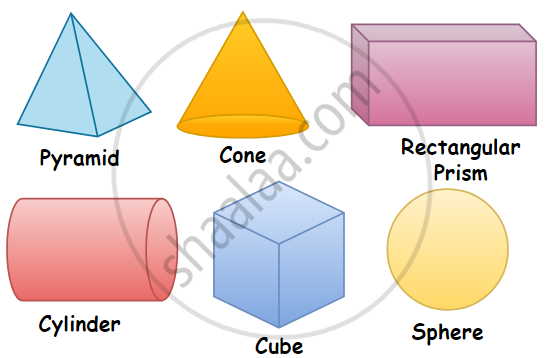
Difference between 2-dimensional shapes and 3-dimensional shapes:
2-dimensional shapes |
3-dimensional shapes |
|
2-dimensional shapes have only length and breadth. |
3-dimensional shapes have length, breadth, height, or depth. |
|
Plane figures are of two-dimensions (2-D). |
Solid shapes are of three-dimensions (3-D). |
|
The circle, the square, the rectangle, the quadrilateral and the triangle are examples of plane figures. |
The cube, the cuboid, the sphere, the cylinder, the cone, and the pyramid are examples of solid shapes. |
|
2D objects do not have different views from different positions. |
3D objects have different views from different positions. |
|
We can measure their area and Perimeter. |
We can measure their volume, Curved Surface Area, Lateral Surface Area or Total Surface Area. |
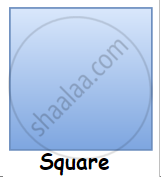 |
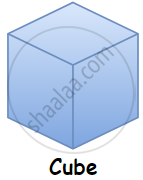 |
Shaalaa.com | Three Dimensional Shapes
Related QuestionsVIEW ALL [22]
Match the following:
| Column A | Column B | ||
| (i) | 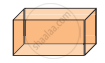 |
(a) | Cylinder |
| (ii) |  |
(b) | Cuboid |
| (iii) |  |
(c) | Triangular Prism |
| (iv) |  |
(d) | Square Pyramid |
Match the following :
| (a) | Cone | (i) |  |
| (b) | Sphere | (ii) |  |
| (c) | Cylinder | (iii) |  |
| (d) | Cuboid | (iv) |  |
| (e) | Pyramid | (v) |  |
