- Partner: A person in the partnership.
- Partnership Firm: A business formed by partners.
- Firm Name: The name of the business.
- Partnership Deed: A written agreement that explains the rules of the partnership.
Topics
Introduction of Commerce and Business
Trade
- Concept of Trade
- Internal Trade
- Wholesale Trade
- Retail Trade
- Types of Retailers> Itinerant Retailers
- Types of Retailers> Fixed Shop Retailer
- Small Scale Fixed Retailer
- Large Scale Fixed Retailers
- Departmental Stores
- Super Market Shop
- Chain Stores or Multiple Shops
- One Price Shop
- Concept of Mall
- International Trade
- Export Trade
- Procedure of Export Trade
- Import Trade
- Procedure of Import Trade
- Entrepot Trade
- Comparison of Different Types of Retailers and Trade Practices
Small Scale Industry and Business
Forms of Business Organisation - 1
- Private Sector Organisations
- Sole Trading Concern
- Partnership Firm
- Types of Partners
- Types of Partnerships Firms
- Hindu Undivided Family Business Or Joint Hindu Family Business
- Co-operative Society
- Types of Cooperative Societies
- Joint Stock Company
- Amul: A Successful Co-operative Movement in India
- Private Limited Company
- Public Limited Company
- Comparison of Different Forms of Business Organization
Forms of Business Organisation - 2
Institutes Supporting Business
Business Environment
- Concept of Business Environment
- Importance of Business Environment
- Dimensions of Business Environment
- Internal Factors
- External Factors> Natural Environment
- External Factors> Social Environment
- External Factors> Political Environment
- External Factors> Economic Environment
- External Factors> Technological Environment
- External Factors> Legal Environment
- New Economic Policy and Business
- Liberalisation
- Privatisation
- Globalisation
- Impact of New Economic Policy on Business
Introduction to Management
- Introduction
- Definition: Partnership Firm
- Important Terms
- Features
- Merits
- Demerits
- Real-Life Application
- Key Point Summary
Maharashtra State Board: Class 11
Introduction
A partnership is a business owned and managed by two or more people, where all partners share the profits, losses, and liabilities. It developed as a solution to the limitations of sole proprietorship, allowing more people to join and expand the business.
Maharashtra State Board: Class 11
Definition: Partnership Firm
- Section 4 of the Indian Partnership Act, 1932, defines partnership as -
“Partnership is the relation between persons who have agreed to share the profits of a business carried on by all or any of them acting for all.” - Prof. L. H. Haney defined Partnership as -
“Partnership is the relation existing between persons competent to make contracts, who have agreed to carry on a lawful business in common with a view to private gain.”
Maharashtra State Board: Class 11
Important Terms
Maharashtra State Board: Class 11
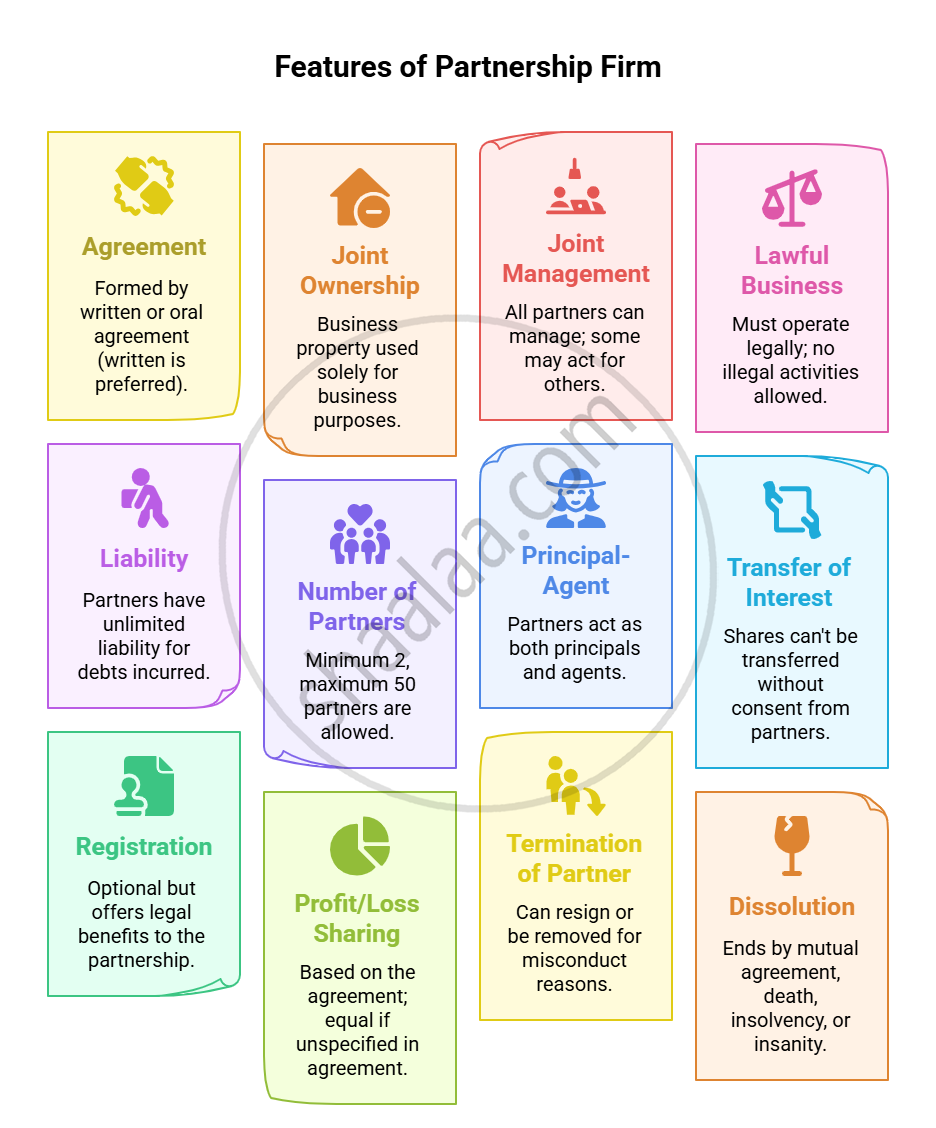
Features
Maharashtra State Board: Class 11
Merits
- Easy Formation: Simple to form, with quick registration.
- Capital: More capital can be raised with multiple partners.
- Business Secrecy: No need to publish accounts, ensuring confidentiality.
- Continued Existence: Can continue after a partner’s death or insolvency, if agreed.
- Flexibility: Easy to expand, change, or shut down the business.
- Decision Making: Faster decisions through fewer partners and discussions.
- Effort-Reward Relationship: Efforts are directly tied to rewards, with active partners getting more.
- Goodwill: Strong reputation based on quality and ethics.
- Specialization: Partners bring different skills, improving efficiency.
Maharashtra State Board: Class 11
Demerits
- Problem of Continuity: The business may dissolve if a partner dies, becomes insolvent, or becomes insane, unless otherwise agreed.
- Absence of Legal Status: The partnership and its partners are treated as a single entity in law.
- Disputes: Conflicts between partners can lead to the dissolution of the business.
- Non-Transferability of Interest: Partners can’t transfer their shares without the others' consent.
- Limitations on Number of Partners: A Maximum of 50 partners, limiting capital and management.
- Difficulty in Admission of Partner: Adding a new partner can cause disagreements and affect profit-sharing.
- Unlimited Liability: Partners are personally liable for the business's debts.
- Risk of Implied Authority: Partners may make decisions without others' approval, risking the firm’s interests.
- Limited Capital: Less capital compared to joint-stock companies, restricting growth.
- Problem of Secrecy: Some partners may share confidential business info, harming secrecy.
Maharashtra State Board: Class 11
Real-Life Application
Dr. Sharma and Dr. Mehta start a clinic together, pooling money and splitting responsibilities. This clinic is a partnership firm.
Maharashtra State Board: Class 11
Key Point Summary
- A partnership firm is managed jointly by two or more people.
- Trust, clear agreements, and teamwork are essential.
- Partners share both profits and risks, including personal liability.
- Proper documentation (partnership deed) avoids confusion.
