Topics
Introduction of Commerce and Business
Trade
- Concept of Trade
- Internal Trade
- Wholesale Trade
- Retail Trade
- Types of Retailers> Itinerant Retailers
- Types of Retailers> Fixed Shop Retailer
- Small Scale Fixed Retailer
- Large Scale Fixed Retailers
- Departmental Stores
- Super Market Shop
- Chain Stores or Multiple Shops
- One Price Shop
- Concept of Mall
- International Trade
- Export Trade
- Procedure of Export Trade
- Import Trade
- Procedure of Import Trade
- Entrepot Trade
- Comparison of Different Types of Retailers and Trade Practices
Small Scale Industry and Business
Forms of Business Organisation - 1
- Private Sector Organisations
- Sole Trading Concern
- Partnership Firm
- Types of Partners
- Types of Partnerships Firms
- Hindu Undivided Family Business Or Joint Hindu Family Business
- Co-operative Society
- Types of Cooperative Societies
- Joint Stock Company
- Amul: A Successful Co-operative Movement in India
- Private Limited Company
- Public Limited Company
- Comparison of Different Forms of Business Organization
Forms of Business Organisation - 2
Institutes Supporting Business
Business Environment
- Concept of Business Environment
- Importance of Business Environment
- Dimensions of Business Environment
- Internal Factors
- External Factors> Natural Environment
- External Factors> Social Environment
- External Factors> Political Environment
- External Factors> Economic Environment
- External Factors> Technological Environment
- External Factors> Legal Environment
- New Economic Policy and Business
- Liberalisation
- Privatisation
- Globalisation
- Impact of New Economic Policy on Business
Introduction to Management
- Introduction
- Reasons for NEP 1991
- Core Components of LPG Policy
- Impact on Business
- Real-Life Application
- Key Point Summary
Maharashtra State Board: Class 11
Introduction
After India's independence in 1947, the government focused on state-controlled industrial growth. This led to the License Raj- a complex system of approvals and restrictions.
By the late 1980s, India’s economy was struggling:
- Low foreign exchange reserves
- High inflation
- Slow industrial growth
To address this crisis, the New Economic Policy (NEP) of 1991 was introduced, focusing on Liberalization, Privatization, and Globalization (LPG).
Maharashtra State Board: Class 11
Reasons for NEP 1991
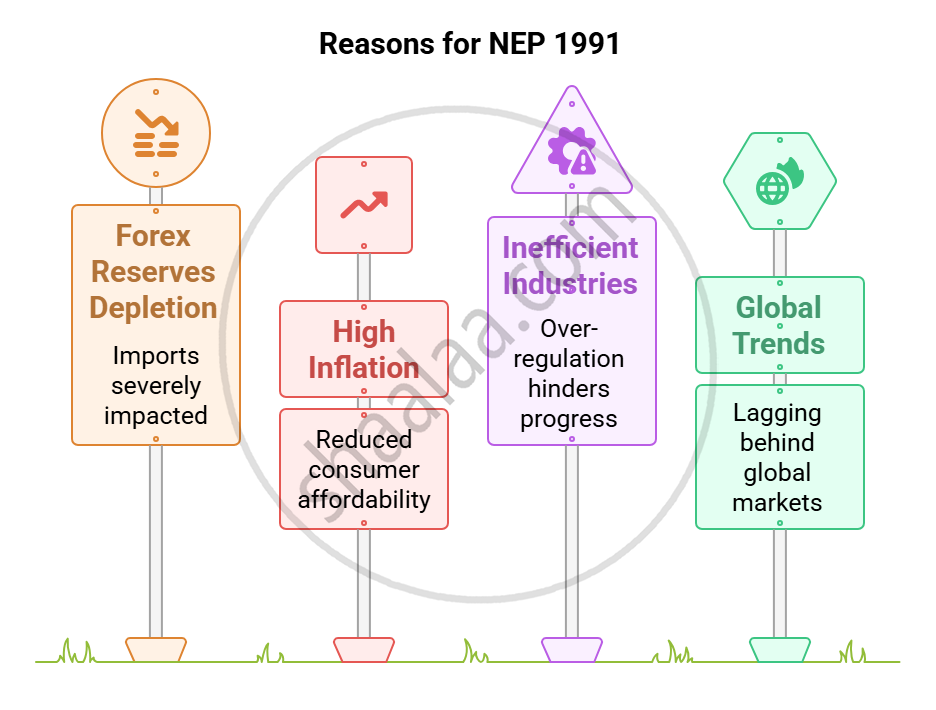
Maharashtra State Board: Class 11
Core Components of LPG Policy
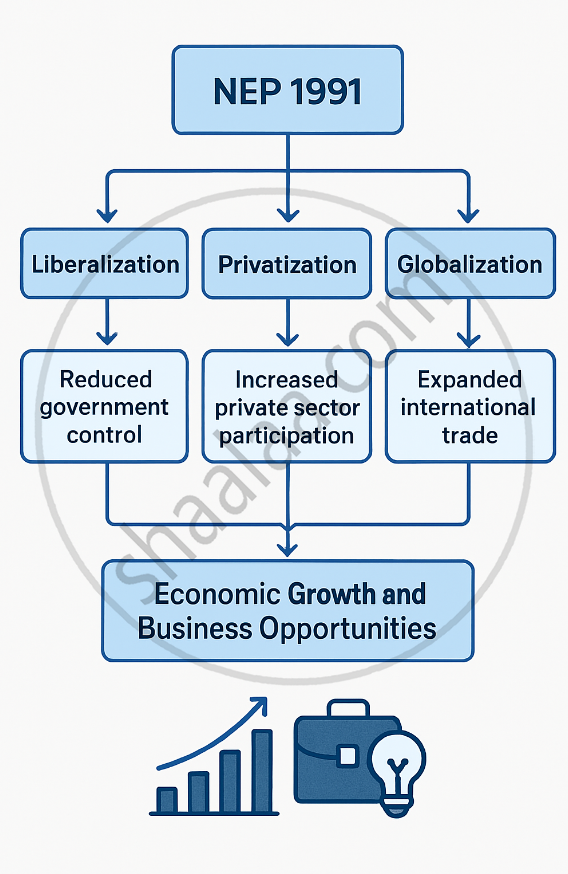
Maharashtra State Board: Class 11
Impact on Business
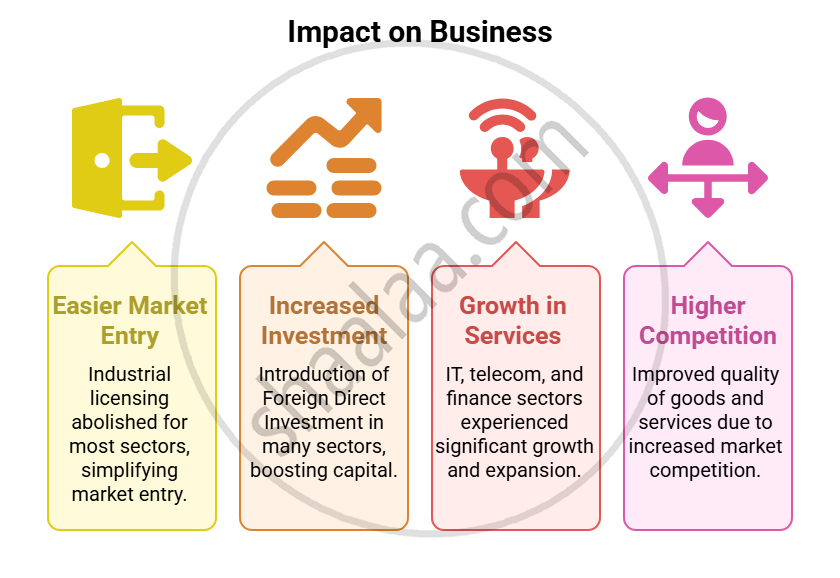
Maharashtra State Board: Class 11
Real-Life Application
-
Before the NEP 1991, a businessman in Pune needed multiple licenses and months of approval to start a factory.
-
After NEP 1991, IT startups in Pune and Mumbai could launch quickly, attract foreign clients, and export services, leading to India’s IT outsourcing boom.
Maharashtra State Board: Class 11
Key Point Summary
- NEP 1991 transformed India’s closed economy into a globally connected one.
- It boosted efficiency, competitiveness, and business opportunities.
- The LPG model remains a foundation for India’s current economic policies.
