Topics
Entrepreneurial Opportunity
- Concept and Elements of Business Opportunity
- Process of Sensing Opportunities
- Factors Involved in Sensing Opportunities
- Environment Scanning
- Enlist the Various Factors Affecting Business Environment
- Problem Identification
- Idea Fields
- Technique of Transformation of Ideas into Opportunities
- Trend Spotting
- Elaborate on the Creative and Innovative Processes
Enterprise Planning
- Types of Economic Activities
- Business Organization
- Forms of Enterprises
- Sole Proprietorship
- Concept of Partnership
- Joint Stock Company
- Hindu Undivided Family Business Or Joint Hindu Family Business
- Co-operative Organisations
- Business Plan
- Introductory Profile /General Introduction
- Description of Venture/Business Venture
- Production Plan
- Operational Plan
- Elements of Operational Plan
- Organizational Plan
- Financial Plan
- Components of Financial Plan
- Manpower Planning
- Marketing Plan
- Assessment of Risk
- Appendix
Enterprise Marketing
- Goal-setting and Smart Goals
- Various Marketing Strategies Used in a Firm
- 4p’s of Marketing
- Product
- Price
- Place
- Promotion
- Sales Strategy
- Promotion Strategy
- Negotiation
- Customer Relations
- Employee Management
- Vendor Management
- Reasons for Business Failure
Enterprise Growth Strategies
- Growth and Development of an Enterprise
- Franchising
- Growth Through Mergers and Acquisitions (M and A)
- Meaning and Types of Acquisitions
- Reasons for Mergers and Acquisitions
- Reasons for Failure of Mergers and Acquisitions
- Concept of Value Addition
- Moving-up the Value Chain
- Six Requirements for Value Chain Management
Business Arithmetic
- Concept of Unit Price
- Break Even Analysis
- Cash Flow Projection
- Budgeting and Managing the Finances
- Working Capital
- Inventory Control and Economic Order Quantity
- Return on Investment and Equity
Resource Mobilization
- Capital Market
- Secondary Market/Stock Exchange
- Securities and Exchange Board of India (SEBI)
- Angel Investors
- Venture Capital
- Specialised Financial Institutions
- Types of Specialised Financial Institutions
- Introduction
- Definition: Joint Hindu Family Business
- Types of Law Schools Governing HUF
- Features
- Merits
- Demerits
- Real-Life Application
- Key Point Summary
Maharashtra State Board: Class 11
Introduction
The Joint Hindu Family Business (JHFB), also known as a Hindu Undivided Family (HUF), is a unique form of business found exclusively in India. It is governed by Hindu law, not by written contracts.
Maharashtra State Board: Class 11
Definition: Joint Hindu Family Business
Under Hindu Law, an HUF is a family that consists of all persons lineally descended from a common ancestor and includes their wives and unmarried daughters. An HUF cannot be created under a contract.
Maharashtra State Board: Class 11
Types of Law Schools Governing HUF
| Feature | Mitakshara School | Dayabhaga School |
|---|---|---|
| Region | Most of India (except Bengal and Assam) | Bengal, Assam |
| Membership Rights | Only male members as coparceners | Both male and female coparceners |
| Inheritance | Right at birth | Right after the ancestor’s death |
| Example | Son gets equal rights with the father | A widow can inherit property |
Maharashtra State Board: Class 11
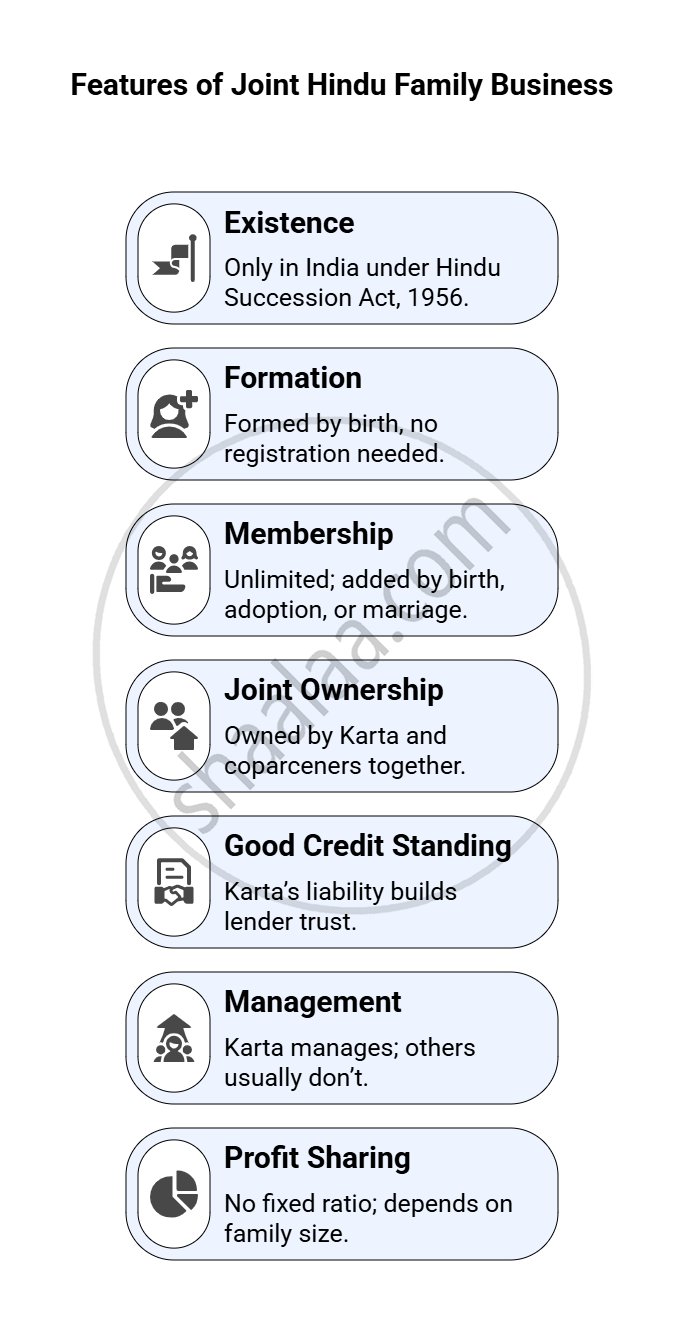
Features
Maharashtra State Board: Class 11
Merits
- Easy Formation: No registration or agreement needed; formed under Hindu Law with no member limit.
- Protection of Co-parceners' Interest: Co-parceners can demand partition; Karta safeguards their interests.
- Quick and Prompt Decision: Karta takes fast, experienced decisions for the business.
- On-the-Job Training: Members learn business skills by observing and working with the Karta.
- Co-parcener’s Liability: Co-parceners' liability is limited to their share; personal assets are safe.
Maharashtra State Board: Class 11
Demerits
- Unlimited Liability: Karta’s assets are at risk.
- Limited Resources: Funds and managerial skills may be lacking.
- No Legal Status: Business and family are treated equally in terms of legal status.
- Risk of Partition: Conflicts may lead to a business split.
- Unequal Rewards: Profits are shared equally, regardless of effort.
Maharashtra State Board: Class 11
Real-Life Application
The Patil family in Pune operates a grocery store as a JHFB; Mr. Patil, the eldest member, serves as the Karta. His sons and daughters are coparceners. When he retires, his eldest son becomes the next Karta.
Maharashtra State Board: Class 11
Key Point Summary
- HUF/JHFB is unique to India and is automatically formed under Hindu law.
- Karta leads: He has full responsibility and authority; coparceners share profits, but not management.
- Law schools: Rules differ by region (Mitakshara vs. Dayabhaga).
- Offers stability and simplicity, but is limited in terms of resources and growth.
Test Yourself
Shaalaa.com | Joint Hindu Family Business
to track your progress
