Topics
Elementary Theory of Demand
Demand and Supply: Basic Concepts
Elasticity of Demand
Factors of Production: Basic Concepts
Theory of Supply
- Concept of Supply
- Types of Supply
- Determinants Or Factors Governing the Supply
- Determinants of Supply
- Law of Supply
- Concept of Stock
- Distinction Between Supply and Stock
- Why Does the Supply Curve Slopes Upward to the Right
- Movement Along the Supply Curve Or Expansion and Contraction of Supply
- Distinction Between Change in Quantity Supplied (Or Movement Along Supply Curve and Change in Supply Or Shift of the Supply Curve)
- Difference Between Extension and Increase in Demand
- Contraction of Supply and Decrease in Supply
- Elasticity of Supply
Alternative Market Structures: Basic Concepts
The State and Economic Development
Factors of Production
- Production is Transformation
- Meaning of Production Mechanism
- Factors of Production
- Relative Importance of Different Factors of Production
Elasticity of Supply
- Elasticity of Supply
- Categories (Degrees) of Elasticity of Supply
- Measurement of Elasticity of Supply > Percentage Method
- Factors Affecting Elasticity of Supply
Money and Banking: Basic Concepts
Land
- Land
- Characteristics of Land
- Functions of Land
- Importance of Land
- Productivity of Land
- Factors Affecting Productivity of Land
Nature and Structure of Markets
- Alternative Market Structures
- Concept of Market
- Characteristics of Market
- Factors Determining Market Forms
- Factors Determining Forms of Market
- Market Structure
- Factors Determining Market / Extent of Market
- Similarities Between Monopolistic Competition and Perfect Competition
- Similarities Between Monopolistic Competition and Monopoly
The State and Economic Development
- The State and Economic Development
- Introduction of Public and Private Sector
- Functions of the State in Promoting Economic Development
- Role of State in Economic Development
Destruction of Ecosystem
- Industrialisation
- Urbanisation in India
- Migration
- Dwelling Units
- Mining (Economy)
- Construction of Dams
- Shifting Cultivation
- Causes of Destruction of Ecosystem
Labour
- Factors of Production
- Characteristics of Labour
- Labour: an Important Factor of Production
- Entrepreneur - Special Type of Labour
- Labour and Economic Activities
- Division (Specialisation) of Labour
- Types of Division of Labour
- Advantages of Division of Labour
- Disadvantages of Division of Labour
- Necessary Conditions for the Division of Labour
- Efficiency of Labour
- Reasons for Low Efficiency of Labour in India
- Suggestions for Improving the Efficiency of Indian Workers
Meaning and Functions of Money
Commercial Banks
Capital and Capital Formation
- Factors of Production
- Difference Between Capital and Other Related Concepts
- Differences Between Land and Capital
- Differences Between Capital and Labour
- Characteristics of Capital
- Types of Capital
- Functions of Capital
- Is Land Capital?
- Factors Influencing Or Affecting Capital Formation
- Significance of Capital Formation
- Causes of Low Rate of Capital Formation
- Suggestions to Raise Rate of Capital Formation
Entrepreneur
- Factors of Production
- Concept of Entrepreneur
- Difference Between Entrepreneur and Organisation
- Distinction Between Labour and Entrepreneur
- Distinction Between Capitalist and Entrepreneur
- Role of Entrepreneurs in Economic Development
Central Banks
Inflation
Instruments of State Intervention
- The Instruments of State Intervention
- Objectives of Fiscal Policy
- Types of Taxes
- Monetary Policy
- Distinction Between Monetary and Fiscal Policy
Public Sector Enterprises
- Public Sector Organisations
- Role of Public Sector Enterprises
- Problems of Public Sector Enterprises/Reasons for Declining Popularity of Public Sector
- Suggestions to Improve the Efficiency of Public Sector Enterprises
Privatization of Public Enterprises
- Privatization of Public Enterprises
- Rationale of Privatisation in India
- Reasons in Favour of Privatisation
- Pre-requisites for Privatisation
- Limitations of the Privatisation
- Suggestive Framework for Privatisation
- Arguments for Privatisation Or Disinvestment
- Arguments Against Privatisation (Or Disinvestment)
Money and Inflation
- Barter system
- Importance of Money
- Forms of Money
- Qualities of Money
- Inflation
- Characteristics of Inflation
- Types of Inflation
- Causes of Inflation
- Effects of Inflation
- Anti-inflationary Measures
Banking : Commercial Banks and Central Bank
- Commercial Banks
- Importance of Banks
- Functions of Commercial Bank
- Credit Creation by Commercial Banks
- Nationalisation of Banks
- Meaning of Central Bank
- Differences Between a Central Bank and a Commercial Bank
- Central Bank
- Functions of a Central Bank
- Monetary Policy of the Central Bank
- Various Aspects of Credit Control Measures
- Objectives of Credit Control
- Methods of Credit Control by the Central Bank
- Reserve Bank of India (RBI)
- Introduction
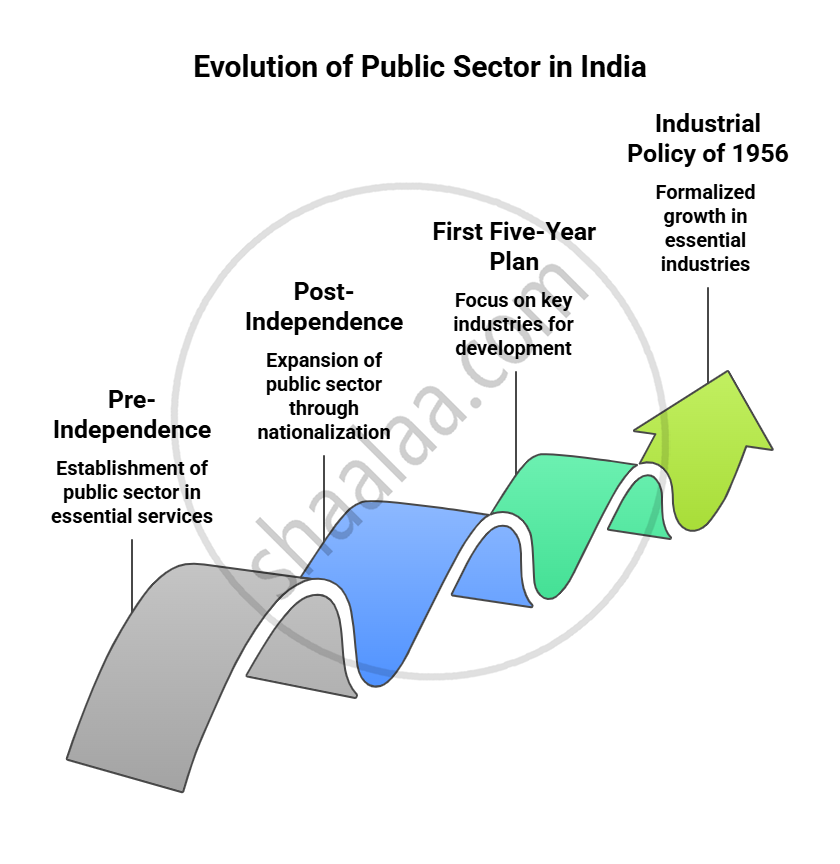
- Evolution of Public Sector in India
- Definition: Public Sector Organisation
- Real-Life Application
- Key Point Summary
Maharashtra State Board: Class 11
Introduction
A public sector organisation is owned and operated by central, state, or local government bodies, with the main aim of providing essential services and promoting public welfare.
Maharashtra State Board: Class 11
Evolution of Public Sector in India
Maharashtra State Board: Class 11
Definition: Public Sector Organisation
- According to Britannica Encyclopedia:
“An undertaking that is owned by a central, state, or local government, supplies services or goods at a price and is operated on a more or less self-supporting basis is called a Public Sector Organisation.” - According to Prof. Hansen:
“Public Enterprise means state ownership & operation of industrial, agricultural, financial & commercial undertakings.”
Maharashtra State Board: Class 11
Real-Life Application
- HPCL- Hindustan Petroleum Corporation Limited
- BPCL- Bharat Petroleum Corporation Limited
- Indian Railways
- SBI
- Air India
Maharashtra State Board: Class 11
Key Point Summary
- Private Sector: Owned by private individuals/groups; focus- profit.
- Public Sector: Owned/controlled by the government; focus- welfare and service.
- Both are crucial for India’s balanced growth.
Test Yourself
Related QuestionsVIEW ALL [29]
State True or False.
Private sector Organisations are owned by individuals or groups of individuals.
Match the pairs.
| Group ‘A’ | Group ‘B’ | ||
| A) | BHEL | 1) | Special Legislature |
| B) | Statutory Corporation | 2) | 49% paid up capital by govt. |
| C) | Departmental Organisation | 3) | Service Motive |
| D) | Private Sector | 4) | Railway |
| E) | Public Sector | 5) | Profit Motive |
| 6) | 51% paid up capital by govt. | ||
Match the pairs.
| Group 'A' | Group 'B' | ||
| A) | BHEL | 1) | Special Legislature |
| B) | Statutory Corporation | 2) | 49% paid up capital by govt. |
| C) | Department Organisation | 3) | Service Motive |
| D) | Private Sector | 4) | Railway |
| E) | Public Sector | 5) | Profit Motive |
| 6) | 51% paid up capital by govt. |
