Topics
Introduction to Micro and Macro Economics
- Introduction to Microeconomics and Macroeconomics
- Father of Econometrics: Ragnar Frisch
- Microeconomics
- Macroeconomics
- Macroeconomics Vs Microeconomics
Micro Economics
Introduction to Micro Economics
- Analysis of Market Structure
- Microeconomics
- Micro Economics - Slicing Method
- Use of Marginalism Principle in Micro Economics
- Micro Economics - Price Theory
- Micro Economic - Price Determination
- Micro Economics - Working of a Free Market Economy
- Micro Economics - International Trade and Public Finance
- Welfare Economics
- Micro Economics - Useful to Government
- Assumption of Micro Economic Analysis
Consumers Behavior
Analysis of Demand and Elasticity of Demand
Analysis of Supply
Types of Market and Price Determination Under Perfect Competition
Factors of Production
- Factors of Production - Feature of Capital
- Factors of Production
Macro Economics
Utility Analysis
- Basic Concepts of Microeconomics > Utility
- Commodities and Their Specific Utility for Individuals
- Total Utility and Marginal Utility
- Law of Diminishing Marginal Utility
- Paradox of Value
- Relationship Between Marginal Utility and Price
- Indifference Curve Analysis by Hicks and Allen
Introduction to Macro Economics
- Macroeconomics
- Allocation of Resource and Economic Variable
National Income
Determinants of Aggregates
- Total Demand for Good and Services
- Concept of Aggregate Demand and Aggregate Supply
- Consumption
- Investment Demand
- Government Demand
- Foreign Demand
- Difference Betweeen Export and Import
- Effect of Population of Consumption Expediture
- Types of Investment Expenditure
- Micro Eco-Equilibrium
Money
- Concept of Money
- Functions of Money
- Standard of Deferred Payment
- Standard of Transfer Payment
- Money - Store of Value
- Barter system
- Monetary Payments
- Qualities of Good Money
Commercial Bank
Central Bank
- Central Bank
- Central Bank Function - Banker's Bank
- Central Bank as a Controller of Credit
- Monetary Function of Central Bank
- Non Monetary Function of Central Bank
- Methods of Credit Control by the Central Bank
- Repo Rate and Reverse Repo Rate
- Central Bank Function - Goverment Bank
Public Economics
- Introduction of Public Economics
- Features of Public Economics
- Government Budget
- Objectives of Government Budget
- Features of Government Budget
- Public Economics - Budget (1 Year)(1 April to 31 March)
- Types of Budget
- Taxable Income
- Budgetary Accounting in India
- Budgetary Accounting - Consolidated , Contingency and Public Fund
- Components (Structure) of the Government Budget
- Factor Influencing Government Budget
Demand Analysis
Elasticity of Demand
- Introduction to Elasticity of Demand
- Income Elasticity of Demand
- Cross Elasticity of Demand
- Price Elasticity of Demand
- Perfectly Elastic Demand
- Perfectly Inelastic Demand
- Unitary Elastic Demand
- Relatively Elastic Demand
- Relatively Inelastic Demand
- Methods of Measuring Price Elasticity of Demand
- Linear Demand Curve
- Non-Linear Demand Curve
- Factors Influencing the Elasticity of Demand
- Importance of Elasticity of Demand
- Determinants of Price Elasticity of Demand
Supply Analysis
Forms of Market
- Concept of Market
- Classification of Market > Based on Place
- Classification of Market > Based on Place
- Classification of Market > Based on Time
- Classification of Market > Based on Competition
- Perfect Competition
- Price Determination Under Perfect Competition
- Imperfect Competition
- Monopoly
- Monopsony
- Oligopoly
- Monopolistic Competition
Index Numbers
- Index Numbers
- Features of Index Numbers
- Types of Index Numbers
- Index Numbers Used by Government of India
- Significance of Index Numbers
- Rebasing of GDP, IIP, and WPI
- Construction of Index Numbers
- Methods of Constructing Index Numbers > Simple Index Number
- Price Index Number
- Quantity Index Number
- Value Index Number
- Methods of Constructing Index Numbers > Weighted Index Number
- Laaspeyre’s Price Index Number
- Paasche’s Price Index Number
- Concepts of Sensex and Nifty
- Crops in India's Agricultural and Industrial Production Index
- Limitations of Index Numbers
National Income
- Concept of National Income
- Features of National Income
- Circular Flow of National Income
- Circular Flow of Income in a Two-Sector Economy
- Circular Flow of Income in a Three-Sector Economy
- Four Sector Model of Circular Income
- Different Concepts of National Income
- Concept of Green GNP
- Methods of Measurement of National Income
- Output Method/Product Method
- Income Method
- Expenditure Method
- Concept of Mixed income
- Difficulties in the Measurement of National Income
- Significance or Importance of National Income
Public Finance in India
- Introduction to Public Finance
- Difference Between Public Finance and Private Finance
- Public Expenditure
- Important Social Welfare Schemes by the Government
- Structure of Public Finance > Public Revenue
- Public Revenue > Taxes
- Types of Taxes
- Public Revenue > Non-tax Revenue
- Structure (Types) of Public Debt
- Fiscal Policy
- Structure of Public Finance > Financial Administration
- GST(Economics)
- Government Budget
- Revenue and Capital Budgets
- Types of Budget
- Importance of Budget
Money Market and Capital Market in India
- Concept of Financial Market
- Money Market
- Structure of Money Market in India > Organized Sector
- Structure of Money Market in India > Organized Sector
- Reserve Bank of India (RBI)
- Commercial Banks
- Co-operative Banks
- Development Financial Institutions (DFIs)
- Discount and Finance House of India (DFHI)
- Structure of Money Market in India > Unorganized Sector
- Money Market
- Role of Money Market in India
- Problems of the Indian Money Market
- Reforms Introduced in the Money Market
- Recent Developments in Banking Sector
- Capital Market
- Structure of Capital Market in India
- Role of Capital Market in India
- Problems of the Capital Market
- Regional Stock Exchanges in India
- Reforms Introduced in the Capital Market
- Economic Policy in an Economy
Foreign Trade of India
- India’s Trade Relations Before 1947
- Internal Trade
- Foreign Trade of India
- Types of Foreign Trade
- Role of Foreign Trade
- India’s Recent Trade Relations with China and Japan
- Composition of India’s Foreign Trade
- India’s Foreign Trade Share in GNI
- Composition of India's Imports
- Composition of India's Exports
- Direction of India’s Foreign Trade
- Trends in India’s Foreign Trade since 2001
- Concept of Balance of Payments
- Balance of Trade
- Member Nations of OPEC and OECD
Individual and Market Demand
1) Meaning:
- Individual demand is the quantity of a good that one consumer (or household) is willing to buy at different prices over a time period.
- Market demand is the total amount all consumers in the market are willing to buy at different prices.
2) Example:
If one family buys 2 litres of milk daily (individual demand), and all families together buy 10,000 litres daily (market demand).
3) Key Point:
Market demand is the sum of all individual demands.
Ex Ante and Ex Post Demand
1) Ex Ante Demand:
Planned or desired demand; what consumers intend to buy.
2) Ex Post Demand:
Actual demand: what consumers actually buy.
3) Key Point:
Ex ante may differ from ex post due to price changes, availability, or other market factors.
Joint Demand
1) Meaning:
Demand for two or more goods used together (complementary goods).
2) Example:
- Cars and petrol, bread and butter.
- Demand for petrol rises if more cars are bought.
3) Key Point:
The demand for one good affects the demand for another when they’re jointly used.
Derived Demand
1) Meaning:
Demand for goods/services as inputs needed to produce other goods.
2) Examples:
- Demand for steel is derived from demand for cars.
- Demand for cotton is derived from demand for cloth.
3) Key Point:
Inputs and labour are demanded only if consumers want the final products.
Composite Demand
1) Meaning:
Demand for a commodity used for multiple purposes.
2) Examples:
- Electricity (for lighting, cooling, industrial machines)
- Milk (for drinking, desserts, tea)
3) Key Point:
Increasing demand for one use limits its availability for other uses.
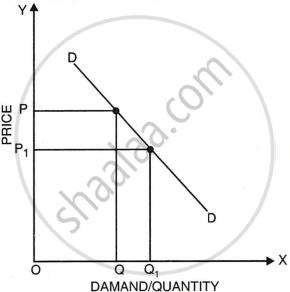
Price Demand
1) Meaning:
Quantity of a product that consumers buy at different prices, keeping other factors unchanged.
2) Law:
Price falls → demand rises; price rises → demand falls.
3) Formula:
\[D_A=f(P_A)\]
4) Diagram:
5) Key Point:
Price and demand have an inverse relationship.
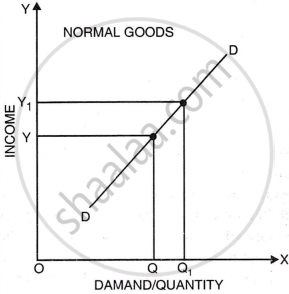
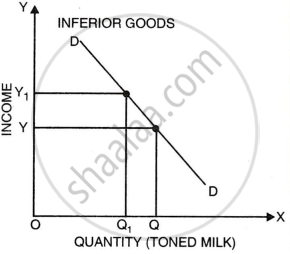
Income Demand
1) Meaning:
How demand changes with consumer income, with other factors constant.
2) Types:
- Normal goods: Demand rises as income rises.
- Inferior goods: Demand falls as income rises.
3) Formula:
\[D_x=f(Y)\]
4) Diagram:
5) Key Point:
Normal goods: positive slope; inferior goods: negative slope.
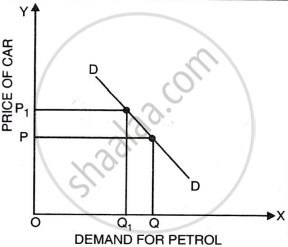
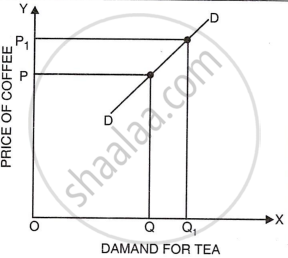
Cross Demand
1) Meaning:
How demand for a good changes with the price of a related good.
2) Types:
Substitutes (tea/coffee): Price of coffee rises → demand for tea rises.
Complements (car/petrol): Price of car rises → demand for petrol falls.
3) Formula:
\[D_x=f(P_y)\]
4) Diagram:
5) Key Point:
Substitutes: direct relation; complements: inverse relation.
Direct Demand
1) Meaning:
Consumer goods fulfilling wants directly (food, clothes).
2) Key Point:
Direct satisfaction.
Alternative Demand
1) Meaning:
Demand satisfied by two or more goods (alternatives).
2) Example:
Rice or chapati for food needs.
Competitive Demand
1) Meaning:
Demand for close substitutes—using more of one means using less of the other.
2) Example:
More tea, less coffee.
CISCE: Class 12
Key Points: Types of Demand
| Type of Demand | Meaning / Explanation | Examples |
|---|---|---|
| Individual Demand | Demand of a single consumer | Demand of one person for a product |
| Market Demand | Sum total of demands of all consumers | Total demand for rice in a market |
| Ex ante Demand | Planned or desired demand | Expected demand for a product |
| Ex post Demand | Actual demand realised in the market | Actual sales of a product |
| Joint Demand | Demand for goods used together | Car and petrol |
| Derived Demand | Demand arising from demand for another good | Labour, raw materials |
| Composite Demand | Demand for goods with multiple uses | Coal, electricity, milk |
| Direct Demand | Demand for goods directly satisfying wants | Food, clothes |
| Alternative Demand | Demand satisfied by alternatives | Rice or chapati |
| Competitive Demand | Demand for substitute goods | Tea and coffee |
