Topics
Introduction to Micro and Macro Economics
- Introduction to Microeconomics and Macroeconomics
- Father of Econometrics: Ragnar Frisch
- Microeconomics
- Macroeconomics
- Macroeconomics Vs Microeconomics
Micro Economics
Introduction to Micro Economics
- Analysis of Market Structure
- Microeconomics
- Micro Economics - Slicing Method
- Use of Marginalism Principle in Micro Economics
- Micro Economics - Price Theory
- Micro Economic - Price Determination
- Micro Economics - Working of a Free Market Economy
- Micro Economics - International Trade and Public Finance
- Welfare Economics
- Micro Economics - Useful to Government
- Assumption of Micro Economic Analysis
Consumers Behavior
Analysis of Demand and Elasticity of Demand
Analysis of Supply
Types of Market and Price Determination Under Perfect Competition
Factors of Production
- Factors of Production - Feature of Capital
- Factors of Production
Macro Economics
Utility Analysis
- Basic Concepts of Microeconomics > Utility
- Commodities and Their Specific Utility for Individuals
- Total Utility and Marginal Utility
- Law of Diminishing Marginal Utility
- Paradox of Value
- Relationship Between Marginal Utility and Price
- Indifference Curve Analysis by Hicks and Allen
Introduction to Macro Economics
- Macroeconomics
- Allocation of Resource and Economic Variable
National Income
Determinants of Aggregates
- Total Demand for Good and Services
- Concept of Aggregate Demand and Aggregate Supply
- Consumption
- Investment Demand
- Government Demand
- Foreign Demand
- Difference Betweeen Export and Import
- Effect of Population of Consumption Expediture
- Types of Investment Expenditure
- Micro Eco-Equilibrium
Money
- Concept of Money
- Functions of Money
- Standard of Deferred Payment
- Standard of Transfer Payment
- Money - Store of Value
- Barter system
- Monetary Payments
- Qualities of Good Money
Commercial Bank
Central Bank
- Central Bank
- Central Bank Function - Banker's Bank
- Central Bank as a Controller of Credit
- Monetary Function of Central Bank
- Non Monetary Function of Central Bank
- Methods of Credit Control by the Central Bank
- Repo Rate and Reverse Repo Rate
- Central Bank Function - Goverment Bank
Public Economics
- Introduction of Public Economics
- Features of Public Economics
- Government Budget
- Objectives of Government Budget
- Features of Government Budget
- Public Economics - Budget (1 Year)(1 April to 31 March)
- Types of Budget
- Taxable Income
- Budgetary Accounting in India
- Budgetary Accounting - Consolidated , Contingency and Public Fund
- Components (Structure) of the Government Budget
- Factor Influencing Government Budget
Demand Analysis
Elasticity of Demand
- Introduction to Elasticity of Demand
- Income Elasticity of Demand
- Cross Elasticity of Demand
- Price Elasticity of Demand
- Perfectly Elastic Demand
- Perfectly Inelastic Demand
- Unitary Elastic Demand
- Relatively Elastic Demand
- Relatively Inelastic Demand
- Methods of Measuring Price Elasticity of Demand
- Linear Demand Curve
- Non-Linear Demand Curve
- Factors Influencing the Elasticity of Demand
- Importance of Elasticity of Demand
- Determinants of Price Elasticity of Demand
Supply Analysis
Forms of Market
- Concept of Market
- Classification of Market > Based on Place
- Classification of Market > Based on Place
- Classification of Market > Based on Time
- Classification of Market > Based on Competition
- Perfect Competition
- Price Determination Under Perfect Competition
- Imperfect Competition
- Monopoly
- Monopsony
- Oligopoly
- Monopolistic Competition
Index Numbers
- Index Numbers
- Features of Index Numbers
- Types of Index Numbers
- Index Numbers Used by Government of India
- Significance of Index Numbers
- Rebasing of GDP, IIP, and WPI
- Construction of Index Numbers
- Methods of Constructing Index Numbers > Simple Index Number
- Price Index Number
- Quantity Index Number
- Value Index Number
- Methods of Constructing Index Numbers > Weighted Index Number
- Laaspeyre’s Price Index Number
- Paasche’s Price Index Number
- Concepts of Sensex and Nifty
- Crops in India's Agricultural and Industrial Production Index
- Limitations of Index Numbers
National Income
- Concept of National Income
- Features of National Income
- Circular Flow of National Income
- Circular Flow of Income in a Two-Sector Economy
- Circular Flow of Income in a Three-Sector Economy
- Four Sector Model of Circular Income
- Different Concepts of National Income
- Concept of Green GNP
- Methods of Measurement of National Income
- Output Method/Product Method
- Income Method
- Expenditure Method
- Concept of Mixed income
- Difficulties in the Measurement of National Income
- Significance or Importance of National Income
Public Finance in India
- Introduction to Public Finance
- Difference Between Public Finance and Private Finance
- Public Expenditure
- Important Social Welfare Schemes by the Government
- Structure of Public Finance > Public Revenue
- Public Revenue > Taxes
- Types of Taxes
- Public Revenue > Non-tax Revenue
- Structure (Types) of Public Debt
- Fiscal Policy
- Structure of Public Finance > Financial Administration
- GST(Economics)
- Government Budget
- Revenue and Capital Budgets
- Types of Budget
- Importance of Budget
Money Market and Capital Market in India
- Concept of Financial Market
- Money Market
- Structure of Money Market in India > Organized Sector
- Structure of Money Market in India > Organized Sector
- Reserve Bank of India (RBI)
- Commercial Banks
- Co-operative Banks
- Development Financial Institutions (DFIs)
- Discount and Finance House of India (DFHI)
- Structure of Money Market in India > Unorganized Sector
- Money Market
- Role of Money Market in India
- Problems of the Indian Money Market
- Reforms Introduced in the Money Market
- Recent Developments in Banking Sector
- Capital Market
- Structure of Capital Market in India
- Role of Capital Market in India
- Problems of the Capital Market
- Regional Stock Exchanges in India
- Reforms Introduced in the Capital Market
- Economic Policy in an Economy
Foreign Trade of India
- India’s Trade Relations Before 1947
- Internal Trade
- Foreign Trade of India
- Types of Foreign Trade
- Role of Foreign Trade
- India’s Recent Trade Relations with China and Japan
- Composition of India’s Foreign Trade
- India’s Foreign Trade Share in GNI
- Composition of India's Imports
- Composition of India's Exports
- Direction of India’s Foreign Trade
- Trends in India’s Foreign Trade since 2001
- Concept of Balance of Payments
- Balance of Trade
- Member Nations of OPEC and OECD
CISCE: Class 12
Introduction
The law helps a consumer decide how to spend their limited income on multiple goods to get the most satisfaction.
A consumer reaches maximum satisfaction when the last rupee spent on each good provides the same level of utility (satisfaction).
CISCE: Class 12
Explanation
- If you spend a rupee on X and get more satisfaction than spending it on Y, you should buy more X and less Y.
- Keep switching spending from one good to another until every rupee gives you equal satisfaction, considering each good’s price.
- Condition for Maximum Utility: \[\frac{MU_X}{P_X}=\frac{MU_Y}{P_Y}\]
where MUX and MUY are marginal utilities, and PX and PY are their respective prices.
CISCE: Class 12
Assumptions
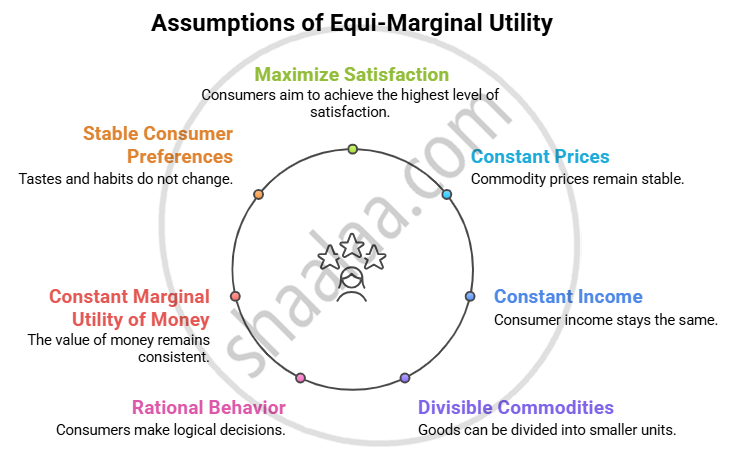
CISCE: Class 12
Utility Table
| Units | MUx (utils) | MUy (utils) | MUx/Px | MUy/Py |
|---|---|---|---|---|
| 1 | 50 | 80 | 10 | 8 |
| 2 | 45 | 70 | 9 | 7 |
| 3 | 40 | 60 | 8 | 6 |
| 4 | 35 | 50 | 7 | 5 |
| 5 | 30 | 40 | 6 | 4 |
| 6 | 25 | 30 | 5 | 3 |
CISCE: Class 12
Steps in Consumer Decision-Making
- Calculate MU/P for each good at every unit.
- Compare combinations that match the budget.
- Choose the combination where MUX/PX=MUY/PY and all money is used.
- That’s the highest satisfaction (utility).
CISCE: Class 12
Stepwise Example: Spending on Mangoes and Oranges
1) When a consumer spends money only on oranges, marginal utility from each additional rupee falls (e.g., first rupee = 10 utils, second = 8, then 6, then 4, then
2) Spending all ₹5 on oranges: total utility = 10 + 8 + 6 + 4 + 2 = 30 utils.
3) Instead, combining purchases of mangoes and oranges gives higher total utility.
- Best combination: ₹3 on oranges and ₹2 on mangoes is optimal, yielding 10 + 8 + 6 (oranges) + 8 + 6 (mangoes) = 38 utils.
- Other combinations (e.g., ₹3 mangoes + ₹2 oranges, or all on one) yield less total utility.
CISCE: Class 12
Diagram-Based Explanation
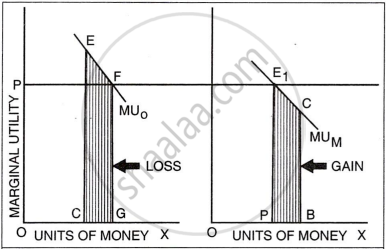
- The diagram below shows equilibrium at the point where the marginal utility of spending on mangoes equals the marginal utility of oranges.
- Shaded area E1PBC (right panel) = Gain in total utility by choosing more balanced spending.
- Shaded area ECGF (left panel) = Loss in utility from unbalanced spending.
- The intersection of MU lines shows the best allocation, maximising overall satisfaction.
CISCE: Class 12
The Law in Modern Terms ("Law of Proportionality")
- Modern economists state that maximum satisfaction is reached when the ratios of marginal utilities to their prices across all goods are equal.
- Key Formula: \[\frac{MU_a}{P_a}=\frac{MU_b}{P_b}=\cdots=\frac{MU_n}{P_n}\]
where MU = Marginal Utility and P = Price for different goods.
Maharashtra State Board: Class 12
CISCE: Class 12
CISCE: Class 12
Key Points: Law of Equi-Marginal Utility
-
The law of equi‑marginal utility explains how a rational consumer allocates limited income among many goods to get maximum satisfaction.
It states that a consumer reaches maximum satisfaction when the marginal utility per unit of money is equal for all goods, i.e. MUA/PA=MUB/PB=⋯=MUn/Pn.
This is an extension of the law of diminishing marginal utility to many commodities and is also called Gossen’s Second Law or the law of maximum satisfaction.
Test Yourself
Shaalaa.com | Law of Equi-marginal Utility
to track your progress
