Topics
Relations and Functions
Relations and Functions
Algebra
Inverse Trigonometric Functions
Calculus
Matrices
- Concept of Matrices
- Types of Matrices
- Equality of Matrices
- Operations on Matrices> Addition and Subtraction of Matrices
- Operations on Matrices>Scalar Multiplication
- Operations on Matrices> Matrix Multiplication
- Transpose of a Matrix
- Symmetric and Skew Symmetric Matrices
- Invertible Matrices
- Overview of Matrices
Determinants
Vectors and Three-dimensional Geometry
Continuity and Differentiability
- Continuous and Discontinuous Functions
- Algebra of Continuous Functions
- Concept of Differentiability
- Derivatives of Composite Functions
- Differentiation of Implicit Functions
- Derivative of Inverse Trigonometric Function
- Exponential and Logarithmic Functions
- Logarithmic Differentiation
- Derivatives of Functions in Parametric Forms
- Second Order Derivative
- Overview of Continuity and Differentiability
Linear Programming
Applications of Derivatives
Probability
Integrals
- Integration
- Integration as an Inverse Process of Differentiation
- Properties of Indefinite Integral
- Methods of Integration> Integration by Substitution
- Methods of Integration>Integration Using Trigonometric Identities
- Methods of Integration> Integration Using Partial Fraction
- Methods of Integration> Integration by Parts
- Integrals of Some Particular Functions
- Definite Integrals
- Fundamental Theorem of Integral Calculus
- Evaluation of Definite Integrals
- Properties of Definite Integrals
- Overview of Integrals
Sets
Applications of the Integrals
Differential Equations
- Basic Concepts of Differential Equations
- Order and Degree of a Differential Equation
- Solution of a Differential Equation
- Forms of Solving Differential Equations> Variable Separable
- Forms of Solving Differential Equations> Homogeneous Differential Equations
- Forms of Solving Differential Equations>Linear Differential Equations
- Overview of Differential Equations
Vectors
- Basic Concepts of Vector Algebra
- Direction Ratios, Direction Cosine & Direction Angles in Vector
- Types of Vectors in Algebra
- Algebra of Vectors > Addition & Subtraction of Two Vectors
- Algebra of Vectors > Scalar Multiplication
- Components of Vector in Algebra
- Vector Joining Two Points in Algebra
- Section Formula in Vector Algebra
- Product of Two Vectors > Scalar (Dot) Product
- Product of Two Vectors > Vector (Cross) Product
- Overview of Vectors
Three - Dimensional Geometry
Linear Programming
Probability
Maharashtra State Board: Class 12
Definition: Minor
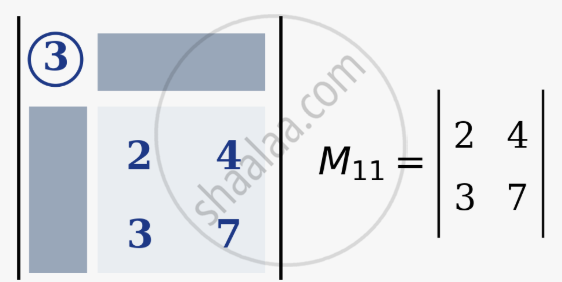
Let A = [aij] be a square matrix of order n. Then, the minor Mij of aij in A is the determinant obtained by deleting the ith row and the jth column in which element aij lies. It is denoted by Mij of A.
Maharashtra State Board: Class 12
Definition: Co-factors
Let A = [aij] be a square matrix of order n. Then, the cofactor Cij (or Aij) of aij in A is (−1)i+j times Mij, where Mij is the minor of aij in A.
∴ Cij = (−1)i+j Mij
Step‑by‑Step Procedures
To Find the Minor:
-
Select the element \[a_{ij}\] whose minor you want.
-
Delete the i-th row and j-th column of the matrix.
-
Calculate the determinant of the remaining \[(n - 1) \times (n - 1)\] matrix.
-
The resulting value is \[M_{ij}\], the minor of \[a_{ij}\].
To Find the Cofactor
-
Find the minor \[M_{ij}\] of \[a_{ij}\] as above.
-
Compute the sign factor \[(-1)^{i+j}\].
-
Multiply: \[C_{ij} = (-1)^{i+j} M_{ij}\].
Example 1
Find minors and cofactors of all the elements of the determinant \[\begin{vmatrix} 1 & -2 \\ 4 & 3 \end{vmatrix}\]
Solution: Minor of the element \[a_{ij}\] is \[M_{ij}\]
Here \[a_{11} = 1\]. So \[M_{11} = \text{Minor of } a_{11} = 3\]
\[M_{12} = \text{Minor of the element } a_{12} = 4\]
\[M_{21} = \text{Minor of the element } a_{21} = -2\]
\[M_{22} = \text{Minor of the element } a_{22} = 1\]
Now, cofactor of \[a_{ij}\] is \[A_{ij}\]. So
\[A_{11} = (-1)^{1+1} M_{11} = (-1)^{2} (3) = 3\]
\[A_{12} = (-1)^{1+2} M_{12} = (-1)^{3} (4) = - 4\]
\[A_{21} = (-1)^{2+1} M_{21} = (-1)^{3} (-2) = 2\]
\[A_{22} = (-1)^{2+2} M_{22} = (-1)^{4} (1) = 1\]
Key Points: Minors and Co-factors
-
Minor \[M_{ij}\]: determinant of the matrix obtained by deleting row i and column j.
-
Cofactor \[C_{ij}\]: \[C_{ij} = (-1)^{i+j}M_{ij}\].
-
Determinant expansion along row i: \[|A| = \sum_{j=1}^{n} a_{ij}C_{ij}\].
-
Determinant expansion along column j: \[|A| = \sum_{i=1}^{n} a_{ij}C_{ij}\].
-
Determinant value is the same for any choice of row or column for expansion.
-
Mixed row/column property: \[\sum_{j=1}^{n} a_{ij}C_{kj} = 0\] for \[i \neq k\].
