Topics
Mathematical Logic
- Statements and Truth Values in Mathematical Logic
- Logical Connectives
- Tautology, Contradiction, and Contingency
- Quantifier, Quantified and Duality Statements in Logic
- Negations of Compound Statements
- Converse, Inverse, and Contrapositive
- Algebra of Statements
- Application of Logic to Switching Circuits
- Overview of Mathematical Logic
Matrices
- Elementry Transformations
- Adjoint and Inverse of a Matrix
- Application of Matrices
- Overview of Matrices
Trigonometric Functions
- Trigonometric Equations and Their Solutions
- Solutions of Triangle>Polar Co-Ordinates
- Solving a Triangle>Solving a Triangle
- Basics of Inverse Trigonometric Functions
- Graphs of Inverse Trigonometric Functions
- Domain, Range & Principal Value
- Properties of Inverse Trigonometric Functions > Self-adjusting Property
- Overview of Trigonometric Functions
- Properties of Inverse Trigonometric Functions > Reciprocal Property
- Properties of Inverse Trigonometric Functions > Complementary Property
- Properties of Inverse Trigonometric Functions > Addition & Subtraction Formula for Inverse Tangent
- Properties of Inverse Trigonometric Functions > Double-angle Property
- Properties of Inverse Trigonometric Functions > Triple-angle Property
- Properties of Inverse Trigonometric Functions > Addition–Subtraction Formula for Inverse Sine & Cosine
- Properties of Inverse Trigonometric Functions > Negative Argument Property
Pair of Straight Lines
Vectors
- Overview of Vectors
- Basic Concepts of Vector Algebra
- Types of Vectors in Algebra
- Algebra of Vectors > Scalar Multiplication
- Algebra of Vectors > Addition & Subtraction of Two Vectors
- Collinearity and Coplanarity of Vectors
- Vectors in Coordinate Geometry
- Components of Vector in Algebra
- Vector Joining Two Points in Algebra
- Section Formula in Vector Algebra
- Product of Two Vectors > Scalar (Dot) Product
- Product of Two Vectors > Vector (Cross) Product
- Direction Ratios, Direction Cosine & Direction Angles in Vector
- Scalar Triple Product
- Vector Triple Product
Line and Plane
Linear Programming
Differentiation
- Introduction & Derivatives of Some Standard Functions
- Derivatives of Composite Functions
- Geometrical Meaning of Derivative
- Derivative of Inverse Trigonometric Function
- Logarithmic Differentiation
- Differentiation of Implicit Functions
- Derivatives of Functions in Parametric Forms
- Higher Order Derivatives
- Overview of Differentiation
Applications of Derivatives
Indefinite Integration
Definite Integration
- Definite Integral as Limit of Sum
- Integral Calculus
- Methods of Evaluation and Properties of Definite Integral
- Overview of Definite Integration
Application of Definite Integration
- Application of Definite Integration
- Area Bounded by Two Curves
- Overview of Application of Definite Integration
Differential Equations
- Basic Concepts of Differential Equations
- Order and Degree of a Differential Equation
- Formation of Differential Equations
- Forms of Solving Differential Equations> Homogeneous Differential Equations
- Forms of Solving Differential Equations>Linear Differential Equations
- Applications of Differential Equation
- Solution of a Differential Equation
- Overview of Differential Equations
Probability Distributions
- Random Variables
- Probability Distribution of Discrete Random Variables
- Probability Distribution of a Continuous Random Variable
- Variance of a Random Variable
- Expected Value and Variance of a Random Variable
- Overview of Probability Distributions
Binomial Distribution
Introduction
A differential equation is an equation involving an independent variable, a dependent variable, and one or more derivatives of the dependent variable with respect to the independent variable.
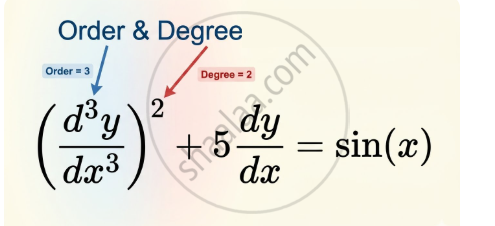
In this topic, the main goal is to understand two basic ideas: the order of a differential equation and the degree of a differential equation.
Maharashtra State Board: Class 12
Definition: Order of the Differential Equation
The order of the highest differential coefficient (or the highest order derivative appearing in a differential equation) is the order of the differential equation.
Maharashtra State Board: Class 12
Definition: Degree of the Differential Equation
The highest exponent of the highest derivative is called the degree of a differential equation, provided exponents of each derivative and an unknown variable appearing in the differential equation are non-negative integers.
Example 1
Find the order and degree, if defined, of each of the following differential equations:
- \[\frac{dy}{dx} - \cos x = 0\]
- \[xy \frac{d^{2}y}{dx^{2}} + x \left( \frac{dy}{dx} \right)^{2} - y \frac{dy}{dx} = 0\]
- \[y''' + y^{2} + e^{y'} = 0\]
Solution:
- The highest order derivative in the given differential equation is \[\frac{dy}{dx}\], so its order is one.
Order = 1, Degree = 1
- The highest order derivative in the given differential equation is \[\frac{d^{2}y}{dx^{2}}\], so its order is two.
Order = 2, Degree = 1
- The highest order derivative in the given differential equation is \[y'''\], so its order is three.
Order = 3,
Degree = the equation is not a polynomial in its derivatives.
Therefore: Degree is not defined.
Key points: Order and Degree of a Differential Equation
-
Order = highest derivative order.
-
Degree = power of highest derivative.
-
Degree exists only for polynomial equations in derivatives.
-
Always check polynomial condition before stating the degree.
- Order and degree, if defined, are always positive integers.
