Topics
Mathematical Logic
- Statements and Truth Values in Mathematical Logic
- Logical Connectives
- Tautology, Contradiction, and Contingency
- Quantifier, Quantified and Duality Statements in Logic
- Negations of Compound Statements
- Converse, Inverse, and Contrapositive
- Algebra of Statements
- Application of Logic to Switching Circuits
- Overview of Mathematical Logic
Matrices
- Elementry Transformations
- Adjoint and Inverse of a Matrix
- Application of Matrices
- Overview of Matrices
Trigonometric Functions
- Trigonometric Equations and Their Solutions
- Solutions of Triangle>Polar Co-Ordinates
- Solving a Triangle>Solving a Triangle
- Basics of Inverse Trigonometric Functions
- Graphs of Inverse Trigonometric Functions
- Domain, Range & Principal Value
- Properties of Inverse Trigonometric Functions > Self-adjusting Property
- Overview of Trigonometric Functions
- Properties of Inverse Trigonometric Functions > Reciprocal Property
- Properties of Inverse Trigonometric Functions > Complementary Property
- Properties of Inverse Trigonometric Functions > Addition & Subtraction Formula for Inverse Tangent
- Properties of Inverse Trigonometric Functions > Double-angle Property
- Properties of Inverse Trigonometric Functions > Triple-angle Property
- Properties of Inverse Trigonometric Functions > Addition–Subtraction Formula for Inverse Sine & Cosine
- Properties of Inverse Trigonometric Functions > Negative Argument Property
Pair of Straight Lines
Vectors
- Overview of Vectors
- Basic Concepts of Vector Algebra
- Types of Vectors in Algebra
- Algebra of Vectors > Scalar Multiplication
- Algebra of Vectors > Addition & Subtraction of Two Vectors
- Collinearity and Coplanarity of Vectors
- Vectors in Coordinate Geometry
- Components of Vector in Algebra
- Vector Joining Two Points in Algebra
- Section Formula in Vector Algebra
- Product of Two Vectors > Scalar (Dot) Product
- Product of Two Vectors > Vector (Cross) Product
- Direction Ratios, Direction Cosine & Direction Angles in Vector
- Scalar Triple Product
- Vector Triple Product
Line and Plane
Linear Programming
Differentiation
- Introduction & Derivatives of Some Standard Functions
- Derivatives of Composite Functions
- Geometrical Meaning of Derivative
- Derivative of Inverse Trigonometric Function
- Logarithmic Differentiation
- Differentiation of Implicit Functions
- Derivatives of Functions in Parametric Forms
- Higher Order Derivatives
- Overview of Differentiation
Applications of Derivatives
Indefinite Integration
Definite Integration
- Definite Integral as Limit of Sum
- Integral Calculus
- Methods of Evaluation and Properties of Definite Integral
- Overview of Definite Integration
Application of Definite Integration
- Application of Definite Integration
- Area Bounded by Two Curves
- Overview of Application of Definite Integration
Differential Equations
- Basic Concepts of Differential Equations
- Order and Degree of a Differential Equation
- Formation of Differential Equations
- Forms of Solving Differential Equations> Homogeneous Differential Equations
- Forms of Solving Differential Equations>Linear Differential Equations
- Applications of Differential Equation
- Solution of a Differential Equation
- Overview of Differential Equations
Probability Distributions
- Random Variables
- Probability Distribution of Discrete Random Variables
- Probability Distribution of a Continuous Random Variable
- Variance of a Random Variable
- Expected Value and Variance of a Random Variable
- Overview of Probability Distributions
Binomial Distribution
Introduction
Vectors are quantities that have both magnitude and direction, while scalars have magnitude only. In Vector Algebra, understanding different types of vectors is important because these classifications are used in geometry, physics, and later topics such as direction ratios, dot product, and three-dimensional geometry.
Types of Vectors
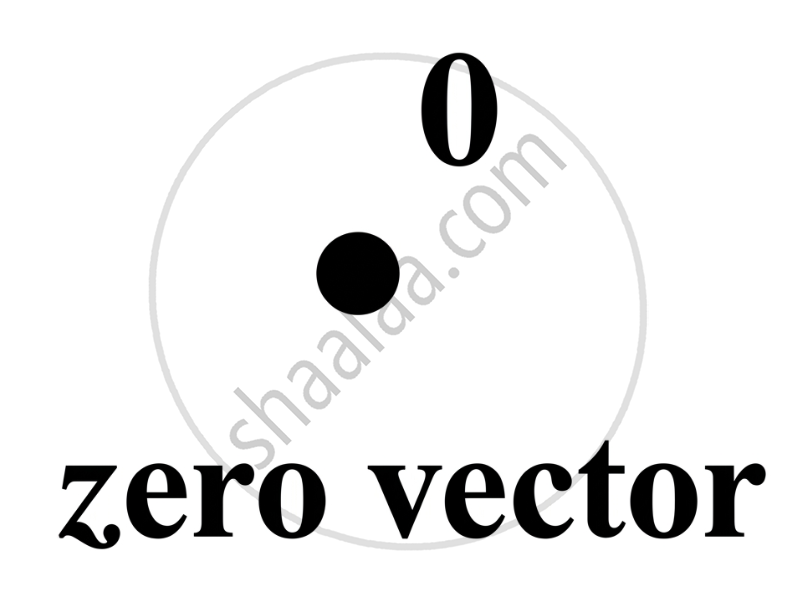
1. Zero Vector (Null Vector):
A vector whose initial point and terminal point coincide is called a zero vector. Its magnitude is zero, and it does not have a definite direction in the usual sense.
- Notation: \[\vec{0}\]
- Key idea: No net displacement.
2. Unit Vector
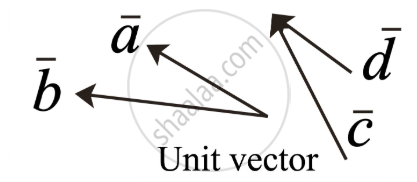
A vector having magnitude 1 is called a unit vector. If a vector \[\vec{a}\] is given, then the unit vector in its direction is written as \[\hat{a}\].
- Key idea: It shows direction only.
- Common examples: \[\hat{i}, \hat{j}, \hat{k}\] along x, y, z axes.
3. Coinitial Vectors
Vectors having the same initial point are called coinitial vectors. Their magnitudes and directions may be different, but they begin from a common point.
4. Collinear Vectors
Vectors that are parallel to the same line are called collinear vectors. They may act in the same direction or opposite direction and may have different magnitudes.
5. Equal Vectors
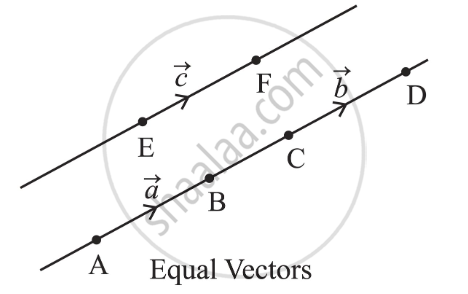
Two vectors are called equal vectors if they have the same magnitude and the same direction. Their positions in space may be different, but equality depends only on magnitude and direction
6. Negative of a Vector
A vector having the same magnitude as a given vector but opposite direction is called the negative of that vector. For example, \[\overrightarrow{BA} = -\overrightarrow{AB}\].
7. Free Vectors
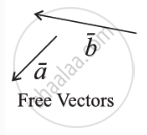
Vectors that can be moved parallel to themselves without changing magnitude and direction are called free vectors.
Key Points: Types of Vectors
| Type of Vector | Definition | Main Property | Simple Recall Cue |
|---|---|---|---|
| Zero vector | Initial and terminal points are same | Magnitude = 0 | No displacement |
| Unit vector | Magnitude is 1 | Gives direction conveniently | Length 1 |
| Coinitial vectors | Same starting point | Start together | Common origin |
| Collinear vectors | Parallel to same line | Lie along one line | Same line |
| Equal vectors | Same magnitude and direction | Position may differ | Same length + same direction |
| Negative vectors | Same magnitude, opposite direction | Sign changes direction | Reverse arrow |
| Free vectors | Can shift parallelly without change | Independent of position | Slide without changing |
