Topics
Similarity
- Ratios of Areas of Two Triangles
- Basic Proportionality Theorem
- Property of an Angle Bisector of a Triangle
- Property of Three Parallel Lines and Their Transversals
- Similarity of Triangles (Corresponding Sides & Angles)
- Theorem of Areas of Similar Triangles
- Overview of Similarity
Pythagoras Theorem
- Pythagorean Triplet
- Property of 30°- 60°- 90° Triangle Theorem
- Property of 45°- 45°- 90° Triangle Theorem
- Theorem of Similarity in Right Angled Triangle
- Theorem of Geometric Mean
- Pythagoras Theorem
- Application of Pythagoras Theorem
- Apollonius Theorem
- Overview of Pythagoras Theorem
Circle
- Properties of Chords of a Circle
- Circles Passing Through One, Two, Three Points
- Secant and Tangent
- Tangent Theorem
- Tangent Segment Theorem
- Touching Circles
- Arc of the Circle
- Central Angle and the Measure of an Arc
- Congruence of Arcs
- Property of Sum of Measures of Arcs
- Inscribed Angle & Intercepted Arc
- Cyclic Quadrilateral
- Overview of Circle
- Theorem of Angle between Tangent and Secant
- Theorem of Internal Division of Chords
- Theorem of External Division of Chords
- Tangent Secant Segments Theorem
Geometric Constructions
- Construction of Similar Triangle
- Construction of a Tangent to a Circle at a Point on the Circle
- Construction of a Tangent to a Circle from a Point Outside the Circle
- Overview of Geometric Constructions
Co-ordinate Geometry
Trigonometry
Mensuration
Notes
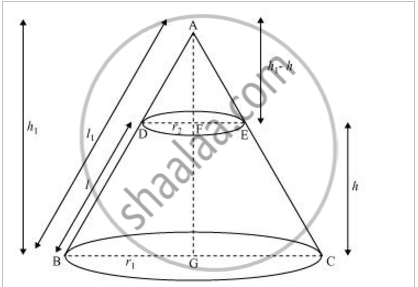
In ΔAFE and ΔAGC
ΔAFE ≅ ΔAGC (Angle-Angle rule)
`"AF"/"AG"= "FE"/"GC"= "AE"/"AC"`
`(h_1-h)/(h_1)= r_2/r_1= (l_1-l)/l_1 `
`(r_2)/(r_1)= (l_1-l)/(l_1)`
`r_2l_1= r_1(l_1-l)`
`r_2l_1= r_1l_1- r_1l`
`r_1l= r_1l_1- r_2l_1`
`r_1l= l_1 (r_1-r_2)`
`l_1= (r_1l)/ (r_1-r_2)` ...........eq1
`(h_1-h)/h_1= r_2/r_1= (l_1-l)/l_1`
`(h_1-h)/h_1= r_2/r_1`
`r_1(h_1-h)= h_1r_2`
`r_1h_1- r_1h= h_1r_2`
`r_1h_1- r_2h_1= r_1h`
`h_1(r_1-r_2)= r_1h`
`h_1= (r_1h)/(r_1-r_2)` ............eq2
1) Curved surface area of frustum= Curved surface area of ABC- Curved surface area of ADE
= `pi r_1l_1- pi r_2 (l_1-l)`
= `pi r_1l_1- pi r_2l_1 + pi r_2l`
= `pi l_1 (r_1- r_2) + pi r_2l`
= `pi r_1/(r_1-r_2) (r_1-r_2) +pi r_2l` (from eq1)
= `pi r_1l + pi r_2l`
Curved surface area of frustum = `pi l(r_1+r_2)`
2) Total surface area of frustum= Curved surface area of frustum + area of the circle above+ area of the circle below
Total surface area of frustum = `pi l (r_1+r_2) + pi r_1^2+ pi r_2^2`
3) Volume of frustum= Volume of cone ABC- Volume of cone ADE
= `1/3 pi r_1^2h_1- 1/3 pi r_2^2 (h_1-h)`
=`1/3 pi r_1^2h_1- 1/3 pi r_2^2h_1+ 1/3 pi r_2^2h`
= `1/3 pi h_1 (r_1^2- r_2^2) +1/3 pi r_2^2h`
= `1/3 pi (r_1h)/(r_1-r_2) (r_1^2-r_2^2)+ 1/3 pi r_2^2h` (from eq2)
= `1/3 pi (r_1h)/(r_1-r_2) (r_1-r_2) (r_1-r_2)+ 1/3 pi r_2^2h`
= `1/3 pi r_1h (r_1+r_2)+ 1/3 pi r_2^2h`
= `1/3 pi h [r_1 (r_1+r_2)+ r_2^2]`
Volume of frustum= `1/3 pi h (r_1^2+ r_2^2+ r_1r_2)`
Example- Hanumappa and his wife Gangamma are busy making jaggery out of sugarcane juice. They have processed the sugarcane juice to make the molasses, which is poured into moulds in the shape of a frustum of a cone having the diameters of its two circular faces as 30 cm and 35 cm and the vertical height of the mould is 14 cm. If each `cm^3` of molasses has mass about 1.2 g, find the mass of the molasses that can be poured into each mould. `(Take pi= 22/7)`
Solution : Since the mould is in the shape of a frustum of a cone, the quantity (volume) of molasses that can be poured into it = `pi/3 h(r_1^2+ r_2^2+ r_1r_2)`
where `r_1` is the radius of the larger base and `r_2` is the radius of the smaller base
=`1/3 xx 22/7 xx 14 [(35/2)^2+ (30/2)^2= (35/2 xx 30/2)] cm^3`
It is given that `1 cm^3` of molasses has mass `1.2g.` So, the mass of the molasses that can be poured into each mould = `(11641.7 xx 1.2) g`
= `13970.04 g = 13.97 kg = 14 kg ` (approx.)
