Advertisements
Advertisements
प्रश्न
A frustum of a right circular cone is of height 16 cm with radius of its ends as 8 cm and 20 cm. Then, the volume of the frustum is
पर्याय
3328π cm3
3228π cm3
3240π cm3
3340π cm3
Advertisements
उत्तर
3328π cm3
Explanation;
Hint:
Here, h = 16 cm, r = 8 cm, R = 20 cm
Volume of the frustum
= `1/3pi"h"("R"^2 + "r"^2 + "Rr")`
= `1/3pi xx 16(20^2 + 8^2 + 20 xx 8)`
= `1/3 pi xx 16(400 + 64 + 160)`
= `1/3 pi xx 16 xx 624`
= π × 16 × 208
= 3328π cm3
APPEARS IN
संबंधित प्रश्न
A drinking glass is in the shape of a frustum of a cone of height 14 cm. The diameters of its two circular ends are 4 cm and 2 cm. Find the capacity of the glass. [use π=22/7]
A solid toy s in the form of a hemisphere surrounded by a right circular cone . The height of cone is 4 cm and the diameter of the base is 8 cm . Determine the volume of the toy. If a cube circumscribes the toy , then find the difference of the volumes of cube and the toy .
A right triangle with sides 3 cm, 4 cm and 5 cm is rotated about the side of 3 cm to form a cone. The volume of the cone so formed is
In a right circular cone , the cross-section made by a plane parallel to the base is a
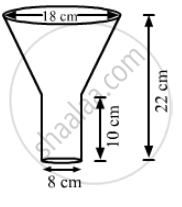
An oil funnel made of tin sheet consists of a 10 cm long cylindrical portion attached to a frustum of a cone. If the total height is 22 cm, diameter of the cylindrical portion is 8 cm and the diameter of the top of the funnel is 18 cm, then find the area of the tin sheet required to make the funnel.
By melting a solid sphere of radius 5 cm a solid right circular cone of the same circular base radius is made. The height of cone is ______.
The slant height of the frustum of a cone having radii of two ends as 5 cm and 2 cm respectively and height 4 cm is ______.
A shuttle cock used for playing badminton has the shape of the combination of ______.
A cone is cut through a plane parallel to its base and then the cone that is formed on one side of that plane is removed. The new part that is left over on the other side of the plane is called ______.
The volume of the frustum of a cone is `1/3 pih[r_1^2 + r_2^2 - r_1r_2]`, where h is vertical height of the frustum and r1, r2 are the radii of the ends.
