Topics
Similarity
- Ratios of Areas of Two Triangles
- Basic Proportionality Theorem
- Property of an Angle Bisector of a Triangle
- Property of Three Parallel Lines and Their Transversals
- Similarity of Triangles (Corresponding Sides & Angles)
- Theorem of Areas of Similar Triangles
- Overview of Similarity
Pythagoras Theorem
- Pythagorean Triplet
- Property of 30°- 60°- 90° Triangle Theorem
- Property of 45°- 45°- 90° Triangle Theorem
- Theorem of Similarity in Right Angled Triangle
- Theorem of Geometric Mean
- Pythagoras Theorem
- Application of Pythagoras Theorem
- Apollonius Theorem
- Overview of Pythagoras Theorem
Circle
- Properties of Chords of a Circle
- Circles Passing Through One, Two, Three Points
- Secant and Tangent
- Tangent Theorem
- Tangent Segment Theorem
- Touching Circles
- Arc of the Circle
- Central Angle and the Measure of an Arc
- Congruence of Arcs
- Property of Sum of Measures of Arcs
- Inscribed Angle & Intercepted Arc
- Cyclic Quadrilateral
- Overview of Circle
- Theorem of Angle between Tangent and Secant
- Theorem of Internal Division of Chords
- Theorem of External Division of Chords
- Tangent Secant Segments Theorem
Geometric Constructions
- Construction of Similar Triangle
- Construction of a Tangent to a Circle at a Point on the Circle
- Construction of a Tangent to a Circle from a Point Outside the Circle
- Overview of Geometric Constructions
Co-ordinate Geometry
Trigonometry
Mensuration
Definition: Pythagorean Triplet
Three natural numbers (a,b,c) form a Pythagorean triplet if:
c2 = a2 + b2
(where c is the largest number)
Examples:
(3,4,5), (5,12,13), (8,15,17)
Formula: Pythagorean Triplets
If a > b, then:
(a2 + b2, a2 − b2, 2ab) is a Pythagorean triplet.
Key Points: Properties of Right Angled Triangle with the Angles
(I)Property of 30°-60°-90° triangle
- Side opposite 30° = \[\frac{1}{2}\] × hypotenuse
- Side opposite 60° = \[\frac{\sqrt{3}}{2}\] × hypotenuse.
(II) Property of 45°-45°-90°
- Each perpendicular side = \[\frac{1}{\sqrt{2}}\] × hypotenuse
Theorem: Similarity and Right Angled Triangle
Statement:
In a right-angled triangle, if the altitude is drawn to the hypotenuse, then the two triangles formed are similar to the original triangle and to each other.
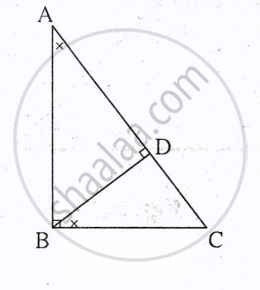
△ADB ~ △ АBС
△ BDC ~ △ ABC
△ ADB ~ △ BDC
Theorem: Theorem of Geometric Mean
Statement:
In a right-angled triangle, the altitude drawn to the hypotenuse is the geometric mean of the two segments of the hypotenuse.
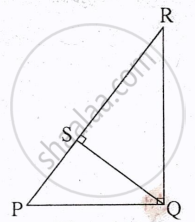
(Altitude)2 = (segment1) × (segment2)
Theorem: Pythagoras Theorem
Statement:
In a right-angled triangle, the square of the hypotenuse is equal to the sum of the squares of the other two sides.
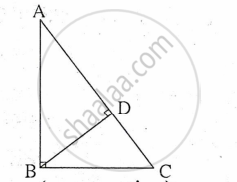
Hypotenuse2 = (base)2 + (perpendicular)2
Converse of Pythagoras Theorem:
In a triangle, if the square of one side is equal to the sum of the squares of the remaining two sides, then the triangle is a right-angled triangle
Theorem: Apollonius Theorem
Statement:
In a triangle, the sum of the squares of any two sides is equal to twice the square of the median to the third side plus twice the square of half the third side.
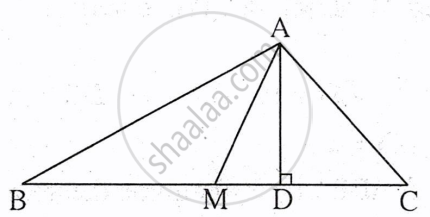
AB2 + AC2 = 2AM2 + 2BM2
(where M is the midpoint of BC)
