Advertisements
Advertisements
प्रश्न
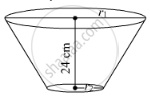
The circumferences of circular faces of a frustum are 132 cm and 88 cm and its height is 24 cm. To find the curved surface area of the frustum complete the following activity.( \[\pi = \frac{22}{7}\])
Advertisements
उत्तर
(Circumference)1 = 2πr1 = 132
∴ r1 = `132/(2π) = (132 xx 7)/(2 xx 22)` = 21 cm
(Circumference)1 = 2πr2 = 88
r2 = `88/(2π) = (88 xx 7)/(2 xx 22)`
= 14 cm
Slant height of frustum, `l = sqrt(h^2 + (r_1 - r_2)^2`
= `sqrt((24)^2 + (21 - 14)^2`
= `sqrt((24)^2 + (7)^2`
= `sqrt(576 + 49)` = `sqrt(625)`
= `sqrt(25 xx 25)` = 25 cm
Curved surface area of the frustum = `π(r_1 + r_2)l`
= `22/7 (21 + 14) xx 25`
= `22/7 xx 35 xx 25`
= 2750 cm2
संबंधित प्रश्न
Derive the formula for the volume of the frustum of a cone.
The radii of ends of a frustum are 14 cm and 6 cm respectively and its height is 6 cm. Find its volume \[\pi\] = 3.14)
An open metal bucket is in the shape of a frustum of a cone of height 21 cm with radii of its lower and upper ends as 10 cm and 20 cm respectively. Find the cost of milk which can completely fill the bucket at Rs. 30 per litre. `[User pi22/7]`
A milk container of height 16 cm is made of metal sheet in the form of a frustum of a cone with radii of its lower and upper ends as 8 cm and 20 cm respectively . Find the cost of milk at the rate of ₹44 per litre which the container can hold.
A bucket is in the form of a frustum of a cone of height 30 cm with radii of its lower and upper ends as 10 cm and 20 cm respectively. Find the capacity and surface area of the bucket. Also, find the cost of milk which can completely fill the container , at thr rate of ₹25 per litre. (Use \[\pi = 3 . 14) .\]
A hemisphere of lead of radius 7 cm is cast into a right circular cone of height 49 cm. Find the radius of the base.
The slant height of the frustum of a cone is 5 cm. If the difference between the radii of its two circular ends is 4 cm, write the height of the frustum.
A solid consists of a circular cylinder with an exact fitting right circular cone placed at the top. The height of the cone is h. If the total volume of the solid is 3 times the volume of the cone, then the height of the circular is
A reservoir is in the shape of a frustum of a right circular cone. It is 8 m across at the top and 4 m across at the bottom. If it is 6 m deep, then its capacity is
A cylinder with base radius of 8 cm and height of 2 cm is melted to form a cone of height 6 cm. The radius of the cone is
A tent is made in the form of a frustum of a cone surmounted by another cone. The diameters of the base and the top of the frustum are 20 m and 6 m, respectively, and the height is 24 m. If the height of the tent is 28 m and the radius of the conical part is equal to the radius of the top of the frustum, find the quantity of canvas required. `["Take" π = 22/7.]`
A bucket is in the form of a frustum of a cone with a capacity of 12308.8 cm3 of water. The radii of the top and bottom circular ends are 20 cm and 12 cm, respectively. Find the height of the bucket. [Use π = 3.14.]
A milk container is made of metal sheet in the shape of frustum of a cone whose volume is `"10459" 3/7 "cm"^3`. The radii of its lower and upper circular ends are 8 cm and 20 cm, respectively. Find the cost of metal sheet used in making the container at the rate of ₹ 1.40 per cm2.
A drinking glass is in the shape of frustum of a cone of height 21 cm with 6 cm and 4 cm as the diameters of its two circular ends. Find the capacity of the glass.
The base radii of two circular cones of the same height are in the ratio 3 : 5. The ratio of their volumes are ______.
The volume of the frustum of a cone is `1/3 pih[r_1^2 + r_2^2 - r_1r_2]`, where h is vertical height of the frustum and r1, r2 are the radii of the ends.
Read the following passage and answer the questions given below.
|
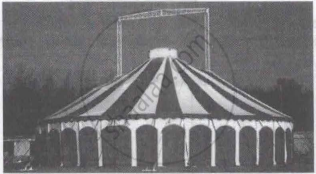
A 'circus' is a company of performers who put on shows of acrobats, clowns etc. to entertain people started around 250 years back, in open fields, now generally performed in tents. One such 'Circus Tent' is shown below. The tent is in the shape of a cylinder surmounted by a conical top. If the height and diameter of cylindrical part are 9 m and 30 m respectively and height of conical part is 8 m with same diameter as that of the cylindrical part, then find |
- the area of the canvas used in making the tent;
- the cost of the canvas bought for the tent at the rate ₹ 200 per sq m, if 30 sq m canvas was wasted during stitching.
Find the curved surface area of a right circular cone whose height is 15 cm and base radius is 8 cm. tan β = `3/4`.
