Advertisements
Chapters
2: Compound Interest
3: Expansions
4: Factorisation
5: Simultaneous Linear Equations
6: Indices/Exponents
7: Logarithms
▶ 8: Triangles
9: Mid-point Theorem
10: Pythagoras Theorem
11: Rectilinear Figures
12: Constructions of Polygons
13: Theorems on Area
14: Circles
15: Statistics
16: Mensuration
17: Trigonometric Ratios
18: Trigonometric Ratios of Some Standard Angles and Complementary Angles
19: Co-ordinate Geometry: An Introduction
![Nootan solutions for मैथमैटिक्स [अंग्रेजी] कक्षा ९ आईसीएसई chapter 8 - Triangles - Shaalaa.com](/images/mathematics-english-class-9-icse_6:f26eb985e8254aa987299226050d7c71.jpg "Nootan solutions for मैथमैटिक्स [अंग्रेजी] कक्षा ९ आईसीएसई chapter 8 - Triangles")
Advertisements
Solutions for Chapter 8: Triangles
Below listed, you can find solutions for Chapter 8 of CISCE Nootan for मैथमैटिक्स [अंग्रेजी] कक्षा ९ आईसीएसई.
Nootan solutions for मैथमैटिक्स [अंग्रेजी] कक्षा ९ आईसीएसई 8 Triangles Exercise 8A [Pages 158 - 160]
If ΔABC ≅ ΔPQR, is it true to say that AB = PR? Why?
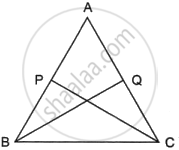
In the adjoining figure, AB = AC, AP = AQ. Prove that :
- ΔAPC ≅ ΔAQB
- CP = BQ
- ∠APC ≅ ∠AQB
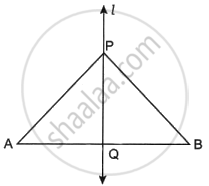
AB is a line segment and line l is its perpendicular bisector. If P is a point on line l, show that P is equidistant from A and B.
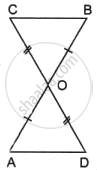
In the adjoining figure, OA = OB and OC = OD. Show that :
- ΔOAD ≅ ΔOBC
- AD || CB
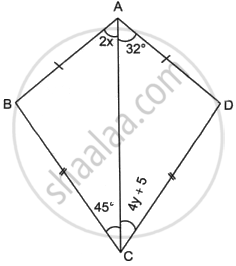
In quadrilateral ABCD, AB = BC and AD = CD. Show that BD bisects ∠ABC and ∠ADC both.
From the adjoining figure, find the values of x and y.
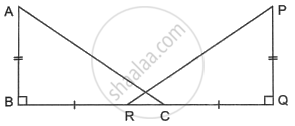
In the adjoining figure, AB = PQ, BR = CQ, ∠ABC = ∠PQR = 90°. Prove that AC = PR.
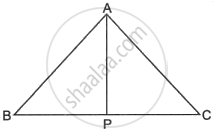
In the adjoining figure, AB = AC and AP is the bisector of ∠A. Prove that:
- P is the mid-point of BC
- AP is perpendicular to BC
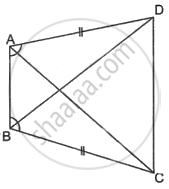
In the adjoining figure, ABCD is a quadrilateral in which AD = BC and ∠DAB = ∠CBA. Prove that:
- ΔABD ≅ ΔBAC
- BD = AC
- ∠ABD = ∠BAC
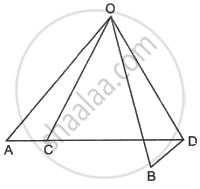
In the adjoining figure, OA = OB, OC = OD and ∠AOB = ∠COD. Prove that: AC = BD.
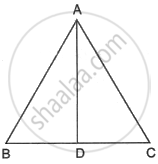
In the adjoining figure, AB = AC and D is the mid-point of BC. Use SSS criteria of congruency and prove that:
- ΔABD ≅ ΔACD
- AD bisects ∠A.
- AD is perpendicular to BC.
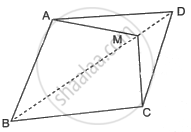
In a rhombus ABCD, M is any point in its interior as shown in the adjoining figure, such that MA = MC. Prove that B, M, D are collinear.
Line segment joining the mid-points M and N of parallel sides AB and DC, respectively of a trapezium ABCD is perpendicular to both the sides AB and DC. Prove that AD = BC.
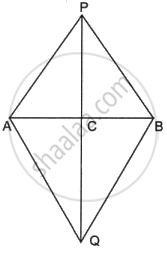
In the adjoining figure, AB is a line segment, P and Q are points on opposite sides of AB such that each of them is equidistant from the points A and B. Show that the line PQ is the perpendicular bisector of AB.
Nootan solutions for मैथमैटिक्स [अंग्रेजी] कक्षा ९ आईसीएसई 8 Triangles Exercise 8B [Pages 165 - 167]
In ΔABC and ΔPQR, ∠A = ∠R and ∠B = ∠P. Which side of ΔABC should be equal to ΔPQR, so that the two triangles are congruent. Give reason.
In ΔABC and ΔPQR, AB = PQ and AC = PR. Which angle of ΔABC should be equal to ΔPQR, so that the two triangles are congruent. Give reason.
In the adjoining figure, BE = CD and ∠BEA = ∠CDA. Prove that AE = AD.
P is a point equidistant from two lines m and n intersecting at a point M. Show that the line MP bisects the angle between the lines m and n.
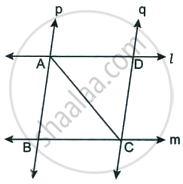
In the adjoining figure, l and m are two parallel lines intersected by another pair of parallel lines p and q. Show that : ΔABC ≅ ΔCDA.
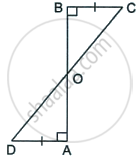
In the adjoining figure, AD and BC are equal perpendiculars to the line segment AB. Show that : CD bisects AB.
In quadrilateral ABCD, the diagonal AC bisects ∠A and ∠C both. Prove that AB = AD and CB = CD.
In a rectangle ABCD, X and Y are points on the sides AD and BC respectively such that AY = BX. Prove that: BY = AX and ∠BAY = ∠ABX.
ABC is an isosceles triangle with AB = AC. If AP ⊥ BC, then show that: ∠B = ∠C.
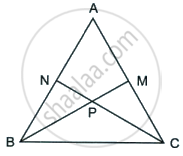
In the adjoining figure, ∠ABC = ∠ACB. M and N are points on the sides AC and AB respectively such that BN = CM. Prove that :
- ΔNBC ≅ ΔMCB
- ΔPNB ≅ ΔPMC
- PB = РС.
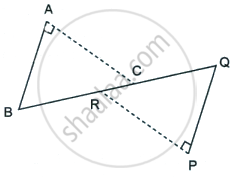
In the adjoining figure, BA ⊥ AC, PQ ⊥ PR, such that BA = PQ and BR = CQ. Show that : ΔΑΒC ≅ ΔΡQR.
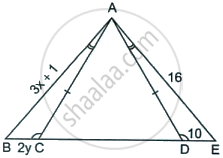
From the adjoining figure, find the value of x and y.
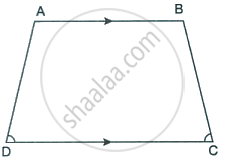
In the adjoining figure, AB || DC and ∠C = ∠D. Prove that:
- AD = BC
- AC = BD.
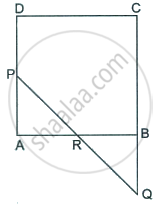
In the adjoining figure, ABCD is a squre and R is the mid-point of AB. PQ is any line segment passing through R which meets AD at P and CB produced at Q. Prove that R is the midpoint of PQ.
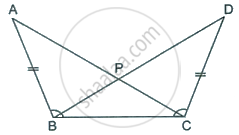
In the adjoining figure, AB = CD and ∠ABC = ∠BCD. Prove that :
- AC = BD
- BP = CP.
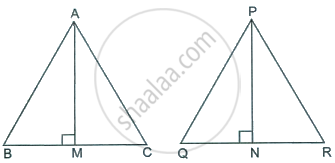
In the adjoining figure, two sides AB, AC and altitude AM of ΔABC are respectively equal to two sides PQ, PR and altitude PN of ΔPQR. Prove that ΔABC ≅ ΔPQR.
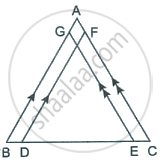
In the adjoining figure, AB || FD, AC || GE and BD = EC. Prove that:
- BG = DF
- EG = CF.
AD is an altitude of an isosceles triangles ABC in which AB = AC. Show that
- AD bisects BC
- AD bisects ∠A
Nootan solutions for मैथमैटिक्स [अंग्रेजी] कक्षा ९ आईसीएसई 8 Triangles Exercise 8C [Pages 173 - 176]
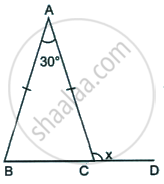
In ΔАВC, AB = AC and ∠BAC = 30°. Find the value of x.
In the adjoining figure, AC = CD = BD and ∠CBD = 40°. Find ∠ACD.
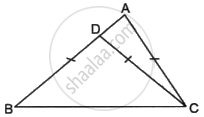
In the adjoining figure, AC = BC = CD and ∠ADC = 40°. Find ∠BAC.
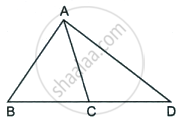
In the adjoining figure, AC = BC and CD = AD. If ∠ADC = 60°. Find ∠BAC.
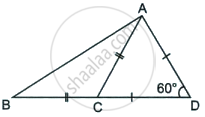
Show that the angles of an equilateral triangle are 60° each.
In the adjoining figure, BC = CD. Find ∠ACB.
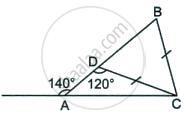
In the adjoining figure, ABC and DBC are two isosceles triangles on the same base BC. Prove that ∠ABD = ∠ACD.
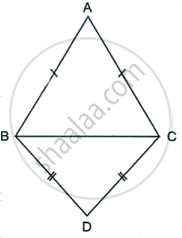
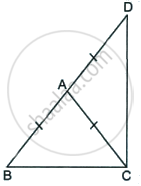
In the adjoining figure, ABC is an isosceles triangle in which AB = AC. Its side BA is produced to D such that AD = AB. Show that ∠BCD = 90°.
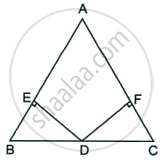
In the adjoining figure, D is the mid-point of BC. DE and DF are perpendiculars to AB and AC respectively, such that DE = DF. Prove that ΔABC is an isosceles triangle.
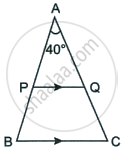
In the adjoining figure, ABC is an isosceles triangle in which AB = AC and PQ is parallel to BC. If ∠A = 40°, find ∠PQC.
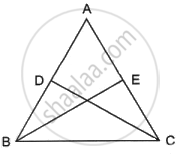
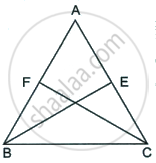
In the adjoining figure, AB = AC and BE, CF are the bisectors of ∠B, ∠C respectively. Prove that:
- ΔΕΒC ≅ ΔFCB
- BE = CF
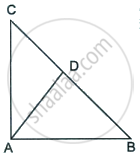
In the adjoining figure, ABC is a right-angled triangle, right-angled at A such that AB = AC. Bisector of ∠A meets BC at D. Prove that BC = 2AD.
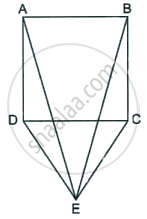
In the adjoining figure, ΔCDE is an equilateral triangle and ABCD is a square. Show that:
- ΔΑDE ≅ ΔBCE
- ΔАЕВ is an isosceles triangle.
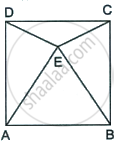
In the adjoining figure, ABCD is a square and ABE is an equilateral triangle. Prove that ΔECD is an isosceles triangle.
In a triangle ABC, AB = AC, D and E are points on the sides AB and AC, respectively such that BD = CE. Show that:
- ΔDBC ≅ ΔЕСВ
- ΔDCB = ΔЕВС
- OB = OC, where O is the point of intersection of BE and CD.
If the bisector of an angle of a triangle also bisects the opposite side, prove that the triangle is isosceles.
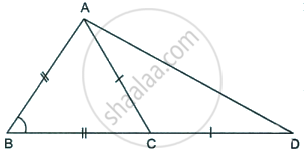
In the adjoining figure, AB = BC and AC = CD. Prove that ∠BAD : ∠ADB = 3 : 1.
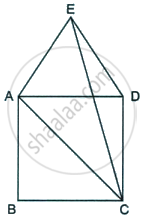
In the adjoining figure, ABCD is a square and ADE is an equilateral triangle. Prove that `∠ACE = 1/2 ∠ DAE`.
Nootan solutions for मैथमैटिक्स [अंग्रेजी] कक्षा ९ आईसीएसई 8 Triangles Exercise 8D [Pages 181 - 183]
In ΔАВC, ∠A = 30°, ∠B = 90°. Find the longest side of ΔАВС.
In ∆АВC, ∠A = 68°, AB = AC. Find the longest side of ∆AВС.
Show that in a right angled triangle, the hypotenuse is the longest side.
In ΔАВC, AB = 4 cm, BC = 5 cm and CA = 6 cm. Find the longest angle of ΔABC.
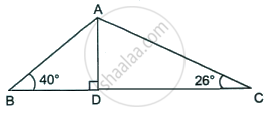
From the adjoining figure, find:
- The longest side of ABC
- The smallest side of ΔABC.
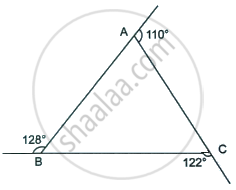
From the adjoining figure, find:
- The longest side of ΔABC
- The nature of ∠ВАС.
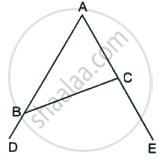
In the adjoining figure ∠DBC > ∠BCE. Prove that AB > AC.
In a quadrilateral ABCD. Prove that:
- BC + CD + DA > AB
- AB + BC + CD + DA > 2AC
- AB + BC + CD + DA > 2BD
In ΔABC, if AB < AC < BC, then what is the relation between ∠A and ∠C?
In ΔABC, if AB < AC < BC, then what is the relation between the values of (AB + AC) and BC?
In ΔABC, if AB < AC < BC, then what is the relation between the values of (BC – AB) and AC?
In ΔABC, if AB < AC < BC, then which is the largest angle of ΔABC?
Let ‘O’ be any point in the interior of ΔACB. Prove that:
- AB + AC > OB + ОС
- AB + BC + CA > (OA + OB + OC)
- AB + BC + CA < 2(OA + OB + ОС)
In the adjoining figure, AD = DE. Prove that AB + BC > CЕ.
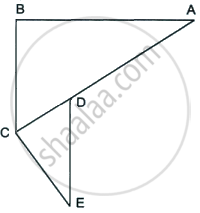
Prove that the sum of three medians of a triangle is less than the perimeter of the triangle.
If P is any interior point of ΔABC, prove that ∠BPC > ∠BAC.
In the adjacent figure, BE = DE. Prove that AC + BC > CD.
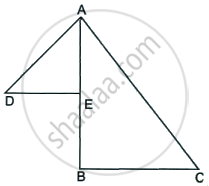
In the adjoining figure, AB = AD. Prove that BC > CD.
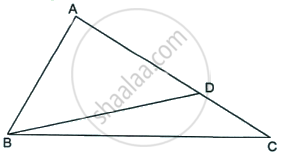
In the adjoining figure, x > y > z. Write the sides of ΔABC in ascending order.
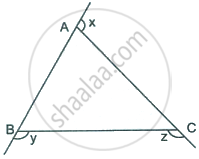
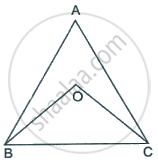
In the adjoining figure AB > AC. If OB and OC are the bisectors of ∠ABC and ∠ACB, respectively, then prove that OB > ОС.
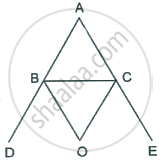
In the adjoining figure OB and OC are the bisectors of ∠DBC and ∠ECB, respectively. If AC > AB prove that OB > OC.
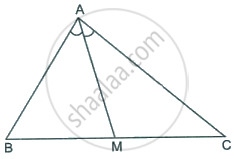
In the adjoining figure, AC > AB and AM is the bisector of ∠BAC. Prove that ∠AMC > ∠AMB.
Nootan solutions for मैथमैटिक्स [अंग्रेजी] कक्षा ९ आईसीएसई 8 Triangles Exercise 8E [Pages 183 - 184]
Multiple Choice Questions Choose the correct answer from the given four options in each of the following questions:
In ΔPQR, ∠R < ∠Q, then ______.
PR > PQ
PR < PQ
QR > PQ
QR < AB
In ΔABC, AB = AC and ∠A = 100°, then ∠C is equal to ______.
30°
35°
40°
80°
In ΔАВC, the correct relation is ______.
AB – BC > CA
BC – CA > AB
AB + BC < AC
AB < BC + AC
If ΔАВC ≅ ΔDEF, then the correct statement is ______.
AB = EF
BC = EF
∠B = ∠F
∠A = ∠E
In the adjoining figure, AD = CD = BD. ∠ABC is equal to:
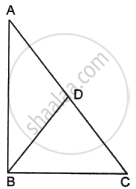
80°
90°
95°
100°
In the adjoining figure, the value of x is:
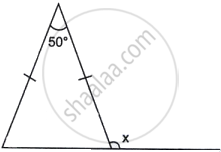
100°
105°
115°
130°
Two sides of a triangle are 3 cm and 6 cm, the length of third side of triangle cannot be ______.
2.5 cm
3.5 cm
4 cm
8 cm
Which of the following is not the criterion for the congruency of two triangles?
SAS
SSS
RHS
ASS
In a right-angled triangle, the longest side is ______.
base
altitude
hypotenuse
can’t say
In a ΔABC, right-angled at A, it is given that AB = AC, ∠C is equal to ______.
30°
45°
60°
90°
Solutions for 8: Triangles
Nootan solutions for मैथमैटिक्स [अंग्रेजी] कक्षा ९ आईसीएसई chapter 8 - Triangles
Shaalaa.com has the CISCE Mathematics मैथमैटिक्स [अंग्रेजी] कक्षा ९ आईसीएसई CISCE solutions in a manner that help students grasp basic concepts better and faster. The detailed, step-by-step solutions will help you understand the concepts better and clarify any confusion. Nootan solutions for Mathematics मैथमैटिक्स [अंग्रेजी] कक्षा ९ आईसीएसई CISCE 8 (Triangles) include all questions with answers and detailed explanations. This will clear students' doubts about questions and improve their application skills while preparing for board exams.
Further, we at Shaalaa.com provide such solutions so students can prepare for written exams. Nootan textbook solutions can be a core help for self-study and provide excellent self-help guidance for students.
Concepts covered in मैथमैटिक्स [अंग्रेजी] कक्षा ९ आईसीएसई chapter 8 Triangles are .
Using Nootan मैथमैटिक्स [अंग्रेजी] कक्षा ९ आईसीएसई solutions Triangles exercise by students is an easy way to prepare for the exams, as they involve solutions arranged chapter-wise and also page-wise. The questions involved in Nootan Solutions are essential questions that can be asked in the final exam. Maximum CISCE मैथमैटिक्स [अंग्रेजी] कक्षा ९ आईसीएसई students prefer Nootan Textbook Solutions to score more in exams.
Get the free view of Chapter 8, Triangles मैथमैटिक्स [अंग्रेजी] कक्षा ९ आईसीएसई additional questions for Mathematics मैथमैटिक्स [अंग्रेजी] कक्षा ९ आईसीएसई CISCE, and you can use Shaalaa.com to keep it handy for your exam preparation.
