Advertisements
Advertisements
प्रश्न
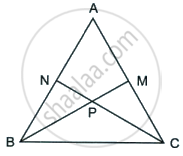
In the adjoining figure, ∠ABC = ∠ACB. M and N are points on the sides AC and AB respectively such that BN = CM. Prove that :
- ΔNBC ≅ ΔMCB
- ΔPNB ≅ ΔPMC
- PB = РС.
Advertisements
उत्तर
Given:
In ΔABC, ∠ABC = ∠ACB.
Points M ∈ AC and N ∈ AB are such that BN = CM.
Let BM and CN meet at P.
To Prove:
- ΔNBC ≅ ΔMCB
- ΔPNB ≅ ΔPMC
- PB = PC
Proof [Step-wise]:
i. ΔNBC ≅ ΔMCB
1. NB = CM ...(Given)
2. BC = CB ...(Common side)
3. ∠NBC = ∠ABC because N lies on AB and ∠MCB = ∠ACB because M lies on AC.
Given ∠ABC = ∠ACB.
So ∠NBC = ∠MCB.
4. Therefore in triangles NBC and MCB we have side–angle–side (NB = CM, included angle ∠NBC = ∠MCB and BC common).
Hence ΔNBC ≅ ΔMCB. ...(SAS)
ii. ΔPNB ≅ ΔPMC
Here, P is the intersection of BM and CN.
So PN lies on CN and PM lies on BM.
1. From (i), corresponding parts of congruent triangles give NC = MB and also corresponding angles equal in particular ∠CNB = ∠BMC and ∠MBN = ∠NCM.
2. ∠PNB = ∠CNB because PN is a part of CN; ∠PMC = ∠BMC because PM is a part of BM.
By (i) ∠CNB = ∠BMC.
Hence ∠PNB = ∠PMC.
3. ∠PBN = ∠MBN (PB lies on BM) and ∠PCM = ∠NCM (PC lies on CN).
By (i) ∠MBN = ∠NCM.
Hence ∠PBN = ∠PCM.
4. BN = CM ...(Given)
5. In triangles PNB and PMC we now have two angles equal (∠PNB = ∠PMC and ∠PBN = ∠PCM) and the included side between those two angles BN = CM.
Hence, by ASA, ΔPNB ≅ ΔPMC.
iii. PB = PC
1. From (ii), corresponding sides PB and PC are equal.
Therefore, PB = PC.
- ΔNBC ≅ ΔMCB,
- ΔPNB ≅ ΔPMC,
- PB = PC, as required.
