Advertisements
Advertisements
प्रश्न
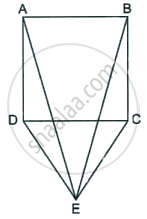
In the adjoining figure, ΔCDE is an equilateral triangle and ABCD is a square. Show that:
- ΔΑDE ≅ ΔBCE
- ΔАЕВ is an isosceles triangle.
Advertisements
उत्तर
Given:
- ABCD is a square.
- ΔCDE is an equilateral triangle.
To Prove:
- ΔADE ≅ ΔBCE.
- ΔAEB is an isosceles triangle.
Proof [Step-wise]:
1. From ABCD being a square:
AD = BC
And ∠ADC = ∠BCD = 90° ...(Each corner of a square)
2. From ΔCDE equilateral:
CD = DE = CE
And ∠CDE = ∠DCE = 60°
3. Compute the included angles:
∠ADE is the angle between AD and DE.
Moving from AD to DE can be done via AD → DC. ...(90°)
Then DC → DE. ...(60°)
So, ∠ADE = 90° + 60° = 150°.
Similarly, ∠BCE is the angle between BC and CE:
BC → CD ...(90°)
Then CD → CE ...(60°)
So, ∠BCE = 90° + 60° = 150°.
Hence, ∠ADE = ∠BCE.
4. In triangles ADE and BCE we now have:
AD = BC ...(Sides of the square)
DE = CE ...(Sides of the equilateral triangle)
Included angle ∠ADE = ∠BCE ...(Proved above)
Therefore, by SAS, ΔADE ≅ ΔBCE.
5. From the congruence (CPCTC) corresponding sides AE and BE are equal.
Therefore, AE = BE.
So, ΔAEB has two equal sides and is an isosceles triangle.
i. ΔADE ≅ ΔBCE ...(By SAS)
ii. ΔAEB is isosceles ...(AE = BE, from congruence)
