Advertisements
Advertisements
प्रश्न
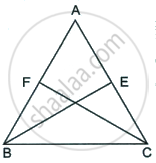
In the adjoining figure, AB = AC and BE, CF are the bisectors of ∠B, ∠C respectively. Prove that:
- ΔΕΒC ≅ ΔFCB
- BE = CF
Advertisements
उत्तर
Given: In △ABC, AB = AC and BE, CF are the bisectors of ∠B and ∠C respectively.
To Prove:
- △EBC ≅ △FCB
- BE = CF
Proof [Step-wise]:
1. From AB = AC (given) △ABC is isosceles, so the base angles are equal: ∠B = ∠C.
2. BE is the bisector of ∠B, so `∠EBC = (1/2) ∠B`.
3. CF is the bisector of ∠C, so `∠FCB = (1/2) ∠C`.
4. From step 1, ∠B = ∠C, hence ∠EBC = ∠FCB. (Equal corresponding half-angles)
5. Note that CE lies on AC, so ∠ECB = ∠ACB = ∠C.
6. Note that BF lies on AB, so ∠CBF = ∠CBA = ∠B.
7. From step 1, ∠B = ∠C, hence ∠ECB = ∠CBF.
8. In triangles EBC and FCB, the two angles adjacent to side BC are equal pairwise: ∠EBC = ∠FCB and ∠ECB = ∠CBF and the included side BC is common.
9. Therefore, by the ASA congruence criterion, △EBC ≅ △FCB.
10. From the congruence (corresponding parts of congruent triangles), BE = CF.
