Advertisements
Advertisements
प्रश्न
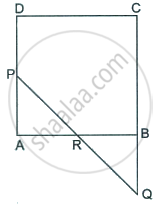
In the adjoining figure, ABCD is a squre and R is the mid-point of AB. PQ is any line segment passing through R which meets AD at P and CB produced at Q. Prove that R is the midpoint of PQ.
Advertisements
उत्तर
Given: ABCD is a square and R is the midpoint of AB.
PQ is any line through R meeting AD at P and the extension of CB at Q.
To Prove: R is the midpoint of PQ.
Proof [Step-wise]:
1. Choose a convenient coordinate system:
Let A(0, 0), B(2, 0), C(2, 2), D(0, 2).
Then AB is horizontal of length 2 and R, the midpoint of AB, has coordinates R(1, 0).
Any side length 2k works; 2 is chosen for simplicity.
2. Let the line PQ through R meet AD (x = 0) at P and the produced CB (x = 2) at Q.
Thus, P has coordinates P(0, p) for some p and Q has coordinates Q(2, q) for some q.
3. Collinearity of P, R, Q they lie on the same line implies the slope from P to R equals the slope from R to Q.
Compute slopes:
Slope (PR)
= `(0 - p)/(1 - 0)`
= –p
Slope (RQ)
= `(q - 0)/(2 − 1)`
= q
Hence, –p = q, so q = –p.
4. The midpoint M of PQ has coordinates M
= `((0 + 2)/2, (p + q)/2)`
= `(1, (p + q)/2)`
Using q = –p gives `(p + q)/2 = (p + (-p))/2 = 0`.
So, M = (1, 0).
5. But R = (1, 0).
Therefore, M = R.
So, R is the midpoint of PQ.
