Please select a subject first
Advertisements
Advertisements
A refrigerator converts 100 g of water at 20°C to ice at -10°C in 35 minutes. Calculate the average rate of heat extraction in terms of watts.
Given: Specific heat capacity of ice = 2.1 J g-1°C-1
Specific heat capacity of water = 4.2 J g-1°C-1
Specific latent heat of fusion of ice = 336 J g-1
Concept: undefined >> undefined
50 g of metal piece at 27°C requires 2400 J of heat energy so as to attain a temperature of 327°C . Calculate the specific heat capacity of the metal.
Concept: undefined >> undefined
Advertisements
Heat energy is supplied at a constant rate to 100g of ice at 0 °C. The ice is converted into water at 0° C in 2 minutes. How much time will be required to raise the temperature of water from 0 °C to 20 °C? [Given: sp. heat capacity of water = 4.2 J g-1 °C-1, sp. latent heat of ice = 336 J g-1].
Concept: undefined >> undefined
Specific heat capacity of substance A is 3.8 J g-1K-1 whereas the specific heat capacity of substance B is 0.4 J g-1 K-1
(i) Which of the two is a good conductor of heat?
(ii) How is one led to the above conclusion?
(iii) If substances A and B are liquids then which one would be more useful in car radiators?
Concept: undefined >> undefined
A liquid X has the maximum specific heat capacity and is used as a coolant in Car Radiators. Name the liquid X.
Concept: undefined >> undefined
A solid metal weighing 150 g melts at its melting point of 800 °C by providing heat at the rate of 100 W. The time taken for it to completely melt at the same temperature is 4 min. What is the specific latent heat of fusion of the metal?
Concept: undefined >> undefined
Heat supplied to a solid change it into liquid. What is this change in the phase called?
Concept: undefined >> undefined
During the phase change does the average kinetic energy of the molecules of the substance increase?
Concept: undefined >> undefined
Give a mathematical relation between Heat Capacity and Specific Heat Capacity.
Concept: undefined >> undefined
The temperature of 170 g of water at 50°C is lowered to 5°C by adding a certain amount of ice to it. Find the mass of ice added.
Given: Specific heat capacity of water = 4200 J kg-1 °C-1 and specific latent heat of ice = 336000 J kg-1.
Concept: undefined >> undefined
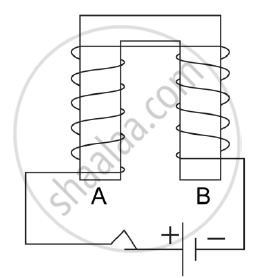
The diagram shows a coil wound around a U shape soft iron bar AB.
1) What is the polarity induced at the ends A and B when the switch is pressed?
2) Suggest one way to strengthen the magnetic field in the electromagnet
3) What will be the polarities at A & B if the direction of current is reversed in the circuit?
Concept: undefined >> undefined
Name the three classes of levers and state how are they distinguished. Give two examples of each class.
Concept: undefined >> undefined
Give one example of a class I lever where mechanical advantage is less than 1.
Concept: undefined >> undefined
What is the use of the lever if its mechanical advantage is
- more than 1,
- equal to 1, and
- less than 1?
Concept: undefined >> undefined
Both a pair of scissors and a pair of pliers belong to the same class of levers. Name the class of lever. Which one has the mechanical advantage less than 1?
Concept: undefined >> undefined
Explain why scissors for cutting cloth may have blades longer than the handles, but shears for cutting metals have short blades and long handles.
Concept: undefined >> undefined
Which type of lever has a mechanical advantage always more than one? Give one example. What change can be made in this lever to increase its mechanical advantage?
Concept: undefined >> undefined
Explain why the mechanical advantage of a class II of lever is always more than 1.
Concept: undefined >> undefined
Draw a labelled diagram of a class II lever. Give one example of such a lever.
Concept: undefined >> undefined
Explain why the mechanical advantage of the class III type of lever is always less than 1.
Concept: undefined >> undefined
