Advertisements
Advertisements
Define ampere and volt with respect to Ohm’s law.
Concept: undefined >> undefined
State the limitations of Ohm’s law.
Concept: undefined >> undefined
Advertisements
What is non-ohmic resistor?
Concept: undefined >> undefined
What are ohmic conductors? Give one exmaple. Draw a graph showing the current-voltage relationship for an ohmic conductor.
Concept: undefined >> undefined
What are non-ohmic conductors? Give one exmaple. Draw a current-voltage graph for a non-ohmic conductor.
Concept: undefined >> undefined
Draw a neat diagram for the verification of Ohm’s law by voltmeter-ammeter method. By another diagram show the relation between p.d. and current.
Concept: undefined >> undefined
An ammeter placed in series with an electric radiator reads 0.5 amps and a voltmeter placed across it reads 230 volts. What is the resistance of the radiator?
Concept: undefined >> undefined
A ray of light is moving from a rarer medium to a denser medium and strikes a plane mirror placed at 90° to the direction of the ray as shown in the diagram.
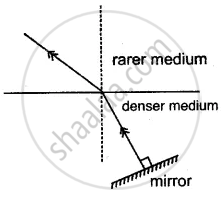
(i) Copy the diagram and mark arrows to show the path of the ray of light after it is reflected from the mirror.
(ii) Name the principle you have used to mark the arrows to show the direction of the ray.
Concept: undefined >> undefined
The diagram shows a current-carrying coil passing through a cardboard sheet. Draw three magnetic lines of force on the board.
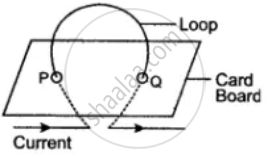
State two factors on which magnitude of magnetic field at the centre depends.
Concept: undefined >> undefined
Sketch the lines of force of the magnetic field of a solenoid. How does its field compare with that of a bar magnet?
Concept: undefined >> undefined
The adjacent diagram shows a small magnet placed near a solenoid. State whether the magnet is attracted or repelled, as the switch is pressed. Give a reason.
Concept: undefined >> undefined
What is a solenoid? Why do we usually keep its diameter small in comparison to its length?
Concept: undefined >> undefined
The diagram below shows a magnet moved near a coil along its axis. Which of the diagram shows correct flow of current during this motion?
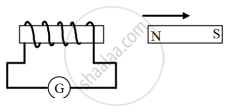
Concept: undefined >> undefined
The diagram below shows an insulated copper wire wound around a hollow cardboard cylindrical tube. Answer the questions that follow:
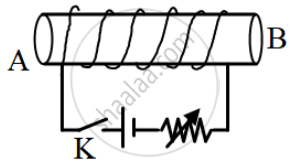
- What are the magnetic poles at A and B when the key K is closed?
- State two ways to increase the strength of the magnetic field in this coil without changing the coil.
- If we place a soft iron bar at the centre of the hollow cardboard and replace the DC source with an AC source then will it attract small iron pins toward itself when the current is flowing through the coil?
Concept: undefined >> undefined
Calculate the power spent by a crane while lifting a load of mass 2000 kg, at velocity of 1.5 ms-1. (g = 10 ms-2)
Concept: undefined >> undefined

In the above diagram Lata stands between two cliffs and claps her hands.
Determine the time taken by her to hear the first echo. Speed of sound in air 320 ms-1.
Concept: undefined >> undefined
The voltage - current readings of a certain material are shown in the table given below:
| Voltage (V) | 10 V | 20 V | 30 V |
| Current (I) | 2 A | 3 A | 4 A |
Study the table.
- State whether the conductor used is ohmic or non-ohmic.
- Justify your answer.
- State Ohm's law.
Concept: undefined >> undefined
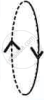
Current is flowing through a coil as shown in the figure. Which one of the given figures will correctly depict the magnetic polarity and the direction of the lines of force along the axis of the coil?
Concept: undefined >> undefined
Unit of power used in mechanical engineering is ______.
Concept: undefined >> undefined
The circuit depicted in the figure is employed for studying Ohm’s Law. Instead of using a standard resistor, a student opts for a glass tube filled with mercury (tube 1), connected to the circuit through two electrodes, E1 and E2. He records the readings of the ammeter and voltmeter, thereby calculating the resistance. The student repeats the experiment by substituting tube 1 with tube 2, where the same amount of mercury fills tube 2.
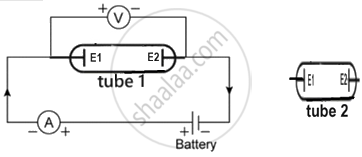
Neglecting internal resistance of the cell use (> or < or =) to compare:
- the resistance in both the cases.
- the voltmeter readings in both the cases.
- the specific resistance in both the cases.
Concept: undefined >> undefined
