Advertisements
Advertisements
प्रश्न
What is a solenoid? Why do we usually keep its diameter small in comparison to its length?
Advertisements
उत्तर

If a conducting wire (coated with an insulating paint or varnish) is closely wound on a (long) cylindrical core, the resulting coil is referred to as solenoid. It is usual to keep the diameter of the solenoid small compared to its length. This is done to bring about a greater degree of uniformity (and simplicity) in the axial magnetic field of the solenoid.
संबंधित प्रश्न
How does a solenoid behave like a magnet? Can you determine the north and south poles of a current-carrying solenoid with the help of a bar magnet? Explain.
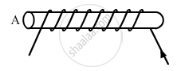
The figure shows a solenoid wound on a core of soft iron. Will the end A be a N pole or S pole when the current flows in the direction shown?
Draw the pattern of magnetic field lines of a solenoid through which a steady current flows. What does the pattern of field lines inside the solenoid indicate?
Draw magnetic field lines in and around a current-carrying straight solenoid.
The pattern of the magnetic field produced by the straight current-carrying conducting wire is ____________.
For a current in a long straight solenoid, N-pole and S-pole are created at the two ends. Among the following statements, the incorrect statement is ____________.
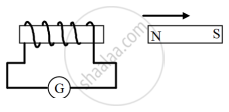
The diagram below shows a magnet moved near a coil along its axis. Which of the diagram shows correct flow of current during this motion?
What does the divergence of magnetic field lines near the ends of a current carrying straight solenoid indicate?
When does a solenoid behave as a magnet? Draw the pattern of the magnetic field produced inside it showing the directions of the magnetic field lines.
How is a solenoid prepared?
