Advertisements
Advertisements
A body of mass 60 kg has the momentum 3000 kg m s-1. Calculate:
- the kinetic energy.
- the speed of the body.
Concept: undefined >> undefined
How much work is needed to be done on a ball of mass 50 g to give it a momentum of 5 kg cm s-1?
Concept: undefined >> undefined
Advertisements
Show by a ray diagram that a diverging lens cannot form a real image of an object placed anywhere on its principal axis.
Concept: undefined >> undefined
A body is thrown vertically upwards. Its velocity keeps on decreasing. What happens to its kinetic energy as its velocity becomes zero?
Concept: undefined >> undefined
A body falls freely under gravity from rest. Name the kind of energy it will possess on reaching the ground.
Concept: undefined >> undefined
Two bodies have masses in the ratio 5 : 1 and their kinetic energies are in the ratio 125 : 9. Calculate the ratio of their velocities.
Concept: undefined >> undefined
(i) Define resonant vibrations.
(ii) Which characteristic of sound, makes it possible to recognize a person by his voice without seeing him?
Concept: undefined >> undefined
Two pendulums C and D are suspended from a wire as shown in the figure give below. Pendulum C is made to oscullate by displaying it from its mean position. It is seen that D also starts oscillating.
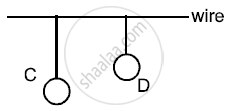
(i) Name the type of oscillation, C will execute.
(ii) Name the type of oscillation, D will execute.
(iii) If the length of D is made equal to C then what difference will you notice in the oscillations of D ?
(iv) What is the name of the phenomenon when the length of D is made equal to C ?
Concept: undefined >> undefined
What do you understand by the kinetic energy of a body?
Concept: undefined >> undefined
Which of the following quantity remains constant in a uniform circular motion?
Concept: undefined >> undefined
Concept: undefined >> undefined
Concept: undefined >> undefined
Concept: undefined >> undefined
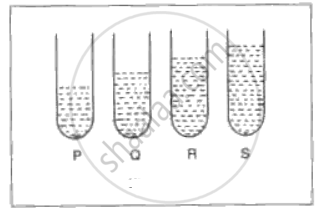
In fig. , P, Q, R and S represent test tubes each of height 20 cm which are filled with water upto heights of 10 cm, 14 cm, 16 cm and 18 cm respectively. If a vibrating tuning fork is placed over the mouth of test tube Q, a loud sound is heard.
(i) Describe the observations with the tubes P, R and S.
(ii) Give the reason for your observation in each case.
(iii) State the principle illustrated by the above experiment.
Concept: undefined >> undefined
Concept: undefined >> undefined
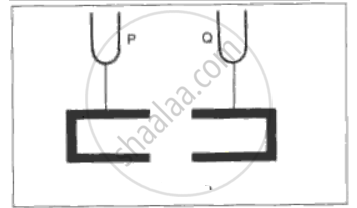
In fig. shows two tuning forks P and Q of the same frequency mounted on separate sound boxes with their open ends facing each other. The fork A is set into vibration. (i) Describe your observation. (ii) State the principle illustrated by this experiment.
Concept: undefined >> undefined
In Fig. A, B, C and D are four pendulums suspended from the same elastic string XY. The lengths of pendulum A and D are equal, while the length of pendulum B is shorter and of the pendulum C is longer. Pendulum A is set into vibrations.

- What is your observation about the vibrations of pendulum D?
- Give reason for your observation in part (a).
- What type of vibrations take place in pendulums Band C?
- Give reason for the answer in part (c).
Concept: undefined >> undefined
Differentiate between the following:
Light and sound waves.
Concept: undefined >> undefined
Differentiate between the following:
Free and forced vibrations.
Concept: undefined >> undefined
Differentiate between the following:
Radio waves and light waves.
Concept: undefined >> undefined
