Advertisements
Advertisements
Answer the following question, which help you understand the difference between Thomson’s model and Rutherford’s model better.
In which model is it completely wrong to ignore multiple scattering for the calculation of average angle of scattering of α-particles by a thin foil?
Concept: undefined >> undefined
From the relation R = R0A1/3, where R0 is a constant and A is the mass number of a nucleus, show that the nuclear matter density is nearly constant (i.e. independent of A).
Concept: undefined >> undefined
Advertisements
In an n-type silicon, which of the following statement is true:
Concept: undefined >> undefined
A double convex lens is made of a glass of refractive index 1.55, with both faces of the same radius of curvature. Find the radius of curvature required, if the focal length is 20 cm.
Concept: undefined >> undefined
Consider a plane wave front incident on a thin convex lens. Draw a proper diagram to show how the incident wave front traverses through the lens and after refraction focusses on the focal point of the lens, giving the shape of the emergent wave front.
Concept: undefined >> undefined
Use Huygens' principle to verify the laws of refraction.
Concept: undefined >> undefined
Define the distance of closest approach. An α-particle of kinetic energy 'K' is bombarded on a thin gold foil. The distance of the closest approach is 'r'. What will be the distance of closest approach for an α-particle of double the kinetic energy?
Concept: undefined >> undefined
Write two important limitations of Rutherford's nuclear model of the atom.
Concept: undefined >> undefined
How does one explain the emission of electrons from a photosensitive surface with the help of Einstein's photoelectric equation?
Concept: undefined >> undefined
The work function of the following metals is given : Na 2.75 ev, K = 2.3 eV, Mo = 4.17 eV and Ni = 5.15 eV. Which of these metals will not cause photoelectric emission for radiation of wavelength 3300 Å from a laser source placed 1 m away from these metals? What happens if the laser source is brought nearer and placed 50 cm away?
Concept: undefined >> undefined
Using Huygens’ principle, verify the laws of reflection at a plane surface.
Concept: undefined >> undefined
The charging current for a capacitor is 0.25 A. What is the displacement current across its plates?
Concept: undefined >> undefined
An electron in an atom revolves round the nucleus in an orbit of radius r with frequency v. Write the expression for the magnetic moment of the electron.
Concept: undefined >> undefined
A capacitor has been charged by a dc source. What are the magnitude of conduction and displacement current, when it is fully charged?
Concept: undefined >> undefined
Answer the following question.
Show that the density of the nucleus is independent of its mass number A.
Concept: undefined >> undefined
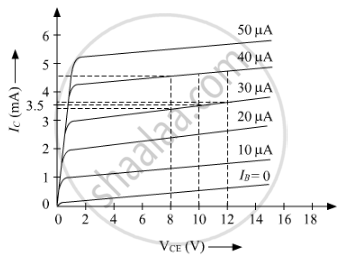
Output characteristics of an n-p-n transistor in CE configuration is shown in the figure.
Determine:
(i) dynamic output resistance
(ii) dc current gain and
(iii) ac current gain at an operating point VCE = 10 V, when IB = 30 μA.
Concept: undefined >> undefined
Using this principle draw a diagram to show how a plane wave front incident at the interface of the two media gets refracted when it propagates from a rarer to a denser medium. Hence verify Snell's law of refraction.
Concept: undefined >> undefined
When an ideal capacitor is charged by a dc battery, no current flows. However, when an ac source is used, the current flows continuously. How does one explain this, based on the concept of displacement current?
Concept: undefined >> undefined
Use Huygens’s principle to explain the formation of diffraction pattern due to a single slit illuminated by a monochromatic source of light.
Concept: undefined >> undefined
