Advertisements
Advertisements
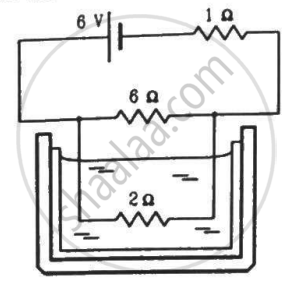
The 2.0 Ω resistor shown in the figure is dipped into a calorimeter containing water. The heat capacity of the calorimeter together with water is 2000 J K−1. (a) If the circuit is active for 15 minutes, what would be the rise in the temperature of the water? (b) Suppose the 6.0 Ω resistor gets burnt. What would be the rise in the temperature of the water in the next 15 minutes?
Concept: undefined >> undefined
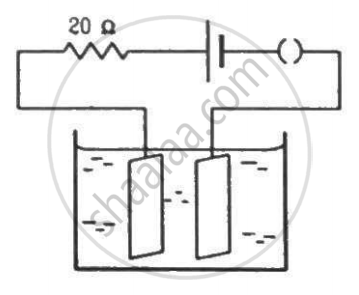
The figure shows an electrolyte of AgCl through which a current is passed. It is observed that 2.68 g of silver is deposited in 10 minutes on the cathode. Find the heat developed in the 20 Ω resistor during this period. Atomic weight of silver is 107.9 g/mol−1.
Concept: undefined >> undefined
Advertisements
A long, straight wire carries a current i. The magnetising field intensity H is measured at a point P close to the wire. A long, cylindrical iron rod is brought close to the wire, so that the point P is at the centre of the rod. The value of H at P will ______________ .
Concept: undefined >> undefined
Which of the following pairs has quantities of the same dimensions?
(a) Magnetic field B and magnetising field intensity H
(b) Magnetic field B and intensity of magnetisation I
(c) Magnetising field intensity H and intensity of magnetisation I
(d) Longitudinal strain and magnetic susceptibility
Concept: undefined >> undefined
Mark out the correct options.
(a) Diamagnetism occurs in all materials.
(b) Diamagnetism results from the partial alignment of permanent magnetic moment.
(c) The magnetising field intensity, H, is always zero in free space.
(d) The magnetic field of induced magnetic moment is opposite the applied field.
Concept: undefined >> undefined
The magnetic intensity H at the centre of a long solenoid carrying a current of 2.0 A, is found to be 1500 A m−1. Find the number of turns per centimetre of the solenoid.
Concept: undefined >> undefined
The magnetic field inside a long solenoid of 50 turns cm−1 is increased from 2.5 × 10⁻³ T to 2.5 T when an iron core of cross-sectional area 4 cm2 is inserted into it. Find (a) the current in the solenoid (b) the magnetisation I of the core and (c) the pole strength developed in the core.
Concept: undefined >> undefined
The magnetic field B and the magnetic intensity H in a material are found to be 1.6 T and 1000 A m−1, respectively. Calculate the relative permeability µr and the susceptibility χ of the material.
Concept: undefined >> undefined
Assume that each iron atom has a permanent magnetic moment equal to 2 Bohr magnetons (1 Bohr magneton equals 9.27 × 10⁻²⁴ A m2). The density of atoms in iron is 8.52 × 1028 atoms m−3. (a) Find the maximum magnetisation I in a long cylinder of iron (b) Find the maximum magnetic field B on the axis inside the cylinder.
Concept: undefined >> undefined
Two circular loops are placed with their centres separated by a fixed distance. How would you orient the loops to have (a) the largest mutual inductance (b) the smallest mutual inductance?
Concept: undefined >> undefined
A rectangular coil of 100 turns has length 5 cm and width 4 cm. It is placed with its plane parallel to a uniform magnetic field and a current of 2 A is sent through the coil. Find the magnitude of the magnetic field B if the torque acting on the coil is 0.2 N m−1
Concept: undefined >> undefined
Is p − E/c valid for electrons?
Concept: undefined >> undefined
The frequency and intensity of a light source are doubled. Consider the following statements.
(A) The saturation photocurrent remains almost the same.
(B) The maximum kinetic energy of the photoelectrons is doubled.
Concept: undefined >> undefined
A non-monochromatic light is used in an experiment on photoelectric effect. The stopping potential
Concept: undefined >> undefined
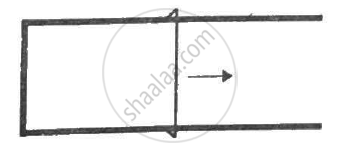
Figure shows a metallic wire of resistance 0.20 Ω sliding on a horizontal, U-shaped metallic rail. The separation between the parallel arms is 20 cm. An electric current of 2.0 µA passes through the wire when it is slid at a rate of 20 cm s−1. If the horizontal component of the earth's magnetic field is 3.0 × 10⁻⁵ T, calculate the dip at the place.
Concept: undefined >> undefined
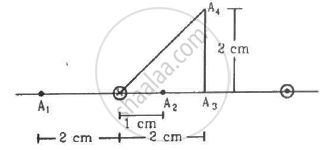
Figure shows two parallel wires separated by a distance of 4.0 cm and carrying equal currents of 10 A along opposite directions. Find the magnitude of the magnetic field B at the points A1, A2, A3.
Concept: undefined >> undefined
Two parallel wires carry equal currents of 10 A along the same direction and are separated by a distance of 2.0 cm. Find the magnetic field at a point which is 2.0 cm away from each of these wires.
Concept: undefined >> undefined
Two long, straight wires, each carrying a current of 5 A, are placed along the x- and y-axis respectively. The currents point along the positive directions of the axes. Find the magnetic fields at the points (a) (1 m, 1 m), (b) (−1 m, 1 m), (c) (−1 m, −1 m) and (d) (1 m, −1 m).
Concept: undefined >> undefined
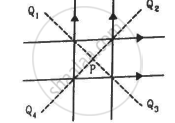
Four long, straight wires, each carrying a current of 5.0 A, are placed in a plane as shown in figure. The points of intersection form a square of side 5.0 cm.
(a) Find the magnetic field at the centre P of the square.
(b) Q1, Q2, Q3, and Q4, are points situated on the diagonals of the square and at a distance from P that is equal to the diagonal of the square. Find the magnetic fields at these points.
Concept: undefined >> undefined
Consider a 10-cm long piece of a wire which carries a current of 10 A. Find the magnitude of the magnetic field due to the piece at a point which makes an equilateral triangle with the ends of the piece.
Concept: undefined >> undefined
