Please select a subject first
Advertisements
Advertisements
Two long parallel wires kept 2 m apart carry 3A current each, in the same direction. The force per unit length on one wire due to the other is ______.
Concept: undefined >> undefined
Draw the circuit arrangement for studying V-I characteristics of a p-n junction diode in (i) forward biasing and (ii) reverse biasing. Draw the typical V-I characteristics of a silicon diode.
Concept: undefined >> undefined
Advertisements
The photon emitted during the de-excitation from the first excited level to the ground state of a hydrogen atom is used to irradiate a photocathode in which the stopping potential is 5 V. Calculate the work function of the cathode used.
Concept: undefined >> undefined
Describe the following term briefly:
Minority carrier injection in forward biasing.
Concept: undefined >> undefined
Describe the following term briefly:
Breakdown voltage in reverse biasing
Concept: undefined >> undefined
A heavy nucleus P of mass number 240 and binding energy of 7.6 MeV per nucleon splits into two nuclei Q and R of mass number 110 and 130 and binding energy per nucleon of 8.5 MeV and 8.4 MeV respectively. Calculate the energy released in fission.
Concept: undefined >> undefined
Charges (+q) and (–q) are placed at points A and B respectively which are a distance 2L apart. C is the midpoint between A and B. What is the work done in moving a charge +Q along the semicircle CRD?

Concept: undefined >> undefined
Two circular loops, one of small radius r and the other of larger radius R, such that R >> r, are placed coaxially with centres coinciding. Obtain the mutual inductance of the arrangement.
Concept: undefined >> undefined
Two long straight parallel current-carrying conductors are kept ‘a’ distant apart in the air. The direction of current in both the conductors is the same. Find the magnitude of force per unit length and the direction of the force between them. Hence define one ampere.
Concept: undefined >> undefined
Read the following paragraph and answer the questions that follow.
| A semiconductor diode is basically a pn junction with metallic contacts provided at the ends for the application of an external voltage. It is a two-terminal device. When an external voltage is applied across a semiconductor diode such that the p-side is connected to the positive terminal of the battery and the n-side to the negative terminal, it is said to be forward-biased. When an external voltage is applied across the diode such that the n-side is positive and the p-side is negative, it is said to be reverse-biased. An ideal diode is one whose resistance in forward biasing is zero and the resistance is infinite in reverse biasing. When the diode is forward biased, it is found that beyond forward voltage called knee voltage, the conductivity is very high. When the biasing voltage is more than the knee voltage the potential barrier is overcome and the current increases rapidly with an increase in forward voltage. When the diode is reverse biased, the reverse bias voltage produces a very small current of about a few microamperes which almost remains constant with bias. This small current is a reverse saturation current. |
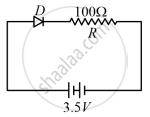
- In the given figure, a diode D is connected to an external resistance R = 100 Ω and an emf of 3.5 V. If the barrier potential developed across the diode is 0.5 V, the current in the circuit will be:
(a) 40 mA
(b) 20 mA
(c) 35 mA
(d) 30 mA - In which of the following figures, the pn diode is reverse biased?
(a)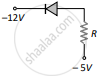
(b)
(c)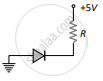
(d)
- Based on the V-I characteristics of the diode, we can classify the diode as:
(a) bilateral device
(b) ohmic device
(c) non-ohmic device
(d) passive element
OR
Two identical PN junctions can be connected in series by three different methods as shown in the figure. If the potential difference in the junctions is the same, then the correct connections will be:
(a) in the circuits (1) and (2)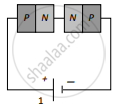

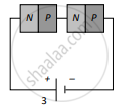
(b) in the circuits (2) and (3)
(c) in the circuits (1) and (3)
(d) only in the circuit (1) 
The V-I characteristic of a diode is shown in the figure. The ratio of the resistance of the diode at I = 15 mA to the resistance at V = -10 V is
(a) 100
(b) 106
(c) 10
(d) 10-6
Concept: undefined >> undefined
Write the S.I. unit of mutual inductance.
Concept: undefined >> undefined
Calculate the energy in fusion reaction:
`""_1^2H+_1^2H->_2^3He+n`, where BE of `""_1^2H`23He=7.73MeV" data-mce-style="position: relative;">=2.2323He=7.73MeV MeV and of `""_2^3He=7.73 MeV`
Concept: undefined >> undefined
Write the function of a transformer.
Concept: undefined >> undefined
In what way is the behaviour of a diamagnetic material different from that of a paramagnetic, when kept in an external magnetic field?
Concept: undefined >> undefined
Calculate the shortest wavelength of the spectral lines emitted in Balmer series.
[Given Rydberg constant, R = 107 m–1]
Concept: undefined >> undefined
Draw a labeled diagram of a step-down transformer.
Concept: undefined >> undefined
How does one explain, using de Broglie hypothesis, Bohr's second postulate of quantization of orbital angular momentum?
Concept: undefined >> undefined
In a given coil of self-inductance of 5 mH, current changes from 4 A to 1 A in 30 ms. Calculate the emf induced in the coil.
Concept: undefined >> undefined
Show that the radius of the orbit in hydrogen atom varies as n2, where n is the principal quantum number of the atom.
Concept: undefined >> undefined
