हिंदी

Science (English Medium) कक्षा १२ - CBSE Question Bank Solutions

Advertisements
[object Object]
[object Object]
विषयों
मुख्य विषय
अध्याय

Please select a subject first

Advertisements
Advertisements
< prev  22501 to 22520 of 25888  next > 

Why is zener diode fabricated by heavily doping both p- and n-sides of the junction?

[14] Semiconductor Electronics - Materials, Devices and Simple Circuits
Chapter: [14] Semiconductor Electronics - Materials, Devices and Simple Circuits
Concept: undefined >> undefined

How is a photodiode fabricated?

[14] Semiconductor Electronics - Materials, Devices and Simple Circuits
Chapter: [14] Semiconductor Electronics - Materials, Devices and Simple Circuits
Concept: undefined >> undefined

Advertisements

Briefly explain its working. Draw its V - I characteristics for two different intensities of illumination ?

[14] Semiconductor Electronics - Materials, Devices and Simple Circuits
Chapter: [14] Semiconductor Electronics - Materials, Devices and Simple Circuits
Concept: undefined >> undefined

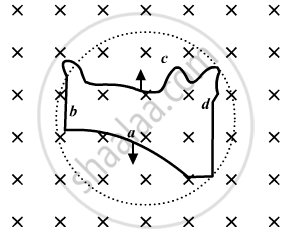
A flexible wire of irregular shape, abcd, as shown in the figure, turns into a circular shape when placed in a region of magnetic field which is directed normal to the plane of the loop away from the reader. Predict the direction of the induced current in the wire.
[4] Moving Charges and Magnetism
Chapter: [4] Moving Charges and Magnetism
Concept: undefined >> undefined

A proton and a deuteron having equal momenta enter in a region of a uniform magnetic field at right angle to the direction of a the field. Depict their trajectories in the field.

[4] Moving Charges and Magnetism
Chapter: [4] Moving Charges and Magnetism
Concept: undefined >> undefined

A capacitor, made of two parallel plates each of plate area A and separation d, is being charged by an external ac source. Show that the displacement current inside the capacitor is the same as the current charging the capacitor. 

[2] Electrostatic Potential and Capacitance
Chapter: [2] Electrostatic Potential and Capacitance
Concept: undefined >> undefined

Draw V − I characteristics of a p-n junction diode. Answer the following questions, giving reasons:

(i) Why is the current under reverse bias almost independent of the applied potential up to a critical voltage?

(ii) Why does the reverse current show a sudden increase at the critical voltage?

Name any semiconductor device which operates under the reverse bias in the breakdown region.

[14] Semiconductor Electronics - Materials, Devices and Simple Circuits
Chapter: [14] Semiconductor Electronics - Materials, Devices and Simple Circuits
Concept: undefined >> undefined

The current in the forward bias is known to be more (~mA) than the current in the reverse bias (~μA). What is the reason, then, to operate the photodiode in reverse bias?

[14] Semiconductor Electronics - Materials, Devices and Simple Circuits
Chapter: [14] Semiconductor Electronics - Materials, Devices and Simple Circuits
Concept: undefined >> undefined

Draw the circuit diagram of a full wave rectifier using p-n junction diode.

Explain its working and show the output, input waveforms.

[14] Semiconductor Electronics - Materials, Devices and Simple Circuits
Chapter: [14] Semiconductor Electronics - Materials, Devices and Simple Circuits
Concept: undefined >> undefined

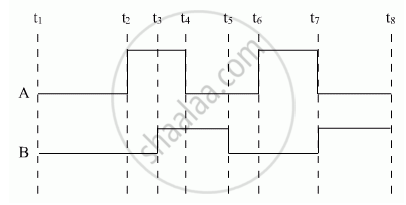
Show the output waveforms (Y) for the following inputs A and B of (i) OR gate (ii) NAND gate ?
[14] Semiconductor Electronics - Materials, Devices and Simple Circuits
Chapter: [14] Semiconductor Electronics - Materials, Devices and Simple Circuits
Concept: undefined >> undefined

Describe briefly, with the help of a diagram, the role of the two important processes involved in the formation of a p-n junction.

[14] Semiconductor Electronics - Materials, Devices and Simple Circuits
Chapter: [14] Semiconductor Electronics - Materials, Devices and Simple Circuits
Concept: undefined >> undefined

Write the expression for the force,`vecF` acting on a charged particle of charge ‘q’, moving with a velocity `vecV` in the presence of both electric field `vecF`and magnetic field `vecB` . Obtain the condition under which the particle moves undeflected through the fields.

[4] Moving Charges and Magnetism
Chapter: [4] Moving Charges and Magnetism
Concept: undefined >> undefined

How does a light emitting diode (LED) work? Give two advantages of LED’s over the conventional incandescent lamps.

[14] Semiconductor Electronics - Materials, Devices and Simple Circuits
Chapter: [14] Semiconductor Electronics - Materials, Devices and Simple Circuits
Concept: undefined >> undefined

When the width of the slit is made double, how would this affect the size and intensity of the central diffraction band? Justify.

[10] Wave Optics
Chapter: [10] Wave Optics
Concept: undefined >> undefined

What happens to the width of depletion player of a p-n junction when it is (i) forward biased, (ii) reverse biased?

[14] Semiconductor Electronics - Materials, Devices and Simple Circuits
Chapter: [14] Semiconductor Electronics - Materials, Devices and Simple Circuits
Concept: undefined >> undefined

Net capacitance of three identical capacitors in series is 2 μF. What will be their net capacitance if connected in parallel?

[2] Electrostatic Potential and Capacitance
Chapter: [2] Electrostatic Potential and Capacitance
Concept: undefined >> undefined

Write the expression for Lorentz magnetic force on a particle of charge ‘q’ moving with velocity `vecv` in a magnetic field`vecB`. Show that no work is done by this force on the charged particle.

[4] Moving Charges and Magnetism
Chapter: [4] Moving Charges and Magnetism
Concept: undefined >> undefined

A parallel plate capacitor is being charged by a time varying current. Explain briefly how Ampere’s circuital law is generalized to incorporate the effect due to the displacement current ?

[2] Electrostatic Potential and Capacitance
Chapter: [2] Electrostatic Potential and Capacitance
Concept: undefined >> undefined

Draw the circuit diagram of an illuminated photodiode in reverse bias. How is photodiode used to measure light intensity?

[14] Semiconductor Electronics - Materials, Devices and Simple Circuits
Chapter: [14] Semiconductor Electronics - Materials, Devices and Simple Circuits
Concept: undefined >> undefined

Explain the formation of depletion layer and potential barrier in a p−n junction.

[14] Semiconductor Electronics - Materials, Devices and Simple Circuits
Chapter: [14] Semiconductor Electronics - Materials, Devices and Simple Circuits
Concept: undefined >> undefined
< prev  22501 to 22520 of 25888  next > 
Advertisements
Advertisements
CBSE Science (English Medium) कक्षा १२ Question Bank Solutions
Question Bank Solutions for CBSE Science (English Medium) कक्षा १२ Biology
Question Bank Solutions for CBSE Science (English Medium) कक्षा १२ Chemistry
Question Bank Solutions for CBSE Science (English Medium) कक्षा १२ Computer Science (C++)
Question Bank Solutions for CBSE Science (English Medium) कक्षा १२ Computer Science (Python)
Question Bank Solutions for CBSE Science (English Medium) कक्षा १२ English Core
Question Bank Solutions for CBSE Science (English Medium) कक्षा १२ English Elective - NCERT
Question Bank Solutions for CBSE Science (English Medium) कक्षा १२ Entrepreneurship
Question Bank Solutions for CBSE Science (English Medium) कक्षा १२ Geography
Question Bank Solutions for CBSE Science (English Medium) कक्षा १२ Hindi (Core)
Question Bank Solutions for CBSE Science (English Medium) कक्षा १२ Hindi (Elective)
Question Bank Solutions for CBSE Science (English Medium) कक्षा १२ History
Question Bank Solutions for CBSE Science (English Medium) कक्षा १२ Informatics Practices
Question Bank Solutions for CBSE Science (English Medium) कक्षा १२ Mathematics
Question Bank Solutions for CBSE Science (English Medium) कक्षा १२ Physical Education
Question Bank Solutions for CBSE Science (English Medium) कक्षा १२ Physics
Question Bank Solutions for CBSE Science (English Medium) कक्षा १२ Political Science
Question Bank Solutions for CBSE Science (English Medium) कक्षा १२ Psychology
Question Bank Solutions for CBSE Science (English Medium) कक्षा १२ Sanskrit (Core)
Question Bank Solutions for CBSE Science (English Medium) कक्षा १२ Sanskrit (Elective)
Question Bank Solutions for CBSE Science (English Medium) कक्षा १२ Sociology
Share
Notifications

Englishहिंदीमराठी


      Forgot password?
Use app×