Advertisements
Advertisements
प्रश्न
A parallel plate capacitor is being charged by a time varying current. Explain briefly how Ampere’s circuital law is generalized to incorporate the effect due to the displacement current ?
Advertisements
उत्तर
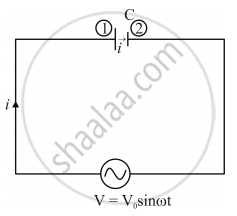
When a capacitor is connected to an alternating current, it offers a resistance `X_e (1/(omegac))`and allows the current to pass through.
As the current is moving from plate (1) to plate (2) there should be a magnetic field associated with this current as explained by Ampere circuital law, but as there can’t be movement of actual electrons from plate (2) to plate (1), there will be no physical current, and still there will be a magnetic field.
To solve this paradox Maxwell altered the form of Ampere’s law as followed.
Original form
`int_c vecE*vecdl =mu_0i +mu_0 in_0 (dphi)/(dt)`
`=mu_0 (i +i_D)`
`i_D = in_0 (dphi_(E))/(dt)`(Displacement current)
`phi_E` = Electric flux
By introducing displacement current, Maxwell argued that due to change in electric field associated with alternating voltage, there will be a time dependent electric flux. This flux will cause a displacement current and hence there will be a magnetic field.
APPEARS IN
संबंधित प्रश्न
Two parallel-plate capacitors X and Y have the same area of plates and same separation between them. X has air between the plates, while Y contains a dielectric medium of εr = 4.

(i) Calculate capacitance of each capacitor if the equivalent capacitance of the combination is 4 μF.
(ii) Calculate the potential difference between the plates X and Y.
(iii) Estimate the ratio of electrostatic energies stored in X and Y.
A capacitor, made of two parallel plates each of plate area A and separation d, is being charged by an external ac source. Show that the displacement current inside the capacitor is the same as the current charging the capacitor.
A dielectric slab is inserted between the plates of an isolated capacitor. The force between the plates will
Define the dielectric constant of a medium. What is its S.I unit?
A dielectric is inserted between the plates of a charged and isolated parallel-plate air capacitor. Then, the charge on the plates and the potential difference, respectively, ______.
A parallel plate capacitor has a uniform electric field `overset(->)("E")` in the space between the plates. If the distance between plates is 'd' and the area of each plate is 'A', the energy stored in the capacitor is ______
(ε0 = permittivity of free space)
A free electron and a free proton are placed between two oppositely charged parallel plates. Both are closer to the positive plate than the negative plate.

Which of the following statements is true?
- The force on the proton is greater than the force on the electron.
- The potential energy of the proton is greater than that of the electron.
- The potential energy of the proton and the electron is the same.
A parallel plate air capacitor of capacitance C is connected to a cell of emf V and then disconnected from it. A dielectric slab of dielectric constant K, which can just fill the air gap of the capacitor, is now inserted in it. Which of the following is incorrect?
A parallel plate capacitor is made by stocking n equally spaced plates connected alternately. If the capacitance b/w any two plate is x, then the total capacitance is
The capacity of the parallel plate condenser depends on ______
