Please select a subject first
Advertisements
Advertisements
Write two factors that affect the rate of reaction.
Concept: Factors Influencing Rate of a Reaction
For a reaction : 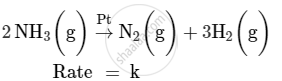
(i) Write the order and molecularity of this reaction.
(ii) Write the unit of k.
Concept: Factors Influencing Rate of a Reaction
The rate constant for the first-order decomposition of H2O2 is given by the following equation:
`logk=14.2-(1.0xx10^4)/TK`
Calculate Ea for this reaction and rate constant k if its half-life period be 200 minutes.
(Given: R = 8.314 JK–1 mol–1)
Concept: Temperature Dependence of the Rate of a Reaction
For the hydrolysis of methyl acetate in aqueous solution, the following results were obtained :
| t/s | 0 | 30 | 60 |
| [CH3COOCH3] / mol L–1 | 0.60 | 0.30 | 0.15 |
(i) Show that it follows pseudo first order reaction, as the concentration of water remains constant.
(ii) Calculate the average rate of reaction between the time interval 30 to 60 seconds.
(Given log 2 = 0.3010, log 4 = 0.6021)
Concept: Factors Influencing Rate of a Reaction
A first order reaction takes 30 minutes for 50% completion. Calculate the time required for 90% completion of this reaction.
(log 2 = 0.3010)
Concept: Half Life Period of a Reaction
The decomposition of NH3 on platinum surface is zero order reaction. What are the rates of production of N2 and H2 if k = 2.5 × 10⁻⁴ mol−1 L s−1?
Concept: Zero Order Reactions
Account for the following:
Cr2+ is a strong reducing agent.
Concept: General Properties of the Transition Elements (d-block)
When chromite ore FeCr2O4 is fused with NaOH in presence of air, a yellow-coloured compound (A) is obtained, which on acidification with dilute sulphuric acid gives a compound (B). Compound (B) on reaction with KCl forms an orange coloured crystalline compound (C).
(i) Write the formulae of the compounds (A), (B) and C.
(ii) Write one use of compound (C).
Concept: Some Important Compounds of Transition Elements - Oxides and Oxoanions of Metals
Complete the following chemical equation
8MnO4- + 3S2O32- + H2O →
Concept: Some Important Compounds of Transition Elements - Oxides and Oxoanions of Metals
What are the transition elements? Write two characteristics of the transition elements.
Concept: General Properties of the Transition Elements (d-block)
How would you account for the following:
Actinoid contraction is greater than lanthanoid contraction.
Concept: F-block Elements >> The Actinoids
How would you account for the following : Transition metals form coloured compounds
Concept: General Properties of the Transition Elements (d-block)
Complete the following equation :
`2MnO_4^(-)+6H^++5NO_2^(-)rarr`
Concept: Some Important Compounds of Transition Elements - Oxides and Oxoanions of Metals
Account for the following:
Cu+ ion is unstable in aqueous solution.
Concept: General Properties of the Transition Elements (d-block)
Complete the following equations:Cr2O72- + 2OH- →
Concept: Some Important Compounds of Transition Elements - Oxides and Oxoanions of Metals
Complete the following equations : MnO4- + 4H+ + 3e- →
Concept: Some Important Compounds of Transition Elements - Oxides and Oxoanions of Metals
With reference to structural variability and chemical reactivity, write the differences between lanthanoids and actinoids
Concept: F-block Elements >> The Actinoids
Name a member of the lanthanoid series which is well known to exhibit +4 oxidation state.
Concept: F-block Elements >> The Lanthanoids
Out of Mn3+ and Cr3+, which is more paramagnetic and why ?
(Atomic nos. : Mn = 25, Cr = 24)
Concept: General Properties of the Transition Elements (d-block)
Complete the following chemical equation
Cr2O72- + 3Sn2+ + 14H+ →
Concept: Some Important Compounds of Transition Elements - Oxides and Oxoanions of Metals
