Advertisements
Advertisements
प्रश्न
The rate constant for the first-order decomposition of H2O2 is given by the following equation:
`logk=14.2-(1.0xx10^4)/TK`
Calculate Ea for this reaction and rate constant k if its half-life period be 200 minutes.
(Given: R = 8.314 JK–1 mol–1)
Advertisements
उत्तर
Given:
Order of the reaction = First order
t1/2 = 200 minutes = 200 × 60 = 12,000 seconds
The relation between t1/2 and k is given by
t1/2 = 0.693/k
k = 0.693/12000 = 5.7 × 10⁻⁵
The rate constant for the first-order decomposition of H2O2 is given by
`logk=14.2-(1.0xx10^4)/TK...................(i)`
By Arrhenius equation
`log k=logA-E_a/(2.303RT)...............(ii)`
Comparing (i) and (ii), we get
Ea = 1.91 × 10⁵
APPEARS IN
संबंधित प्रश्न
The rate of the chemical reaction doubles for an increase of 10 K in absolute temperature from 298 K. Calculate Ea.
The rate of a reaction quadruples when the temperature changes from 293 K to 313 K. Calculate the energy of activation of the reaction assuming that it does not change with temperature.
Explain the following terms :
Half life period of a reaction (t1/2)
Write a condition under which a bimolecular reaction is kinetically first order. Give an example of such a reaction. (Given : log2 = 0.3010,log 3 = 0.4771, log5 = 0.6990).
Activation energy of a chemical reaction can be determined by ______.
Which of the following graphs represents exothermic reaction?
(a)

(b)
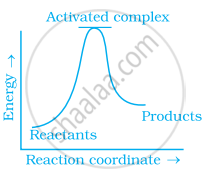
(c)
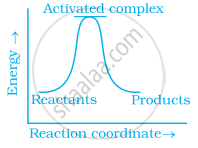
Explain how and why will the rate of reaction for a given reaction be affected when the temperature at which the reaction was taking place is decreased.
The equation k = `(6.5 xx 10^12 "s"^(-1))"e"^(- 26000 " K"//"T")` is followed for the decomposition of compound A. The activation energy for the reaction is ______ kJ mol-1. (Nearest integer) (Given: R = 8.314 JK-1 mol-1)
The decomposition of N2O into N2 and O2 in the presence of gaseous argon follows second-order kinetics, with k = (5.0 × 10¹¹ L mol−1 s−1) `"e"^(-(29000 "K")/"T")`. Arrhenius parameters are ______ kJ mol−1.
The rate of a reaction quadruples when temperature changes from 27°C to 57°C calculate the energy of activation.
(Given: R = 8. 314 J K−1 mol−1, log 4 = 0.6021)
