Please select a subject first
Advertisements
Advertisements
Active Transport and Diffusion [Significance in plants]
Concept: Absorption and Conduction of Water and Minerals >> Active Transport
The diagram given below represents a plant cell after being placed in a strong sugar solution. Study the diagram and answer the questions that follow:

- What is the state of the cell shown in the diagram?
- Name the structure that acts as a selectively permeable membrane.
- Label the parts numbered 1 to 4 in the diagram.
- How can the above cell be brought back to its original condition? Mention the scientific term for the recovery of the cell.
- State any two features of the above plant cell which is not present in animal cells.
Concept: Turgidity and Flaccidity (Plasmolysis)
A plant cell may burst when :
Concept: Turgidity and Flaccidity (Plasmolysis)
State the main function of the Guard cells
Concept: Absorption and Conduction of Water and Minerals >> Active Transport
The figure given below is a diagrammatic representation of a part of the cross section of the root in the root hair zone. Study the same and then answer the questions that follow

(i) Name the parts indicated by the guidelines 1 to 4.
(ii) Which is the process that enables the passage of water from the soil into the root hair?
(iii) Name the pressure that is responsible for the movement of water in the direction indicated by the arrows. Define it.
(iv) Due to an excess of this pressure sometimes drops of water are found along the leaf margins of some plants especially in the early mornings. What is the phenomenon called?
(v) Draw a well labelled diagram of the root hair cell as it would appear if an excess of fertiliser is added to the soil close to it.
Concept: Concept of Absorption by the Roots
The diagram of an given below demonstrates a particular process in plants. Study the same and answer the questions that follow:
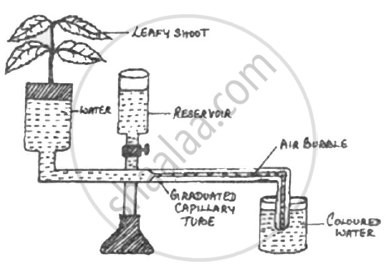
- Name the apparatus.
- Which phenomenon is demonstrated by this apparatus?
- Explain the phenomenon mentioned in (ii) above.
- State two limitations of using this apparatus.
- What is the importance of the air bubble in the experiment?
- Name the structures in a plant through which the above process takes place.
Concept: Concept of Absorption by the Roots
the exact location of the Lenticels
Concept: Concept of Absorption by the Roots
fill in the blanks with suitable functions: Xylem and __________.
Concept: Absorption and Conduction of Water and Minerals
The phenomenon of loss of water through a cut stem or injured part of plant is called ___________.
Concept: Concept of Absorption by the Roots
Differentiate between Diffusion and Osmosis (Definition)
Concept: Osmotic Pressure
Explain Turgor pressure
Concept: Turgidity and Flaccidity (Plasmolysis)
Differentiate between Turgor pressure and Wall pressure (explain)
Concept: Osmotic Pressure
A candidate in order to study the process of osmosis has taken 3 potato cubes and put them in 3 different beakers containing 3 different solutions. After 24 hours, in the first beaker the potato cube increased in size, in the second beaker the potato cube decreased in size and in the third beaker there was no change in the size of the potato cube. The following diagram shows the result of the same experiment:

(i) Give the technical terms of the solutions used in beakers, 1, 2 and 3.
(ii) In beaker 3, the size of the potato cube remains the same. Explain the reason in brief.
(iii) Write the specific feature of the cell sap of root hairs which helps in absorption of water.
(iv) What is osmosis?
(v) How does a cell wall and a cell membrane differ in their permeability?
Concept: Osmotic Pressure
Give scientific reasons : Balsam plants wilt during mid-day even if the soil is well watered.
Concept: Turgidity and Flaccidity (Plasmolysis)
Correct the following statement by changing the underlined word.
Xylem transports starch from the leaves to all parts of the plant body.
Concept: Concept of Absorption by the Roots
Lenticels or stomata (Which one remains open always?)
Concept: Absorption and Conduction of Water and Minerals >> Active Transport
Give the appropriate biological or technical term for the following.
Movement of molecules of a substance from their higher concentration to lower concentration when they are in direct contact.
Concept: Osmotic Pressure
Differentiate between the following on the basis of what is indicated in the bracket.
Hypotonic solution and Hypertonic solution (condition of a plant cell when placed in them).
Concept: Osmotic Pressure
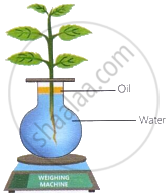
Fig. represents aprocess in plants. The set up was placed in bright sunlight. Answer the following questions:
-
- Name the physiological process depicted in the figure.
- Why was oil added to the water?
- When placed in bright sunlight for four hours, what do you observe with regard to the initial and final weight of the plant? Give a suitable reason for your answer.
- What happens to the level of water when this setup is placed in:
- Humid conditions?
- Windy conditions?
- Mention any three adaptations found in plants to overcome the process mentioned in (a).
- Explain the term ‘Guttation’.
Concept: Turgidity and Flaccidity (Plasmolysis)
Give suitable biological reasons for the following statement:
Root hairs become flaccid and droop when excess fertilizers are added to the moist soil around them.
Concept: Turgidity and Flaccidity (Plasmolysis)
