Advertisements
Advertisements
प्रश्न
Explain Turgor pressure
Advertisements
उत्तर
Turgor pressure:
In a turgid plant cell, the pressure of the cell contents on the cell wall is called the turgor pressure.
APPEARS IN
संबंधित प्रश्न
Give the equivalent term for the following:
The condition in which the cell contents are shrunken.
Give reasons for the following:
If you sprinkle some common salt on grass growing on a lawn, it is killed at that spot.
Give reason for the following:
It is better to transplant seedlings in a flower-bed in the evening and not in the morning.
A leaf cell of a water plant was placed in a liquid other than pond water. After sometime, it assumed a shape as shown below:
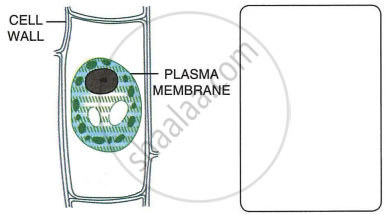
- Give the term for the state of the cell it has acquired.
- Name the structure which acts as a selectively permeable membrane.
- Comment on the nature (tonicity) of the liquid surrounding the cell.
- Name any one feature of this plant cell which is not present in an animal cell.
- Redraw in the space provided, the diagram of the cell if it is soon placed in ordinary water for some time.
Give suitable biological reasons for the following statement:
Root hairs become flaccid and droop when excess fertilizers are added to the moist soil around them.
Name the following:
The process by which wilting or drooping of leaves occurs.
Name the following:
The condition in which the contents of a cell exert pressure against the cell wall making it distended.
Fill in the Blank
Wilting and drooping of leaves is due to loss of ________.
Excessive use of fertilisers in agricultural fields reduces the yield of crops. Justify the statement.
Given below is the figure of a plant cell showing different kinds of pressure acting upon it. Study the figure and answer the questions that follow:

- In the figure, 1, 2 and 3 represent:
- Cytoplasm, Nucleus, Vacuole respectively
- Vacuole, Cytoplasm, Cell wall respectively.
- Cytoplasm, Cell membrane and vacuole respectively.
- Cytoplasm, Cell wall and Vacuole respectively.
- B in the figure represents:
- Osmotic pressure
- Turgor pressure
- Wall pressure
- Diffusion pressure
- A in the figure represents:
- irnbibition pressure
- Wall pressure
- Turgor pressure
- Osmotic pressure
- C in the figure represents:
- Turgor pressure
- Osmotic pressure
- Wall pressure
- Imbibition pressure
- Draw a neat and labelled diagram of a plasmolyzed plant cell.
