CBSE Science (English Medium) कक्षा १२ Important Questions for Physics - Electrostatic Potential and Capacitance
Advertisements
Advertisements
Chapter wise important questions with answers and solutions for Physics in CBSE Science (English Medium) कक्षा १२.
Four point charges Q, q, Q and q are placed at the corners of a square of side 'a' as shown in the figure.
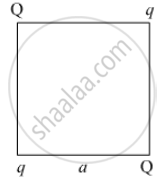
Find the
1) resultant electric force on a charge Q, and
2) potential energy of this system.
अध्याय: [2] Electrostatic Potential and Capacitance
Write two important characteristics of equipotential surfaces.
अध्याय: [2] Electrostatic Potential and Capacitance
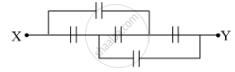
Find the equivalent capacitance of the network shown in the figure, when each capacitor is of 1 μF. When the ends X and Y are connected to a 6 V battery, find out (i) the charge and (ii) the energy stored in the network.
अध्याय: [2] Electrostatic Potential and Capacitance
Define capacitor reactance. Write its S.I units.
अध्याय: [2] Electrostatic Potential and Capacitance
Two capacitors of unknown capacitances C1 and C2 are connected first in series and then in parallel across a battery of 100 V. If the energy stored in the two combinations is 0.045 J and 0.25 J respectively, determine the value of C1 and C2. Also calculate the charge on each capacitor in parallel combination.
अध्याय: [2] Electrostatic Potential and Capacitance
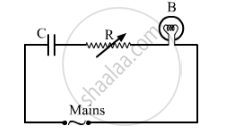
A capacitor 'C', a variable resistor 'R' and a bulb 'B' are connected in series to the ac mains in circuit as shown. The bulb glows with some brightness. How will the glow of the bulb change if (i) a dielectric slab is introduced between the plates of the capacitor, keeping resistance R to be the same; (ii) the resistance R is increased keeping the same capacitance?
अध्याय: [2] Electrostatic Potential and Capacitance
Obtain the expression for the energy stored per unit volume in a charged parallel plate capacitor.
अध्याय: [2] Electrostatic Potential and Capacitance
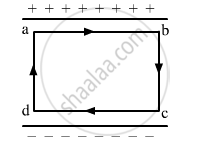
The electric field inside a parallel plate capacitor is E. Find the amount of work done in moving a charge q over a closed loop a b c d a.
अध्याय: [2] Electrostatic Potential and Capacitance
Considering the case of a parallel plate capacitor being charged, show how one is required to generalize Ampere's circuital law to include the term due to displacement current.
अध्याय: [2] Electrostatic Potential and Capacitance
A parallel plate capacitor of capacitance C is charged to a potential V. It is then connected to another uncharged capacitor having the same capacitance. Find out the ratio of the energy stored in the combined system to that stored initially in the single capacitor.
अध्याय: [2] Electrostatic Potential and Capacitance
Find out the amount of the work done to separate the charges at infinite distance.
अध्याय: [2] Electrostatic Potential and Capacitance
What is the geometrical shape of equipotential surfaces due to a single isolated charge?
अध्याय: [2] Electrostatic Potential and Capacitance
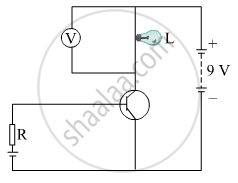
In the given circuit diagram a voltmeter ‘V’ is connected across a lamp ‘L’. Ho would (i) the brightness of the lamp and (ii) voltmeter reading ‘V’ be affected, if the value of resistance ‘R’ is decreased? Justify your answer.
अध्याय: [2] Electrostatic Potential and Capacitance
Draw the equipotential surfaces due to an electric dipole. Locate the points where the potential due to the dipole is zero.
अध्याय: [2] Electrostatic Potential and Capacitance
- Assertion (A): Work done in moving a charge around a closed path, in an electric field is always zero.
- Reason (R): Electrostatic force is a conservative force.
अध्याय: [2] Electrostatic Potential and Capacitance
Justify your answers for each case.
State the significance of the negative value of electrostatic potential energy of a system of charges.
Three charges are placed at the corners of an equilateral triangle ABC of side 2.0 m as shown in the figure. Calculate the electric potential energy of the system of three charges.

अध्याय: [2] Electrostatic Potential and Capacitance
The capacitors, each of 4 µF are to be connected in such a way that the effective capacitance of the combination is 6 µF. This can be achieved by connecting ______.
अध्याय: [2] Electrostatic Potential and Capacitance
Read the following paragraph and answer the questions.
| A capacitor is a system of two conductors separated by an insulator. The two conductors have equal and opposite charges with a potential difference between them. The capacitance of a capacitor depends on the geometrical configuration (shape, size and separation) of the system and also on the nature of the insulator separating the two conductors. They are used to store charges. Like resistors, capacitors can be arranged in series or parallel or a combination of both to obtain the desired value of capacitance. |
- Find the equivalent capacitance between points A and B in the given diagram.

- A dielectric slab is inserted between the plates of the parallel plate capacitor. The electric field between the plates decreases. Explain.
- A capacitor A of capacitance C, having charge Q is connected across another uncharged capacitor B of capacitance 2C. Find an expression for (a) the potential difference across the combination and (b) the charge lost by capacitor A.
OR
Two slabs of dielectric constants 2K and K fill the space between the plates of a parallel plate capacitor of plate area A and plate separation d as shown in the figure. Find an expression for the capacitance of the system.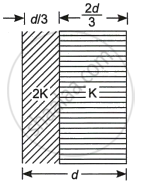
अध्याय: [2] Electrostatic Potential and Capacitance
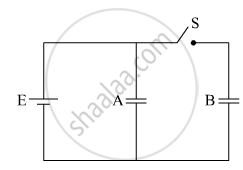
Two identical parallel plate capacitors A and B are connected to a battery of V volts with the switch S closed. The switch is now opened and the free space between the plates of the capacitors is filled with a dielectric of dielectric constant K. Find the ratio of the total electrostatic energy stored in both capacitors before and after the introduction of the dielectric.
अध्याय: [2] Electrostatic Potential and Capacitance
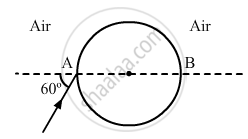
A ray of light falls on a transparent sphere with centre C as shown in the figure. The ray emerges from the sphere parallel to the line AB. Find the angle of refraction at A if the refractive index of the material of the sphere is \[\sqrt{3}\].