CBSE Science (English Medium) कक्षा १२ Important Questions for Physics - Dual Nature of Radiation and Matter
Advertisements
Advertisements
Chapter wise important questions with answers and solutions for Physics in CBSE Science (English Medium) कक्षा १२.
The following graph shows the variation of photocurrent for a photosensitive metal :
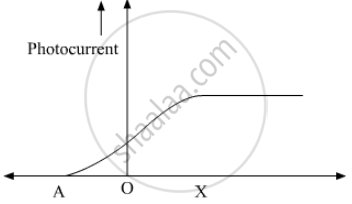
(a) Identify the variable X on the horizontal axis.
(b) What does the point A on the horizontal axis represent?
(c) Draw this graph for three different values of frequencies of incident radiation v1, v2 and v3 (v1 > v2 > v3) for same intensity.
(d) Draw this graph for three different values of intensities of incident radiation I1, I2 and I3 (I1 > I2 > I3) having same frequency.
अध्याय: [11] Dual Nature of Radiation and Matter
The work function of the following metals is given : Na 2.75 ev, K = 2.3 eV, Mo = 4.17 eV and Ni = 5.15 eV. Which of these metals will not cause photoelectric emission for radiation of wavelength 3300 Å from a laser source placed 1 m away from these metals? What happens if the laser source is brought nearer and placed 50 cm away?
अध्याय: [11] Dual Nature of Radiation and Matter
A electron of mass me revolves around a nucleus of charge +Ze. Show that it behaves like a tiny magnetic dipole. Hence prove that the magnetic moment associated wit it is expressed as `vecμ =−e/(2 m_e)vecL `, where `vec L` is the orbital angular momentum of the electron. Give the significance of negative sign.
अध्याय: [11] Dual Nature of Radiation and Matter
A photosensitive surface emits photoelectrons when red light falls on it. Will the surface emit photoelectrons when blue light is incident on it? Give reason.
अध्याय: [11] Dual Nature of Radiation and Matter
Draw a plot showing the variation of photoelectric current with collector potential for different frequencies but same intensity of incident radiation ?
अध्याय: [11] Dual Nature of Radiation and Matter
Use Einstein's photoelectric equation to explain the observations from this graph ?
अध्याय: [11] Dual Nature of Radiation and Matter
What change will you observe if intensity of incident radiation is changed but the frequency remains the same?
अध्याय: [11] Dual Nature of Radiation and Matter
Plot a graph showing the variation of photoelectric current with intensity of light. The work function for the following metals is given:
Na: 2.75 eV and Mo : 4.175 eV.
Which of these will not give photoelectron emission from a radiation of wavelength 3300
\[A^\circ\] from a laser beam? What happens if the source of laser beam is brought closer?
अध्याय: [11] Dual Nature of Radiation and Matter
Define the term "cut off frequency" in photoelectric emission. The threshod frequency of a metal is f. When the light of frequency 2f is incident on the metal plate, the maximum velocity of photo-electrons is v1. When the frequency of the incident radiation is increased to 5f, the maximum velocity of phto-electrons is v2. Find the ratio v1 : v2.
अध्याय: [11] Dual Nature of Radiation and Matter
A beam of monochromatic radiation is incident on a photosensitive surface. Answer the following question giving reason :
Do the emitted photoelectrons have the same kinetic energy?
अध्याय: [11] Dual Nature of Radiation and Matter
A beam of monochromatic radiation is incident on a photosensitive surface. Answer the following question giving reason :
Does the kinetic energy of the emitted electrons depend on the intensity of incident radiation?
अध्याय: [11] Dual Nature of Radiation and Matter
A beam of monochromatic radiation is incident on a photosensitive surface. Answer the following question giving reason :
On what factors does the number of emitted photoelectrons depend?
अध्याय: [11] Dual Nature of Radiation and Matter
Plot a graph showing the variation of photoelectric current with collector plate potential at a given frequency but for two different intensities I1 and I2, where I2 > I1.
अध्याय: [11] Dual Nature of Radiation and Matter
In photoelectric effect, why should the photoelectric current increase as the intensity of monochromatic radiation incident on a photosensitive surface is increased? Explain.
अध्याय: [11] Dual Nature of Radiation and Matter
Draw a plot showing the variation of photoelectric current with collector plate potential for two different frequencies, v1 > v2, of incident radiation having the same intensity. In which case will the stopping potential be higher? Justify your answer.
अध्याय: [11] Dual Nature of Radiation and Matter
Use Einstein’s photoelectric equation to show how from this graph,
(i) Threshold frequency, and (ii) Planck’s constant can be determined.
अध्याय: [11] Dual Nature of Radiation and Matter
Work function of aluminium is 4.2 eV. If two photons each of energy 2.5 eV are incident on its surface, will the emission of electrons take place? Justify your answer.
अध्याय: [11] Dual Nature of Radiation and Matter
Define the term "Threshold frequency", in the context of photoelectric emission.
अध्याय: [11] Dual Nature of Radiation and Matter
Define the term: threshold frequency
अध्याय: [11] Dual Nature of Radiation and Matter
Answer the following question.
Plot a graph of photocurrent versus anode potential for radiation of frequency ν and intensities I1 and I2 (I1 < I2).
