Advertisements
Advertisements
प्रश्न
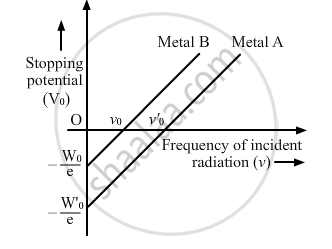
Use Einstein's photoelectric equation to explain the observations from this graph ?
Advertisements
उत्तर
The Einstein's photoelectric equation is \[K_{max} = \frac{1}{2}m \nu^2_{max} = h\nu - \phi_o\]
From the graph, we noticed that
(i) The value of stopping potential is different for radiation of different frequencies.
\[\text { As } \]
\[e V_o = h\nu - \phi_o \]
\[\text { Hence }, V_o \propto \nu\]
(ii) The value of stopping potential is more negative for radiation of higher incident frequency.
APPEARS IN
संबंधित प्रश्न
Draw a neat labelled circuit diagram of experimental arrangement for study of photoelectric effect.
Light of intensity ‘I’ and frequency ‘v’ is incident on a photosensitive surface and causes photoelectric emission. What will be the effect on anode current when (ii) the frequency of incident radiation is increased. In each case, all other factors remain the same. Explain, giving justification in each case.
The graph shows the variation of stopping potential with frequency of incident radiation for two photosensitive metals A and B. Which one of the two has higher value of work-function? Justify your answer.
A photosensitive surface emits photoelectrons when red light falls on it. Will the surface emit photoelectrons when blue light is incident on it? Give reason.
A beam of monochromatic radiation is incident on a photosensitive surface. Answer the following question giving reason :
Does the kinetic energy of the emitted electrons depend on the intensity of incident radiation?
A beam of monochromatic radiation is incident on a photosensitive surface. Answer the following question giving reason :
On what factors does the number of emitted photoelectrons depend?
If the frequency of the incident radiation is increased from 4 × 10¹⁵ Hz to 8 × 10¹⁵ Hz, by how much will the stopping potential for a given photosensitive surface go up?
What happens when light falling on a material (usually a metal) causes photoelectric emission?
Who discovered the phenomenon of photoelectric emission?
During which experiments did Heinrich Hertz observe photoelectric emission?
