- A concave mirror has an inward-curved reflecting surface, while a convex mirror has an outward-curved reflecting surface.
- Important parts of a spherical mirror: Pole (P), Centre of Curvature (C), Principal Axis, and Principal Focus (F).
- For spherical mirrors, the relation is R = 2f, where R is the radius of curvature and f is the focal length.
- In concave mirrors, parallel rays converge at the focus; in convex mirrors, they appear to diverge from the focus behind the mirror.
Definitions [73]
Define Regular reflection.
The phenomenon due to which a parallel beam of light traveling through a certain medium, on striking some polished surface, bounces off from it, as a parallel beam, in some other direction, is called regular reflection.
Define reflection.
The bouncing of light by any smooth or polished surface is called.
Define the term Principle axis.
The principal axis is the straight line passing through the pole and the centre of curvature.
Define the following term
Angle of incidence
Angle of incidence: The angle formed between the incident ray PO and the normal ‘ON’ is angle of incidence.
Define the following term
Reflected ray
Reflected ray: The ray of light that comes from the point when the incident ray falls on the reflection material.
Define the following term
Normal
Normal: The perpendicular line drawn from, the point of incidence to the plane of reflecting surface is called normal.
Define the following term
Incident ray
Incident ray- The ray of light that falls on the surface of the reflection materials.
Define the term Pole.
Pole is the centre of the reflecting surface, in this case, a spherical mirror.
Define the term Aperture.
Aperture is the distance between the extreme points on the periphery of the mirror.
Define focal length.
The distance between the pole and the principal focus is called the focal length (f) of a spherical mirror.
Define the term Centre of curvature.
Centre of curvature is the centre of the imaginary sphere to which the mirror belongs.
Define the following term:
spherical mirror
“A mirror which is made from a part of a hollow sphere is called Spherical Mirror.
Define the following term:
convex mirror
“A mirror made by silvering the inner surface such that reflection takes place from the bulging surface” is called Convex Mirror.
The Centre of curvature is towards the silvered surface.
Define the following term:
concave mirror
“A mirror made by silvering the outer or the bulging surface such that the reflection takes place from the concave surface.” Centre of curvature is towards the reflecting surface.
Define the following term in relation to concave mirror.
Pole
Pole “is the mid-point of the mirror”.
Define the following term in relation to concave mirror.
Center of curvature
The centre of a hollow sphere of which the mirror forms a part is called the centre of curvature.
Define the following term in relation to concave mirror.
Principal axis
An imaginary line passing through the pole and the centre of curvature of a spherical mirror is called principal axis.
Define the following term in relation to concave mirror.
Principal focus
It is a point on the principal axis, where a beam of light, parallel to the principal axis, after reflection actually meet.
Define the following term in relation to concave mirror.
Radius of curvature
The linear distance between the pole and the center of curvature is called the radius of curvature.
Define the following term in relation to concave mirror.
Focal length
The linear distance between the pole and the principal focus is called focal length.
Define the term Principle focus.
Principal focus of a spherical mirror is a point on the principal axis of the mirror, where all the rays travelling parallel to the principal axis and close to it after reflection from the mirror, converge to or appear to diverge from.
Define the term Normal.
Normal to the surface of a mirror at any point is the straight line at the right angle to the tangent drawn at that point.
Define the term Focus of a concave mirror.
The focus of a concave mirror is a point on the principal axis of the mirror, where all the rays travelling parallel to the principal axis and close to it after reflection from the mirror converge to that point.
Definition: Spherical Mirrors
Mirrors whose reflecting surfaces are spherical are called spherical mirrors.
OR
A spherical mirror is a part of a hollow sphere, whose one side is silvered and coated with red oxide and the other side is the reflecting surface.
Definition: Pole
The centre of the reflecting surface of a spherical mirror is a point called the pole. The pole is usually represented by the letter P.
OR
The central point of the reflecting surface of the mirror is called the 'pole' of the mirror.
Definition: Concave Mirror
A spherical mirror, whose reflecting surface is curved inwards, that is, faces towards the centre of the sphere, is called a concave mirror.
OR
A concave mirror is one whose reflecting surface is towards the centre of the sphere of which the mirror is a part.
Definition: Convex Mirror
A spherical mirror whose reflecting surface is curved outwards, is called a convex mirror.
OR
A convex mirror is one whose reflecting surface is away from the centre of the sphere of which the mirror is a part.
Definition: Centre of Curvature
The reflecting surface of a spherical mirror forms a part of a sphere. This sphere has a centre. This point is called the centre of curvature of the spherical mirror. It is represented by the letter C.
OR
The centre of the sphere of which the mirror forms a part, is called the ‘centre of curvature' of the mirror.
Definition: Radius of Curvature
The radius of the sphere of which the reflecting surface of a spherical mirror forms a part is called the radius of curvature of the mirror. It is represented by the letter R.
OR
The radius of the sphere of which the mirror forms a part, is called the 'radius of curvature' of the mirror.
Definition: Principal Axis
A straight line passing through the pole and the centre of curvature of a spherical mirror. This line is called the principal axis.
OR
The straight line joining the pole and the centre of curvature of the mirror and extended on both sides is called the 'principal axis' of the mirror.
Define linear magnification produced by a mirror.
The ratio of the height of an image (h') to the height of an object (h) is known as linear magnification
That is,
`mh/h`
where, h' = height of image
h = height of object
Definition: Refracted Light
Refracted light is the part of light enters into the other medium and travels in a straight path but in a direction different from its initial direction and is called the refracted light.
Define the principal focus of a concave mirror.
Light rays that are parallel to the principal axis of a concave mirror converge at a specific point on its principal axis after reflecting from the mirror. This point is known as the principal focus of the concave mirror.
Definition: Refraction of Light
When travelling obliquely from one medium to another, the direction of propagation of light in the second medium changes. This phenomenon is known as refraction of light.
OR
Light changes its direction when going from one transparent medium to another transparent medium. This is called the refraction of light.
OR
The bending of the light ray from its path in passing from one medium to the other medium is called 'refraction' of light.
Definition: Refraction
The change in the direction of the path of light when it passes from one transparent medium to another transparent medium is called refraction. The refraction of light is essentially a surface phenomenon.
Define the absolute refractive index of a medium.
The absolute refractive index is the ratio of the velocity of light in a vacuum to that of the medium.
`n = c/v`
Definition: Lateral Displacement
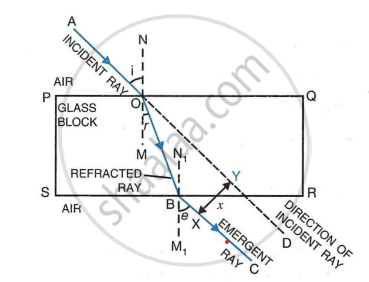
The perpendicular distance XY between the path of the emergent ray BC and the direction of the incident ray OD is called the lateral displacement.
Define the term refractive index of a medium in terms of velocity of light.
It is defined as the ratio of the velocity of light in medium 1 to the velocity of light in medium 2.
Definition: Critical Angle
Critical angle is the angle of incidence in the denser medium corresponding to which the angle of refraction in the rarer medium is 90°.
Define critical angle for a given medium.
When a ray of light propagates from a denser medium to a rarer medium, the angle of incidence for which the angle of refraction is 90° is called the critical angle.
Define the term ‘focal length of a mirror’.
When rays of light parallel to the principal axis of a mirror are incident on it, the rays after reflection either converge at a point or appear to diverge from a point. The distance of that point from the pole of the mirror is known as the focal length of the mirror.
Definition: Focal Length
The distance between the optical centre and principal focus of a lens is called its focal length.
Definition: Principal Axis
The imaginary line passing through both centres of curvature is called the principal axis of the lens.
OR
The line joining the centres of curvature of the surfaces of the lens is called the 'principal axis' of the lens.
Definition: Principal Focus
Principal focus (F) is the point on the principal axis at which light rays parallel to the principal axis converge after passing through a convex lens.
Definition: Centre of Curvature
The centres of spheres whose parts form surfaces of the lenses are called centres of curvatures of the lenses.
Definition: Diverging Lens or Concave Lens
A lens which is bent inwards in the middle is a concave lens. Such a lens diverges the light rays incident on it, so it is also called a diverging lens.
OR
This lens is thicker near the centre as compared to the edges. The lens with both surfaces spherical on the inside is called a concave or double concave lens.
OR
The lenses which are thinner in the middle and thicker at the edges, are called 'concave lenses'.
Definition: Converging Lens or Convex Lens
A lens which bulges out in the middle, is a convex lens. A light beam converges on passing through such a lens, so it is also called a converging lens.
OR
The lens which has two spherical surfaces which are puffed up outwards is called a convex or double convex lens.
OR
The lenses which are thicker in the middle and thinner at the edges, are called 'convex lenses'.
Definition: Lens
A lens is a transparent refracting medium bounded by either two spherical surfaces, or one spherical surface and the other surface plane.
OR
A lens is a transparent medium bound by two surfaces.
OR
A lens is a transparent medium (such as glass) bounded by two curved surfaces or one curved and one plane surface.
Definition: Optical Centre
The point inside a lens on the principal axis, through which light rays pass without changing their path is called the optical centre of a lens.
OR
The point on the principal axis of a lens such that a ray of light directed towards it emerges from the lens in the same direction, without deviation.
Definition: Radius of Curvature
The radii (R1 and R2) of the spheres whose parts form surfaces of the lenses are called the radii of curvature of the lens.
Definition: First Focal Length
The distance from the optical centre O of the lens to its first focal point F1 is called the first focal length Ji of the lens.
Definition: Radius of Curvature
The radius of the sphere, whose part is the lens surface, is called the radius of curvature of that surface of the lens.
Definition: Principal Axis
It is the line joining the centres of curvature of the two surfaces of the lens.
Definition: Optic Centre
It is a point on the principal axis of the lens such that a ray of light directed towards this point emerges parallel to its direction of incidence.
Definition: Second Focal Point for Convex Lens
For a convex lens, the second focal point is a point F2 on the principal axis of the lens such that the rays of light incident parallel to the principal axis, after refraction from the lens, pass through it.
Definition: First Focal Point for Convex Lens
For a convex lens, the first focal point is a point F1 on the principal axis of the lens such that the rays of light coming from it, after refraction through the lens, becomes parallel to the principal axis of the lens.
Definition: Focal Length of a Lens
The distance of focus (or focal point) from the optical centre of a lens, is called its focal length.
Definition: Second Focal Length
The distance from the optical centre 0 of the lens to the second focal point F2 is called the second focal length f2 of the lens.
Definition: Second Focal Point for Concave Lens
For a concave lens, second focal point is a point F2 on the principal axis of the lens such that the rays of light incident parallel to the principal axis, after refraction from the lens, appear to be diverging from this point.
Define the term focus of a lens.
The focus of a lens (often called the principal focus) is a specific point on its principal axis where light rays parallel to the axis either converge or appear to originate from after passing through the lens.
Definition: Centre of Curvature
The centre of the sphere, whose part is the lens surface, is called the centre of curvature of that surface of the lens.
Definition: First Focal Point for Concave Lens
For a concave lens, the first focal point is a point F1 on the principal axis of the lens such that the incident rays of light appearing to meet at it, q,fter refraction from the lens become parallel to the principal axis of the lens.
Definition: Focal Plane
A plane normal to the principal axis, passing through the focus, is called the focal plane.
Definition: First Focal Plane
A plane passing through the first focal point and normal to the principal axis of the lens, is called the first focal plane.
Definition: Second Focal Plane
A plane passing through the second focal point and normal to the principal axis of the lens, is called the second focal plane.
Definition: Power of a Lens
The deviation of the incident light rays produced by a lens on refraction through it, is a measure of its power.
or
The power of a lens is defined as the reciprocal of its focal length. It is represented by the letter P.
OR
The power (P) of a thin lens is equal to the reciprocal of its focal length (f) measured in metres.
Define the power of a lens.
Power of a lens is defined as the ability of a lens to bend the rays of light. It is given by the reciprocal of focal length in metre.
The power of a lens is a measure of the deviation produced by it in the path of rays refracted through it.
Definition: Prism
A prism is a transparent medium bounded by five plane surfaces with a triangular cross-section.
Define the term dispersion of light.
The phenomenon of the splitting of white light by a prism into its constituent colours is known as dispersion of light.
When a beam of white light or composite light is refracted through any transparent media such as glass or water, it is split into its component colours. This phenomenon is called ‘dispersion of light’.
Definition: Dispersion
The phenomenon of splitting of white light by a prism into its constituent colours is known as dispersion.
OR
The splitting of light into its component colours is called dispersion.
OR
The process of separation of light into its component colours while passing through a medium is called the dispersion of light.
Definition: Spectrum
On passing white light through a prism, the band of colours seen on a screen is called the spectrum.
or
The band of the coloured components of a light beam is called its spectrum.
Definition: Scattering of Light
Scattering is the process of absorption and then re-emission of light energy by the dust particles and air molecules present in the atmosphere.
Define the following term:
Adaptation
Adaptation is the process by which the human eye adjusts to changes in light intensity.
- Light Adaptation: When a person moves from a dark environment to a brightly lit area (e.g., stepping out of a cinema hall in the afternoon), they initially experience a dazzling effect. After a few seconds, the eyes adjust to the brightness. This process is called light adaptation.
- Dark Adaptation: When a person enters a dark area from a brightly lit environment (e.g., entering a cinema hall), they initially struggle to see clearly. Gradually, their vision improves as the eyes adapt to the darkness. This process is called dark adaptation.
Formulae [1]
Formula: Power of a Lens
Power of lens (in D) = \[\frac{1}{\text{focal length (in metre)}}\]
or
P = \[\frac {1}{f}\]
or
P = \[\frac {1}{f (m)}\]
Power of a Lens in a Medium:
P = (n2 - n1)\[\left(\frac{1}{R_{1}}-\frac{1}{R_{2}}\right)\] = \[\frac {n_1}{f}\]
Theorems and Laws [2]
A ray of light moves from a rare medium to a dense medium as shown in the diagram below. Write down the number of the ray which represents the partially reflected ray.

Ray 2 shows partially reflected ray.
Prove that Refractive index = `"Real depth"/"Apparent depth"`.

Consider a point object O kept at the bottom of a transparent medium (such as water or glass) separated from air by the surface PQ.
A ray of light OA, starting from the object O, is incident on the surface PQ normally, so it passes undeviated along the path AA'. Another ray, OB, starting along the object O, strikes the boundary surface PQ at B and suffers refraction.
Since the ray travels from a denser to a rarer medium, it bends away from the normal N'BN drawn at the point of incidence B on the surface PQ and travels along BC in air.
When viewed by the eye, the ray BC seems to originate from point I, which is the virtual image of O created by extending lines A'A and CB backwards.
Thus, any point seen from the air will appear to be at I, which is a lesser depth = AI than its actual depth AO.
Angle of incidence = ∠OBN'
Angle of refraction = ∠CBN
Since, AO and BN' are parallel and OB is transversal line, so
∠AOB = ∠OBN' = i
Similarly, IA' and BN are parallel and IC is the transversal line, so
∠BIA' = ∠CBN = r
In right-angle triangle BAO,
sin i = `(BA)/(OB)` and,
In right-angle triangle IAB,
sin r = `(BA)/(IB)`
For refraction from medium to air, by Snell’s law
`""_mμ_a = sin i/sin r = ((BA)/(OB))/((BA)/(IB))`
⇒ `""_mμ_a = (IB)/(OB)`
Hence, refractive index of medium with respect to air is,
`""_aμ_m = 1/(""_mμ_a) = (OB)/(IB)`
The object is viewed from a point vertically above the object O, since point B is very close to the point A.
∴ IB = IA and OB = OA
Hence,
`""_aμ_m = 1/(""_mμ_a) = (OA)/(IA)`
⇒ `"Real depth"/"Apparent depth"`
Key Points
Key Points: Reflection of Light
- Reflection occurs when light bounces off a smooth surface like a mirror, following fixed laws.
- Plane mirrors always form virtual, erect, and same-sized images that are laterally inverted.
- Curved surfaces (like a spoon) act as spherical mirrors, changing the image size and orientation depending on the object's position.
Key Points: Spherical Mirrors
Key Points: Sign Convention
- Pole (mirror) or optical centre (lens) is the origin; principal axis is the X-axis.
- Distances to the right are positive, to the left are negative; heights above the axis are positive, below are negative.
- Concave mirror: and R are negative; Convex mirror: and R are positive.
- Real images: image distance and magnification are negative; Virtual images: both are positive.
- Lenses are always negative; they are positive for real images and negative for virtual images; they are positive for convex lenses and negative for concave lenses.
Key Points: Refraction of Light
Key Points: Refraction of Light Through a Rectangular Glass Block
Key Points: Real and Apparent Depth
- An object in a denser medium (such as water or glass) appears shallower when viewed from a rarer medium (such as air) due to refraction.
- Apparent depth < Real depth, and the ratio is given by:
μ = \[\frac {\text{Real depth}}{\text{Apparent depth}}\] - Shift in position = Real depth – Apparent depth =
Real depth × (1 − \[\frac {1}{μ}\]) - The shift is greater when:
The refractive index of the medium is higher,
The medium is thicker, or
The wavelength is shorter (more for violet, less for red). - These formulas are valid only when the object is viewed vertically from above.
Key Points: Concept of Lenses
- Lenses are widely used in daily life, such as in spectacles, peepholes, magnifiers, and telescopes.
- Light passing through a lens undergoes refraction twice: once on entering and once on exiting the lens.
- The shape of a lens affects the direction of light; convex lenses converge light, while concave lenses diverge it.
- Most lenses have surfaces that are parts of spheres, with common types including biconvex, biconcave, plano-convex, and meniscus lenses.
Key Points: Sign Convention
- Pole (mirror) or optical centre (lens) is the origin; principal axis is the X-axis.
- Distances to the right are positive, to the left are negative; heights above the axis are positive, below are negative.
- Concave mirror: and R are negative; Convex mirror: and R are positive.
- Real images: image distance and magnification are negative; Virtual images: both are positive.
- Lenses are always negative; they are positive for real images and negative for virtual images; they are positive for convex lenses and negative for concave lenses.
Key Points: Characteristics and Location of Images for a Concave Lens
| S. No. | Position of the Object | Position of the Image | Nature of the Image | Size of the Image | Remarks / Applications |
|---|---|---|---|---|---|
| 1 | At infinity | At focus (F₂), on the same side as the object | Virtual and erect | Highly diminished | — |
| 2 | At any finite distance | Between focus (F) and optical centre, same side | Virtual and erect | Diminished | Image moves closer to optical centre as object nears |
| 3 | General behaviour of concave lens | Always on the same side of the object | Virtual and upright | Always smaller than object | Independent of object position |
| 4 | As object moves closer to the lens | Image shifts from F₂ towards optical centre | Virtual and erect | Gradually increases, still < object | — |
| 5 | — | — | Forms virtual, diminished image | — | Used in spectacles (myopia) and Galilean telescopes |
Key Points: Characteristics and Location of Images for a Convex Lens
| S. No. | Position of the Object | Position of the Image | Size of the Image | Nature of the Image |
|---|---|---|---|---|
| 1 | At infinity | At focus (F₂) | Point image | Real and inverted |
| 2 | Beyond (2F₁) | Between (F₂) and (2F₂) | Smaller | Real and inverted |
| 3 | At (2F₁) | At (2F₂) | Same size | Real and inverted |
| 4 | Between (F₁) and (2F₁) | Beyond (2F₂) | Larger | Real and inverted |
| 5 | At focus (F₁) | At infinity | Very large | Real and inverted |
| 6 | Between (F₁) and O | On the same side of the lens as the object | Very large | Virtual and erect |
Key Points: Dispersion of Light
- Dispersion is the splitting of white light into seven colours (VIBGYOR) when it passes through a prism or similar transparent medium.
- Human eyes can detect light with wavelengths ranging from 400 nm (violet) to 700 nm (red).
- Different colours travel at different speeds in a medium like glass, so each colour has a different refractive index.
- Violet light bends the most, and red light bends the least, as it passes through a prism, producing a spectrum.
- A rainbow is formed due to dispersion, refraction, and internal reflection of sunlight by raindrops acting as tiny prisms.
key Points: Scattering of Light
- Shorter wavelengths (violet and blue) are scattered more than longer wavelengths (red).
- The intensity of scattering follows Rayleigh’s law:
- Very small particles (smaller than the wavelength of light) scatter light more effectively than larger particles.
- The sky appears blue because blue light is scattered more due to its shorter wavelength.
- Red light scatters least, causing red/orange sunsets and making sunlight near Earth richer in red light.
Key Points: Applications of Scattering of Light
- Red colour of the Sun at sunrise and sunset is due to maximum scattering of blue light and least scattering of red light in the atmosphere.
- The blue colour of the sky is due to the greater scattering of blue (or violet) light by air molecules because of its short wavelength.
- The black colour of the sky in the absence of atmosphere occurs because there is no scattering of sunlight.
- Red light is used for danger signals because it has the longest wavelength and is scattered the least, so it can be seen from a far distance.
Key Points: Human Eye
- The human eye works like a camera, forming a real and inverted image on the retina, which is light-sensitive.
- The cornea allows light to enter the eye and performs most of the refraction, while the lens fine‑tunes the focus.
- The iris controls the pupil, regulating the amount of light entering the eye—contracting in bright light and widening in dim light.
- The power of accommodation is the ability of the eye lens to change its focal length by altering its curvature using the ciliary muscles.
- For a normal eye, the near point is 25 cm and the far point is at infinity.
Key Points: Myopia
- Myopia is a vision defect in which distant objects appear blurry, while near objects are seen clearly.
- This occurs because the image of distant objects forms on the retina.
- The far point is not at infinity but is shifted closer to the eye.
- Causes include increased curvature of the cornea/lens or elongation of the eyeball.
- Corrected using a concave lens of negative power, which diverges light rays to focus the image on the retina.
Key Points: Hypermetropia
Key Points: Presbyopia
- Presbyopia is an age-related vision defect where the eye’s ability to focus on nearby objects decreases.
- It is caused by weakened ciliary muscles and reduced flexibility of the eye lens.
- The near point shifts farther, making close-up vision difficult.
- Bifocal lenses are commonly used for correction—concave at the top (for myopia) and convex at the bottom (for hypermetropia).
- It can also be corrected with contact lenses or, in some cases, surgery.
Concepts [48]
- Fundamental Concepts of Light
- Reflection of Light
- Terms Used in Reflection of Light
- Law of Reflection of Light
- Types of Reflection
- Plane Mirror
- Images Formed in Two Inclined Mirrors
- Spherical Mirrors
- Relationship Between the Focal Length and Radius of Curvature
- Sign Convention
- Position and Nature of Image Formed by Spherical Mirrors
- Mirror Equation/Formula
- Linear Magnification by Spherical Mirrors
- Refraction of Light
- Some Terms Related to Refraction of Light
- Principle of Reversibility of the Path of Light
- Refraction of Light Through a Rectangular Glass Block
- Refraction Through a Compound Slab
- Real and Apparent Depth
- Application of Atmospheric Refraction
- Critical Angle
- Total Internal Reflection
- Refraction at Spherical Surfaces
- Concept of Lenses
- Some Definitions Related to Lens
- Sign Convention
- Technical Terms Related to a Lens
- Images Formed by Concave Lenses
- Images Formed by Convex Lenses
- Thin Lens Formula
- Lens Maker's Formula
- Magnification
- Power of a Lens
- Thin Lenses and Their Combination
- Prism
- Refraction of Light Through a Prism
- Dispersion of Light
- Some Natural Phenomena Due to Sunlight
- Scattering of Light
- Applications of Scattering of Light
- The Human Eye
- Defects of Vision and Their Corrections > Myopia
- Defects of Vision and Their Corrections > Hypermetropia
- Eye Defect and Its Correction: Astigmatism
- Defects of Vision and Their Corrections > Presbyopia
- Microscope and it’s types
- Fundamentals of Telescope
- Types of Telescope: Optical Telescope
