Advertisements
Advertisements
प्रश्न
Write the formula for a lens connecting image distance (v), object distance (u) and the focal length (f). How does the lens formula differ from the mirror formula?
Advertisements
उत्तर
Lens formula is:
`1/v-1/u=1/f`
Now, the mirror formula is given by:
`1/v+1/u=1/f`
In both the formulas,
u = Object distance
v = Image distance
f = Focal length
In the mirror formula, a positive sign is present between the reciprocals of the image distance and object distance.
In lens formula, a negative sign is present between the reciprocals of image distance and object distance.
संबंधित प्रश्न
Explain the following term related to spherical lenses: focal length
An image that cannot be obtained on a screen is called ______.
What type of image is formed:
on a cinema screen?
What is the relation between the focal length and radius of curvature of a spherical mirror (concave mirror or convex mirror)?
Define the following terms in the context of spherical mirrors :
(i) Pole
(ii) Centre of curvature
(iii) Radius of curvature
(iv) Principal axis
Three mirrors are created from a single sphere. Which of the following - pole, centre of curvature, radius of curvature, principal axis - will be common to them and which will not be common?
State the number of images of an object placed between two mirrors, formed in each case when mirrors are inclined to each other at (a) 90°, and (b) 60°.
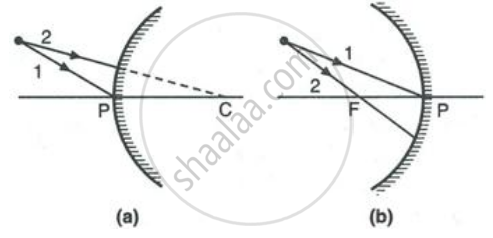
Complete the following diagrams in Figure by drawing the reflected rays for the incident rays 1 and 2.
The diagram below in Figure, shows a convex mirror. C is its centre of curvature and F is its focus. (i) Draw two rays from A and hence locate the position of image of object OA. Label the image IB. (ii) State three characteristics of the image.
When an object of height 1 cm is kept at a distance 4 cm from a concave mirror, its erect image of height 1.5 cm is formed at a distance 6 cm behind the mirror. Find the focal length of mirror, by drawing.
Answer the following question.
Write the modification in the curvature of the eye lens which enables us to see the nearby objects clearly?
Define the following term in relation to concave mirror.
Principal axis
Does the mirror name by your form a real image for all locations? Give a reason for your answer.
Is real image always inverted?
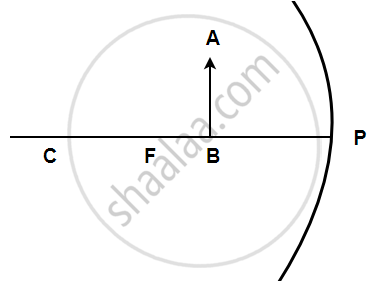
In the following figure shows a concave mirror with its pole (P), focus (F) and centre of curvature (C). Draw a ray diagram to show the formation of the image of an object AB by the concave mirror.
What is the difference between virtual images of an object formed by a concave mirror and a convex mirror?
A spherical mirror whose reflecting surface is curved outwards is called ______ mirror.
In normal adjustment, for a refracting telescope, the distance between objective and eye piece is 30 cm. The focal length of the objective, when the angular magnification of the telescope is 2, will be ______.
