Advertisements
Advertisements
प्रश्न
Write the equation involved in the following reaction:
Reimer-Tiemann reaction
Explain the following with an example.
Reimer-Tiemann reaction
Write a chemical equation to illustrate the following name reaction:
Reimer-Tiemann reaction
Advertisements
उत्तर १
On treating phenol with chloroform in the presence of sodium hydroxide, a -CHO group is introduced at the ortho position of the benzene ring. This reaction is known as the Reimer-Tiemann reaction. The intermediate substituted benzal chloride is hydrolysed in the presence of alkali to produce salicylaldehyde.

उत्तर २
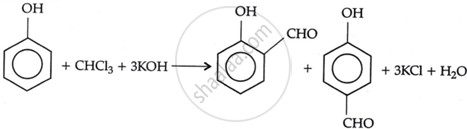
उत्तर ३
Phenol reacts with sodium hydroxide (or KOH) and chloroform in this reaction. 4-hydroxybenzaldehyde is a minor product, while salicylaldehyde is the primary product. Steam distillation can be used to separate it from the p-isomer. Intramolecular hydrogen bonding is responsible for the stability of the p-isomer.

Notes
Students should refer to the answers according to their questions and provide marks.
APPEARS IN
संबंधित प्रश्न
Give simple chemical tests to distinguish between the following pairs of compounds: Benzoic acid and Phenol
Write the final product(s) in each of the following reactions:

Explain the following with an example.
Kolbe’s reaction.
Picric acid is ____________.
When phenol is treated with excess bromine water, it gives:
When phenol is heated with CHCl3 and alcoholic KOH when salicylaldehyde is produced. This reaction is known as ____________.
On distilling phenol with Zn dust, one gets:
The electrophile involved in Reimer-Tiemann reaction of phenol with CHCl3 in presence of NaOH:

Which of the following species can act as the strongest base?
\[\ce{C2H5OH + SOCl2 ->[Pyridine] C2H5Cl + SO2 + HCl}\]
The above reaction is known as:
Which of the following reactions is used to prepare salicylaldehyde?
Out of o-nitrophenol and p-nitrophenol, which is more volatile? Explain.
Which of the following is not aromatic?
Attacking species in nitration of benzene in presence of fuming HNO3 is
Why ortho-nitrophenol is steam volatile while para-nitrophenol is not?
For the pair phenol and cyclohexanol, answer the following:
Give one chemical test to distinguish between the two.
