हिंदी
कर्नाटक बोर्ड पी.यू.सी.पीयूसी विज्ञान 2nd PUC Class 12

Write the equation involved in the following reaction: Kolbe’s reaction - Chemistry

Advertisements
Advertisements

प्रश्न

Write the equation involved in the following reaction:

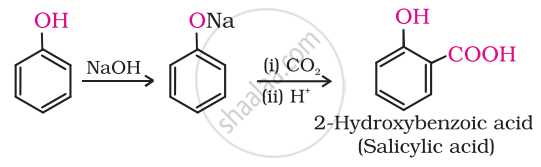
Kolbe’s reaction

Explain the following with an example.

Kolbe’s reaction

रासायनिक समीकरण/संरचनाएँ
स्पष्ट कीजिए
Advertisements

उत्तर

Phenoxide ion generated by treating phenol with sodium hydroxide is even more reactive than phenol towards electrophilic aromatic substitution. Hence, it undergoes electrophilic substitution with carbon dioxide, a weak electrophile. Ortho hydroxybenzoic acid is formed as the main reaction product.

shaalaa.com
  क्या इस प्रश्न या उत्तर में कोई त्रुटि है?
अध्याय 7: Alcohols, Phenols and Ethers - Intext Questions [पृष्ठ २१३]

APPEARS IN

एनसीईआरटी Chemistry Part 1 and 2 [English] Class 12
अध्याय 7 Alcohols, Phenols and Ethers
Intext Questions | Q 7.9 (ii) | पृष्ठ २१३
एनसीईआरटी Chemistry Part 1 and 2 [English] Class 12
अध्याय 7 Alcohols, Phenols and Ethers
Exercises | Q 7.18 (i) | पृष्ठ २२३

संबंधित प्रश्न

Write the main products when

2, 4, 6-trinitrochlorobenzene is subjected to hydrolysis


Write the main product(s) in each of the following reactions:


Give the equation of the following reaction: 

Bromine in CS2 with phenol.


Name the reagent used in the following reaction:

Bromination of phenol to 2, 4, 6-tribromophenol.


When phenol is treated with excess bromine water, it gives:


When phenol is heated with CHCl3 and alcoholic KOH when salicylaldehyde is produced. This reaction is known as ____________.


On distilling phenol with Zn dust, one gets:


In the reaction of phenol with CHCl3 and aqueous NaOH at 343 K, the electrophile attacking the ring is:


\[\ce{C2H5OH + SOCl2 ->[Pyridine] C2H5Cl + SO2 + HCl}\]

The above reaction is known as:


Which of the following compounds is aromatic alcohol?

(A)
(B)
(C)
(D)

Which of the following are used to convert \[\ce{RCHO}\] into \[\ce{RCH2OH}\]?

(i) \[\ce{H2/Pd}\]

(ii) \[\ce{LiAlH4}\]

(iii) \[\ce{NaBH4}\]

(iv) Reaction with \[\ce{RMgX}\] followed by hydrolysis


Out of o-nitrophenol and p-nitrophenol, which is more volatile? Explain.


Nitration is an example of aromatic electrophilic substitution and its rate depends upon the group already present in the benzene ring. Out of benzene and phenol, which one is more easily nitrated and why?


Convert the following:

Phenol to N-phenylethanamide.


Which of the following is not aromatic?


Which of the following reacts with phenol to give salicylaldehyde after hydrolysis?


Why ortho-nitrophenol is steam volatile while para-nitrophenol is not?


Convert the following by giving a chemical equation:

Phenol to salicylaldehyde.


Share
Notifications

Englishहिंदीमराठी


      Forgot password?
Use app×