English
Karnataka Board PUCPUC Science 2nd PUC Class 12

Write the equation involved in the following reaction: Kolbe’s reaction - Chemistry

Advertisements
Advertisements

Questions

Write the equation involved in the following reaction:

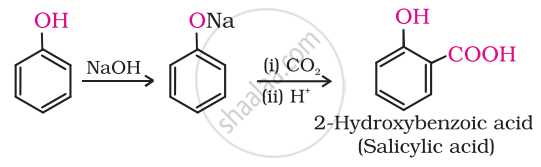
Kolbe’s reaction

Explain the following with an example.

Kolbe’s reaction

Chemical Equations/Structures
Explain
Advertisements

Solution

Phenoxide ion generated by treating phenol with sodium hydroxide is even more reactive than phenol towards electrophilic aromatic substitution. Hence, it undergoes electrophilic substitution with carbon dioxide, a weak electrophile. Ortho hydroxybenzoic acid is formed as the main reaction product.

shaalaa.com
  Is there an error in this question or solution?
Chapter 7: Alcohols, Phenols and Ethers - Intext Questions [Page 213]

APPEARS IN

NCERT Chemistry Part 1 and 2 [English] Class 12
Chapter 7 Alcohols, Phenols and Ethers
Intext Questions | Q 7.9 (ii) | Page 213
NCERT Chemistry Part 1 and 2 [English] Class 12
Chapter 7 Alcohols, Phenols and Ethers
Exercises | Q 7.18 (i) | Page 223

RELATED QUESTIONS

Write the main product(s) in each of the following reactions:


Write the structures of A, B, C, D and E in the following reactions:


While separating a mixture of ortho and para nitrophenols by steam distillation, name the isomer which will be steam volatile. Give reason.


Name the reagent used in the following reaction:

Bromination of phenol to 2, 4, 6-tribromophenol.


Explain the following with an example.

Kolbe’s reaction.


Picric acid is ____________.


In the reaction of phenol with CHCl3 and aqueous NaOH at 343 K, the electrophile attacking the ring is:


When Phenol is distilled with zinc dust, it gives:


Which of the following reactions is used to prepare salicylaldehyde?


Which of the following are used to convert \[\ce{RCHO}\] into \[\ce{RCH2OH}\]?

(i) \[\ce{H2/Pd}\]

(ii) \[\ce{LiAlH4}\]

(iii) \[\ce{NaBH4}\]

(iv) Reaction with \[\ce{RMgX}\] followed by hydrolysis


Which of the following are benzylic alcohols?

(i) \[\ce{C6H5 - CH2 - CH2OH}\]

(ii) \[\ce{C6H5 - CH2OH}\]

(iii) \[\begin{array}{cc}
\ce{C6H5 - CH - OH}\\
\phantom{}|\phantom{.}\\
\phantom{..}\ce{CH3}\phantom{}
\end{array}\]

(iv) \[\begin{array}{cc}
\ce{C6H5 - CH2 - CH - OH}\\
\phantom{.......}|\phantom{}\\
\phantom{.........}\ce{CH3}\phantom{}
\end{array}\]


Out of o-nitrophenol and p-nitrophenol, which is more volatile? Explain.


Convert the following:

Phenol to N-phenylethanamide.


Which of the following is not aromatic?


For the pair phenol and cyclohexanol, answer the following:

Give one chemical test to distinguish between the two.


How can phenol be prepared from anisole? Give reaction.


Write the name of the reaction, structure and IUPAC name of the product formed when:

Phenol reacts with CHCl3 in the presence of NaOH followed by hydrolysis.


Share
Notifications

Englishहिंदीमराठी


      Forgot password?
Use app×