Advertisements
Advertisements
प्रश्न
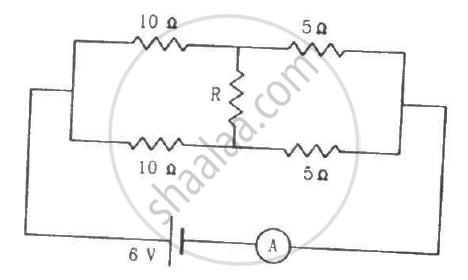
What should be the value of R in the figure for which the current in it is zero?
Advertisements
उत्तर
For current to be zero in the middle branch, the circuit should be balanced. According to the Wheatstone bridge principle, balancing a circuit does not depend on the value of resistance R in the middle branch. The circuit in this case is balanced. Hence, any value of R is acceptable.
APPEARS IN
संबंधित प्रश्न
Choose the correct:
Four resistances 10 Ω, 10 Ω, 10 Ω and 15 Ω form a Wheatstone’s network. What shunt is required across 15 Ω resistor to balance the bridge
With resistances P and Q placed in the left and right gaps of a metre bridge, the balance point divides the wire in the ratio of 1/3. When P and Q are increased by 40 n each. the balance point divides the wire in the ratio of 3/5. The values of P and Q will be respectively, ______
Two wires A and B of equal lengths are connected in left and right gap of a meter bridge, null point is obtained at 40 cm from left end. Diameters of the wire A and B are in that ratio 3 : 1. The ratio of specific resistance of A to the of B is ____________.
In a metre bridge, the gaps are closed by two resistances P and Q and the balance point is obtained at 40 cm. When Q is shunted by a resistance of 10 Ω, the balance point shifts to 50 cm. The values of P and Q are ______
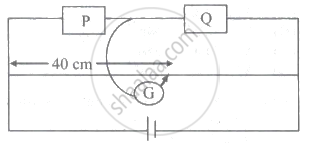
In a metre bridge experiment. the ratio of the left-gap resistance to right gap resistance is 2: 3. The balance point from the left is ______.
The metre bridge works on the principle of ______.
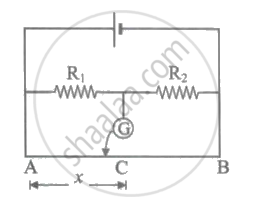
In the metre bridge experiment shown in the figure, the balance length AC corresponding to null deflection of the galvanometer is x. What would be the balance length if the radius of the wire AB is doubled?
In Wheatstone's bridge P = 7 ohm, Q = 12 ohm, R = 3 ohm and S = 8 ohm. How much resistance must be put in parallel to the resistance S to balance the bridge?
In following figure, a current of 1.4 A flows towards the bridge circuit. The current in 2 n resistor is ______.
In the meter bridge experiment, the null point is obtained at a distance of ℓ from the left end. The resistance in the left and right gaps are halved and then interchanged. The new position of the null point is at ______
In a metre bridge experiment, the ratio of the left-gap resistance to right gap resistance is 2: 3. The balance point from the left is ______.
The figure below shows a balanced Wheatstone network. If it is disturbed by changing P to 22Ω, then which of the following steps will bring the bridge again to a balanced state?
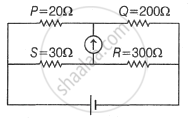
With an unknown resistance X in the left gap and a resistance of 30 Ω of the gap of a metre bridge, the null point is obtained at 40 cm from the left end of the wire. Find the unknown resistance. Also, find the shift in the null point when resistance in each gap is shunted by a resistance of 8 Ω.
Four resistances 4Ω, 4Ω, 4Ω and 12Ω form a Wheatstone's network. Find the resistance which when connected across the 12Ω resistance will balance the network.
Write balancing condition of a Wheatstone bridge.
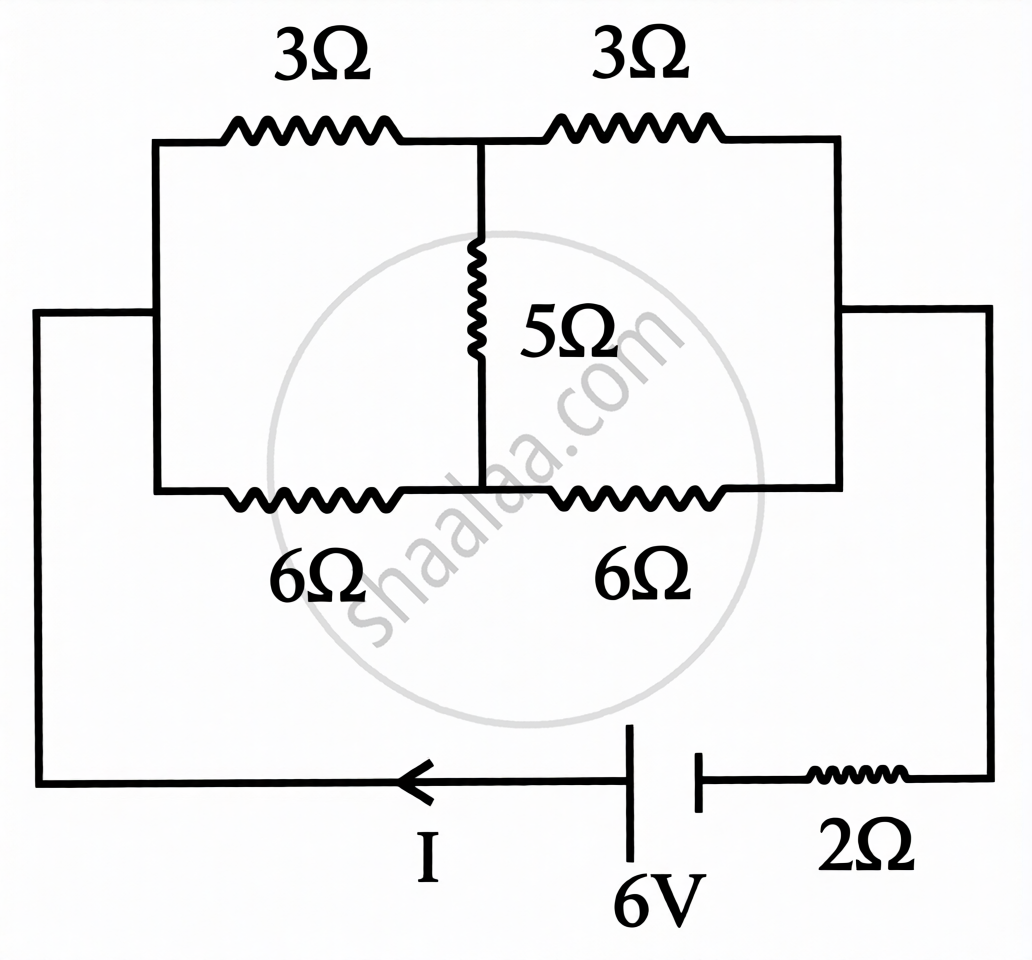
A battery of 6 V is connected to the circuit as shown below. The current I drawn from the battery is:
What is the condition called when the galvanometer shows zero deflection in a Wheatstone bridge, with \[I_g = 0\]?
